Quick facts
- Located in
- Banff National Park, Alberta
- Peak season
- Late June to early September
- Daylight
- Up to 17 hours in late June
- Days needed
- 5-7 days for highlights
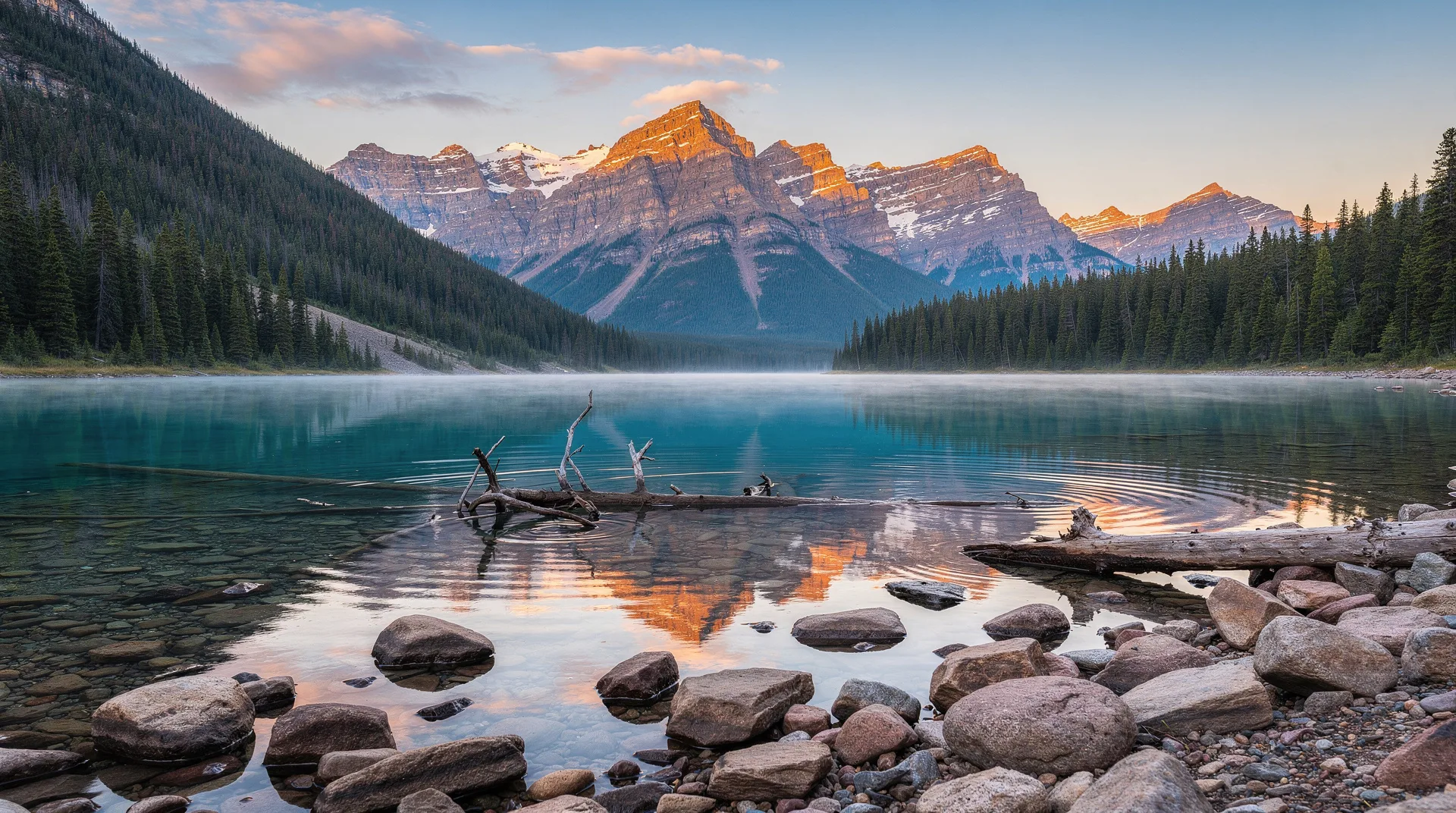
Banff in summer is the postcard Banff: turquoise lakes at their most saturated, larch and pine forests in full growth, grizzlies and black bears on open meadows, and the kind of long, slanting alpine light that makes even a gas-station parking lot photogenic. It is also the Banff with the steepest learning curve for visitors — shuttles that book out in minutes, parking lots that fill by 7 a.m., and accommodation rates that can triple between May and July.
This guide covers what summer in Banff actually looks like month by month, the practical bookings you need to make before you arrive, and how to organise your days so that peak season crowds do not blunt the experience.
| At a glance | |
|---|---|
| Where | Banff National Park, Alberta, around 130 km west of Calgary |
| Cost | Parks Canada day pass required (around CAD $11/adult) plus accommodation that peaks in July-August |
| Time needed | 5-7 days for the highlights; longer for hiking-focused trips |
| Getting there | Fly into Calgary and drive around 90 minutes, or take a shuttle — see getting to Banff |
| Best time | Mid-June to mid-September; early September for fewer crowds with mostly-open trails |
The summer season, month by month
June: The shoulder month. High-elevation hikes often still carry snow, and Moraine Lake Road typically opens between late May and early June depending on snowpack. Wildflowers start blooming in the lower meadows; black bears are highly visible grazing on dandelions along the Bow Valley Parkway. Rates are noticeably cheaper than July. The trade-off is that the highest lakes can still be partially iced, and some alpine trails remain closed into mid-June.
July: Peak summer begins. All roads and trails are fully open. Daylight reaches its maximum — sunrise around 5:30 a.m., sunset close to 10 p.m. Temperatures average highs of 22 degC in the townsite and 14-16 degC at higher elevations. Prices are at their highest. Moraine Lake and Lake Louise shuttles require booking well in advance.
August: Similar to July but often slightly drier and warmer, with less afternoon thunderstorm activity. Wildfire smoke from BC or the Northwest Territories can occasionally reduce visibility for multi-day periods. Still peak pricing, still heavy crowds, but the long days remain a gift for photographers and hikers.
Early September: The crowds thin noticeably after Labour Day. Temperatures drop into the low teens, larches begin their golden transition toward month-end, and some summer services start winding down. A genuinely excellent time for a quieter summer-like experience.
| Month | Typical weather | Crowds |
|---|---|---|
| June | Cool, some snow still on high trails; afternoon showers | Moderate, building through the month |
| July | Warm days (around 22 degC), cooler nights; occasional thunderstorms | Peak — book well ahead |
| August | Warm and often drier than July; possible wildfire smoke | Peak, similar to July |
| Early September | Cooling into the low teens; clearer light | Thins noticeably after Labour Day |
Getting to Banff and getting around in summer
Most summer visitors fly into Calgary and either rent a car or take a shuttle for the roughly 90-minute drive — see getting to Banff and driving from Calgary to Banff for the route and timing. Once in the park, Roam Transit and other ways to get around Banff without a car cover the town core and several of the marquee stops, which matters given how tight summer parking is.
Basing yourself in nearby Canmore instead of Banff townsite is a reasonable summer strategy — rates are often lower and the drive in is short; see Banff vs Canmore for the trade-offs. Families weighing pace and logistics may also find Banff with kids useful for what to prioritise.
Driving and parking tips for July and August
If you are renting a car, pick it up at Calgary airport and plan to arrive in Banff before midday on arrival day, since Friday afternoons and Sunday evenings bring heavy traffic on the Trans-Canada Highway. The Calgary to Banff transport guide compares driving with scheduled shuttles. In town, the paid lots fill by late morning, so park once and walk or use transit rather than circling for a closer space. Budget for the possibility of a wildlife traffic jam: a bear or elk beside the road can add 20 to 30 minutes to a drive that looks short on the map. Never stop in the travel lane, and use a pullout.
The non-negotiable summer bookings
Several Banff experiences in summer are either impossible or deeply frustrating without advance reservations. Secure these first:
Moraine Lake Road shuttle. Private vehicles are not permitted on Moraine Lake Road from roughly late May to mid-October. Access is via the Moraine Lake shuttle operated by Parks Canada from the Lake Louise Park and Ride, or by booked commercial operators. Reservations on the Parks Canada system open months ahead and sell out within minutes. Plan B: commercial shuttles or a guided Moraine Lake tour with transport included.
Accommodation. Banff town, Canmore, and Lake Louise village lodging for July and August should be booked 6-9 months ahead for best selection. Last-minute summer availability does exist but at premium prices. Consider where to stay in Banff for options and neighbourhood strategy.
Parks Canada Discovery Pass. Required for every day spent inside Banff National Park. Either daily passes at the gate or an annual pass if you are visiting multiple national parks. See the Banff Park Pass guide.
Guided tours. Popular GYG products — Moraine Lake sunrise tours, Icefields Parkway day trips, wildlife evening tours, guided hikes — fill up in peak weeks. Book at least two to three weeks ahead.
The essential summer experiences
Lake Louise and Moraine Lake
These two lakes are why most first-time visitors come to Banff in summer. Both are genuinely as spectacular as the photography suggests, and both are ruthlessly crowded in peak season. Strategies that work:
- Sunrise at Moraine Lake. The first shuttle of the day arrives before most of the crowd. The sunrise alpenglow on the Ten Peaks is one of the finest visual experiences in the Rockies. Book the earliest available shuttle slot.
- Hike above the crowds. The shorelines and viewpoints of both lakes are busy; the trails above them quickly thin. From Lake Louise, the Lake Agnes Tea House hike, Plain of Six Glaciers, and Big Beehive all shed crowds within the first kilometre.
- Canoe the lakes. Rental canoes at both lakes are expensive but the experience of paddling the turquoise water with mountain walls rising on either side is genuinely unforgettable.
Icefields Parkway
Allow a full day for the drive from Banff to the Columbia Icefield, or two days if continuing to Jasper. Key stops: Peyto Lake, Bow Lake, Parker Ridge, and the Columbia Icefield. See the full Icefields Parkway stops guide for a stop-by-stop plan.
High-alpine hiking
Summer opens terrain that is inaccessible the rest of the year. Healy Pass for wildflower meadows, Sentinel Pass for a true pass crossing, Tunnel Mountain for an easy townsite summit, Sulphur Mountain trail for fitness with a gondola ride back down.
Wildlife
Summer is the best season for wildlife activity in the valley and on the open meadows. Dawn and dusk drives along the Bow Valley Parkway (Highway 1A) between Banff and Lake Louise regularly produce sightings of elk, deer, black bears, and occasionally wolves or grizzlies. Evening guided wildlife tours take visitors to the best viewing areas with experienced spotters.
Eating well in peak season
Restaurant tables in Banff town are hard to get on summer evenings, and walk-in waits of an hour or more are common at popular spots between 6 and 8 p.m. Reserve dinner a few days ahead where you can, or eat early or late. Our guide to the best restaurants in Banff sorts options by style and budget. For hiking days, a packed lunch from a grocery store or bakery saves time and money, and cafés near trailheads can have long lines at midday.
A day away from the busiest spots
By the second or third day, many visitors want somewhere calmer. Quieter valleys, scenic drives, and smaller lakes are covered in our list of day trips from Banff town. Set out early, carry extra water and a rain layer, and check trail and road conditions with Parks Canada the evening before, because summer storms and the occasional wildfire closure can change plans quickly.
Canoeing and lake activities
Beyond the iconic lakes, Lake Minnewanka (cruises), Two Jack Lake, Johnson Lake (warmer and swimmable), and the Vermilion Lakes all offer paddling and lake-edge experiences. See canoeing on Rockies lakes.
Crowd management strategies
Peak summer crowds in Banff are real. Strategies that meaningfully improve the experience:
Start early. Trailhead parking at Johnston Canyon, Moraine Lake Park and Ride, and Lake Louise fills by 7 a.m. on summer weekends. Plan to be at major sites by sunrise; you will have the place nearly to yourself for the first hour.
Midday indoors. Use 11 a.m. to 3 p.m. for the Banff Gondola, Whyte Museum, Cave and Basin National Historic Site, or a sit-down lunch. Crowds are at their densest, trailheads are overflowing, and the light for photography is at its least flattering.
Evening return. Sunset at 9:30-10 p.m. in July gives hours of soft light after the day-tour crowds have left. Most attractions thin out dramatically after 5 p.m.
Weekdays over weekends. If your schedule allows, Tuesday-Thursday are noticeably quieter than Friday-Sunday in summer, particularly for day-trippers from Calgary.
Roam Transit. The Roam Transit system connects Banff town with Canmore, Lake Louise, Johnston Canyon, and Lake Minnewanka. For visitors without a car or who want to avoid parking struggles, it is genuinely useful.
What to pack for Banff summer
- Layered clothing — mornings near freezing at elevation, afternoons in the high 20s in the valley
- Rain shell — afternoon thunderstorms are routine in July and August
- Hiking boots with ankle support for mountain trails
- Bear spray (available for purchase or rental in town)
- Water bottle and sun protection — UV at altitude is intense
- Insect repellent for June and early July — mosquitoes are active
- A refillable water bottle and snacks, since services along trails and the Icefields Parkway are sparse
- A paper or offline map, because cell coverage drops out in many valleys
Frequently asked questions about Banff in Summer: Peak Season Guide
Do I need a car in summer? Technically no — Roam Transit and organised tours cover the main sights. But a car opens up flexibility, early starts, and access to less-visited trailheads. Most visitors benefit from having one.
How early should I book summer trips? 6-9 months for July/August hotels in prime locations. Shuttle reservations open earlier in the year on Parks Canada’s schedule — check and book as soon as they open.
Is it busy in early June and late September? Significantly less than July/August. Early June still has some trails snow-bound; late September has larch season but also cooler weather and earlier sunsets.
When does Moraine Lake Road open? Typically late May, but depends on snow clearance each year. Check Parks Canada for current status.
Is Banff or Jasper better in summer? Both are excellent; Banff has the more famous lakes and easier access from Calgary, while Jasper is quieter and larger. See Banff vs Jasper for a full comparison.
Browse guided Banff summer tours with hotel pickupRelated pages
- Things to do in Banff — the master activity list
- Where to stay in Banff — neighbourhoods and options
- Banff in winter — the alternative season
- Best time to visit Banff — month-by-month deep dive
- 3 days in Banff — weekend itinerary
- 5 days in Banff — complete first-timer plan