Quick facts
- Population
- 675,000 city / 2.6M metro
- Best time
- June to September
- Languages
- English
- Days needed
- 4-5 days
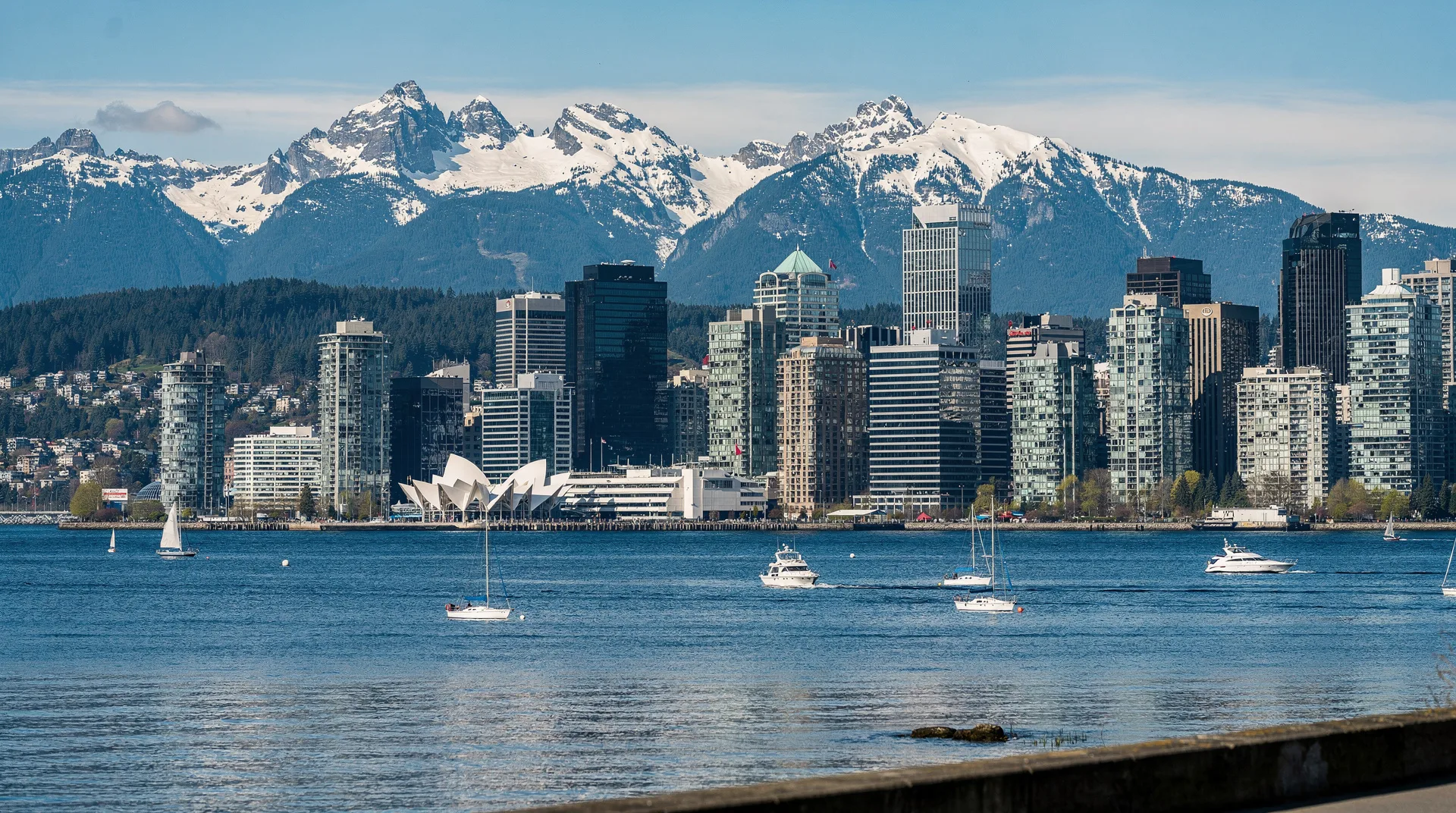
Vancouver is one of those cities that makes people reconsider everything they thought they knew about where to live. Mountains rise directly behind the downtown skyline. The Pacific Ocean laps at the edge of the city’s most famous park. Within an hour you can be skiing at a world-class resort, kayaking in a sheltered inlet, or hiking through temperate rainforest. Back in the city, the food scene draws on the largest Asian community in Canada, the arts culture is sophisticated and vital, and the neighbourhoods are varied enough to reward weeks of exploration.
Consistently ranked among the most liveable cities on the planet, Vancouver is also one of Canada’s most visited — and once you arrive, it is not hard to understand why.
| Where | Pacific coast of British Columbia, between the Coast Mountains and the Strait of Georgia |
| Cost | Around CAD $200-350/day mid-range (hotel, meals, transit, one paid attraction); budget travellers can manage CAD $80-120/day |
| Time needed | 4-5 days for the city; add 1-2 days for a Whistler or Victoria side trip |
| Getting there | Canada Line SkyTrain from YVR to downtown in about 26 minutes, roughly CAD $9-11 |
| Best time | June to September for dry, warm weather; December to March for nearby skiing |
Why Vancouver is unlike any other city in Canada
Vancouver occupies a narrow coastal strip between the Coast Mountain Range and the Strait of Georgia, a geography that defines everything about it. The mountains are not distant scenery — they are a daily presence, visible from most streets on clear days and forming the backdrop for almost every outdoor activity the city offers. The ocean influence keeps winters mild by Canadian standards (though rainy) and summers long and luminous.
The city is also remarkably young in cultural terms. Its rapid growth through the late 20th century, fuelled partly by Hong Kong immigration ahead of the 1997 handover, created one of North America’s most genuinely multicultural food and cultural environments. Richmond, just south of the city, has a higher proportion of Chinese residents than any other municipality in North America and operates the continent’s most authentic Asian night market.
For anyone travelling through British Columbia, Vancouver is the natural starting or ending point. It sits just two hours south of Whistler via the Sea to Sky Highway, and within reasonable reach of the Canadian Gulf Islands, the Sunshine Coast, and Victoria on Vancouver Island.
Top things to do in Vancouver
Stanley Park
The 405-hectare forested peninsula that juts into Burrard Inlet is one of the great urban parks in the world. The 9-kilometre seawall that circles the park offers continuous views of the water, the mountains, and the downtown skyline, and the forest interior contains centuries-old Douglas firs and western red cedars. The Hollow Tree — a massive ancient western red cedar stump — has been a landmark since the late 1800s. Rent a bike at the park’s eastern entrance and do the full loop; it is one of the most enjoyable two hours you will spend in any city.
Within the park, the Vancouver Aquarium houses over 50,000 animals including beluga whales, Pacific octopus, and sea otters. Prospect Point at the northern tip of the park offers one of the best views of the Lions Gate Bridge.
Capilano Suspension Bridge
Suspended 70 metres above the Capilano River on a 137-metre span, the Capilano Suspension Bridge has been drawing visitors since 1889, making it one of Vancouver’s oldest tourist attractions. The park around it has expanded over the years to include Cliffwalk — a series of cantilevered walkways that cling to a granite cliff above the river — and Treetops Adventure, a network of suspension bridges between old-growth Douglas firs up to 30 metres above the forest floor.
Book the Stanley Park and Capilano Suspension Bridge day tourGrouse Mountain
The mountain that towers over North Vancouver offers year-round activities at its peak. In winter it is a genuine ski resort with night skiing. In summer, the Skyride gondola delivers you to alpine terrain with hiking trails, lumberjack shows, a refuge for orphaned grizzly bears, and paragliding. On a clear day the view from the summit takes in the entire Lower Mainland, the Gulf Islands, and on exceptional days, Mount Baker in Washington State. The Eye of the Wind turbine has an observation pod at 100 metres that offers a vertigo-inducing panorama.
Granville Island Public Market
Under the south end of the Granville Bridge, this former industrial site has been transformed into Vancouver’s most beloved food and arts destination. The Public Market is the centrepiece — a covered market where local farmers, fishmongers, cheese makers, bakers, and charcutiers jostle for space. Outside, the island’s studios, theatres, galleries, and restaurants spread through repurposed industrial buildings. The False Creek ferry is the most enjoyable way to arrive.
Gastown and Downtown Eastside
Vancouver’s oldest neighbourhood, identifiable by its cobblestone streets and the famous steam-powered clock on Water Street, has evolved into a district of design studios, cocktail bars, and quality restaurants. The steam clock dates to 1977 and runs on a combination of steam and electricity — it whistles on the quarter hour. Nearby, the Chinatown neighbourhood contains the Dr. Sun Yat-Sen Classical Chinese Garden, a tranquil Ming Dynasty garden that provides complete contrast to the city around it.
Museum of Anthropology
On the campus of the University of British Columbia, the Museum of Anthropology holds one of the world’s finest collections of Northwest Coast Indigenous art. The Great Hall, designed by Arthur Erickson, houses an extraordinary gathering of totem poles, feast dishes, and carved canoes in a space flooded with natural light. The Haida Gwaii-related collections are particularly significant. The museum sits above the ocean on cliffs that were once a gun battery, and the grounds contain additional outdoor totem poles overlooking Spanish Banks beach.
Vancouver Art Gallery
The former courthouse at the heart of Robson Square houses the largest art gallery in western Canada. The permanent collection emphasises Canadian artists, including the most comprehensive collection of works by Emily Carr — the BC painter whose powerful depictions of BC coastal forests and Indigenous villages are among the most iconic images in Canadian art. The gallery also hosts major international touring exhibitions.
Best neighbourhoods in Vancouver
Downtown and the West End form the urban core. The West End, just west of the central business district and bordering Stanley Park, is one of Canada’s densest and most walkable neighbourhoods, with Denman Street as its main commercial strip.
Yaletown occupies converted warehouse buildings south of downtown and is one of Vancouver’s most sophisticated neighbourhoods for dining and cocktails. The seawall connects it to the rest of False Creek.
Kitsilano on the south shore of English Bay is the city’s quintessential beach neighbourhood. Kits Beach is the summer gathering place for young Vancouver, and West 4th Avenue has excellent independent retailers and cafes.
Commercial Drive in East Vancouver is the city’s most eclectic neighbourhood — Italian espresso bars, Ethiopian restaurants, independent bookshops, and a thriving queer community share a 20-block corridor.
Mount Pleasant and Main Street have emerged as Vancouver’s creative hub, with breweries, record shops, vintage clothing, and some of the city’s best restaurants along Main Street South.
When to visit Vancouver
Summer (June to September) is the undisputed peak season. Temperatures reach 22–27°C, the rain largely disappears, and the city’s outdoor life reaches full expression. Festivals cluster in this period: the Celebration of Light fireworks competition in July, Pride in August, and the Vancouver Fringe Festival in September.
Spring (April to May) is mild but genuinely rainy. Cherry blossoms in the West End and along East Broadway are stunning in late March and April. Accommodation prices are lower and crowds are thinner.
Fall (September to October) offers Vancouver’s second-best weather window. September is often warm and sunny after the summer crowds have dispersed. The Vancouver International Film Festival runs in late September and early October.
Winter (November to March) is wet and grey at sea level but spectacular in the mountains. Ski season at Whistler, Grouse Mountain, Cypress, and Mount Seymour typically runs from November to April. The city hosts an outdoor Christmas market at Jack Poole Plaza in December.
Where to stay in Vancouver
Downtown offers the densest concentration of hotels and the most convenient base for exploring the city. The Fairmont Hotel Vancouver on Burrard Street is the city’s grand railway hotel, with a distinctive copper roof and a heritage interior that has hosted royalty and celebrities since 1939. The Rosewood Hotel Georgia on West Georgia Street is Vancouver’s most refined boutique luxury option, positioned beautifully for Robson Street shopping and the art gallery. The JW Marriott Parq Vancouver beside BC Place offers contemporary luxury and excellent amenities.
Kitsilano suits travellers who want a more residential neighbourhood feel with easy beach access. The Sylvia Hotel in the West End, a vine-covered 1912 heritage building on English Bay Beach, is one of Vancouver’s most charming and well-priced hotels.
Food and drink in Vancouver
Vancouver’s food scene is one of the best in North America, driven by exceptional local ingredients — Pacific salmon, Dungeness crab, spot prawns, halibut — and the culinary traditions of the city’s large Asian communities.
Pacific seafood should anchor your eating here. The wild salmon season runs through summer and autumn, and the spot prawn season in May is a city-wide event. The Salmon n’ Bannock restaurant, BC’s only Indigenous-owned fine dining restaurant, is essential.
Sushi and Japanese food in Vancouver is genuinely world-class. The city has a larger Japanese community than almost any western city outside Japan, and the quality of ramen, izakayas, and sushi rivals Tokyo in many respects. Tojo’s on West Broadway remains the legendary address for high-end Japanese.
Richmond’s Asian dining merits a specific mention. The Aberdeen Centre food court, the Parker Place Mall food court, and the Richmond Night Market (open May to October) offer a concentrated experience of Hong Kong-style dim sum, Taiwanese bubble tea, and pan-Asian street food that has no equivalent elsewhere in Canada.
Craft beer is a serious industry in Vancouver. Granville Island Brewing, established in 1984, was one of Canada’s first craft breweries and still produces reliable session beers. The Mount Pleasant neighbourhood now hosts a concentration of excellent independent breweries within walking distance of each other.
The Granville Island Public Market is essential for a self-guided food tour with fresh oysters, smoked salmon, and Rainforest Creations’ legendary butter chicken wraps.
Getting around Vancouver
The TransLink system integrates SkyTrain, buses, and the SeaBus ferry to North Vancouver. The Canada Line connects Vancouver International Airport to downtown in 26 minutes — one of the most convenient airport connections of any Canadian city. A Compass Card represents the best value for multi-day transit use.
The SkyTrain has three urban lines. The Expo and Millennium Lines serve the eastern parts of the city and suburbs. The Canada Line connects the airport, downtown, and Cambie Street to Richmond. The system is clean, frequent, and covers most tourist destinations.
Walking and cycling are excellent options in the flat city core and along the seawall. Mobi bike share operates across the city with stations at most major attractions.
North Shore destinations — Capilano and Grouse Mountain — are reachable by bus from downtown via the Lions Gate Bridge. The #232 and #236 buses run from Lonsdale Quay (reached by SeaBus) to the Capilano Suspension Bridge area.
The False Creek ferries operated by Aquabus and False Creek Ferries are a delightful way to move between Granville Island, Yaletown, Science World, and the West End.
Day trips from Vancouver
Whistler via the Sea to Sky Highway is Vancouver’s most spectacular day trip. The 120-kilometre drive north passes through Squamish, with views of the Stawamus Chief granite monolith and Shannon Falls, before arriving in the Whistler Valley.
Victoria on Vancouver Island is reachable by BC Ferries (1.5 hours from Tsawwassen) or seaplane (35 minutes from Vancouver Harbour). The provincial capital has outstanding gardens, whale watching, and a charming Inner Harbour.
The Fraser Valley to the east offers wineries, farm markets, and the Bridal Veil Falls provincial park. Chilliwack and Hope are popular day trip destinations for hiking.
A hop-on hop-off bus tour is a good way to get oriented in the city before exploring independently:
Extending into the rest of British Columbia
Vancouver’s location makes it an efficient base for exploring the wider province without changing hotels every night. Whistler is under two hours north via the Sea to Sky Highway and is a legitimate day trip in summer for the gondola and lakes, or a multi-night ski base in winter — see the Vancouver to Whistler guide for driving notes and bus options. The Gulf Islands are reachable by BC Ferries from Tsawwassen or Horseshoe Bay for a slower, quieter contrast to the city. For a longer loop, Vancouver pairs naturally with Vancouver Island and Victoria as bookends of a British Columbia itinerary. If you would rather not organise every leg yourself, browse guided tours across British Columbia before you go.
Frequently asked questions about Vancouver
How many days should you spend in Vancouver?
Four to five days gives you enough time to explore Stanley Park thoroughly, visit Granville Island, see the key museums, take the North Shore attractions (Capilano and Grouse Mountain), and spend an evening in Gastown or Yaletown. A day trip to Whistler or Victoria adds value for longer stays.
Is Vancouver expensive?
Yes — Vancouver is one of Canada’s priciest cities. Budget travellers staying in hostels and eating at markets and food courts can manage on CAD $80–$120 per day. Mid-range travellers should budget CAD $200–$350 per day with hotel, meals, and attraction tickets. The excellent transit system means car rental is unnecessary for city exploration.
What is the best way to get from Vancouver Airport to downtown?
The Canada Line SkyTrain connects YVR Airport to downtown Waterfront Station in 26 minutes. Trains run every 6–7 minutes and a single fare costs CAD $9–$11 depending on time of day. Taxis and rideshares take 25–45 minutes and cost CAD $35–$50.
Is it worth visiting Capilano Suspension Bridge?
The Capilano Suspension Bridge Park is genuinely impressive, but the admission price (around CAD $60 for adults) is substantial. The combination of the suspension bridge, Cliffwalk, and Treetops Adventure justifies the cost for most visitors. Budget travellers might consider the Lynn Canyon Suspension Bridge instead — it is free and set in equally beautiful forest.
When is the best time to see killer whales near Vancouver?
Orca sightings in the waters around Vancouver are most reliable from May to October. Northern resident orca pods follow the chinook salmon migration. Whale watching tours depart from Steveston, Horseshoe Bay, and Vancouver Harbour. There are no guarantees, but May through September has the highest success rates.
Is Vancouver good for hiking?
Vancouver is outstanding for hiking. The North Shore mountains contain dozens of trails ranging from easy forest walks to technical alpine scrambles. The Grouse Grind — a 2.9-kilometre staircase up the face of Grouse Mountain — is the city’s most famous trail and a genuine fitness challenge. The Baden-Powell Trail traverses all three North Shore mountains. In summer, the alpine meadows above the ski resorts offer exceptional wildflower hiking.
Can you take a day trip from Vancouver to see the Canadian Rockies?
The Canadian Rockies are roughly 900 kilometres east of Vancouver by road — too far for a day trip. Banff is best accessed from Calgary (a 90-minute drive) or by booking a multi-day trip from Vancouver. However, the Coastal Mountains visible from Vancouver and easily accessed via the Sea to Sky corridor offer spectacular mountain scenery without the long drive.
Is Vancouver or Victoria better for a first trip to British Columbia?
They serve different purposes rather than competing directly. Vancouver is the larger, more urban base with mountains, food, and easy access to Whistler; Victoria is smaller, more genteel, and centred on Butchart Gardens and the Inner Harbour. Most itineraries benefit from both — Vancouver for 4-5 days and Victoria for 2-3, connected by ferry or seaplane.
Do you need a car in Vancouver?
No, not for the city itself. The SkyTrain, buses, SeaBus, and False Creek ferries cover downtown, Stanley Park’s edges, Granville Island, and the University of British Columbia efficiently. A car becomes useful only if you plan to drive to Whistler, the Fraser Valley, or beyond on your own schedule.