Quick facts
- Located on
- Icefields Parkway (Highway 93N), Banff National Park
- Distance from Banff
- 90 km north (~1h15 drive)
- Distance from Lake Louise
- 35 km north
- Days needed
- 2-4 hours
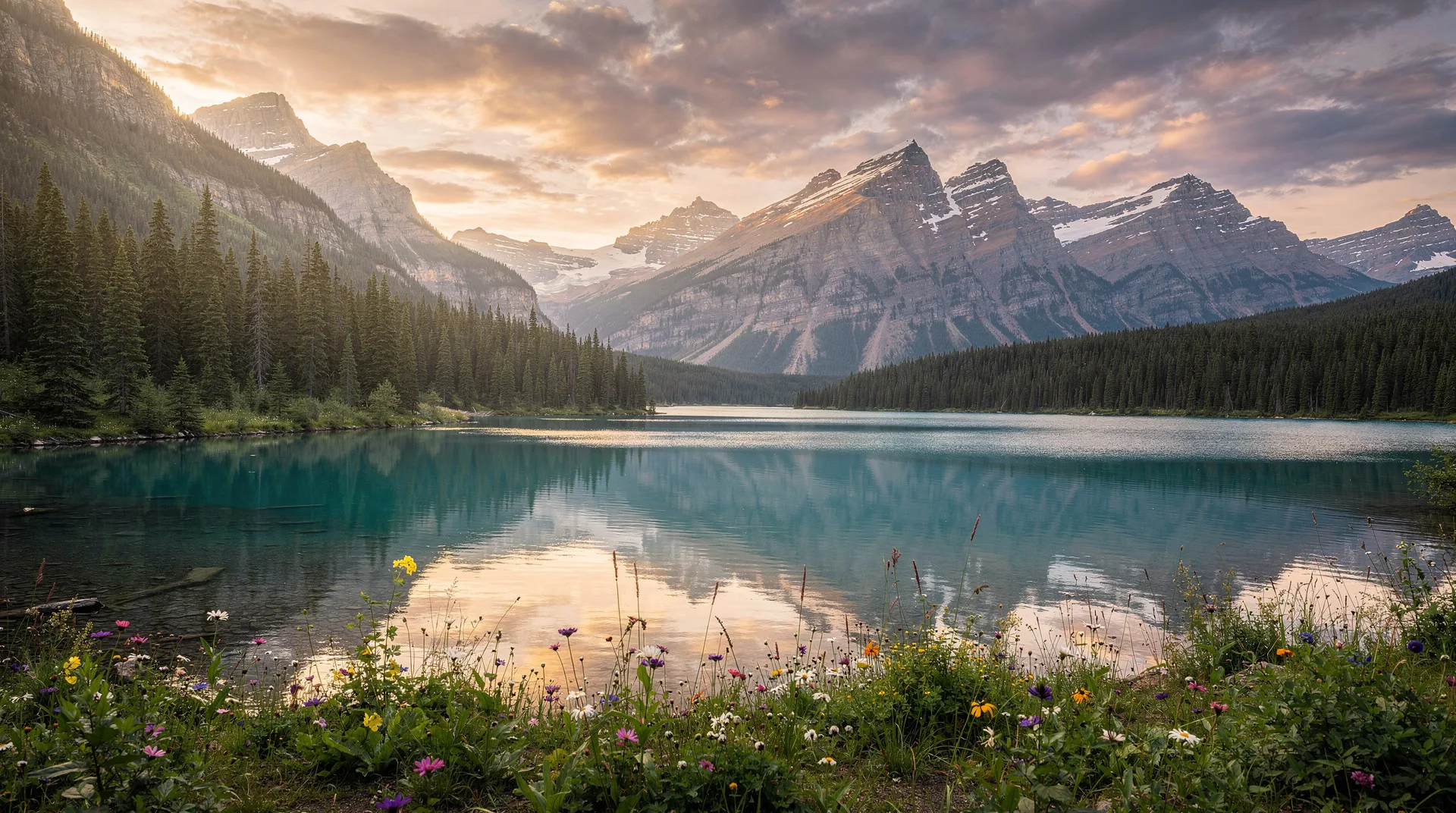
Bow Lake is the quiet counterpoint to Peyto Lake on the Icefields Parkway. Where Peyto’s viewpoint is a roadside overlook that can be visited in 20 minutes, Bow Lake is a full lakeshore experience: you park at the water’s edge, walk the trail along a broad gravel delta, and can spend anywhere from an hour to most of a day exploring. For many visitors who take time to stop here rather than rushing past to the Columbia Icefield, Bow Lake becomes the most memorable single stop of the Banff-Jasper drive.
The lake sits at the headwaters of the Bow River — the river that flows south through Banff town, through Canmore, out of the mountains, and eventually to Calgary and beyond. The water is an intense glacial turquoise because the Bow Glacier, visible high above the lake at the end of the valley, grinds rock into the finest particles (glacial flour) that suspend in the meltwater and refract blue-green light.
| At a glance | |
|---|---|
| Where | Icefields Parkway, km 36 north of Lake Louise, inside Banff National Park |
| Cost | Free to visit; a Parks Canada park pass is required for the parkway itself |
| Time needed | Around 45 minutes for the lakeshore and photography; half a day if you add the Bow Glacier Falls hike |
| Getting there | Self-drive (around 40 min from Lake Louise, 1h15 from Banff) or a guided Icefields Parkway tour |
| Best time | Late June to early October; larches turn gold in the last two weeks of September |
Where Bow Lake is and how to get there
Bow Lake is at kilometre 36 of the Icefields Parkway measuring north from Lake Louise — approximately 40 minutes by car from the Lake Louise village or 1 hour 15 minutes from Banff town. The large parking area is well-signed; the turnoff is directly accessible from the highway.
For itinerary planning, Bow Lake pairs naturally with Peyto Lake (5 km further north) and the stretch of the Icefields Parkway around Bow Summit. Most visitors treat these three locations as a single half-day or day from Banff or Lake Louise. For the full stop-by-stop route, see the Icefields Parkway stops guide.
Num-Ti-Jah Lodge
At the north end of the lake stands one of the most photographed buildings in the Canadian Rockies: the red-roofed, octagonal Num-Ti-Jah Lodge. Built by mountain guide and outfitter Jimmy Simpson in 1937-1950, the lodge is the only inhabited structure on Bow Lake and has been operating as a remote mountain lodge ever since. Its distinctive silhouette against the turquoise water and the mountain backdrop features in countless calendars and photography portfolios.
The lodge is a working hotel with rooms, a dining room open to non-guests, and a gift shop. Its remote setting and historic character make it a genuine destination in its own right, though most day visitors simply photograph it from outside and enjoy the restaurant for lunch. Booking a night’s stay is one of the best ways to experience Bow Lake at dawn and after dark.
The Bow Glacier Falls hike
The signature hike from Bow Lake is the walk to Bow Glacier Falls — the meltwater cascade pouring off the face of the Bow Glacier at the head of the valley above the lake.
Distance: 9 km return Elevation gain: 155 m Difficulty: Moderate (mostly gentle, with a rockier final section) Duration: 3-4 hours Starting point: Bow Lake main parking area
The trail begins at the Num-Ti-Jah Lodge end of the lake, follows the lake’s south shore on a wide, flat path, then climbs gently up the terminal moraine of the valley before reaching the rocky basin below the falls. The falls themselves drop approximately 120 metres from the glacier lip above.
The hike is an exceptional value-per-effort experience: relatively easy terrain, consistently spectacular views throughout, and a dramatic payoff at the falls. Wildlife (grizzlies, black bears, bighorn sheep) is occasionally present; carry bear spray and make noise.
For visitors with limited time, walking just 1-2 kilometres along the lakeshore from the parking area gives most of the best views — the full falls hike is an extension rather than a necessity.
Easy options from the parking area
If a 9-kilometre hike is too much, Bow Lake offers rewarding short walks:
Lakeshore stroll (any distance). A wide, flat gravel path runs along the southern shore for most of its length. Walking for 20-40 minutes puts you past the Num-Ti-Jah Lodge and gives sweeping views of the lake, the Bow Glacier beyond, and Crowfoot Mountain to the east.
Num-Ti-Jah Lodge viewpoint. A 10-minute walk from the parking area puts you at the classic photography spot with the lodge in the foreground and the lake-glacier backdrop.
Bow Glacier Falls trail (partial). Walking even 1 km up the trail from the lake rewards you with views the roadside visitor cannot see.
Photography at Bow Lake
Bow Lake is one of the premier photography locations in Banff National Park. Key conditions:
Morning light. The lake faces roughly southeast, so morning light illuminates the lake and the face of the Bow Glacier beautifully. Mornings are also typically calmer, providing mirror-like reflections.
Late afternoon and evening. The sun drops behind the peaks to the west by mid-afternoon, producing long shadow transitions. The lodge at twilight is particularly atmospheric.
Fall. Larch trees on the surrounding slopes add gold accents in the third and fourth weeks of September — see the Alberta larch season guide.
Winter. The Icefields Parkway remains technically open in winter but requires caution; the lake freezes over, and the Num-Ti-Jah Lodge closes for the coldest months. Consult road conditions before winter travel.
Stargazing at Bow Lake
Because Bow Lake is far from artificial light sources and sits at approximately 1,920 metres elevation, it is one of the best stargazing locations in Banff National Park. On a moonless clear night in summer, the Milky Way arches directly over the lake. The lodge’s rooms are an excellent base for photography at astronomical twilight.
Note that Banff National Park does not have formal dark sky preserve status — that designation belongs to Jasper’s Dark Sky Preserve further north — but the practical darkness at Bow Lake is comparable for most visitors’ purposes.
Guided tours and organised visits
Bow Lake features on essentially every full-day Icefields Parkway tour from Banff or Lake Louise. Guided Icefields Parkway day tours typically include Bow Lake as a 20-40 minute photography stop along with Peyto Lake and a glacier stop further north. For visitors without a car, these tours are the standard way to see Bow Lake.
Wildlife
The Bow Lake area is prime habitat for several species:
Grizzly bears and black bears forage on the slopes above the lake and along the Bow Glacier Falls trail, particularly in buffaloberry season (late July through August). Bear closures on the hike are occasional.
Bighorn sheep are routinely visible on the nearby slopes and sometimes wander close to the parking area.
Pika and marmots are active in the rocky terrain near the falls — watch for movement on the talus slopes.
Moose occasionally feed in the marshy areas at the lake’s outflow.
See the broader wildlife watching in Alberta guide for full species profiles.
Practical information
Facilities. Pit toilets at the parking area. The Num-Ti-Jah Lodge has a restaurant open seasonally. No gas station — the nearest fuel is at Saskatchewan Crossing 40 km north or Lake Louise 35 km south.
Parks Canada pass required. Bow Lake is within Banff National Park; the standard park pass applies.
Cell coverage. Patchy to absent along most of the Icefields Parkway. Download offline maps before leaving Lake Louise or Jasper.
Winter access. The Icefields Parkway remains open in winter but is unserviced; the lake area is usually accessible but facilities close. Winter driving experience is essential.
Combining Bow Lake with the rest of your Rockies trip
Bow Lake works best as one stop in a longer Icefields Parkway day, not a destination on its own. Most visitors base themselves in Lake Louise or Canmore and drive up for a morning or afternoon, folding in Peyto Lake and often continuing to the Columbia Icefield. If you’re deciding how to split time between the two big national parks on the parkway, the Banff vs Jasper comparison covers where each excels. For timing your whole trip, the best time to visit Banff guide breaks down month-by-month conditions on the parkway, including when the road can be affected by weather.
Travellers without a car, or who would rather not manage the drive and parking themselves, are well served by the best tours in Banff roundup — full-day Icefields Parkway itineraries almost always include a stop at Bow Lake alongside Peyto Lake and the Columbia Icefield.
What makes Bow Lake different from other parkway lakes
Unlike Moraine Lake, where private vehicles are no longer permitted and access now requires a shuttle, bus, or guided tour, Bow Lake still allows you to drive straight to a large parking area and walk to the water in minutes. That accessibility, combined with the presence of Num-Ti-Jah Lodge, gives it a different character from purely scenic pull-offs: you can linger for a meal, book a room, or simply take a longer walk without the logistics that now govern Moraine Lake visits.
Frequently asked questions about Bow Lake & Bow Glacier Falls Visitor Guide
Is Bow Lake better than Peyto Lake? They are different experiences rather than competitors. Peyto is a dramatic roadside overlook; Bow is an immersive lakeshore visit. Most visitors do both in the same day.
How long should I plan to spend at Bow Lake? Minimum 45 minutes for the lakeshore walk and photography. Half-day or more if you do the Bow Glacier Falls hike.
Is the Bow Glacier Falls hike worth it? Yes — it is one of the best-value hikes in Banff National Park for the effort involved. Experienced hikers can easily complete it in 3 hours.
Can I stay at Bow Lake? Yes, at Num-Ti-Jah Lodge, which operates seasonally. Rooms book far in advance for summer dates.
Is Bow Lake frozen in winter? Yes. The lake freezes from approximately November through April. The Icefields Parkway remains open but access requires winter driving capability.
Do I need a park pass just to see Bow Lake? Yes. Bow Lake sits inside Banff National Park, so the standard Parks Canada park pass applies even if you’re only stopping for a short walk.
Is Bow Lake accessible without a car? Only via a guided tour. There’s no public transit on the Icefields Parkway, so travellers without a vehicle should join one of the Banff day tours that include a Bow Lake stop.
Book an Icefields Parkway day tour with Bow Lake stopRelated pages
- Icefields Parkway stops — full route guide
- Peyto Lake — the neighbouring viewpoint
- Driving Banff to Jasper — full driving guide
- Icefields Parkway day drive itinerary — one-day plan
- Columbia Icefield — major stop 40 km further north