21 days in Canada: the ultimate coast-to-coast itinerary
Overview
Three weeks is the threshold at which Canada begins to feel less like a destination and more like an experience of genuine scale. This 21-day itinerary runs from the Pacific coast of British Columbia through the Canadian Rockies, across the Prairies to Toronto, east through Ottawa and Montreal to Quebec City, and then — for those willing to push further — into the Maritime provinces to Halifax. It is the most complete overview of Canada that a single trip can reasonably accommodate.
The itinerary requires two internal flights: Calgary to Toronto (3.5 hours) and, if including the Maritimes extension, Quebec City to Halifax (1.5 hours). For those preferring to stay terrestrial, the historic Via Rail Canadian train from Vancouver to Toronto (4 nights) is one of the world’s great rail journeys and an alternative to the western road section.
| Days | Destination | Highlights |
|---|---|---|
| 1–3 | Vancouver | Stanley Park, Granville Island, North Shore |
| 4 | Whistler | Sea-to-Sky, Peak 2 Peak Gondola |
| 5–7 | Banff National Park | Lake Louise, Moraine Lake, gondola |
| 8–9 | Icefields Parkway + Jasper | Columbia Icefield, Maligne Lake |
| 10 | Calgary | Stampede grounds, Drumheller option |
| 11–12 | Toronto | CN Tower, Distillery, Kensington |
| 13 | Niagara Falls | Falls, Niagara-on-the-Lake |
| 14 | Ottawa | Parliament, ByWard Market, museums |
| 15–16 | Montreal | Old Port, Plateau, food scene |
| 17–18 | Quebec City | Old Quebec, Plains of Abraham |
| 19–21 | Halifax + day trips | Peggy’s Cove, Lunenburg, Annapolis Valley |
At a glance
| Where | Vancouver to Halifax, coast to coast via the Rockies, Ontario, Quebec, and the Maritimes |
| Cost per person (2 sharing) | around CAD 12,000-18,000, excluding international flights |
| Time needed | 21 days; two internal flights (Calgary-Toronto, Quebec City-Halifax) |
| Getting there | fly into Vancouver International, fly or take VIA Rail’s Ocean home from Halifax |
| Best time | June-September for full access; September for warmth with fewer crowds and early fall colour |
Days 1–3: Vancouver — Pacific gateway
Vancouver is one of the world’s most livable cities and the natural entry point for a westward-to-eastward crossing of Canada. Three days in Vancouver allows a thorough introduction: the full seawall loop around Stanley Park (8.8 km, allow 3 hours), the totem poles at Brockton Point, Granville Island’s covered public market for breakfast or lunch, and a ferry crossing to the North Shore for either the Capilano Suspension Bridge Park or the free Lynn Canyon suspension bridge.
Day 2 is best spent at the University of British Columbia: the Museum of Anthropology’s Great Hall houses one of the finest collections of Northwest Coast First Nations art in the world, providing essential context for the Indigenous cultures you will encounter across Canada. The Nitobe Memorial Garden adjacent to the museum is a meditative interlude. Spend the afternoon in Kitsilano and watch the sun set over English Bay from the Kitsilano Beach viewpoint.
Day 3: the Yaletown neighbourhood for brunch, Robson Street for a sense of the urban scale, and a boat tour of the harbour.
Getting around: The SkyTrain Canada Line connects Vancouver International Airport (YVR) to downtown in 26 minutes. The city is walkable in the downtown and beach neighbourhoods; the North Shore requires a SeaBus crossing and bus connections.
Day 4: Sea-to-Sky Highway to Whistler
Collect your rental car and head north on Highway 99. The Sea-to-Sky Highway — recently widened and improved — runs through one of the most dramatic combinations of mountain and ocean scenery in Canada. Stop at Shannon Falls Provincial Park (84-metre waterfall, 5-minute walk from the road), consider a stop in Squamish beneath the 700-metre granite face of the Stawamus Chief, and arrive in Whistler by early afternoon.
Book a full-day guided tour from Vancouver to WhistlerWhistler is pedestrian-only in its village core. In summer, the Peak 2 Peak Gondola connecting Whistler and Blackcomb mountains at a height of 436 metres above the valley is the main event — the engineering is spectacular and the views are extraordinary. In winter, 200+ ski runs and the largest ski resort in North America replace the summer activities. Dine at Araxi or Il Caminetto for a Whistler evening at its best.
Days 5–7: Banff National Park — heart of the Rockies
From Whistler, the drive east through the Coquihalla Highway to Kamloops and then east on the Trans-Canada to Banff takes approximately 7 hours — a long day, but the Rogers Pass through Glacier National Park is spectacular enough to justify the drive. Alternatively, fly from Vancouver to Calgary (1.5 hours) and drive west to Banff (90 minutes).
Book the Lake Louise, Moraine Lake, gondola and hot springs Banff tourDay 5: Arrive in Banff town, check in, take the Banff Gondola up Sulphur Mountain (2,281 m) for sunset panoramas, and soak in the Upper Hot Springs.
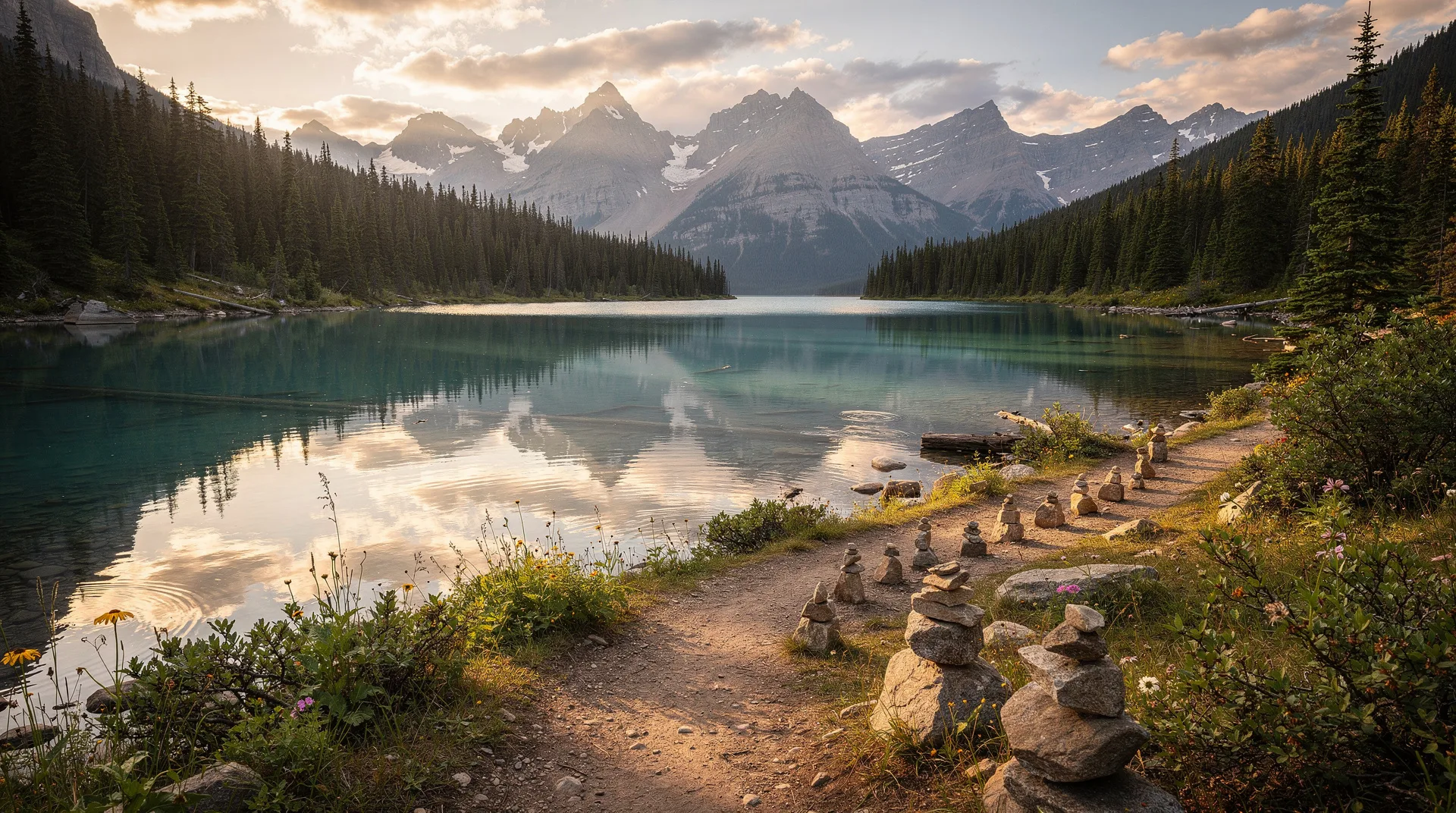
Day 6: The essential day. Lake Louise requires an early start — arrive before 7am or use the Parks Canada shuttle reservation system (mandatory June–October). The Victoria Glacier backdrop, the canoe rentals on the lake, and the Plain of Six Glaciers tea house trail above make this a full morning. In the afternoon, Moraine Lake in the Valley of the Ten Peaks: arguably the single most beautiful scene in Canada, and best experienced before the crowds arrive at 9am.
Day 7: Johnston Canyon (limestone slot canyon with walkway catwalks), Cave and Basin historic site (the thermal springs that created Canada’s national park system in 1885), and Bow Falls.
Days 8–9: Icefields Parkway to Jasper
The 232-kilometre Icefields Parkway from Lake Louise to Jasper is one of the most spectacular drives in the world. Allow a full day with stops: Bow Lake, Peyto Lake viewpoint, the Columbia Icefield (Ice Explorer tours onto the Athabasca Glacier are available), Athabasca Falls. Arrive in Jasper for the first evening.
Day 9 is Jasper’s Maligne Lake: the 22-kilometre lake backed by the Queen Elizabeth Ranges is accessed by a 90-minute drive from Jasper town. Spirit Island, reached by the 2-hour boat cruise with Maligne Lake Boat Tours, is one of the most photographed images in Canada. After the boat tour, the Maligne Canyon hike (6 limestone bridges over a gorge up to 55 metres deep) is an excellent hour-and-a-half.
Day 10: Calgary
Drive from Jasper to Calgary (approximately 4 hours via Highway 93/1). Consider the Drumheller detour (additional 1.5 hours east of Calgary) through the Alberta Badlands to the Royal Tyrrell Museum — the finest dinosaur museum in the world, with over 40 mounted skeletal specimens. Calgary itself: the Glenbow Museum’s First Nations galleries, Stephen Avenue, and if timing aligns, the Calgary Tower.
Logistics: Drop the rental car at Calgary Airport (YYC) and take an afternoon or evening flight to Toronto (3.5 hours).
Days 11–12: Toronto
Toronto is a larger and more complex city than it is typically given credit for. The CN Tower’s glass-floor observation deck and Skywalk are the obvious starting points. Day 11: Distillery District (Victorian-era industrial complex converted to art galleries, restaurants, and boutiques), St. Lawrence Market (Canada’s finest farmers’ and food market), Kensington Market. Day 12: the Royal Ontario Museum (world-class natural history and archaeology collection), Spadina and Chinatown, a Raptors or Blue Jays game if timing allows.
Day 13: Niagara Falls
A 90-minute drive from Toronto, Niagara Falls is obligatory — the Horseshoe Falls are more than a cliché, they are an overwhelming natural phenomenon at close range. The Journey Behind the Falls descends to tunnels behind the Horseshoe Falls; the Hornblower/Niagara Cruises boats approach the falls from the water.
Book the Toronto to Niagara Falls day tour with optional boat cruiseSpend the afternoon in Niagara-on-the-Lake, 20 km north of the falls — a beautifully preserved 19th-century town with Loyalist architecture, abundant Niagara Peninsula wineries, and the Shaw Festival theatre. Return to Toronto or continue east toward Ottawa.
Day 14: Ottawa
Canada’s capital is underrated. The Parliament Buildings on their hill above the Ottawa River are visually impressive and freely visitable (the guided tours are excellent, though advance booking is required for the Confederation Hall). The National Gallery of Canada houses the finest collection of Canadian art in the world, anchored by the iconic Rideau Chapel and the indigenous art collection. The Canadian Museum of History, just across the river in Gatineau, Quebec, presents the complete story of human presence on this continent from pre-contact through the present.
The ByWard Market neighbourhood for dinner — one of the most concentrated restaurant districts in the country.
Days 15–16: Montreal
Book a Toronto–Montreal–Quebec 3-day guided tourMontreal rewards multiple visits and two days provides enough time for a proper introduction. Day 15: Old Montreal — the 18th and 19th-century stone buildings of Rue Saint-Paul and Place Jacques-Cartier, the Basilique Notre-Dame (the finest church interior in Canada), Pointe-à-Callière archaeology museum (built over the original founding site of Ville-Marie). Day 16: Mont Royal in the morning (the cross at the summit, the Belvédère Kondiaronk panorama), then the Plateau neighbourhood — Rue Saint-Denis, Parc La Fontaine, the distinct Quebec urban residential architecture. Food: the smoked meat at Schwartz’s, bagels from St-Viateur or Fairmont, the poutine standard-bearer La Banquise.
Days 17–18: Quebec City
Quebec City is the only walled city in North America north of Mexico, and the Haute-Ville (Upper Town) and the Basse-Ville (Lower Town) of Old Quebec together constitute a UNESCO World Heritage Site. Two days: Day 17 for the walled Old City — the Château Frontenac, the Plains of Abraham battlefield (where the fate of New France was decided in 1759), the fortification walls walk, and the funicular between the upper and lower cities. Day 18 for the Basse-Ville — Rue du Petit-Champlain (North America’s oldest commercial street), the Quartier Petit-Champlain, and a day trip to Montmorency Falls (83 metres, taller than Niagara) or Île d’Orléans.
Days 19–21: Halifax and the Maritimes
Fly from Quebec City to Halifax (1.5 hours) or take the overnight train (the Ocean, 21 hours from Montreal).
Halifax is one of Canada’s most agreeable cities: compact, walkable, historically layered, and with a genuinely excellent food scene anchored by locally harvested seafood. Day 19: the waterfront boardwalk, the Halifax Citadel National Historic Site (the star-shaped fortification overlooking the harbour), the Historic Properties mercantile district, and the Museum of the Atlantic.
Day 20: Peggy’s Cove (the most photographed lighthouse in Canada, 45 minutes southwest) is an essential excursion. The granite coastline, the small fishing harbour, and the lighthouse itself — in fog, in low evening light, or in the clear air after a storm — justify every travel cliché that has been attached to it. Continue to Lunenburg, a UNESCO World Heritage town with colourfully painted 18th and 19th-century buildings and the museum dedicated to the Bluenose schooner.
Day 21: The Annapolis Valley for orchards, wineries, and the Annapolis Royal National Historic Site. Or, for those preferring coastal drama, the Bay of Fundy at Hopewell Rocks in New Brunswick (an easy detour) where the world’s highest tides create extraordinary sculptured rock formations. Return to Halifax for departure.
Getting around this itinerary
Rental cars: Required for the Rockies section (Days 4–10) and strongly recommended for the Maritimes (Days 19–21). In Vancouver, Toronto, Montreal, Quebec City, and Halifax, cars are unnecessary and parking is expensive — rely on public transport and taxis.
Internal flights: Calgary to Toronto (Day 10) is effectively mandatory — the 3,400 km drive would consume five days of this itinerary. Quebec City to Halifax is optional but saves a long day’s travel.
Train: The Via Rail Corridor service between Toronto, Ottawa, Montreal, and Quebec City (the Corridor trains) is comfortable, frequent, and good value. Consider using the train for some of the Ontario–Quebec section.
Visas, money, and passes for a three-week trip
Most visa-exempt air travellers need an eTA before flying; apply well before departure since a three-week trip is not the moment to discover a problem at check-in. Tipping runs 15-20% across restaurants and tours nationwide — see our currency and tipping guide. The Rockies section requires a Parks Canada pass for Banff and Jasper (neither is free entry); buy the Discovery Pass at the gate or online. If this is your first time driving on the right, review our driving in Canada guide before collecting the rental car in Vancouver.
Pacing a three-week trip without burning out
Three weeks of near-daily movement is tiring even at a relaxed pace, and the itinerary above genuinely earns its “moderate” difficulty rating rather than “easy.” Build at least one true rest day into the plan — Montreal or Quebec City, where walking replaces driving, are the natural places for it. The Rockies section (Days 4-10) is the most demanding stretch, combining long driving days with early starts for Lake Louise and Moraine Lake; if energy is flagging by Day 10, it is entirely reasonable to trim the Drumheller detour rather than push through. See our guide on how long to spend in Canada if you are still deciding on trip length before booking flights.
Where to stay
Vancouver: Fairmont Pacific Rim or Sutton Place for luxury; Century Plaza Hotel for mid-range; YWCA Hotel for budget.
Whistler: Fairmont Chateau Whistler or Summit Lodge Boutique Hotel.
Banff: Fairmont Banff Springs (one of Canada’s great hotels) or Moose Hotel and Suites.
Jasper: Fairmont Jasper Park Lodge (on its own lake outside town) or Lobstick Lodge.
Toronto: Shangri-La, Broadview Hotel (in Leslieville), or Gladstone House.
Ottawa: Fairmont Château Laurier (an Ottawa institution) or Arc the Hotel.
Montreal: Le Mount Stephen or Hotel Nelligan (Old Montreal) for character; Le Square Phillips for mid-range.
Quebec City: Fairmont Le Château Frontenac is the statement choice; Hôtel 71 in the Basse-Ville for boutique.
Halifax: The Muir or Prince George Hotel.
Budget planning
This itinerary spans a wide range depending on accommodation and activity choices. A comfort-level estimate (mid-range hotels, one restaurant meal per day, main activities):
- Accommodation: CAD 200–350/night
- Activities: CAD 100–200/person/day
- Meals: CAD 60–100/person/day
- Car rental (western and Maritime sections): CAD 80–120/day
- Internal flights: CAD 300–600/segment
Total estimated cost for two travellers over 21 days: CAD 12,000–18,000, excluding international flights.
Best time for this itinerary
June to September is the optimal window: all attractions are open, the Rockies are accessible, and the Maritime summer is warm enough for coastal exploration. July and August are the most popular and most expensive months.
September often offers the best combination of factors: summer warmth, lower crowds than August, spectacular autumn colour beginning in the Rockies and the eastern forests, and somewhat more reasonable accommodation prices.
Frequently asked questions about 21 days in Canada: the ultimate coast-to-coast itinerary
Do I need travel insurance for a trip this long? Yes, unreservedly — see our Canada travel insurance guide. With two internal flights, extensive driving, and three weeks of moving parts, insurance is the cheapest hedge against a single disrupted segment derailing the schedule.
How does this compare to the 14-day itinerary? The first 18 days cover almost the same ground as the 14-day coast-to-coast itinerary, with an extra day added to Vancouver, Banff, and Toronto for a less rushed pace, plus a dedicated Ottawa day. The final three days (Halifax and the Maritimes) are the genuine addition — skip them and you have effectively the 14-day trip at a gentler pace instead.
Can this itinerary be reversed? Yes, Halifax to Vancouver works equally well. The main adjustment is the logistics of where you pick up and drop off rental cars.
Can I do this without flying? The Via Rail Canadian from Vancouver to Toronto (4 nights) is a genuine alternative to the western driving section and is itself one of Canada’s great travel experiences. Replacing the Calgary–Toronto flight with the train adds 4 nights to the itinerary.
Is 21 days enough for all of this? It is enough for a thorough introduction to each destination without rushing. Some visitors will find the pace ambitious; others will feel they could add another week. The Maritimes section (Days 19–21) is the most optional for first-time visitors — three days in Halifax and Peggy’s Cove is genuinely brief.
What is the best itinerary for first-time visitors? The core of this itinerary (Vancouver through Quebec City) is the backbone of most first-time Canada trips. The Maritimes section is recommended for those with a strong interest in maritime history and culture, or those returning to Canada for a second visit.