Quick facts
- Population
- 550,000 metro
- Best time
- June to September; February for Carnival
- Language
- French
- Days needed
- 2-3 days
Quebec City is unlike anywhere else in North America. The only walled city north of Mexico, its historic core — Old Quebec, or Vieux-Québec — is a UNESCO World Heritage Site that has preserved the architecture, the street plan, and much of the atmosphere of a French colonial city with a fidelity that seems almost miraculous given the centuries of change around it. Walking the cobblestone streets of the Upper Town, with the Château Frontenac rising above everything like a castle from a fever dream, is the closest most North Americans will ever come to walking through a European medieval city.
But Quebec City is not a museum. The 550,000 residents of the metropolitan area go about their lives in French — the most completely French city in the western hemisphere outside France itself — with a cultural self-confidence that expresses itself in world-class restaurants, a remarkable festival culture, and a relationship with its own history that is engaged rather than merely commemorated.
For anyone travelling through Quebec province, Quebec City is essential. Most visitors combine it with Montreal, which is 250 km to the southwest. Two cities, dramatically different in character, together making the case for Quebec as the most culturally distinctive province in Canada.
| At a glance | |
|---|---|
| Where | On the St. Lawrence River, about 250 km northeast of Montreal |
| Cost | Old Quebec streets are free to walk; expect around CAD 25-30 for the Montmorency Falls cable car and admission fees for museums and the Citadelle |
| Time needed | 2-3 days |
| Getting there | Via Rail from Montreal (around 3 hours) or drive Autoroute 20/40 (about 2.5 hours) |
| Best time | June to September for warm weather; late January to February for Winter Carnival |
Old Quebec: the UNESCO World Heritage Site
Old Quebec divides into Upper Town (Haute-Ville) and Lower Town (Basse-Ville), connected by a clifftop that drops 98 metres from the promontory to the riverfront below. The division defined the city’s social history for centuries — the administrative and military powers in the Upper Town, the merchants and workers in the Lower Town — and the physical drama of the cliff remains the city’s defining feature.
The Château Frontenac
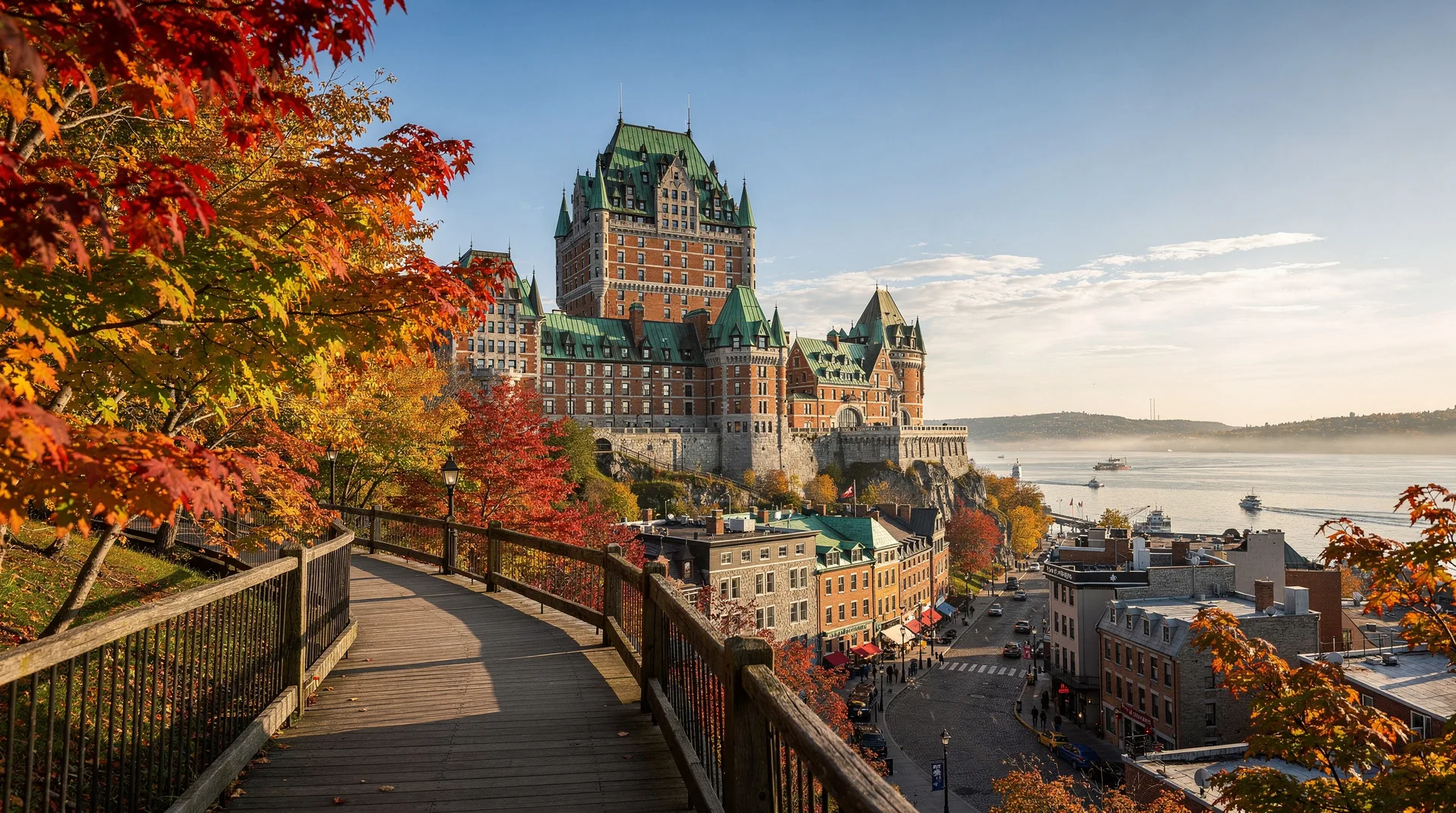
There is no building in Canada more photographed than the Château Frontenac, and it is difficult to argue with the subject matter. The turreted copper-roofed hotel rises above the Upper Town in a composition so perfectly cinematic that it looks like a CGI rendering rather than a real structure. Built in 1893 by the Canadian Pacific Railway as part of their chain of grand railway hotels, the Fairmont Le Château Frontenac has hosted Winston Churchill and Franklin Roosevelt (the 1943 Quebec Conference was held here), Queen Elizabeth II, and generations of honeymooners.
The hotel is still fully operational and rooms are bookable — staying here is one of Canada’s great accommodation experiences. Even if you are not a guest, walking through the lobby, having a drink in one of the bars, or dining in Champlain restaurant allows access to an extraordinary interior. The hotel’s promenade along the clifftop — the Dufferin Terrace — is a public boardwalk with the best views in the city.
The Dufferin Terrace and Governors’ Promenade
The boardwalk that extends along the clifftop from the Château Frontenac is one of the finest urban promenades in North America. The views down the cliff to the Lower Town and across the St. Lawrence are spectacular in every season — in summer with the river sparkling, in autumn with the hills across the river in full colour, in winter when the famous Dufferin Terrace toboggan slide operates and the terrace fills with people in enormous coats.
The Governors’ Promenade extends the walk northeast along the clifftop to the Plains of Abraham, adding another kilometre of views. In summer, parades, festivals, and outdoor performances use the terrace regularly.
Rue du Trésor and the Upper Town streets
The small laneway of rue du Trésor connects rue Sainte-Anne to rue Buade in the Upper Town and has been occupied by artists selling prints, watercolours, and Quebec scenes since the 1960s. It is touristy but atmospheric. The surrounding streets — rue Saint-Louis, rue Sainte-Anne, and the Place d’Armes square in front of the Château — form the commercial heart of the tourist Upper Town.
The more interesting exploration is in the streets north and west of Place d’Armes, where residential Quebec City exists alongside neighbourhood restaurants and bars that are not primarily oriented toward visitors. Rue Saint-Jean, the main commercial artery that bisects the Upper Town, has excellent independent restaurants and food shops.
The Fortifications
Quebec City’s star-shaped fortification walls are the only remaining fortified city walls in North America. The 4.6-kilometre circuit of ramparts, gates, and bastions can be walked in their entirety — a circumnavigation of the Upper Town that takes about 90 minutes and passes through four historic gates (Porte Saint-Louis, Porte Saint-Jean, Porte Kent, Porte Prescott). Parks Canada offers guided walks of the fortifications in summer.
The Citadelle, a star-shaped British fortress begun in 1820 and still an active Canadian military base, occupies the highest point of the promontory. The daily Changing of the Guard ceremony runs from late June to Labour Day — the Royal 22e Régiment is the only French-speaking regiment in the British Commonwealth military tradition with this ceremony.
Lower Town: the birthplace of New France
The funicular from the Dufferin Terrace descends to the Quartier Petit-Champlain — the oldest commercial district in North America and, debatably, the prettiest. The narrow streets of the Lower Town are lined with artisan boutiques, restaurants, and galleries. The Maison Chevalier, dating from 1752, and the Place Royale, the original town square where Samuel de Champlain established his first fur-trading post in 1608, are among the oldest European urban fabric in North America.
Place Royale’s Notre-Dame-des-Victoires church (1688) is Quebec City’s oldest church. The square itself is paved in stone and anchored by a bust of Louis XIV, and in summer it fills with outdoor performances and events. The Musée de la Civilisation, a few blocks north, is one of Canada’s best museums, telling the story of Quebec from Indigenous times through to contemporary Quebecois identity.
Browse all Quebec City tours and experiencesThe Plains of Abraham
The grassy plateau west of the Upper Town was the site of the Battle of the Plains of Abraham on September 13, 1759 — the 15-minute engagement that decided the fate of New France and, by extension, the cultural character of Canada. The British forces under General James Wolfe defeated the French forces under the Marquis de Montcalm; both commanders were mortally wounded. The result transferred control of Quebec to the British and set in motion the sequence of events that eventually produced modern Canada.
Today the Plaines d’Abraham (officially the Battlefields Park) is a beautifully maintained urban park of 107 hectares used daily by Quebec City residents for cycling, running, cross-country skiing, and festivals. The Musée des Plaines d’Abraham brings the battle story to life with multimedia exhibits, artifacts, and guided tours. In summer the park hosts major concerts and the Plains of Abraham outdoor festival season.
Montmorency Falls
Eight kilometres downstream from Old Quebec, the Chute Montmorency is one of the most impressive waterfalls in Canada — 83 metres high, which makes it 30 metres taller than Niagara Falls (though far narrower). The falls, where the Montmorency River drops from the plateau into the St. Lawrence estuary, can be viewed from below (from the park at the base), from the suspension bridge that crosses just above the crest, or from a gondola that ascends the cliff beside the falls.
In winter, the spray from the falls creates a massive cone of ice — the pain de sucre or sugarloaf — that grows through the season and can reach 30 metres in height. The park operates year-round and the winter perspective on the ice cone is one of Quebec City’s most unusual sights.
Book a day trip from Montreal to Quebec City and Montmorency FallsQuebec Winter Carnival
The Carnaval de Québec is the world’s largest winter carnival, running for three weeks in late January and early February. Founded in 1955, it draws roughly half a million visitors to events across the city — an astonishing commitment to celebrating winter rather than enduring it.
Bonhomme Carnaval, the 7-foot snowman mascot who serves as the carnival’s official host, is one of Quebec’s most recognisable cultural icons. The carnival includes the legendary ice sculptures on the Grande-Allée, the Bonhomme Ice Palace (a new ice structure built fresh each year near the Parliament), the famous canoe race across the ice-filled St. Lawrence River, and the night parades that fill the streets of Old Quebec with costumed revellers.
The bathtub races, the snow slides, and the evening balls (soirées) in the Bonhomme Palace are among the most purely joyful public events in Canada. Temperatures during the carnival regularly sit between -10°C and -25°C; the correct response is to dress properly, purchase a Carnaval button (which serves as admission to most events), and embrace it.
Where to eat in Quebec City
Quebec City’s restaurant scene is smaller than Montreal’s but has a distinctive character rooted in traditional Quebecois cooking elevated by French technique.
Aux Anciens Canadiens (Rue Saint-Louis, Upper Town): Occupying a 1675 house with low ceilings and stone walls, this is the place for traditional Quebecois cuisine — tourtière (meat pie), cipaille, sugar pie, and maple-cured ham. Touristy, yes, but the food is genuinely excellent and the setting is irreplaceable.
Le Champlain (Château Frontenac): The hotel’s signature restaurant offers one of the grandest dining experiences in Canada in a room designed in 1926 that has changed very little since. Worth the splurge for a special occasion.
Bistro B (Grande-Allée): A neighbourhood bistro that locals actually use, with seasonal Quebec ingredients and a strong natural wine list.
Le Clan: Modern Quebecois cuisine in a warm, contemporary room — local game, foraged ingredients, and excellent charcuterie in a menu that changes with the seasons.
Chez Ashton: The local fast-food institution for poutine, with locations throughout the city. The local version of the argument about best poutine in Quebec — Ashton’s classic version has partisans who would put it above anything in Montreal.
Where to stay in Quebec City
Within Old Quebec (Upper Town): The Château Frontenac is the obvious choice for a splurge, but also look at the Auberge Saint-Antoine in the Lower Town — a luxury boutique hotel built over an archaeological site, with artifacts from the site incorporated into the interior design. The Hôtel Le Germain Dominion occupies a stunning 1912 building in the Lower Town.
Nearby the Plains of Abraham: Several mid-range hotels line the Grande-Allée, which connects Old Quebec to the Plains. The Hilton Quebec and Delta Hotels Quebec are both comfortable options at this end of the market.
Outside the walls: For better value, the Saint-Roch neighbourhood — a gentrified area about 20 minutes walk west of Old Quebec — has boutique hotels and excellent independent restaurants without the Old Quebec premium.
Getting to Quebec City
From Montreal: Via Rail trains run multiple times daily (around 3 hours). The drive on Autoroute 20 or 40 takes about 2.5 hours depending on traffic. Orléans Express buses are also available.
From the US: There are direct flights from a few US cities; most visitors fly into Montreal or Toronto and travel by ground. From Boston, it is about 6 hours by car through Vermont or Maine.
Planning more time around Quebec City
If the city hooks you, the surrounding region rewards a longer stay. Our Old Quebec guide goes street by street through the walled city, and the best tours in Quebec City page helps you decide which guided experiences are worth fitting in. Travellers interested in the story behind the city’s founding will enjoy the New France heritage guide.
For a longer trip, the 7-day Quebec itinerary strings the city together with the rest of the province, while the Quebec winter itinerary is built around Carnival season. If you are coming from the west, the Montreal to Quebec City guide covers the options for the journey, and Quebec in winter explains what to pack and expect when the cold sets in.
Food is a big part of any visit, and the Quebec food deep dive and the French-Canadian cuisine guide explain the dishes you will meet on the menus above. If your French is rusty, speaking French in Quebec offers a few phrases that will make your stay smoother.
Quebec City by season
| Season | Weather | Crowds | Highlights |
|---|---|---|---|
| Summer (Jun-Aug) | Warm, 20-25°C | Busiest, book ahead | Outdoor dining, festivals, Plains of Abraham events |
| Fall (Sep-Oct) | Cool, colourful foliage | Moderate | Fortification walks, quieter restaurants |
| Winter Carnival (late Jan-Feb) | Cold, -10 to -25°C | Very busy for carnival weekends | Ice sculptures, canoe race, Bonhomme events |
| Deep winter (Dec, Mar) | Cold | Quiet outside Carnival | Christmas markets, ice cone at Montmorency Falls |
Quebec City vs Montreal for a first Canada trip
Travellers with limited time often ask whether to prioritize Quebec City or Montreal. Quebec City wins on atmosphere and history — nowhere else in North America delivers the walled, cobblestoned, castle-topped experience of Old Quebec. Montreal wins on scale, nightlife, and food diversity, with a more cosmopolitan, bilingual character. Most itineraries that include both do Montreal first (better flight connections) and Quebec City as a 2-3 day add-on by train, or the reverse if arriving via the Charlevoix region. See the dedicated Quebec City vs Montreal comparison for a fuller breakdown.
Frequently asked questions about Quebec City
Do I need to speak French to visit Quebec City?
Quebec City is more thoroughly French-speaking than Montreal. In the tourist areas of Old Quebec, English is spoken in most hotels, restaurants, and attractions, but the city’s everyday life is conducted in French. A basic knowledge of French is helpful and appreciated. The welcome for Anglophone visitors is warm, but French is clearly the primary language here.
How many days do I need in Quebec City?
Two days allows you to see the major highlights: Old Quebec upper and lower town, the Plains of Abraham, and Montmorency Falls. Three days is more comfortable and allows for a relaxed pace, a day trip, or deeper exploration of the museums and neighbourhood restaurants.
When is the Quebec Winter Carnival?
The Carnaval de Québec runs for roughly three weekends in late January and the first two weeks of February. Exact dates vary year to year; check the carnival website for the current year’s schedule. Book accommodation very far in advance — the city fills completely for the peak carnival weekends.
Is Quebec City close to Montreal?
Yes — about 250 km apart, connected by Autoroute 20 or 40 (2.5-hour drive) or Via Rail (approximately 3 hours). Many visitors do both cities in a single trip. Montreal to Quebec City is a natural progression if you are heading northeast, or a good combination with Montreal as a base.
What should I not miss in Quebec City?
The Dufferin Terrace at sunset, walking the fortification walls, breakfast in the Lower Town (Café du Monde for the croissants), the Musée de la Civilisation, and a meal at Aux Anciens Canadiens. In winter, add the toboggan slide on the Dufferin Terrace. In summer, add Montmorency Falls and the Plains of Abraham park.
Is Old Quebec safe?
Old Quebec is among the safest urban environments in Canada. The neighbourhood is heavily touristed during the day and well-lit at night, with a strong local restaurant and bar scene that keeps the streets active until late. Normal city precautions apply, but the area is considered very safe by international standards.
What is the best way to explore Old Quebec?
On foot. Old Quebec is compact enough that every major sight is within walking distance of everything else, and the cobblestone streets and narrow lanes reward slow exploration. Wear comfortable shoes suitable for uneven cobblestones. The funicular between Upper and Lower Town (a few dollars) saves a steep staircase climb but the Escalier Casse-Cou (the famous breakneck stairs) is worth descending at least once for the view back up at the cliff face.
Is Montmorency Falls free to visit?
The falls are visible without charge from certain vantage points, but entering the Montmorency Falls park involves parking and admission fees, and the cable car and the suspension bridge crossing are ticketed. Budget around CAD 15-20 for the cable car if you want to cross above the falls rather than just view them from below.