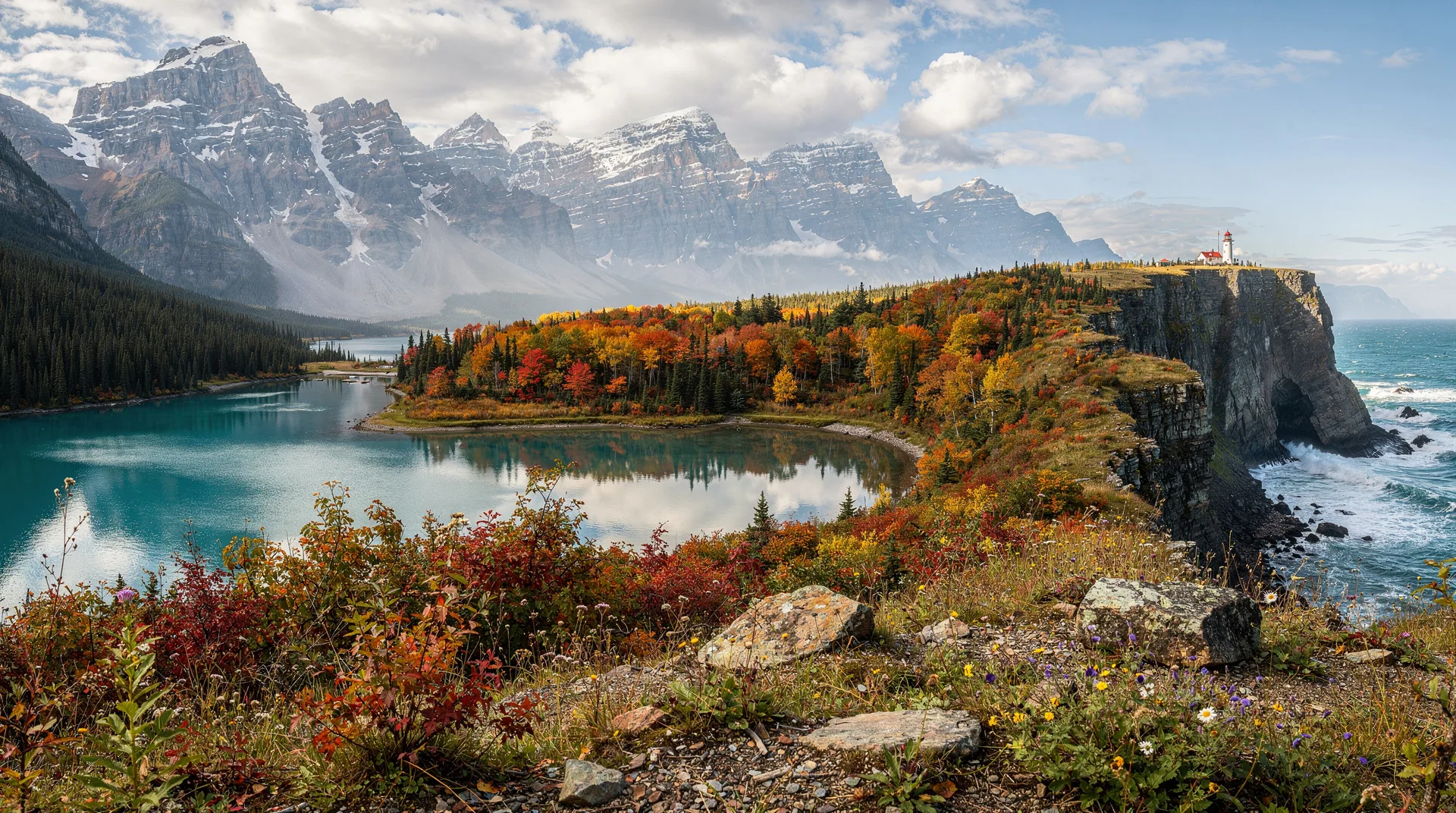
14 days in Canada: the classic coast-to-coast itinerary
Overview
A fortnight in Canada. It sounds generous — and compared to a hurried week it is — but this country is the second-largest in the world, and even 14 days requires careful selection. This itinerary takes you from Vancouver on the Pacific coast to Toronto on the Great Lakes (or runs in reverse: both directions work equally well).
Along the way you cover the Sea-to-Sky Highway, the Canadian Rockies at their most dramatic, a taste of the Prairies, the Great Lakes shoreline, Niagara Falls, and two of Canada’s most compelling cities. It is the journey Canadians themselves describe when they say “see the whole country” — a genuine cross-section of landscape and culture.
The trip requires one internal flight (Calgary to Toronto, approximately 3.5 hours) or, for those with time and an appetite for the experience, the option to take the Via Rail Canadian train all the way across — a three-night, four-day journey that is one of the world’s great rail adventures.
| Days | Destination | Highlights |
|---|---|---|
| 1–2 | Vancouver | Stanley Park, Granville Island, Museum of Anthropology |
| 3 | Sea-to-Sky to Whistler | Shannon Falls, Peak 2 Peak Gondola |
| 4–6 | Banff National Park | Lake Louise, Moraine Lake, Banff town |
| 7–8 | Icefields Parkway + Jasper | Columbia Icefield, Athabasca Falls, Maligne Lake |
| 9 | Calgary | Fly or drive east; optional Drumheller detour |
| 10–11 | Toronto | CN Tower, Distillery District, ROM, Kensington Market |
| 12 | Niagara Falls + Niagara-on-the-Lake | Falls, wineries, historic town |
| 13–14 | Montreal or Quebec City | Old City, food, culture |
At a glance
| Where | Vancouver to Toronto (or reverse), via the Rockies, Prairies, and Great Lakes |
| Cost per person (2 sharing) | around CAD 6,000-8,800 moderate, CAD 9,000-12,900 comfort |
| Time needed | 14 days; one internal flight (Calgary-Toronto) is effectively required |
| Getting there | fly into Vancouver International; fly or take the VIA Rail Canadian home from Toronto or Montreal |
| Best time | June-September for full mountain access; September-early October for fall colour with fewer crowds |
Days 1–2: Vancouver — Pacific gateway
Vancouver is one of the world’s most livable cities and an ideal entry point to Canada’s west coast. Two days covers the essential rhythm: the seawall loop around Stanley Park (8.8 km, allow 2–3 hours), the totem poles at Brockton Point, Granville Island Public Market for the finest local food hall in western Canada, and a crossing to the North Shore for either the Capilano Suspension Bridge or the free suspension bridge at Lynn Canyon.
On Day 2, invest the morning in the Museum of Anthropology at UBC — the Great Hall’s collection of Northwest Coast First Nations art and carving is one of the finest in the world and essential context for everything you will see further north on the coast. Spend the afternoon in the Yaletown and Kitsilano neighbourhoods. Book the full-day Whistler tour from Vancouver for tomorrow or pick up your rental car this afternoon.
Logistics: Fly into Vancouver International Airport (YVR). The Canada Line SkyTrain reaches downtown in 26 minutes (CAD 11). Your rental car is not needed until Day 3 — the city is best navigated on foot and by SkyTrain.
Day 3: Sea-to-Sky Highway to Whistler
Collect your rental car (or board the Whistler Direct coach if you prefer not to drive) and head north on Highway 99. The Sea-to-Sky Highway is one of Canada’s iconic drives: cliffs tumble into Howe Sound below, and the Coast Mountains close in above. Stop at Shannon Falls Provincial Park, a short walk from the highway to an 84-metre waterfall. In Squamish, the Stawamus Chief — a 700-metre granite monolith — looms above the highway. The full Chief hike takes 3–5 hours; the viewpoint from the base takes 20 minutes.
Arrive in Whistler by midday. The village is pedestrian-only and aesthetically coherent, with the two mountains — Whistler and Blackcomb — rising directly behind the resort. In summer, the Peak 2 Peak Gondola connecting the two peaks at 436 metres above the valley floor is the main event; in winter, 200+ ski runs occupy both mountains. Either way, plan an evening in the village for one of its standout restaurants: Araxi and Il Caminetto are both exceptional.
Overnight in Whistler (Fairmont Chateau Whistler or Summit Lodge Boutique Hotel).
Days 4–6: Banff National Park — the heart of the Rockies
From Whistler, drive east on the Coquihalla Highway (Highway 5) to Kamloops, then east on the Trans-Canada (Highway 1) through the Thompson River canyon and the mountains to Banff National Park. This is a long driving day (approximately 7 hours) — break it in Kamloops or Revelstoke, both pleasant small cities with good coffee stops. The Rogers Pass through Glacier National Park is spectacular.
Enter the park through the east gate (Banff park pass required — available at the gate or at Parks Canada kiosks). The Banff and Jasper National Parks comprehensive tour from Calgary is available if you are arriving from Calgary instead.
Day 4: Arrive in Banff town and check in. Walk the town’s one main street, take the Banff Gondola up Sulphur Mountain (panoramic views over the Bow Valley, worth it at sunset), and soak in the Banff Upper Hot Springs.
Day 5: This is the priority day. Lake Louise requires an early start — the Parks Canada reservation system (required mid-May to mid-October) operates shuttle buses from the park-and-ride. Arrive before 8:00am if driving to the lakeshore. The scene — the turquoise water against the Victoria Glacier — is so vivid it barely looks real. Hike the Plain of Six Glaciers trail above the lake for two hours of exceptional alpine scenery. In the afternoon, Moraine Lake in the Valley of the Ten Peaks demands its own visit; the lakeshore viewpoint from the rockpile is arguably the single most beautiful scene in Canada. Arrive at dawn or before 6:00am to guarantee parking access.
Day 6: The town of Banff and surroundings. Johnston Canyon (1.1 km to the Lower Falls, 2.7 km to the Upper Falls) is a popular morning hike through a narrow limestone canyon. The Cave and Basin National Historic Site explains the thermal springs that prompted the creation of Canada’s first national park in 1885. Bow Falls is a short walk from the town centre. Book a if you prefer not to navigate the early-morning reservation logistics alone.
Days 7–8: Icefields Parkway to Jasper
The Icefields Parkway (Highway 93) from Lake Louise to Jasper is 232 kilometres of sustained grandeur. Allow a full day. Major stops:
- Bow Lake (30 km from Lake Louise): a glacially-fed turquoise lake reflecting Crowfoot Glacier — stop at the Num-Ti-Jah Lodge for coffee and the first proper mountain-lake reflection of the drive.
- Peyto Lake Viewpoint (40 km): the classic wolf-head panorama over the electric-blue lake below. A new viewing platform was completed in 2023. Worth the 1.5 km return walk even on sore legs.
- Columbia Icefield (104 km): one of the largest non-polar icefields in the world, where the Athabasca Glacier reaches the roadside. The Ice Explorer bus ride onto the glacier surface takes you to a place where the ice is 300 metres deep. The Columbia Icefield Skywalk — a glass-floored cantilever platform over the Sunwapta Valley — is an optional extra.
- Athabasca Falls (30 km north of the Columbia Icefield): the most powerful waterfall in the Canadian Rockies, where the Athabasca River is forced through a narrow canyon. Short walk from the car park; deeply dramatic.
Overnight in Jasper. Jasper National Park is larger than Banff, quieter, and arguably better for wildlife: elk graze on the golf course at dusk, black bears appear along the Icefields Parkway, and the wetland meadows around Maligne Lake attract moose. The Fairmont Jasper Park Lodge occupies its own lake on the outskirts of town — the most atmospheric accommodation in the Rockies.
Day 8: Maligne Lake is the centrepiece of the Jasper day — a 22-km-long lake at 1,670 metres, hemmed in by the Queen Elizabeth Ranges. Spirit Island, accessible only by boat, is one of the most photographed scenes in Canada. The two-hour boat tour with Maligne Lake Boat Tours is the easiest way to reach it. After lunch, the Maligne Canyon hike passes six natural limestone bridges over a gorge up to 55 metres deep.
Day 9: Calgary — Prairie gateway
Drive from Jasper to Calgary (approximately 4 hours via Highway 93/1 through Banff and east to the city). If time allows, the detour to Drumheller (additional 1.5 hours east of Calgary) passes through the Alberta Badlands — a landscape of hoodoos, canyon walls, and exposed dinosaur strata at the Royal Tyrrell Museum, the finest dinosaur museum in the world. Plan at least 2 hours at the museum if making the detour.
Calgary itself has more character than its reputation suggests. The Stephen Avenue pedestrian mall in the downtown core has good restaurants and the Glenbow Museum (First Nations, Western Canadian history). The Calgary Tower’s glass floor and 360-degree views over the city, the Prairies, and — on clear days — the Rockies to the west is worth the trip up.
Fly Calgary–Toronto this evening (WestJet, Air Canada, and Flair all serve the route; 3.5 hours; book well in advance for reasonable fares). Alternatively, this is the day to board the Via Rail Canadian for the 4-day transcontinental journey — spectacular but requiring a flexible itinerary.
Days 10–11: Toronto — Canada’s largest city
Arrive in Toronto and spend two full days. The CN Tower (553 metres, glass floor, EdgeWalk) sets the orientation. The Distillery District, built in preserved Victorian distillery buildings, is one of the most atmospheric places in the city for galleries and restaurants. The Royal Ontario Museum on Bloor Street holds 13 million objects and has one of the best dinosaur galleries in Canada.
Kensington Market — an eclectic grid of streets in the university district — rewards an afternoon of wandering: vintage clothing shops, independent bakeries, West Indian restaurants, and impromptu street music. The St Lawrence Market (Saturday mornings for the full experience) is a covered Victorian hall with over 120 vendors selling everything from Upper Canadian cheddar to fresh-baked peameal bacon sandwiches.
Dinner on Day 11 could be in Chinatown (one of the most authentic in North America, along Spadina Avenue), Little Portugal (Dundas Street West), or the upscale Yorkville neighbourhood for a special-occasion meal.
Day 12: Niagara Falls and Niagara-on-the-Lake
Drive the QEW highway west from Toronto to Niagara Falls (1.5 hours, 130 km). The falls — three cascades, 57 metres high at Horseshoe Falls, 168,000 cubic metres of water per minute — are one of the genuine natural wonders of the world at close range. The roar is felt as much as heard. The Niagara City Cruises boat takes you directly into the spray at the base; wear the provided poncho and expect to be exhilarated. Journey Behind the Falls goes through tunnels drilled into the cliff beside the cascade.
Book a Toronto to Niagara Falls day tour with optional boat cruise if you prefer not to drive — it handles transport and includes the main attractions.
Drive north 15 minutes to Niagara-on-the-Lake for the afternoon: one of Canada’s most intact 19th-century towns, on the shore of Lake Ontario at the mouth of the Niagara River. The town’s main street (Queen Street) is lined with heritage buildings, and the surrounding countryside is Ontario’s wine country heartland. Peller Estates, Inniskillin, and Trius Winery all open for tastings. The Shaw Festival theatre company, one of Canada’s finest, is based here and performs April through October.
Days 13–14: Montreal or Quebec City
Return to Toronto and fly to Montreal (1.5 hours) or take the VIA Rail train (5 hours — a comfortable, scenic journey along the north shore of Lake Ontario). Two days in Montreal gives time for Old Montreal (Notre-Dame Basilica’s extraordinary interior is essential), the Plateau-Mont-Royal neighbourhood, Jean-Talon Market, and the summit of Mont Royal for city views.
If Quebec City pulls more strongly — and for many visitors it does — the walled city, the Château Frontenac, and the cobblestoned Basse-Ville of Quebec City offer the most thoroughly European experience in the Americas. The city is 4 hours from Montreal by Via Rail.
Both cities have excellent direct international flight connections for the return leg. The guided Toronto–Montreal–Quebec City 3-day tour is available if you want a fully arranged experience for this section.
Getting around
Days 1–2 (Vancouver): Canada Line SkyTrain, Mobi bike-share, taxis. No car needed.
Day 3 (Sea-to-Sky to Whistler): Pick up rental car at Vancouver Airport or downtown. Coach bus alternative from Whistler Direct: departs Pacific Central Station or downtown, 2.5 hours.
Days 3–9 (BC Interior to Calgary): Rental car essential. Roads are well-maintained four-lane highways for most of the Trans-Canada; mountain sections are sealed and scenic. Parks Canada requires a park pass (buy at the gate or online, CAD 12.25 per adult per day, or CAD 83.50 for the annual Discovery Pass). Return the car at Calgary Airport.
Day 9 onward (east): Fly Calgary–Toronto (book 4–8 weeks ahead for best fares, approximately CAD 200–400 depending on airline and timing). Within Toronto, the TTC subway covers the main areas. For the Niagara day trip, rent a car or book a tour. Via Rail for Montreal/Quebec City.
Alternative: Via Rail’s The Canadian departs Calgary (or Vancouver) for Toronto — a 4-day journey through the Rockies, Prairies, and Canadian Shield that is one of the great rail experiences on earth. Dome car views, full dining service, sleeping cabins. Book months in advance.
Practical planning: visas, money, and park passes
Most visa-exempt air travellers need an eTA before flying to Canada — apply online in advance, it usually processes within minutes. Tipping is standard at 15-20% in restaurants, cafés, and on tours; see our currency and tipping guide. The Rockies section requires a Parks Canada pass for Banff and Jasper — buy a Discovery Pass at the gate or online rather than assuming entry is free, since neither park is. If you are nervous about driving on the right for the first time, our driving in Canada guide covers the basics before you collect the rental car in Vancouver.
What can go wrong, and how to hedge against it
The single biggest risk to this itinerary is weather closing or delaying the Icefields Parkway or the Sea-to-Sky Highway — both roads are sealed and well-maintained but can see snow even in shoulder-season months at elevation. Build a half-day of slack around Days 3 and 7-8 rather than a fixed hour-by-hour plan. The second risk is the Calgary-Toronto flight: book it weeks ahead in summer, since last-minute fares on this route are consistently the most expensive segment of the whole trip. Finally, Lake Louise and Moraine Lake parking fills before 7am from mid-June through September — using the Parks Canada shuttle removes this risk entirely and is worth the extra planning.
Where to stay
Vancouver: Rosewood Hotel Georgia (luxury), Loden Hotel (mid-range), HI Vancouver Downtown (budget)
Whistler: Fairmont Chateau Whistler (ski-lodge luxury), Summit Lodge Boutique Hotel (comfortable mid-range)
Banff: Fairmont Banff Springs (historic, castle-like), Moose Hotel and Suites (contemporary mid-range), HI Banff Alpine Centre (budget, excellent)
Jasper: Fairmont Jasper Park Lodge (lakeshore, atmospheric), Maligne Lodge (mid-range, central)
Calgary: Hotel Arts (boutique), Alt Hotel Calgary (clean, modern mid-range)
Toronto: Kimpton Saint George (boutique mid-range), Fairmont Royal York (classic luxury, Union Station location)
Montreal/Quebec City: William Gray (Old Montreal boutique), Fairmont Le Château Frontenac (iconic Quebec City landmark)
Total budget estimate
Per person, two sharing, in Canadian dollars, excluding international flights:
| Category | Moderate | Comfort | Luxury |
|---|---|---|---|
| Accommodation (14 nights) | CAD 2,800–4,200 | CAD 4,500–6,500 | CAD 8,000–14,000 |
| Food and drink | CAD 1,200–1,600 | CAD 1,700–2,400 | CAD 2,800–4,000 |
| Transport (car rental, fuel, internal flight, trains) | CAD 1,500–2,200 | CAD 2,000–2,800 | CAD 3,000–5,000 |
| Activities and park passes | CAD 500–800 | CAD 800–1,200 | CAD 1,500–2,500 |
| Total | ~CAD 6,000–8,800 | ~CAD 9,000–12,900 | ~CAD 15,300–25,500 |
Best time to do this itinerary
June to September is the prime window for the full 14-day coast-to-coast trip. All mountain passes are open, Moraine Lake and Lake Louise are accessible by late June, whale watching season is active off Victoria, and the long days give generous time for driving.
May offers shoulder-season pricing and fewer crowds at the national parks, though some high-elevation trails and Moraine Lake remain snow-covered until mid-June. The Icefields Parkway is driveable from April.
October is spectacular for fall colours — especially Jasper, where the larches turn gold in the third week of September through early October. The crowds thin dramatically after Labour Day.
Winter (November–March) transforms the itinerary: skiing at Banff Sunshine, Lake Louise, and Whistler, the Quebec Winter Carnival, and ice skating on Ottawa’s Rideau Canal (a worthwhile addition). The Icefields Parkway remains open but requires winter-equipped tires and careful driving.
Frequently asked questions about this itinerary
Is 14 days enough to see all of Canada?
Not all of it — no trip of any length will cover everything. Canada is vast: a transcontinental flight from Vancouver to Halifax takes 6 hours. But 14 days covers the essential cross-section that most travellers have in mind when they picture Canada: the Pacific coast, the Rockies, a Prairie transit, and the St Lawrence corridor. The Atlantic provinces, the Yukon, and Northern Canada require separate dedicated trips.
Should I travel west-to-east (Vancouver to Toronto) or east-to-west?
Both directions work. West-to-east (Vancouver to Toronto) is slightly more common because it puts the Rockies early in the trip when legs are fresh for hiking, and the cultural cities come later when physical energy may be lower. East-to-west (Toronto to Vancouver) means ending on the Pacific coast — pleasant if you want to decompress at the end. The internal flight is the same price in either direction.
Can I do this itinerary without a car?
The eastern section (Toronto, Niagara, Montreal) works without a car. But the western section — Vancouver to Calgary via the Rockies — requires one. Lake Louise, Moraine Lake, and the Icefields Parkway are not meaningfully accessible by public transport. The Banff–Jasper section is possible with a combination of tour buses and the Brewster/Pursuit shuttle, but this is more expensive and less flexible than driving.
How physically demanding is this trip?
Moderate overall. The hikes to Lake Louise and Moraine Lake require only short, flat walks to the lake shores. The Plain of Six Glaciers and Maligne Canyon hikes are more sustained (2–4 hours) but not technical. The cities are all flat or gently hilly and walkable. The Icefields Parkway itself is a driving day with optional short walks. Anyone in reasonable health can complete this itinerary comfortably.
What are the best two additions if I have a 16-day trip?
Two extra days is best spent either adding Victoria and Vancouver Island after Vancouver (an excellent contrast to the city — ferry over, two nights, then continue east), or adding Quebec City as a separate destination alongside Montreal rather than choosing between them. Both extensions add genuine value to the 14-day framework.
What should I not miss under any circumstances?
In order of irreplaceability: Moraine Lake at dawn, the Icefields Parkway (full day, not rushed), Quebec City’s walled Old Town, Granville Island Market, and the boat ride at Niagara Falls. These five moments capture Canada’s range — mountains, ice, French history, Pacific culture, and natural spectacle — better than anything else on the route.
Do I need travel insurance for this trip?
Yes — see our Canada travel insurance guide. With an internal flight, mountain driving, and a national park section all in the itinerary, the usual disruption risks (weather, delays, lost luggage) are all present, and a policy makes each one far less costly to fix.
What is the best way to handle currency and tipping across the trip?
Everything runs on the Canadian dollar; cards are accepted almost everywhere, including small cafés, so carrying large amounts of cash is unnecessary. Tipping 15-20% is expected in restaurants and on tours throughout both the western and eastern legs — see our currency and tipping guide for a full breakdown by service type.