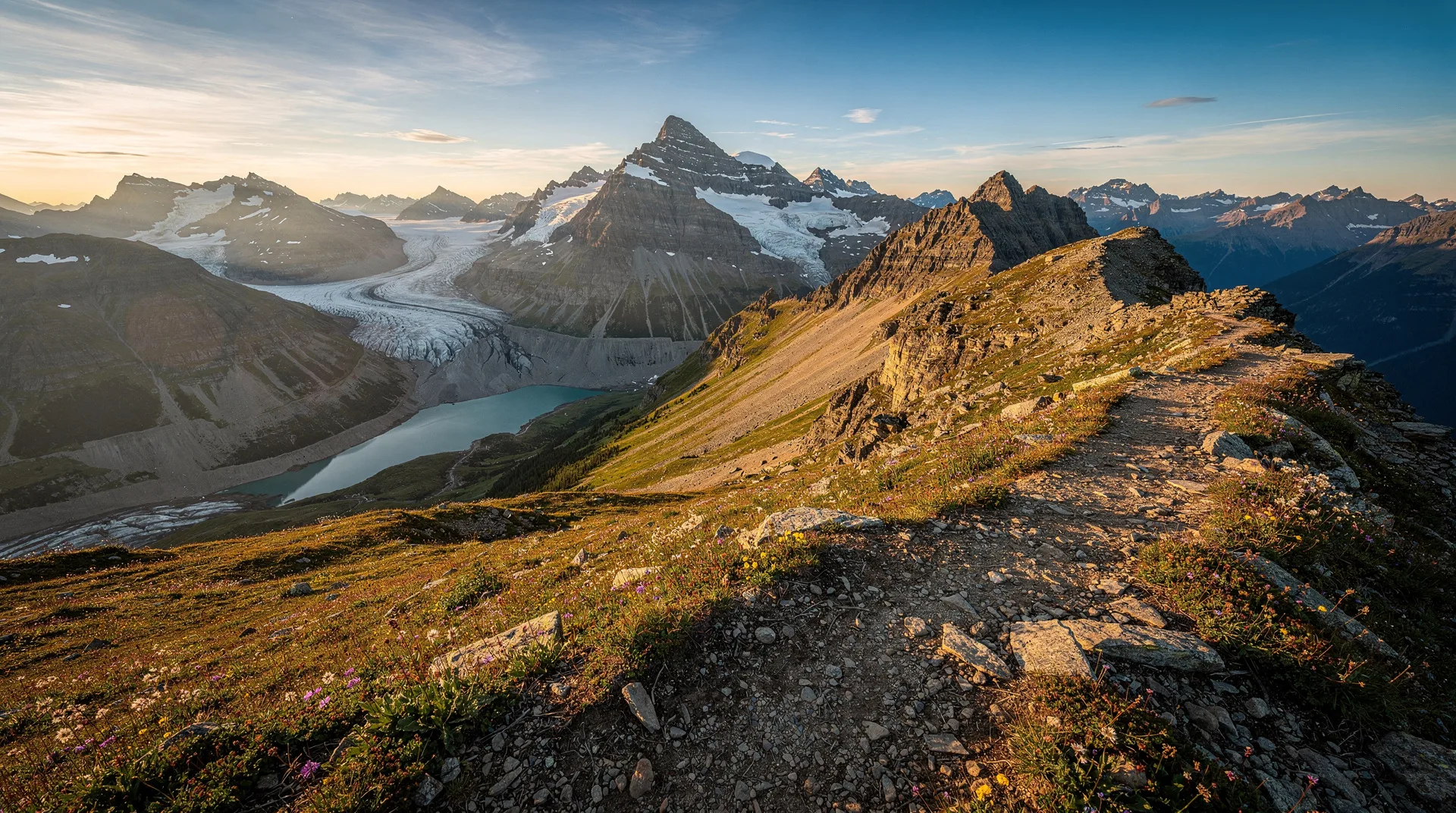
Parker Ridge hike: Saskatchewan Glacier views
How hard is the Parker Ridge hike?
Parker Ridge is a moderate-to-strenuous 5 km return trail with 250 m elevation gain near the Columbia Icefield on the Icefields Parkway. The exposed ridge delivers one of the finest views of the Saskatchewan Glacier in Alberta. Most hikers complete the round trip in 2–3 hours.
Parker Ridge is one of the most rewarding short hikes on the Icefields Parkway — and the Icefields Parkway has the highest concentration of exceptional hike-to-viewpoints of any road in Canada. At just 5 kilometres return, Parker Ridge delivers a view of the Saskatchewan Glacier and the Columbia Icefield that feels wildly disproportionate to the effort required. The Saskatchewan Glacier stretches down from the Columbia Icefield above, 9 kilometres long and visible in remarkable detail from the ridge crest.
The trail sits at one of the highest elevations of any maintained trail on the Parkway, and its exposed subalpine and alpine terrain means it is snow-free for a shorter season than lower-elevation trails — typically July through late September. In those months, the wildflowers on the ridge are spectacular.
At a glance
| Where | Icefields Parkway, 9 km north of the Columbia Icefield Discovery Centre, Banff National Park |
| Cost | Parks Canada Discovery Pass or day pass required — see the Banff park pass guide |
| Time needed | 2-3 hours round trip |
| Getting there | About 2.5 hours from Banff Town or 1.5 hours from Jasper Town via the Icefields Parkway |
| Best time | Mid-July through September, when the trail is snow-free |
Trail overview
Trailhead: Parker Ridge parking area, 9 km north of the Columbia Icefield Discovery Centre on Highway 93 North (Icefields Parkway) Distance: 5 km return Elevation gain: 250 m Difficulty: Moderate (strenuous in upper sections) Duration: 2–3 hours return Elevation at trailhead: Approximately 2,035 m Trail surface: Well-maintained, rocky upper sections; some switchbacks
Getting to the Parker Ridge trailhead
The Parker Ridge parking area is on the east side of Highway 93 North (the Icefields Parkway), 9 kilometres north of the Columbia Icefield Discovery Centre and about 23 kilometres south of the Sunwapta Pass (the boundary between Banff and Jasper national parks).
From Banff Town: 215 km north on the Icefields Parkway via Lake Louise — approximately 2.5 hours of driving. From Jasper Town: 107 km south on the Icefields Parkway — approximately 1.5 hours. From Calgary: Via Lake Louise, approximately 3.5 hours.
A Parks Canada Discovery Pass is required to access this trail, which sits within Banff National Park. The pass is checked at the park gates on the Trans-Canada; ensure yours is valid before entering.
The parking area is a simple gravel lot with an information board. There are no facilities (no toilets, no water, no services) at the trailhead. Use the facilities at the Columbia Icefield Discovery Centre 9 kilometres south before heading here.
The hike: what to expect
The trail begins through a brief section of Engelmann spruce and subalpine fir before quickly rising above treeline into open subalpine meadows. This treeline transition happens early — within the first kilometre — due to the extreme elevation of the trailhead itself. From here, the views begin to open in every direction.
The trail is clearly defined and well-maintained by Parks Canada, though the upper sections are rocky and require some care on footing. Switchbacks ease the gradient in the steeper middle sections. The final approach to the ridge crest involves a short, direct climb on loose gravel and stone.
At the ridge crest (approximately 2,285 m): The view is the payoff. The Saskatchewan Glacier stretches out below — 9 kilometres of ice descending from the Columbia Icefield at the head of the valley. The glacier has retreated measurably over the past century, and interpretive signs at the ridge indicate where the glacier’s terminus stood in 1890, 1920, and successive decades. This makes Parker Ridge simultaneously a scenic viewpoint and one of the most vivid climate change illustrations in the Canadian Rockies.
Looking back (north and west), the view encompasses the Icefields Parkway corridor, the Sunwapta Valley, and a line of peaks that continue toward Jasper. On clear days, the panorama is extraordinary.
Pacing the climb
The best way to enjoy Parker Ridge is to start slowly. The trailhead already sits high, so the air is thinner than most visitors are used to if they have spent the previous days near sea level or in the valley towns. Take the first stretch through the trees at an easy pace, stop when the meadows open up to look back down the valley, and save your energy for the rockier upper switchbacks. Short, frequent breaks cost very little time and make the final push to the crest far more pleasant.
On the way down, take care with your footing. Loose gravel on the steeper sections is harder to manage when you are tired, and trekking poles take a surprising amount of strain off the knees. Step aside for uphill hikers where the trail narrows, and keep conversation at a level that lets you hear other people and any warning sounds from wildlife.
Photography on the ridge
The ridge rewards patience. Light changes quickly over the glacier, and a bank of cloud that hides the ice at your arrival can clear within minutes. If you have time, wait at the crest rather than rushing back down. A wide-angle lens captures the sweep of the valley, while a longer lens picks out the crevasses and the textured surface of the ice. Bring a lens cloth, because spray and dust are common in the wind. Early and late hours give softer, more directional light, and the interpretive signs make useful foreground elements for showing the scale of the glacier’s retreat. If you are also planning photo stops further south, the best photography spots article collects ideas, and Peyto Lake and Bow Lake fit naturally into the same day.
Deciding on the day
Mountain weather near the icefield can turn faster than forecasts suggest. Before committing, look at the sky to the west, check the wind on the Parkway itself, and ask staff at the Columbia Icefield visitor facilities what conditions are like higher up. If the ridge is in cloud, consider using the day for lower-level stops such as the Athabasca Glacier or a drive to Jasper and return another morning. The best time to visit Banff guide and the wider Canadian Rockies overview help with seasonal planning, and the wildlife safety guide is worth a read before any hike in bear country. If you would rather leave the driving to someone else, there are guided tours in Banff that cover the Parkway.
Best time to hike Parker Ridge
July and August are the prime months. The trail is typically snow-free by early July (occasionally late June in good snow years), the wildflowers in the subalpine meadows are at their peak in late July, and the light is long enough to begin an early morning hike and be on the ridge by mid-morning.
September offers the finest light of the year in the Rockies — lower sun angle, golden warmth, larch trees beginning to turn nearby. Parker Ridge itself has few larches, but the access from Lake Louise passes through excellent larch territory at Larch Valley and Sentinel Pass.
Early October is the outer limit. Snow arrives on the ridge reliably by mid-October and can appear in September. If there has been recent snowfall, the trail can be icy and dangerous without microspikes. Check conditions at the Columbia Icefield Discovery Centre before heading north.
Spring and early summer are generally not suitable — the upper trail holds snow late into June and can be avalanche-prone in early spring.
Wildlife on Parker Ridge
The alpine and subalpine terrain of Parker Ridge is excellent wildlife habitat. Bighorn sheep are regularly seen on the upper ridge and rocky slopes — they are accustomed to human presence and may be quite close. Maintain a respectful distance (minimum 30 metres) and never feed wildlife.
Grizzly bears are present throughout the Icefields Parkway corridor. Bear spray is strongly recommended on all hikes in Banff National Park. Carry it accessibly — not buried in your pack — and know how to use it. Making noise while hiking (talking, clapping at blind corners) is standard practice.
Ptarmigan — the alpine grouse — are often seen on the ridge crest and upper meadows, sometimes at very close range. They are curious and relatively tame. Their spectacular seasonal colour change (white in winter, mottled brown in summer) makes them fascinating to observe.
Hoary marmots are common in the rocky terrain and you will almost certainly hear their high-pitched whistle alarm call as you approach the ridge.
What to bring
The elevation and exposed position of Parker Ridge mean conditions change quickly. Even in high summer, wind and cold can be significant on the ridge crest. Layers are essential.
Essential gear:
- Wind and waterproof outer layer (the ridge is consistently windy)
- Warm mid-layer (fleece or down)
- Sturdy hiking boots with ankle support
- Sun protection (sunscreen, sunglasses, hat — UV exposure at 2,285 m is significant)
- Bear spray (carried accessibly)
- Water (minimum 1 litre per person — no water on the trail)
- Snacks and lunch
- Trekking poles (helpful on descent)
Combining Parker Ridge with other Icefields Parkway stops
Parker Ridge sits on the most spectacular section of the Icefields Parkway — between the Columbia Icefield and Jasper National Park. A full day itinerary on this section might include:
Morning: Drive north from Lake Louise with stops at Bow Lake and Peyto Lake (Bow Summit) Midday: Columbia Icefield Discovery Centre and Athabasca Glacier walk; Columbia Icefield Skywalk Afternoon: Drive 9 km north to Parker Ridge for the 2–3 hour hike Evening: Continue to Jasper Town (107 km north) for the night
This makes an excellent 1-day section of the Icefields Parkway, ideally done before or after one or two nights in Jasper.
Book an Icefields Parkway and Columbia Icefield guided tourParker Ridge vs other Icefields Parkway hikes
| Hike | Distance | Gain | Difficulty | Payoff |
|---|---|---|---|---|
| Parker Ridge | 5 km return | 250 m | Moderate | Saskatchewan Glacier panorama |
| Wilcox Pass | 8 km return | 335 m | Moderate | Columbia Icefield bird’s-eye view |
| Bow Glacier Falls | 9 km return | 115 m | Easy-moderate | Glacier waterfall |
| Peyto Lake viewpoint | 1 km return | 80 m | Easy | Iconic Peyto Lake view |
Wilcox Pass is the closest comparison to Parker Ridge in terms of effort and reward — and the two can be combined in a very full day, as they are only 9 kilometres apart on the Parkway. Most hikers rank Parker Ridge as having the more dramatic and intimate glacier view, while Wilcox Pass gives a wider panoramic perspective of the Columbia Icefield system.
Trail etiquette and park rules
Parker Ridge is within Banff National Park and all national park regulations apply. Stay on the maintained trail — the alpine meadows are extremely fragile and footsteps off-trail cause long-lasting damage to plants that may take decades to recover at this elevation. Wildflower picking is prohibited.
Fires are not permitted. Pack out all waste. Dogs must be on a leash at all times in the national park.
Extending the trip along the Icefields Parkway
Parker Ridge works well as one stop in a longer day exploring the corridor between Lake Louise and Jasper. For a structured plan of the whole route, see the Icefields Parkway day-drive itinerary or the general driving Banff to Jasper guide, both of which slot Parker Ridge in among the other major stops. Hikers who want more options nearby should check the Jasper hikes overview and the Lake Louise hikes overview for trails at either end of the drive, and Wilcox Pass specifically as the closest comparable hike, only a short drive further north.
Frequently asked questions about Parker Ridge hike
Do I need hiking experience for Parker Ridge?
Some fitness is needed for the 250 m elevation gain over 2.5 km one-way, and the upper section is rocky with loose gravel, but no technical hiking experience or special equipment beyond sturdy boots is required. It is a reasonable first alpine hike for a fit beginner.
Can Parker Ridge be combined with Wilcox Pass in one day?
Yes — the two trailheads are only about 9 km apart on the Icefields Parkway, and many hikers combine them into one long day, though doing both means roughly 5-6 hours of hiking plus driving time. Splitting them across two days allows more time at each viewpoint.