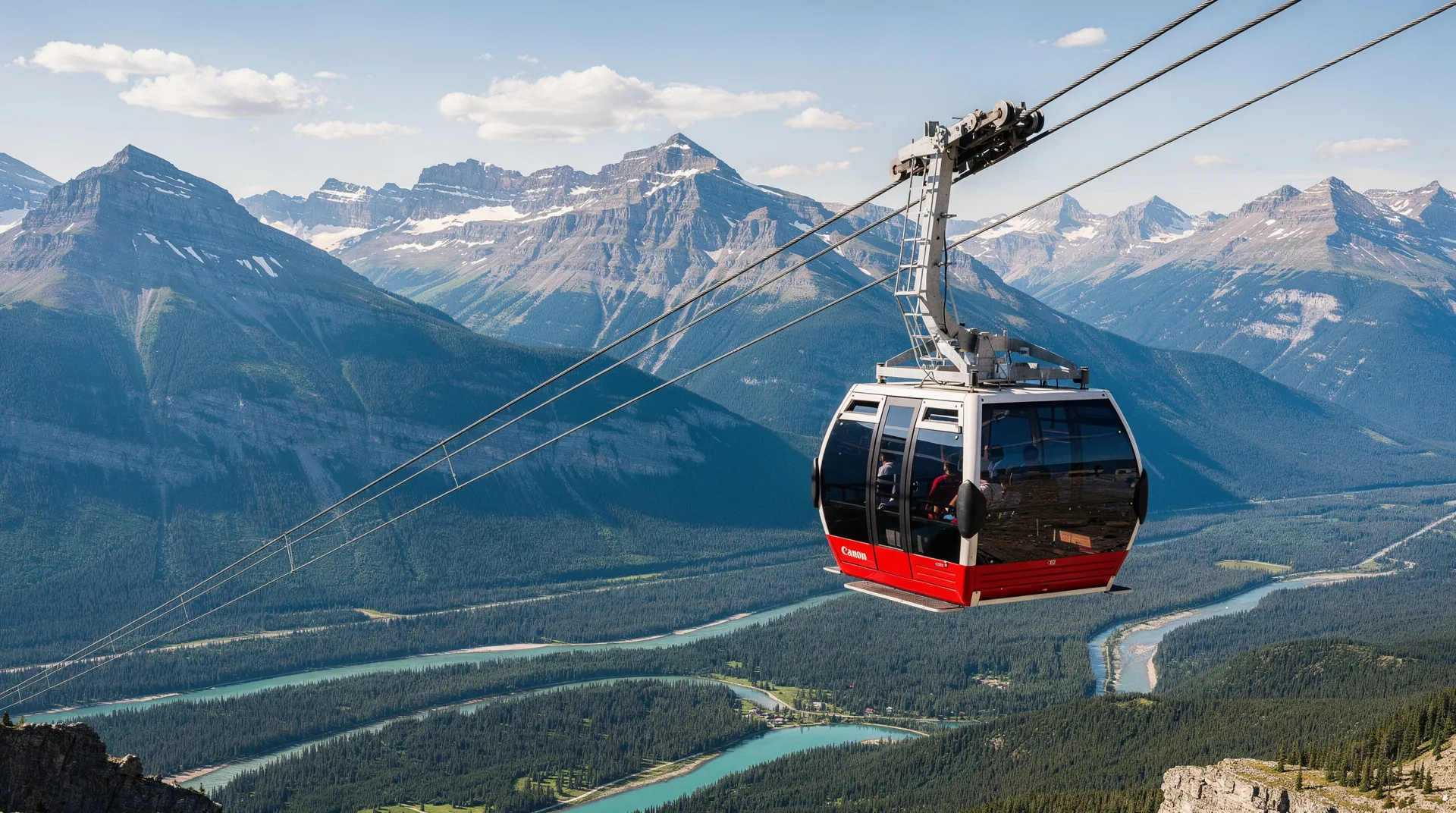
Banff Gondola: Sulphur Mountain summit guide
Is the Banff Gondola worth it?
Yes — the Banff Gondola rises 698 metres to Sulphur Mountain's summit in 8 minutes, delivering panoramic views over the entire Bow Valley and surrounding ranges. The summit boardwalk, Cosmic Ray Station National Historic Site, and optional hike to Sanson Peak make it one of the most rewarding easy mountain experiences in the Canadian Rockies.
At a glance
| Where | Banff Gondola base station, Mountain Avenue, 3 km from Banff townsite |
| Cost | Around CAD 70-80 for adults, CAD 40-50 for youth (6-15); not covered by a Parks Canada Discovery Pass |
| Time needed | 2-3 hours including the ride, boardwalk, Sanson Peak, and summit facilities |
| Getting there | 5-minute drive/taxi or 30-minute walk from Banff town; Roam Transit route 1 also serves the base |
| Best time | Early morning (8-10am) for light and low crowds, or sunset for the colour transition over the valley |
The Banff Gondola is one of the most visited attractions in the Canadian Rockies, and it earns that status. In eight minutes, a fully enclosed gondola cabin lifts passengers 698 vertical metres from the Banff Upper Hot Springs area (1,583 m) to the summit ridge of Sulphur Mountain (2,281 m), where a panoramic boardwalk and observation decks provide a 360-degree view over the Bow Valley, Spray Valley, and the mountains that form the heart of Banff National Park.
The view from the summit is genuinely extraordinary. To the north, the Bow Valley stretches toward Lake Louise with ranks of peaks rising on both sides. The town of Banff sits 698 metres directly below, reduced to a grid of streets and the distinctive spire of the Fairmont Banff Springs. Mount Rundle’s tilted strata dominate the east. Mount Norquay rises immediately to the north. And to the west and south, range after range of the front and main ranges extend to the horizon. On clear days, the visibility is essentially limitless.
What to do at the summit
Summit boardwalk and observation decks
The summit of Sulphur Mountain is accessed from the upper gondola terminal via a 1-km elevated boardwalk constructed in 2014. The boardwalk traverses the ridge connecting the gondola terminal to Sanson Peak (the highest point of Sulphur Mountain at 2,451 m), with observation decks positioned along the route for photography and viewing.
The boardwalk is exposed to wind and weather — the summit is typically 5–8°C colder than Banff town and subject to brisk winds. Bring layers regardless of the valley temperature. The views from the boardwalk’s various angles are different enough to reward walking its full length rather than stopping only at the first deck.
Sanson Peak and the Cosmic Ray Station
At the end of the boardwalk, Sanson Peak is a National Historic Site. The Cosmic Ray Station here was operated from 1903 to 1981 by the Dominion Observatory and later by the National Research Council. The station collected continuous meteorological data for nearly 80 years and contributed to the understanding of cosmic ray physics. The original stone observation building has been restored and is accessible to visitors.
Norman Sanson, the Banff meteorologist after whom the peak is named, climbed Sulphur Mountain over 1,000 times between 1896 and 1931 to take weather readings at the summit station — often in conditions that would deter most modern outdoor enthusiasts. The plaque commemorating his service is one of the more remarkable statistics in Parks Canada’s historical record.
The Sanson Peak summit (2,451 m) itself is the highest point accessible on the gondola + boardwalk route and the most rewarding photography platform — the additional elevation above the gondola terminal gives a slightly wider view in all directions.
Summit restaurant and facilities
The Banff Gondola’s upper terminal building contains a restaurant and café at the summit, with floor-to-ceiling windows facing the Bow Valley. The restaurant serves breakfast, lunch, and dinner; the café offers lighter snacks and hot drinks. Dining at 2,281 metres with a panoramic mountain view is not the cheapest meal option in Banff, but the setting is unmatched.
Gift shop, interpretive displays, and washroom facilities are all located in the upper terminal. The gondola operates year-round; the summit facilities are open daily.
Hike up Sulphur Mountain (optional)
Sulphur Mountain can be reached on foot via the Sulphur Mountain hiking trail — a 5.5 km trail gaining 655 metres from the trailhead near the Banff Upper Hot Springs. The hike takes approximately 2–2.5 hours up at a moderate pace and is accessible to fit walkers. Many visitors hike up and ride the gondola down, or vice versa.
The trail climbs steadily through subalpine forest before emerging on the ridge below the gondola terminal. In late September and October, the larch trees along the upper section turn gold. In winter, the trail is snow-covered and requires microspikes or snowshoes.
Trail details:
- Distance: 5.5 km one way (hike up, gondola down) or 11 km return
- Elevation gain: 655 m
- Difficulty: Moderate
- Duration: 2–2.5 hours up; 1.5 hours down
- Trailhead: Banff Upper Hot Springs parking area
The option of hiking up and gondola-ing down removes the return trip effort while allowing you to earn the summit views. Factor in that gondola tickets are still required for the descent.
Best time to visit
Morning
Morning is the best time for photography — the sun rises over the mountains to the east and illuminates the Bow Valley below the gondola in the golden hour light. The gondola opens at 8am (check current season hours); arriving at opening gives the cleanest light and fewest crowds.
Morning in summer also gives the best chance of clear skies. Afternoon cloud builds frequently in the Rockies from late morning in summer — clear summit panoramas are more reliable between 8am and noon.
Sunset and evening
Sunset from the summit is extraordinary — the sun sets behind the mountains to the west, and the light transitions from gold to pink to deep blue across the ranges. The summit restaurant’s dinner seating with the sunset view is a popular romantic option; book ahead in summer. The gondola’s evening operating hours (until 8 or 9pm in summer season) allow for both dinner and sunset photography.
Winter
The gondola operates year-round, making Sulphur Mountain a winter experience that rivals summer in its own way. Snow-covered peaks, frost on the boardwalk railing, steam rising from the valley below, and the Banff townsite grid visible under its winter blanket create a dramatically different — and equally compelling — visual. Winter temperatures at the summit regularly reach -20°C or below; dress accordingly.
The combination of a Banff Gondola summit experience with a subsequent soak at the Banff Upper Hot Springs (directly at the gondola base) is the classic Banff winter afternoon sequence.
Tickets and booking
The Banff Gondola is operated by Pursuit Collection (the same operator that runs the Athabasca Glacier tours and the Glacier Skywalk on the Icefields Parkway):
- Adult ticket: Approximately CAD 70–80 per person (prices vary by season; higher in peak summer)
- Youth (6–15): Approximately CAD 40–50
- Children under 6: Free
- Parks Canada Discovery Pass: Does not cover the gondola (which is operated by a private concessionaire, not Parks Canada directly)
Booking in advance is strongly recommended in July and August — the gondola sells out completely on peak summer days. Booking online 1–2 weeks ahead secures your time slot and often slightly better prices than at the walk-up window.
Book a Banff full-day tour including the gondola, Lake Louise, and hot springsGetting to the gondola base
The Banff Gondola base station is located on Mountain Avenue, 3 km from Banff townsite centre — easily reached on foot in about 30 minutes up the Bow Falls trail and Mountain Avenue, or by car/taxi in 5 minutes. Paid parking is available at the base station (limited; can fill up on peak summer days).
Roam Transit’s route 1 runs from Banff town to the gondola base and the hot springs. The shuttle from the bus station in Banff town is the most practical option if you do not have a car.
For visitors coming from Calgary as part of a day tour, the gondola is a standard inclusion on guided Banff day tours from Calgary:
Book a small-group Banff day tour from Calgary including gondola and hot springsCombining with the Banff Upper Hot Springs
The Banff Upper Hot Springs — outdoor thermal mineral pools at 1,585 metres, open year-round — are located directly at the gondola base, a 5-minute walk from the upper cable car station. The classic pairing of a gondola summit ascent followed by a soak in the thermal pools is the most popular afternoon itinerary in Banff for good reason: the views from the pools of Mount Rundle across the valley, combined with the warmth of 38°C mineral water, creates a restorative experience perfectly suited to the mountain environment.
Towel and swimsuit rental is available at the hot springs. Admission is separate from gondola tickets (approximately CAD 16–20 per adult). The combination ticket (gondola + hot springs) is available and provides a small saving.
See the full Banff National Park guide for all activities in the park.
Photography tips for the summit
The summit of Sulphur Mountain provides several distinct photography scenarios:
Bow Valley panorama: The classic shot looking north over the town of Banff and down the Bow Valley. Morning light from the east illuminates the valley floor and the mountains on the western side of the valley. Use a wide-angle lens to capture the full panoramic sweep; a telephoto is good for compression shots of layered mountain ridges.
Town of Banff below: The grid of the Banff townsite 698 metres directly below makes for an excellent aerial-style composition. Best at any time of day but particularly good in late afternoon when the town begins to light up.
Boardwalk and railings: The elevated boardwalk with mountain backdrop creates good graphic compositions. Look for lines leading out to the mountain horizon.
Mountain goats: Sulphur Mountain’s summit area is prime mountain goat habitat — the animals regularly appear on the boardwalk and adjacent rocky terrain, apparently indifferent to humans. They are remarkably photogenic at close range.
Winter frost: In winter, the boardwalk railings and exposed surfaces accumulate hoarfrost crystals that catch the low light beautifully in the morning.
What to wear
The summit is consistently colder than the valley:
- In summer: light jacket is essential; the summit is 5–8°C cooler than Banff town and subject to wind
- In shoulder seasons (April–May, September–October): fleece or down jacket required; warm hat useful
- In winter: full cold-weather gear — temperature on the summit regularly reaches -20°C; the boardwalk is wind-exposed
Wind at the summit can make temperatures feel significantly colder than the thermometer reading. Even in a summer T-shirt day in Banff town, pack a jacket for the gondola.
Comparing the Banff Gondola to other Rockies viewpoints
The Banff Gondola is the most convenient panoramic summit in the Bow Valley, but it is not the only ticketed lift in the region. The Lake Louise gondola climbs into ski-area terrain and gives a different angle onto the lake and the Victoria Glacier. Further north on the Icefields Parkway, the Columbia Icefield area offers the Ice Explorer and Glacier Skywalk, a fundamentally different glacier-focused experience rather than a valley panorama. For hikers who want the view without paying for a lift ticket, the Tunnel Mountain trail out of Banff town climbs to a lower but free summit with strong Bow Valley views.
Where the gondola fits in a Banff itinerary
Most visitors slot the gondola into a half-day alongside the Banff Upper Hot Springs, or as one stop on a longer loop through Canmore and Kananaskis. If you are staying in Lake Louise rather than Banff town, budget extra driving time — the gondola base is roughly 45-60 minutes away by car. On a first visit to Banff, the gondola pairs naturally with a stop at the hot springs and an evening drive on the Bow Valley Parkway for wildlife.
Practical tips
Go early or at sunset to avoid peak crowds: The gondola is busiest between 10am and 3pm in summer. Early morning (8–10am) and late afternoon/evening are significantly less crowded and offer better photography light.
Gondola queue management: In peak summer, the queue for gondola boarding can be 30–60 minutes at the base station. Pre-purchased timed entry tickets help — choose an early morning time slot for the best conditions.
Allow 2–3 hours at the summit: The boardwalk, Sanson Peak, the interpretive displays, the restaurant, and photography all add up. Do not arrive on a tight schedule.
Weather changes fast: Clear mornings can cloud over by midday in summer. If the summit is in cloud when you arrive at the base, wait 30–60 minutes and check the summit webcam (visible on the Banff Gondola website) before booking the same-day ticket.
See our guides to the Banff ski resorts and Icefields Parkway for the broader Banff and Rockies experience.
Frequently asked questions about Banff Gondola: Sulphur Mountain summit guide
How long is the Banff Gondola ride?
The gondola ride takes approximately 8 minutes from the base station (1,583 m) to the upper terminal (2,281 m), covering a vertical rise of 698 metres. The cabins seat 8 passengers and have windows on all sides. The gondola operates continuously throughout the day with short intervals between departures.
Can I see wildlife from the gondola summit?
Yes — mountain goats are regularly seen on or near the boardwalk and on the rocky terrain around the summit. In summer, bighorn sheep sometimes appear on the slopes below the summit. The forest on the ascent contains squirrels and potentially bears (visible from the gondola in the right conditions). Eagle and hawk sightings from the summit are also possible. The mountain goat encounters at the boardwalk level are particularly memorable.
Is the Banff Gondola suitable for young children?
Yes — children of all ages are welcome and the gondola is fully enclosed and safe. The boardwalk is accessible (strollers are manageable on the flat sections, though parts of the boardwalk near Sanson Peak involve steps). The summit restaurant has children’s menu options. Very young children are free. The experience is popular with families.
Does the Banff Gondola operate in winter?
Yes — the gondola operates year-round, 365 days a year (weather permitting). Winter operation is from approximately 10am; summer hours begin at 8am. In severe weather or high winds, the gondola may close temporarily. Call ahead or check the website for same-day operating status in winter. The summit in winter is a spectacular but cold experience — dress for -20°C or below.
Is the hike up Sulphur Mountain worth doing instead of taking the gondola?
The hike (5.5 km, 655 m elevation gain) is worth doing if you have the fitness and time. The forest trail provides a different experience from the gondola — you earn the summit views, encounter different wildlife opportunities, and the transition from treeline to the open ridge is a satisfying moment. Many experienced Banff visitors combine the hike up with the gondola down to avoid the return descent. The hike takes 2–2.5 hours; the gondola 8 minutes. Both experiences have value.
What is the best month to visit the Banff Gondola?
The gondola is excellent year-round but the most popular periods are July–August (summer wildflower season, longest days) and September (fall colour in the valley, golden larches visible from the summit on the surrounding slopes, fewer crowds than peak summer). December through February offer the winter snow landscape and are far less crowded. April and May have variable conditions but often excellent visibility on cold clear days.
How does the Banff Gondola compare to the gondola at Lake Louise?
They are different experiences. The Lake Louise gondola (the Lake Louise Ski Resort’s gondola, accessible in summer as a sightseeing experience) rises to the ski area and is primarily a ski facility repurposed for summer viewing. The Banff Gondola is specifically designed and operated as a year-round sightseeing experience with purpose-built summit facilities (boardwalk, interpretive centre, restaurant). The views from Banff Gondola’s Sulphur Mountain summit over the town of Banff and the full Bow Valley are more dramatic than the Lake Louise ski gondola’s perspective.
Can I use a Parks Canada Discovery Pass for the Banff Gondola?
No. The gondola is operated by Pursuit Collection, a private concessionaire, not Parks Canada directly, so the Discovery Pass and daily park pass do not cover the ticket. You still need a valid park pass to enter Banff National Park itself, but the gondola ticket is a separate purchase.
How does the Banff Gondola compare to the Columbia Icefield attractions?
They are different types of experience. The Banff Gondola is a valley-panorama summit near town, reachable in minutes. The Columbia Icefield area, roughly three hours north on the Icefields Parkway, focuses on glacier access via the Ice Explorer and the Glacier Skywalk. Many visitors do both on the same trip, on different days.