Tunnel Mountain hike: Banff's most accessible summit
How hard is the Tunnel Mountain hike?
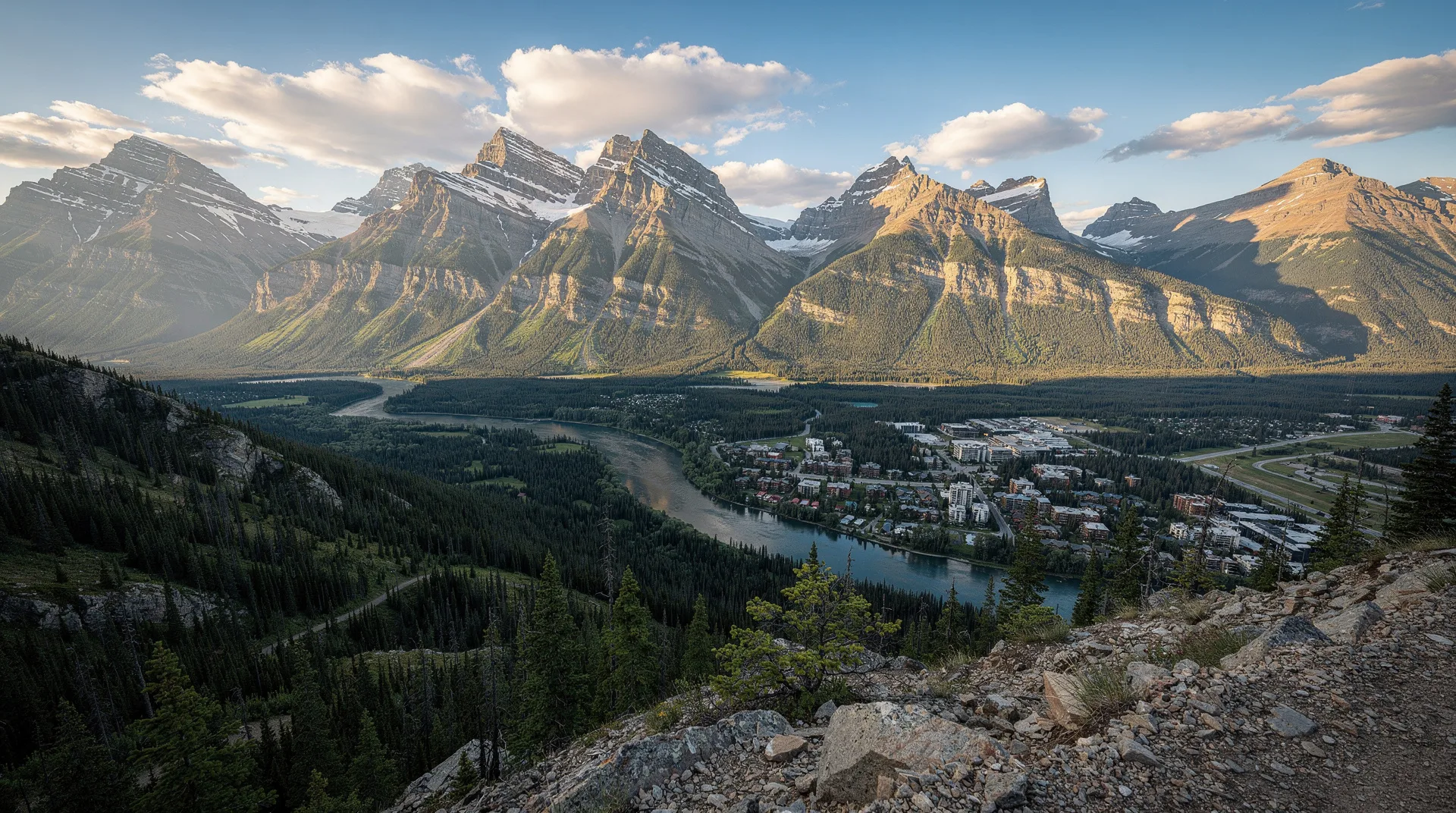
Tunnel Mountain is an easy-to-moderate 4.8 km return hike with 300 m elevation gain from Banff Town. Most hikers complete the round trip in 1.5–2.5 hours. The summit at 1,690 m offers excellent panoramic views over Banff Town and the Bow Valley — making it the best accessible summit hike for first-timers in Banff.
Tunnel Mountain is one of those hikes that overdelivers. For the modest investment of 300 metres of elevation gain and less than 5 kilometres of walking, it returns a genuine summit experience with panoramic views over Banff Town, the Bow Valley, and the surrounding peaks of Banff National Park. The trail begins within walking distance of Banff Avenue, requires no shuttle, no special preparation, and no significant fitness base — making it the most accessible summit hike in the entire national park.
For travellers spending a day or two in Banff who want to hike but aren’t ready for the commitment of longer trails like Lake Agnes Tea House or Larch Valley, Tunnel Mountain is the answer. For experienced hikers, it works perfectly as an early morning warm-up before tackling something more ambitious.
| At a glance | |
|---|---|
| Where | East edge of Banff Town, Banff National Park |
| Cost | Free trail — a Parks Canada park pass is required to enter Banff National Park by vehicle |
| Time needed | Around 1.5–2.5 hours return |
| Getting there | On foot from Banff Avenue (about 15 minutes to the lower trailhead) — no shuttle or car needed |
| Best time | Year-round; July–September mornings or September–October for fewer crowds |
Trail overview
Trailhead: Two access points — the lower trailhead is on St. Julien Road, a 15-minute walk from Banff Avenue; the upper trailhead is accessible from Tunnel Mountain Road near the campground Distance: 4.8 km return (from lower trailhead) Elevation gain: 300 m High point: 1,690 m Difficulty: Easy to moderate Duration: 1.5–2.5 hours return Trail surface: Well-maintained; rocky switchbacks in the upper section
Getting to the trailhead
Tunnel Mountain sits immediately east of Banff Town and the trail can be reached on foot from Banff Avenue. The most commonly used access is from St. Julien Road — walk east from downtown along Wolf Street to Otter Street, then follow signs to the trailhead (about 15 minutes from the main intersection of Banff Avenue and Wolf Street).
Parking is available at the Tunnel Mountain trailhead parking area and at pullouts along Tunnel Mountain Road for those arriving by car.
No shuttle is required, no Parks Canada shuttle booking is needed — this is a walk-from-town hike in every practical sense.
The hike
The trail begins through a brief section of Douglas fir forest before rising quickly via switchbacks up the south face of the mountain. The switchbacks are well-constructed, making the gradient manageable even for hikers who are not in peak condition.
At approximately 2 km (midway): The views begin to open over Banff Town to the west. The distinctive peaks of Mount Rundle (2,948 m) and Sulphur Mountain (2,451 m) come into view. The Bow River curves below through the valley floor.
Summit (2.4 km from lower trailhead): The summit is a broad, open ridge with excellent views in multiple directions. Looking west: Banff Town sits directly below, the Fairmont Banff Springs Hotel visible on its hill above the confluence of the Bow and Spray rivers. Beyond the town, the peaks of the Sundance Range and Mount Rundle dominate the view. Looking north: the Bow Valley opens toward Lake Louise; Mount Norquay’s ski terrain is visible across the valley. Looking south: Spray River Valley and the Sundance Canyon area.
The summit has a small rocky outcrop that serves as a natural viewpoint. It is an excellent place to sit for lunch, watch raptors soaring on thermals, and photograph the mountain panorama.
Why Tunnel Mountain is called Tunnel Mountain
The name has an unusual origin. During the construction of the Canadian Pacific Railway in the early 1880s, railway surveyors initially planned to route the line through the mountain via a tunnel. The tunnel was ultimately not built — a route around the mountain was chosen instead — but the name “Tunnel Mountain” stuck. The mountain is also known as Sleeping Buffalo Mountain in Stoney Nakoda tradition, reflecting its profile resembling a resting bison.
At 1,690 metres, Tunnel Mountain is one of the lower summits in the Banff area, which is precisely what makes it so accessible. The Banff Gondola ascends Sulphur Mountain to 2,281 metres, and most of the major hiking objectives in the park start above 2,000 metres.
Best time to hike Tunnel Mountain
Year-round accessibility: Tunnel Mountain is one of the few Banff hikes that is genuinely accessible in every month of the year. In winter, the trail may have compact snow and ice on the switchbacks — microspikes or traction devices are recommended for safety in icy conditions — but the hike remains passable and the snow-covered Bow Valley below is spectacular.
Summer: July and August mornings (7–9am) hit the trailhead before the main crowds. By mid-morning on summer weekends, the trail is busy.
Fall: September and October are excellent — the crowds thin noticeably after Labour Day weekend, the light is golden and warm, and the larches visible on nearby peaks begin to change colour.
Spring: The trail melts out early, typically by late April, making it a reliable option when higher trails are still snow-covered.
Sunrise and sunset hikes
Tunnel Mountain’s orientation (facing west) makes it outstanding for sunset photography. The town below is lit by warm afternoon light; the western peaks glow with alpenglow in the final minutes before sunset. In summer, sunset arrives late enough (9–10pm) that a post-dinner summit is entirely practical.
Early morning hikes catch the Bow Valley in soft dawn light before the crowds arrive — and Tunnel Mountain’s summit is a particularly pleasant spot for coffee from a thermos as the sun clears the eastern peaks.
Wildlife on Tunnel Mountain
Bighorn sheep are frequently seen on and around Tunnel Mountain, particularly on the rocky upper slopes. They are accustomed to hikers and may allow very close approach — maintain at least 30 metres distance and never feed them.
Elk are regularly seen in the meadows and forests at the base of the mountain, particularly in early morning. Elk can be aggressive during the autumn rut (September–October) and during spring calving — give them wide berth.
The Douglas fir forest on the lower slopes is good habitat for red squirrels, Steller’s jays, and various warbler species in summer.
Bear safety: Black bears and, more rarely, grizzly bears do move through the lower forested sections of Tunnel Mountain, particularly in spring and early summer when they feed on dandelions and buffaloberry. Carry bear spray, know how to use it, hike in a small group where possible, and make noise on blind corners. This is a much lower-risk trail than backcountry routes further into Banff National Park, but it is still bear country.
Park pass and practical logistics
Tunnel Mountain sits inside Banff National Park, so anyone arriving by vehicle needs a valid Parks Canada park pass displayed on the dashboard — a day pass or annual Discovery Pass, available at the park gates or online. Hikers walking straight from a downtown Banff hotel don’t need to buy anything extra to use the trail itself.
There are no facilities (water, toilets) at either trailhead or on the summit, so carry your own water — at least 1 litre per person is sensible even for this short hike, more on hot summer afternoons. Trail running shoes or light hikers are sufficient; the surface only turns properly rocky in the final switchbacks below the summit.
If you’re staying in Banff with kids or on a tight schedule, Tunnel Mountain is realistically doable as a morning outing before an afternoon at Lake Louise or a stop in Canmore on the way out of the park.
Fitting Tunnel Mountain into a Banff itinerary
Because the trail starts almost in town, it slots into a Banff day without any logistics. On arrival day it is a gentle way to stretch the legs after a long drive from Calgary and to get your bearings: from the summit you can pick out the main streets, the river and the big peaks you will be chasing over the following days. If you are building a longer stay, the 3-day Banff itinerary and the 5-day Banff itinerary both leave room for a short morning hike like this one.
Tunnel Mountain also pairs well with the town’s other classic experiences. A morning on the summit followed by an afternoon at the Banff Upper Hot Springs is a very natural combination, since warm water is exactly what tired legs want. Others prefer to go up in the evening and ride the Banff Gondola another day, using the two viewpoints to compare Sulphur Mountain with the view from the other side of the valley. For a wider look at what the area offers, the Banff National Park guide lays out the main areas and activities. If you would rather join an organised excursion on a rest day, you can compare guided tours across Canada before booking.
What to bring and how to dress
Mountain weather changes quickly, even on a short walk from town. The lower forest can feel sheltered and warm while the open summit ridge is windy and noticeably cooler, so a light windproof layer is worth carrying in every season. Sun protection matters too: the upper switchbacks are exposed, and a hat and sunscreen make the final stretch more comfortable on clear days.
Good grip is more important than technical gear. Light hiking shoes or sturdy trail runners handle the rocky upper section, and trekking poles can help some hikers on the descent, when switchbacks are hardest on the knees. A small snack, a camera or phone for the panorama, and your bear spray complete the kit. If you are still working out what to pack for the rest of your trip, the Canada packing list covers clothing for the mountains in every season.
Taking it slowly: tips for first-time mountain walkers
If you have never hiked uphill for an extended stretch, the trick is pacing. Start slower than feels necessary, keep a rhythm you could hold a conversation at, and take short breaks at the points where the views open rather than pushing through. The reward of a viewpoint is a good excuse to stop, drink water and let your heartbeat settle.
Remember that Banff sits at altitude, so visitors arriving from sea level may feel the effort a little more than usual on the first day. Give yourself a generous time allowance, and treat the descent with the same care as the climb: loose stones on the switchbacks are the most common cause of twisted ankles. Staying on the marked trail also protects the slope vegetation, which recovers slowly. Our Canadian wildlife safety guide explains how to behave around animals you may meet on the way, and the Banff in October guide helps if you are planning a visit when the days are shorter and the air is crisper.
More Banff hikes once you have the taste for it
Many people finish Tunnel Mountain wanting something bigger. The natural next steps in the area are the Lake Agnes Tea House hike near Lake Louise, the Johnston Canyon walk, or the climb described in the Sulphur Skyline trail guide for a steeper challenge above the town. The Lake Louise hikes overview is a good place to compare options, and the Grassi Lakes hike in Canmore is another gentle outing with a rewarding payoff. If you want to see how Banff stacks up against its neighbours before deciding where to base yourself, read Banff versus Jasper.
Comparing Tunnel Mountain to other beginner Banff hikes
| Hike | Distance | Elevation | Time | What you see |
|---|---|---|---|---|
| Tunnel Mountain | 4.8 km | 300 m | 1.5–2.5 hrs | Banff Town, Bow Valley panorama |
| Sundance Canyon | 7.4 km | 100 m | 2–3 hrs | Canyon walls, falls |
| Johnston Canyon (Upper Falls) | 5.4 km | 215 m | 2–3 hrs | Canyon catwalks, falls |
| Fenland Trail | 2 km loop | Flat | 30–45 min | Wetlands, birdlife |
| Bow River Trail | 6 km return | Flat | 1.5–2 hrs | Riverside scenery |
Tunnel Mountain is unique in this group because it provides a genuine summit experience — you stand on top of something — rather than a canyon or riverside walk. For hikers who want to feel the accomplishment of reaching a high point, it is the best beginner option in the Banff townsite area.
Continuing beyond Tunnel Mountain
The summit area has a connecting trail that continues north along the ridge before descending toward the Tunnel Mountain campground and eventually rejoining Tunnel Mountain Drive. This creates a loop option (approximately 7 km total) for those who want variety on the descent.
From the summit, the best next step for hikers wanting more is to add the Bow River Loop for a flat riverside walk, or, if time and fitness allow, drive to Johnston Canyon for the afternoon — combining the easy summit of Tunnel Mountain with the canyon walk makes an excellent full first-hiking day in Banff.
Book a Banff sightseeing and hiking day tourFrequently asked questions about Tunnel Mountain hike
Do I need a permit or reservation to hike Tunnel Mountain? No permit or reservation is required for the trail itself. If you drive to the trailhead, your vehicle needs a valid Parks Canada park pass for Banff National Park.
Can I hike Tunnel Mountain with young kids? Yes — it’s one of the more manageable summit hikes in the park for families, though the switchbacks are steady uphill the whole way. Budget extra time for rest stops and see the Banff with kids guide for more family-friendly options nearby.