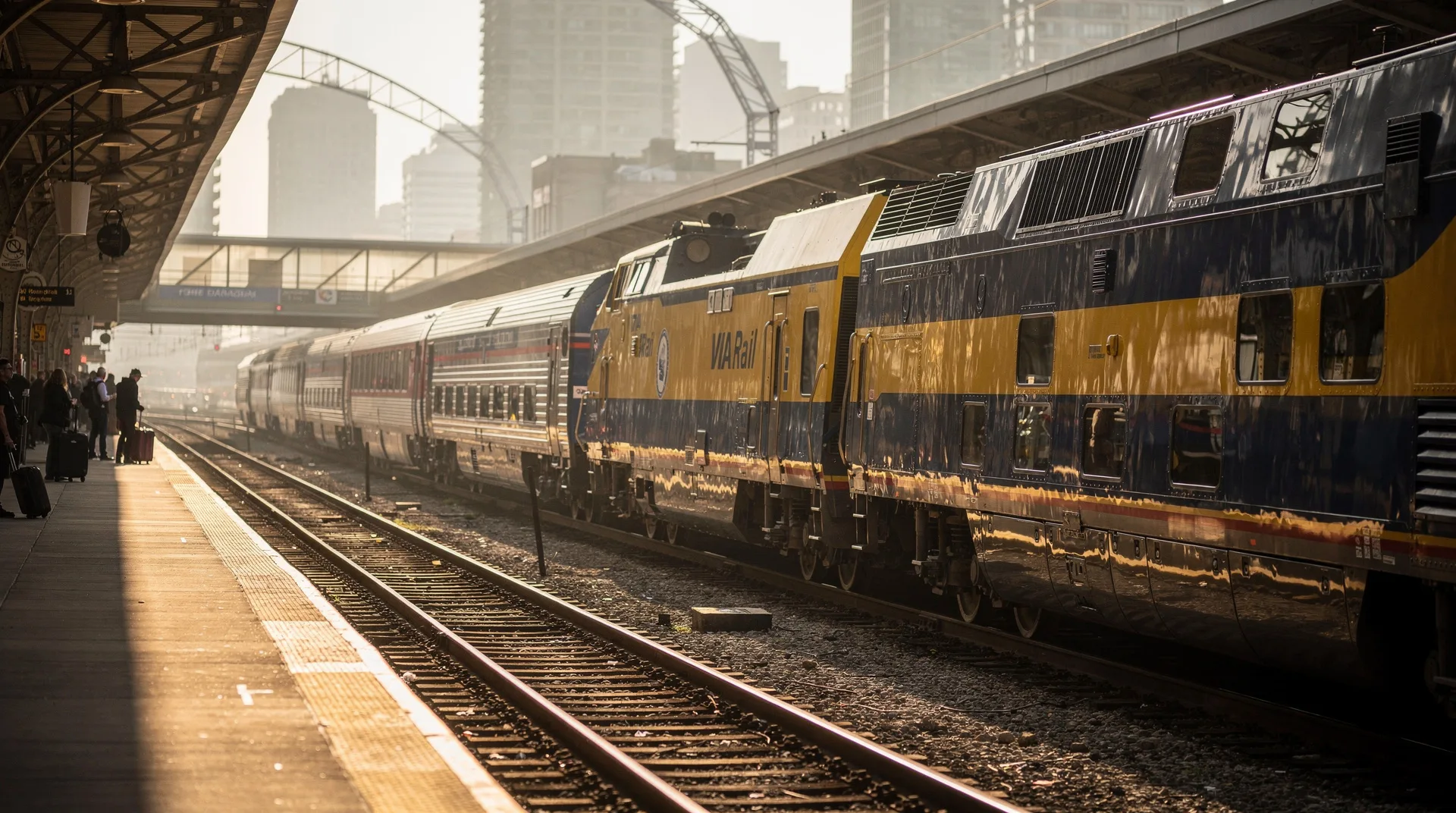
VIA Rail Canada Rail Pass guide
What is the VIA Rail Canada Rail Pass?
The VIA Rail Canada Rail Pass gives you a set number of one-way trips on the VIA Rail network within a 60-day validity window. It can offer savings for travellers planning several VIA Rail journeys. VIA Rail has changed its pass offer, so check the current pass and fares on viarail.ca.
The VIA Rail Canada Rail Pass is one of the better-kept secrets in Canadian travel planning. For visitors building an itinerary that includes multiple train journeys — say, Toronto to Montreal, Montreal to Quebec City, and then the transcontinental Canadian to Vancouver — the pass provides a cost-effective single purchase rather than three separate tickets. The mathematics work clearly in the right circumstances, and understanding those circumstances is the key to using the pass well.
| At a glance | |
|---|---|
| Covers | VIA Rail trips only (not Rocky Mountaineer, White Pass, Ontario Northland) |
| Cost | See current prices on viarail.ca |
| Validity | A fixed number of one-way trips within a 60-day window |
| Best for | 4+ separate VIA Rail journeys across regions |
| Buy | viarail.ca, station counters, or international rail agents |
This guide covers the pass formats, where to check current pricing, how to use it, which journeys are worth counting toward the pass, and the significant limitations you need to understand before buying. It also explains how the pass interacts with the Rocky Mountaineer (it doesn’t — they are entirely separate operators) and how to build a multi-destination Canada rail itinerary using the pass as its foundation.
What the Canada Rail Pass is and what it is not
The Canada Rail Pass covers VIA Rail journeys only. VIA Rail is Canada’s national passenger rail service, covering routes across Ontario, Quebec, the Atlantic provinces, and the transcontinental route to Vancouver via Winnipeg, Saskatoon, Edmonton and Jasper. It does not cover the Rocky Mountaineer (separate private operator), the White Pass and Yukon Route (Alaska-based, separate company), or Ontario Northland services like the Agawa Canyon Tour Train and Polar Bear Express.
The pass provides a fixed number of one-way trip segments within a 60-day validity window. A single one-way journey from Toronto to Vancouver on the Canadian counts as one trip. A journey from Toronto to Montreal also counts as one trip. The pass makes no distinction between a 5-hour corridor ride and a 4-day transcontinental crossing — both use one trip credit.
This is the core calculation that determines whether the pass saves you money. If you are planning the Toronto–Vancouver transcontinental as your sole long VIA Rail journey, the pass is not worthwhile — a single direct purchase will cost less. If you are building a network of multiple journeys, the economics shift.
Pass formats and pricing
VIA Rail has changed its pass offer over time, and the structure and prices below can no longer be confirmed here. Check the current pass and fares on viarail.ca before planning around any of this. The pass has been offered in three trip-count configurations:
7-trip pass
- Price: see current prices on viarail.ca (high and low season rates have applied)
- Best suited to: Travellers combining Eastern Canada corridor rides with the transcontinental
- Maximum value scenario: Mix of Corridor (Toronto-Montreal-Quebec City area) and one transcontinental segment
10-trip pass
- Price: see current prices on viarail.ca
- Best suited to: Complex itineraries with multiple regions of Canada
- Maximum value scenario: Atlantic Canada, Ontario/Quebec corridor, transcontinental
15-trip pass
- Price: see current prices on viarail.ca
- Best suited to: Extended Canada rail itineraries over the full 60 days
- Maximum value scenario: Atlantic loop, Quebec City, Toronto, Winnipeg, Jasper, Vancouver
Note: Prices and pass structure change over time. Always verify the current pass and fares at viarail.ca before making a purchase decision.
Children and youth pricing
VIA Rail offers reduced fares and discount cards for children, youth, students and seniors. Eligibility and discount levels change, so see the current discounts on viarail.ca.
How to calculate whether the pass saves money
The break-even calculation is straightforward: compare the cost of buying all planned trips individually against the pass price for the number of trips included.
Sample itinerary calculation
Suppose you are planning the following VIA Rail journeys:
- Toronto to Ottawa (corridor): regular economy
- Ottawa to Montreal (corridor): regular economy
- Montreal to Quebec City (corridor): regular economy
- Toronto to Vancouver (Canadian, Sleeper Plus Roomette)
Add up the current individual fares for these journeys on viarail.ca, then compare the total with the current pass price. A 7-trip pass with a Sleeper Plus surcharge for the transcontinental would need to be compared carefully. The pass covers the trip credits; for sleeper accommodation on the Canadian, a reservation fee is charged separately on top of the pass (see below).
The pass calculation becomes clearly favourable when you are mixing 4–6 corridor journeys with a transcontinental sleeper — the corridor journeys are free in effect, and the transcontinental’s accommodation surcharge on the pass can be cheaper than the full fare.
Important: The pass covers the base transportation fare. For Sleeper Plus and Prestige class on trains like the Canadian, an accommodation surcharge is added on top of the pass — this covers the actual sleeper room cost. Economy travel is included in the pass with no surcharge.
Booking with a Canada Rail Pass
The reservation requirement
Holding a pass does not guarantee you a seat or sleeper room. Each journey still requires a reservation, made through VIA Rail’s booking system. Reservations with the pass are free (unlike some European rail passes) but must be made for each segment.
For the transcontinental Canadian in sleeper class, the reservation process includes selecting your accommodation type (Roomette, Bedroom, Prestige). The accommodation surcharge at time of reservation reflects the cost of the room minus the base transportation fare covered by the pass.
Advance booking rules
The booking window and reservation rules for pass holders are set by VIA Rail, so check them on viarail.ca. For July–August transcontinental sleepers, making reservations as soon as possible after purchasing the pass is essential — sleeper accommodation sells out regardless of how you are paying for the base fare.
Blackout dates
Passes have carried blackout dates around major holidays. The current dates are not confirmed here, so check the blackout rules on viarail.ca before planning a holiday-weekend trip; the booking system flags any conflict when you make a reservation.
Best VIA Rail routes to combine with the pass
The transcontinental Canadian (Toronto–Vancouver)
The centrepiece of most pass-based itineraries. One trip credit on the pass covers the full 4-day, 4,466-km journey from Toronto to Vancouver (or any segment thereof). The mountain section through Jasper is the scenic highlight. See our VIA Rail Canadian guide for full route detail.
At economy class, the transcontinental journey is covered entirely by the pass with no surcharge. At Sleeper Plus, the accommodation surcharge depends on room type, season, and availability (see current fares on viarail.ca) — added to your pass cost.
The Ocean (Montreal to Halifax)
A dramatic 22-hour overnight journey from Montreal through New Brunswick and Nova Scotia to Halifax. The Bay of Fundy coastline section is spectacular; the train passes through Sackville and the Tantramar Marshes near tidal flat landscapes unique on the continent. This route and the transcontinental together form the two great VIA Rail scenic journeys.
Halifax is the Atlantic Canada gateway — connected to Cape Breton, PEI and the Bay of Fundy by road once you arrive. Including the Ocean in a pass-based itinerary adds significant value and extends the trip into a part of Canada most international visitors miss.
The Corridor (Toronto–Montreal–Ottawa–Quebec City)
VIA Rail’s high-frequency corridor service connects Canada’s major Eastern cities multiple times per day. Individual corridor tickets are comparatively inexpensive (see current fares on viarail.ca) — which means the pass’s value on corridor rides is lower in absolute dollar terms. However, if you are riding the corridor four or five times as part of an Eastern Canada trip before or after a transcontinental, those rides add meaningful pass value.
Corridor trains are modern, fast, and comfortable. The Toronto–Montreal run is 5 hours; Montreal–Quebec City is 3 hours. These are practical travel tools as much as scenic experiences, but the Montreal–Quebec City section through the St Lawrence valley has genuine beauty.
Jasper to Prince Rupert (Skeena route)
An underrated gem of the VIA Rail network. The Skeena runs from Jasper to Prince Rupert, BC, on a route that covers 1,160 km of wilderness in 2 days (with an overnight stop in Prince George). The train follows the Bulkley and Skeena river valleys through the Hazelton Mountains and the Coast Range to the Pacific coast at Prince Rupert.
Prince Rupert is the departure point for BC Ferries to the Haida Gwaii islands and for the Alaska Marine Highway ferry to Southeast Alaska — making it a natural junction for extended Pacific Coast itineraries. The Skeena route is one of the most consistently underrated scenic rail experiences in Canada and pairs naturally with the transcontinental Canadian for a western Canada rail loop.
One trip credit on the pass covers Jasper to Prince Rupert. This segment alone, at individual ticket prices (see current fares on viarail.ca), represents significant pass value.
The Corridor Maple Leaf (Toronto to New York, shared VIA/Amtrak)
Note that the Maple Leaf — VIA Rail’s joint service with Amtrak running from Toronto to New York City — does accept the Canada Rail Pass for the Canadian portion (Toronto to Niagara Falls). The Amtrak portion requires a separate ticket or Amtrak Pass. This is a useful connector for travellers arriving in the US and crossing into Canada or vice versa.
Pass vs individual tickets: when each makes sense
Buy the pass when:
- You are planning 4 or more separate VIA Rail journeys
- Your itinerary includes both the transcontinental Canadian and the Corridor
- You want flexibility to add or change journeys without rebooking individual tickets
- You are travelling off-peak in low season (pass pricing has been lower outside peak season; check viarail.ca)
- You are including the Ocean (Montreal–Halifax) in your itinerary
- Your itinerary includes the Skeena (Jasper–Prince Rupert) route
Buy individual tickets when:
- You are taking only 1–2 VIA Rail journeys
- Your only long journey is the Toronto–Vancouver transcontinental
- Your travel dates include multiple blackout periods
- You want to maximise flexibility with individual Escape fares (pass holders cannot use Escape fares)
- You are booking very far ahead and the individual Escape fares are available at lower prices than the pass-implied cost
The Escape fare caveat
VIA Rail’s Escape fares — promotional prices released periodically on specific dates — can be well below standard pricing. Pass holders cannot apply Escape fares or accumulate them. For travellers who are flexible about exact travel dates and can monitor the Escape fare releases, individual tickets at Escape prices can undercut the pass’s economics significantly. The pass trades flexibility for convenience and predictable costs.
Combining the Canada Rail Pass with other travel
Rocky Mountaineer and the pass
The Canada Rail Pass does not cover the Rocky Mountaineer. These are entirely separate products from different companies. The typical integrated itinerary is:
- VIA Rail (pass): Toronto to Jasper (transcontinental Canadian)
- Rocky Mountaineer (separate booking): Jasper/Banff to Vancouver
- Flights or VIA Rail (pass): Vancouver departure or onward
In this structure, the pass covers the transcontinental section and the Rocky Mountaineer is booked independently. The combination provides the full Canada rail experience: the authentic transcontinental journey and the curated luxury mountain scenery experience. See our Rocky Mountaineer vs VIA Rail comparison for guidance on prioritising.
Agawa Canyon and White Pass with the pass
Neither the Agawa Canyon Tour Train (Ontario Northland) nor the White Pass and Yukon Route accepts the Canada Rail Pass. These are separate operators with independent booking systems. Plan these as standalone purchases alongside your VIA Rail pass itinerary.
Browse Canada tours to pair with your VIA Rail itineraryPractical tips for pass holders
Carry your pass physically: While VIA Rail is moving toward digital systems, having the physical pass booklet and your passenger ID is the most reliable combination for reservation validation at station ticket counters.
Reserve immediately for summer transcontinental: On the day you receive your pass, log into viarail.ca and make your sleeper reservations for the Canadian. Sleeper accommodation sells out regardless of pass status — your pass does not jump any queue.
Track your trips: Each trip used is recorded by VIA Rail, but keeping your own log prevents confusion on long itineraries with multiple segments.
The 60-day window starts on your first travel day: Your pass validity period begins from the date of your first actual travel, not the date of purchase. You can buy the pass months ahead and begin using it when your trip starts.
Ticket counter vs online: Some complex pass bookings (particularly those involving accommodation surcharges and multiple segments) are easier to complete at a VIA Rail station ticket counter than online. Station staff can also advise on the best pass format for your itinerary if you call ahead.
Where to buy the Canada Rail Pass
The Canada Rail Pass is sold directly through VIA Rail (viarail.ca) and through a network of international rail booking agents including Rail Europe, RailPass, and some Canadian travel agencies. Prices are typically the same regardless of purchase channel.
For non-Canadian residents, purchasing through Rail Europe or a dedicated rail pass broker may be convenient if you are already buying Eurail or other passes for a multi-continent itinerary.
Building a pass-based itinerary around the Rockies
Most travellers who buy the pass are using it to reach Banff National Park or Jasper by rail rather than flying and renting a car. If the transcontinental Canadian is one leg of a wider Rockies trip, it’s worth reading our Banff vs Jasper comparison before finalising which stops to build the itinerary around — the pass makes it easy to add both without extra ticket purchases. For the sleeper-vs-flight tradeoff on the long crossing specifically, our coast to coast train vs drive guide walks through the realistic time cost. Once you are off the train, guided tours across Canada are an easy way to cover the stops that rail does not reach.
Comfort and realistic expectations on long segments
Sleeper Plus rooms are compact — a Roomette suits one traveller comfortably or two who don’t mind close quarters; a Bedroom is better for couples on the multi-night Canadian. Meals are included with sleeper accommodation and are genuinely good, but dining car seating is shared, which is part of the appeal for solo travellers (see our Canada solo travel guide for more on this). Wifi on board is limited to non-existent through the Prairies and Rockies — plan to be offline for stretches.
Frequently asked questions about VIA Rail Canada Rail Pass guide
How many trips does the transcontinental Canadian use?
One trip credit, regardless of the number of days or the distance. Toronto to Vancouver is one trip. Vancouver to Jasper is also one trip. Trip credits are used per boarding, not per distance.
Can I use the pass in both directions on the same route?
Yes. If you ride Toronto to Vancouver (one trip) and then Vancouver back to Toronto (second trip), that uses two trip credits. There is no restriction on using segments in either direction.
Is there a rail pass for just the Rocky Mountaineer?
No. The Rocky Mountaineer does not offer a pass product. It is booked as individual journeys. See our Rocky Mountaineer booking guide for how to approach Rocky Mountaineer pricing and itinerary options.
Does the pass include Via Rail’s luxury Prestige class?
Yes, with an accommodation surcharge. The pass covers the base transportation fare; Prestige class requires an additional accommodation surcharge that reflects the premium room cost above economy travel.
Can international visitors buy the Canada Rail Pass?
Yes. The Canada Rail Pass is available to anyone, including international visitors. There is no Canadian residency requirement. Purchase through viarail.ca or an international rail booking agent.
What happens if I miss a reserved train?
If you miss a reserved departure, your trip credit is forfeited unless you contact VIA Rail before the departure to change the reservation. Policies vary — contact VIA Rail as early as possible if your plans change.
Can I carry the pass on my phone?
VIA Rail is progressively moving toward digital passes. Check the current status at viarail.ca; the system may have changed since this guide was last reviewed. Even with a digital pass, carrying identification is required.
Is the pass available at Canadian railway stations?
Yes. You can purchase the pass at major VIA Rail station ticket counters. However, purchasing in advance gives you more time to make reservations before sleeper accommodation sells out.
Does the pass work well for a Rockies-focused trip?
Partially. It covers the transcontinental Canadian to Jasper or onward to Vancouver, which is a strong way to reach the Rockies, but once there you’ll still need a car or shuttle for Banff and Lake Louise — VIA Rail does not run within the park network itself.
Can I mix the pass with one-way flights?
Yes. Many travellers fly one direction (often into or out of Vancouver or Halifax) and use the pass for the rail portion, which avoids doubling back and keeps the trip credits focused on scenic segments rather than repeat journeys.