Quick facts
- Located in
- Banff National Park, Bow Summit, Icefields Parkway
- Best time
- Late June to September
- Getting there
- 40 km north of Lake Louise on Icefields Parkway
- Days needed
- 1-2 hours at the viewpoint
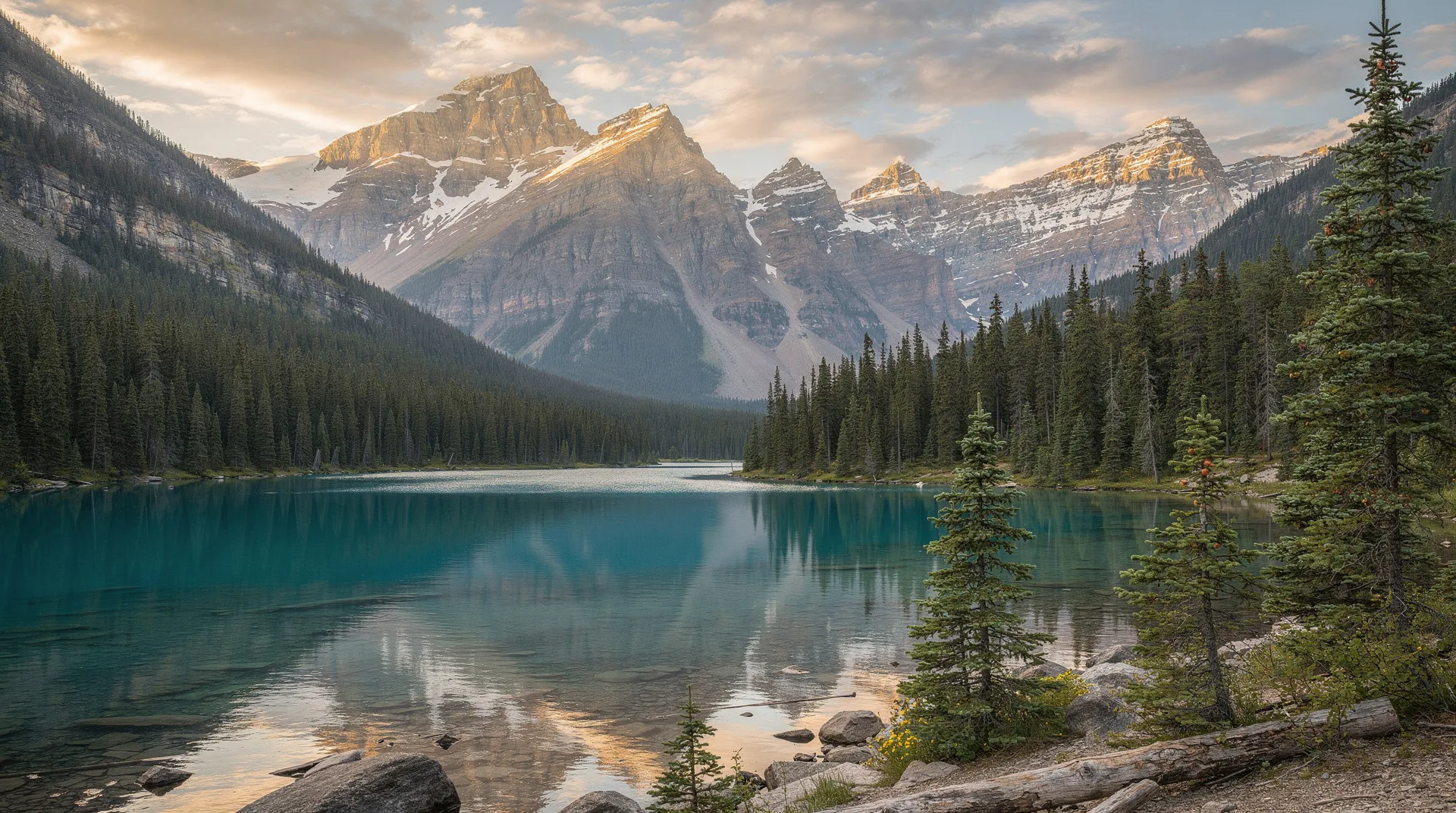
There is a particular moment at the Bow Summit viewpoint when a gap in the spruce trees reveals the lake below — a vivid turquoise shape, wolf-like in outline, filling the valley floor 400 metres beneath the viewpoint ridge. The colour is not what most photographs prepare you for: deeper, more electric, more implausibly blue-green against the surrounding grey limestone. Peyto Lake is the single most visually dramatic viewpoint on the Icefields Parkway, and arguably the most photographed single view in the Canadian Rockies after Moraine Lake.
The lake is named for Bill Peyto, a Banff guide and park warden who reportedly camped at the lake in the 1890s and whose name now attaches to the lake, a peak, and one of Lake Louise’s best-known cafés. Peyto Lake sits at 1,860 metres; the viewpoint at Bow Summit is at 2,090 metres — the highest point on the Icefields Parkway.
| At a glance | |
|---|---|
| Where | Bow Summit, Icefields Parkway, Banff National Park |
| Cost | A Parks Canada park pass is required (day pass or Discovery Pass); the viewpoint itself has no separate fee |
| Time needed | 1-2 hours including the walk from the parking lot |
| Getting there | Self-drive, 40 km / around 30-35 minutes north of Lake Louise |
| Best time | Late June-mid-July for peak colour; early morning for light and space |
Getting to the viewpoint
By car: Peyto Lake is located at Bow Summit, 40 km north of Lake Louise on the Icefields Parkway (Highway 93 North). The parking area (which fills by mid-morning on peak summer days) is at Bow Summit — the highest point on the parkway. The signed trail to the viewpoint begins at the parking lot.
A Banff National Park pass is required — either a daily permit or the annual Discovery Pass. Purchase before reaching the Bow Summit stop.
Distance from Lake Louise: 40 km, approximately 30-35 minutes on the parkway.
Distance from Banff town: 78 km, approximately 65 minutes.
Distance from Jasper: 190 km, approximately 2 hours.
The viewpoint trail
Distance: 1.2 km one-way to the main viewpoint (2.4 km return)
Elevation gain: 100 m
Time: 20-30 minutes one-way; 45-60 minutes return
Difficulty: Easy-moderate — well-maintained boardwalk and gravel trail with some elevation
The trail from the Bow Summit parking area is boardwalked for the upper section (through a recovering area of dwarf krummholz forest damaged by previous visitor pressure) and becomes a gravel path for the descent to the main viewpoint platform. The platform itself, rebuilt with improved sight lines, provides the classic wolf-head panorama: the lake’s outline, the surrounding valley, the Caldron Peak and surrounding mountains above, and the Peyto Glacier visible at the lake’s western end on clear days.
Extended viewpoint (Bow Summit loop): From the main platform, a further 0.8 km of trail continues to a higher viewpoint that provides a different angle on the lake and a wider mountain panorama. This extension is moderately steep and less well-maintained than the main viewpoint trail, but the view from the top is worth the additional 30 minutes.
Photography platform: The main viewpoint has a raised platform designed specifically for photography. Arrive before 8am in summer to have any chance of space on the platform without queuing. By 10am, the platform is typically crowded.
When the colour is best
Peyto Lake’s colour — like all glacially fed Rockies lakes — comes from glacial rock flour suspended in the meltwater that feeds it from the Peyto Glacier above. The colour is most intense when rock flour concentration is highest: late June through mid-July, at peak melt.
Late June to mid-July: Maximum colour intensity. The lake is most electric in this window; photographs from early July regularly show the most vivid blues and greens. The trade-off: early season means the upper trail sections may have residual snow, and the upper extended viewpoint loop may be icy.
August: Still excellent colour, but slightly less vivid than peak melt season. Crowds reach their maximum; parking can be extremely difficult without an early arrival.
September: Colour moderating, but still beautiful. Crowds reduce noticeably after Labour Day. The Bow Summit area in late September may have early snow on the peaks; the larch trees at lower elevations begin turning gold.
May and early June: The Bow Summit area at 2,090 metres retains snow well into June. The lake may still be partially ice-covered in early June. The parkway is open but Bow Summit conditions require winter footwear for the trail.
Early morning vs. midday
Early morning (6-8am): The parking lot has available spaces. The viewpoint is quiet or empty. The lake below may be in shade as the sun rises behind the peaks to the east, but the upper peaks catch the first light and glow. Calm air means the lake surface is still.
Midday (10am-2pm): The parking lot is full or overflowing. The viewpoint is packed. The lake is in direct sun — good for colour saturation but harsh for photography. The crowds at the main platform make tripod photography impractical.
Late afternoon (4-6pm): Crowds reduce as day visitors move on. Light is warming. Longer shadows begin to create texture in the mountain terrain.
The practical answer is simple: arrive before 8am or after 4pm if at all possible.
Browse Icefields Parkway and Banff guided sightseeing toursPhotography guide
Wide angle (14-24mm equivalent): The classic panorama from the main platform. Captures the full lake outline, the surrounding valley walls, and the sky. Use a polarising filter to reduce water surface glare and deepen the turquoise.
Mid-range zoom (35-85mm): Isolating the lake’s wolf-head outline from the surrounding landscape; removing the sky to focus on colour and form.
Telephoto (100-200mm): The Peyto Glacier at the lake’s western end is visible from the extended upper viewpoint on clear days. A telephoto lens allows pulling the glacier into the frame with the lake below.
Composition notes: The most memorable Peyto Lake photographs include foreground interest — the krummholz forest, wildflowers in July, or rocky terrain — to provide depth. Pure lake-only compositions (without foreground) can look flat. The elevated viewpoint and the lake’s wolf-head outline are so distinctive that the image reads well in almost any composition, but foreground elements elevate it.
Peyto Lake by month
| Month | Colour | Crowds | Notes |
|---|---|---|---|
| May-early June | Muted, partly frozen | Low | Trail may need winter footwear at 2,090 m |
| Late June-mid-July | Peak turquoise | High | Best colour; some residual snow possible early on |
| August | Very good | Highest | Parking lot fills earliest of the year |
| September | Moderating | Lower after Labour Day | Larches turning gold at lower elevations |
| October-April | Faded/frozen | Minimal | Many parkway services close for winter |
What else is at Bow Summit
Bow Lake: 6 km south of Bow Summit on the parkway, Bow Lake is a large glacial lake at the base of the Crowfoot Glacier — the source of the Bow River, which flows through Banff and Calgary before joining the South Saskatchewan River. Num-Ti-Jah Lodge (a historic backcountry lodge, now open to day visitors) sits on the north shore. A short lakeshore walk provides views of the Crowfoot Glacier above. Worth a 30-minute stop on the way to or from Peyto Lake.
Bow Summit alpine terrain: The area immediately around Bow Summit supports high-altitude plant communities visible from the trail — alpine flowers, cushion plants, and wind-pruned shrubs at the upper elevation limit of plant growth. Wildflower displays in July at the summit elevation are excellent.
Combining Peyto Lake with the Icefields Parkway
Peyto Lake is best combined with other Icefields Parkway stops as part of a full-day or multi-day drive:
From Lake Louise (south to north): Bow Lake (6 km south of Bow Summit) → Peyto Lake viewpoint → Saskatchewan River Crossing (simple services) → Columbia Icefield and Athabasca Glacier (further 77 km north) → Jasper (further 103 km)
The full parkway drive (Lake Louise to Jasper, 230 km) takes a full day with stops. Most visitors who do the full drive spend at least two days with an overnight at the Columbia Icefield area or in Jasper. If you would rather not drive it yourself, you can compare Canadian Rockies guided tours that include the parkway.
Practical information
Parking: The Bow Summit parking area has limited capacity. Summer peak season (July-August) sees the lot fill by 9-10am. No overflow system exists — if full, you may need to wait for a space to open. Arrive early.
Facilities: No washrooms or food at Bow Summit. The nearest facilities are at Saskatchewan River Crossing (77 km north) or Lake Louise (40 km south). Use the Discovery Centre washrooms at the Columbia Icefield or the facilities at the Lake Louise area before heading to Bow Summit.
Weather: Bow Summit is the highest point on the Icefields Parkway. Weather changes faster here than at lower elevations; afternoon thunderstorms are common in summer. Bring waterproof layers and check the forecast before leaving.
Wildlife: Bow Summit and the surrounding terrain are in active wolf and grizzly territory. Parking lot visits from wildlife (including wolves) have been recorded. Standard Banff precautions apply. The Canada wildlife safety guide and the grizzly bear viewing guide explain how to behave if an animal appears near the car park or the trail.
Where Peyto Lake fits in a Rockies trip
Peyto Lake rarely works as a stand-alone outing. It rewards visitors who treat it as one chapter of a longer drive, and the way you frame the day changes how much you enjoy it. If you are basing yourself in Banff, the lake makes a satisfying anchor for a day that starts early on the parkway and returns in the afternoon, and the Banff National Park guide helps you decide what to pair with it. If you are staying in Lake Louise, the viewpoint is the natural first stop heading north, before the day warms up and the lot fills.
Travellers who only have a few days in the mountains can slot it into a ready-made plan such as the 3-day Banff itinerary or the 5-day Banff itinerary. Those heading north can follow the Banff and Jasper 7-day route, and anyone who prefers a single long day behind the wheel will find the Icefields Parkway day drive a useful skeleton. For the road itself, read driving from Banff to Jasper before you set off, so you know what to expect from the surface, the pull-outs and the pace.
Making the most of your visit
A few habits make the difference between a rushed photo stop and a memorable one. First, give yourself time at the platform itself. The lake changes subtly as clouds move across the valley, and a patient visitor often sees the colour shift from pale green to deep blue within a few minutes. Standing for a quarter of an hour, rather than snapping a picture and leaving, is the best advice anyone can offer.
Second, think about the people around you. The platform is small and shared by a great many visitors in summer, so step back once you have your shot, avoid blocking the rail with a tripod, and leave room for others. Keep to the boardwalk and the signed paths: the vegetation near the summit grows slowly and has already been damaged by years of foot traffic, which is why the trail is built the way it is.
Third, dress for a mountain, not for a car park. Even on a warm day in the valley, the summit can feel cooler and windier, so a light jacket and sturdy shoes are sensible. If you are new to walking in the Rockies, the best hikes in Canada overview and the Canadian Rockies guide give useful context on what to carry and how to pace yourself.
Pairing Peyto Lake with other views
Many visitors ask whether they should see Peyto Lake, Moraine Lake and Lake Louise on the same trip, or choose between them. Each has a different character. Peyto Lake is about the view from above and the shape of the water; the others are experienced mostly from the shoreline. The comparison in Lake Louise vs Moraine Lake and the Moraine Lake guide will help you plan the rest of your turquoise-lake days, while the Lake Louise hikes overview suggests longer walks if the short viewpoint trail leaves you wanting more.
If you want to understand the landscape rather than only photograph it, continue north to the Columbia Icefield and the Icefields Parkway stops guide, where the glaciers that feed lakes like this one come into close view. Hikers who enjoy a high-altitude walk can look at the Parker Ridge hike and the Wilcox Pass hike, both further along the same road, and the Bow Lake stop is an easy, gentle complement on the way back.
Related guides
- Columbia Icefield & Discovery Centre guide
- Athabasca Glacier guide
- Lake Louise visitor guide
- Maligne Lake guide
- Jasper National Park
- Icefields Parkway stops guide
- Bow Lake and Bow Summit
Frequently asked questions about Peyto Lake
Do you need a park pass to visit Peyto Lake?
Yes. Peyto Lake sits inside Banff National Park, and a Parks Canada day pass or annual Discovery Pass is required for anyone stopping at Bow Summit, regardless of how briefly.
How long is the walk to the Peyto Lake viewpoint?
The main viewpoint is 1.2 km one-way (2.4 km return) with about 100 m of elevation gain, typically 45-60 minutes round trip at an easy pace. The extended upper viewpoint adds roughly 0.8 km and 30 minutes more.