Getting around Canada: complete transportation guide
What's the best way to get around Canada?
It depends on the route. Fly for long distances (Toronto-Vancouver). Drive for the Rockies and coastal routes. Take VIA Rail for the cross-country experience. Bus for budget city-to-city travel in eastern Canada.
| At a glance | |
|---|---|
| Where | Nationwide — flights, VIA Rail, car rental, ferries and buses |
| Cost | Roughly CAD $60-120/day for a rental car, CAD $50-450 for a one-way domestic flight, CAD $25-80 for eastern-corridor buses |
| Time needed | Depends on route — a domestic flight is hours, VIA Rail’s Canadian is around 4 days |
| Getting there | Combine modes: fly for long distances, drive for national parks, take VIA Rail or ferries for specific scenic legs |
| Best time | Book flights and Sleeper Plus rail 4-8 weeks ahead; reserve BC Ferries and rental cars at least 2 weeks ahead for summer |
Canada is the second-largest country on earth by land area. The distance from St. John’s, Newfoundland to Victoria, British Columbia is over 7,000 kilometres — roughly the same as crossing the continental United States twice. Understanding this geography is the starting point for any transportation decision. What works on a weekend trip in Europe does not apply here. Once you know your route, you can book guided tours across Canada to fill the legs between stops.
The country’s transportation network is a patchwork shaped by this scale, by the concentration of population along the US border, and by decades of underinvestment in ground transport relative to aviation. Canada has no high-speed rail, limited intercity bus service compared to European standards, and road distances that can exhaust even enthusiastic drivers. That said, the country offers some of the most spectacular road trips and train journeys in the world, and moving through it — slowly, by train or by car — is part of the experience.
This guide covers every major mode of transportation across Canada, with current pricing in CAD, practical route guidance, and a framework for deciding which option makes sense for your trip.
Overview: choosing your mode
| Distance / Route type | Best option | Why |
|---|---|---|
| Cross-country (Vancouver–Toronto) | Domestic flight | VIA Rail is 4 days; air is 5 hours |
| Eastern corridor (Toronto–Montreal–Quebec City) | Train or bus | VIA Rail Corridor is fast and scenic |
| Rocky Mountain road trip | Car rental | No other way to stop where you want |
| Vancouver Island / BC coast | BC Ferries + car | Ferry system is extensive and essential |
| Atlantic Canada loop | Car rental | Distances are manageable; public transit sparse |
| Urban travel (Toronto, Vancouver, Montreal) | City transit | Transit is excellent; driving is expensive |
| Toronto to Ottawa | Train or bus | Both are competitive; Megabus is cheapest |
VIA Rail: Canada’s passenger train network
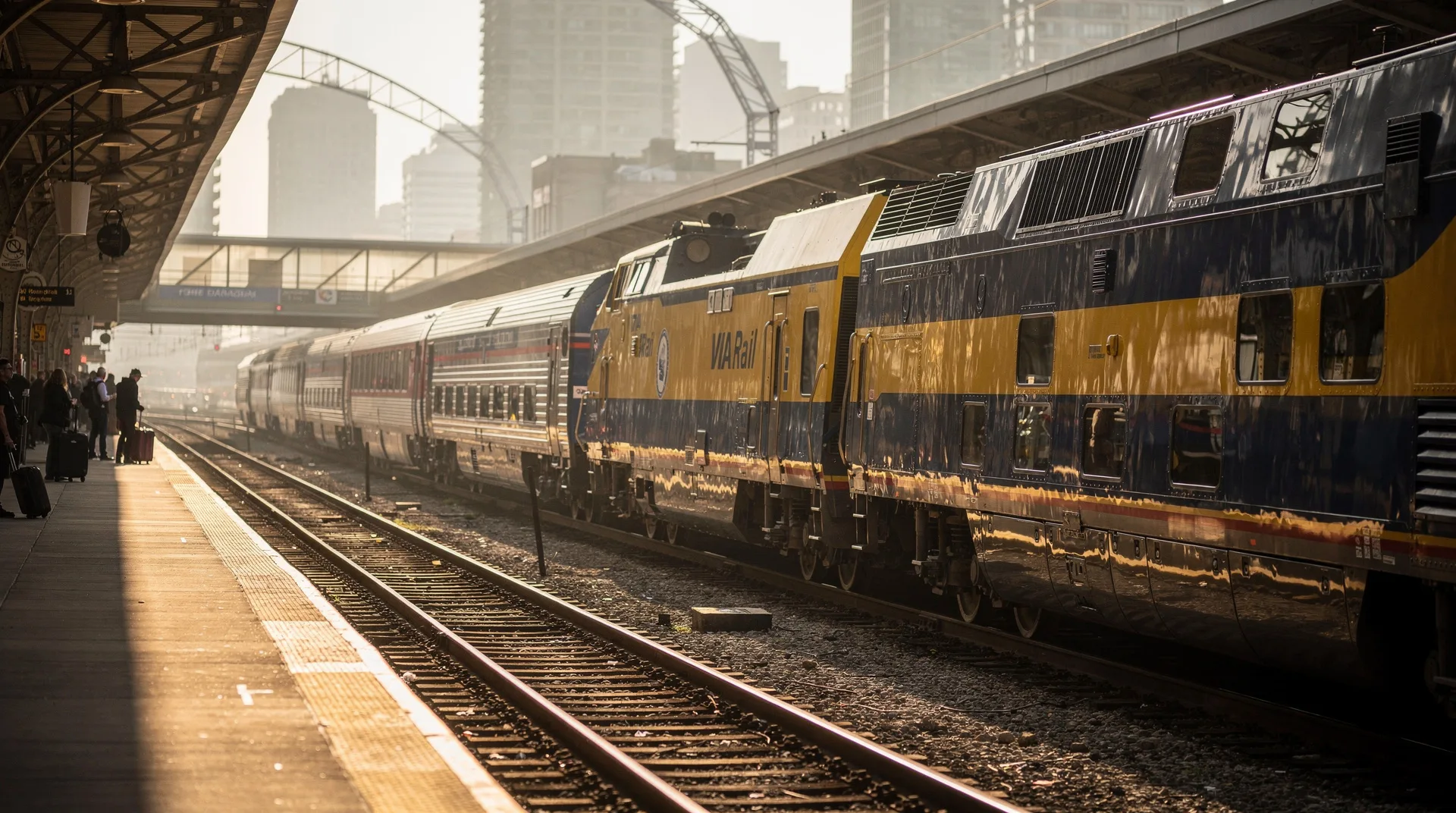
VIA Rail is Canada’s national passenger rail company, operating most intercity train services outside of commuter rail. The network is thin by European standards — decades of route cuts have left large regions of the country without train service — but what remains includes some of the most spectacular train journeys available anywhere.
The Canadian
The Canadian is VIA Rail’s flagship long-distance service: Toronto to Vancouver via Winnipeg, Saskatoon, Edmonton, and Jasper. The train departs Toronto’s Union Station three times weekly (eastbound and westbound) and takes approximately 87-92 hours — just under four days — to complete the journey.
The Canadian is not a fast way to get from Toronto to Vancouver. It is an experience in its own right. The train traverses the Canadian Shield, the boreal forest, the prairies, and the Rockies in sequence — passing through Jasper in daylight on the third day (westbound), which provides one of the more memorable train journeys available in North America.
Classes of service:
- Economy: Seats only, no sleeping accommodation. Manageable for overnight segments but difficult over 4 days. Economy passengers have access to a lounge car.
- Sleeper Plus (economy touring): Roomettes (two seats that convert to upper/lower berths at night) and Bedrooms (larger private room with en suite toilet). Meals are included in the price.
- Prestige class: Larger private suite with full en suite bathroom. Premium meals and service included.
Fares (Toronto to Vancouver, approximate):
| Class | Low season | High season |
|---|---|---|
| Economy | CAD $300-450 | CAD $450-700 |
| Sleeper Plus (roomette) | CAD $900-1,400 | CAD $1,400-2,200 |
| Prestige | CAD $2,500-3,500 | CAD $3,500-5,000+ |
Book well in advance for summer travel — Sleeper Plus accommodation on the Canadian sells out months ahead during July and August. The economy class fare is the most price-competitive option but is a very long journey in a seat.
The Ocean
The Ocean connects Montreal and Halifax in approximately 22 hours, running three times weekly in each direction. It is one of the oldest named passenger train services in North America. The route crosses Quebec, New Brunswick, and Nova Scotia, passing through the forests and river valleys of Atlantic Canada. Economy, Sleeper Plus, and Prestige classes are available. Halifax is a natural endpoint for an Atlantic Canada trip; the train allows you to skip the Rivière-du-Loup to Truro drive (which is not particularly scenic) and arrive rested.
The Corridor
The Corridor is VIA Rail’s busiest and most frequent service, running between Windsor, Ontario and Quebec City via London, Toronto, Ottawa, and Montreal. This is the most European rail experience in Canada — trains run multiple times daily on key segments, are reasonably fast (Toronto to Montreal in approximately 4.5-5 hours; Toronto to Ottawa in about 4 hours), and are genuinely competitive with driving and flying.
Sample Corridor fares (one way, economy):
| Route | Off-peak | Peak / flexible |
|---|---|---|
| Toronto to Montreal | CAD $50-100 | CAD $100-200 |
| Toronto to Ottawa | CAD $50-90 | CAD $90-170 |
| Montreal to Quebec City | CAD $35-70 | CAD $70-140 |
Advance purchase tickets (booked 6+ weeks ahead) are significantly cheaper. VIA Rail’s Escape fare category offers deeply discounted last-minute seats on trains with remaining capacity.
Jasper route
VIA Rail also operates the Jasper (formerly Skeena) service between Jasper and Prince Rupert — a two-day journey via Prince George through some of the most remote territory in British Columbia. This route runs twice weekly and is not designed primarily for tourists, but it connects communities that have no other passenger rail service. The Jasper to Prince George overnight is a solid budget way to traverse central BC; the Prince George to Prince Rupert day segment is the most scenic.
Rocky Mountaineer: luxury rail through the Rockies
Rocky Mountaineer is a privately operated luxury tourist train that runs seasonal services (April to October) through the Canadian Rockies. It is not part of VIA Rail and does not accept rail passes. The trains travel by daylight only — passengers overnight in hotels in Kamloops or Quesnel between rail segments.
Key routes:
- Rainforest to Gold Rush: Vancouver to Jasper via Whistler and Quesnel (2 days of rail, 3 days total with overnight)
- First Passage to the West: Vancouver to Banff or Calgary via Kamloops (2 days of rail)
- Journey through the Clouds: Vancouver to Jasper via Kamloops (2 days of rail)
- Coastal Passage: Seattle to Vancouver (1 day by sea, then connects to rail routes)
Fares: Rocky Mountaineer operates SilverLeaf (upper-deck dome car, meals included) and GoldLeaf (bi-level dome car, meals in lower-level dining room). Fares are significant: a Vancouver-to-Banff First Passage in SilverLeaf runs approximately CAD $1,500-2,000 per person. GoldLeaf adds roughly 40-60%. These prices do not include hotels, which are arranged separately.
If you would rather see the mountains with a local guide, you can also compare Canada day tours and excursions before committing to a rail package. Rocky Mountaineer is explicitly a premium tourism product rather than transport infrastructure. The onboard experience — narrated, with continuous food and drink service, through scenery that justifies the price for many travellers — is polished. For the budget-conscious, the VIA Rail Canadian covers much of the same scenery (the Jasper leg) at a fraction of the cost.
Domestic flights: the practical reality
For most cross-Canada journeys — and for any trip covering more than one major region — flying is the only practical option. The distances are too large and the alternatives too slow for most travellers’ itineraries.
The major carriers
Air Canada is the national carrier, with the most extensive network and the highest base fares. It operates hubs in Toronto (Pearson), Vancouver, Montreal (Trudeau), and Calgary. Air Canada’s Aeroplan loyalty program is integrated with Star Alliance.
WestJet is the main alternative, operating a broad network from its Calgary hub with generally competitive fares, particularly on western Canada routes. WestJet is part of the Oneworld alliance.
Porter Airlines operates primarily in eastern Canada, connecting Toronto (Billy Bishop Island Airport — downtown, no luggage conveyor, no major congestion) with Ottawa, Montreal, Halifax, Quebec City, and several smaller eastern cities. Porter’s Billy Bishop hub is its key advantage: the downtown location saves 45-60 minutes of airport transfer time relative to Pearson. Porter has expanded westward to Pearson and beyond in recent years.
Flair Airlines and Swoop (now merged with WestJet) are the primary ultra-low-cost carriers, with the lowest base fares and stripped-back service. Flair operates between major cities with very competitive prices, particularly on the Toronto-Vancouver and Toronto-Calgary routes. Add-on fees for checked bags, seat selection, and changes can push prices up substantially.
Sample domestic fares (one way, economy, advance purchase):
| Route | Budget carrier | Major carrier |
|---|---|---|
| Toronto to Vancouver | CAD $120-220 | CAD $200-450 |
| Toronto to Calgary | CAD $100-200 | CAD $180-380 |
| Calgary to Vancouver | CAD $70-150 | CAD $120-280 |
| Toronto to Halifax | CAD $100-200 | CAD $160-350 |
| Vancouver to Whitehorse | CAD $220-380 | CAD $280-550 |
| Montreal to Quebec City | CAD $80-160 | — (train is better) |
Book domestic flights 4-8 weeks ahead for the best fares. Last-minute domestic fares in Canada are disproportionately expensive — a Toronto-Vancouver ticket bought 48 hours before departure can run CAD $600-900 in economy.
Northern routes (to Whitehorse, Yellowknife, Iqaluit, Churchill) are serviced by Air Canada, WestJet, and regional carriers including Canadian North. Fares are high relative to distance due to limited competition; route availability varies by season.
Car rental: the essential tool for regional travel
A rental car is the most practical and flexible way to explore most of Canada outside major cities. The national park road trips — the Icefields Parkway, the Sea-to-Sky Highway, the Cabot Trail, the Pacific Rim Highway — simply cannot be done properly without a vehicle.
Rental basics
Cost: A standard mid-size car (Toyota Corolla, Honda Civic, or equivalent) runs approximately:
| Season | Daily rate |
|---|---|
| Summer (June-August) | CAD $70-120/day |
| Shoulder (May, September) | CAD $55-90/day |
| Winter (November-March) | CAD $45-75/day |
Resort towns (Banff, Whistler, Tofino) and airports in peak season are consistently at the higher end. One-way rentals (picking up in Calgary, dropping in Vancouver, for example) are common on the Icefields Parkway route and carry a one-way drop fee — typically CAD $50-150 depending on the companies and the route.
Fuel: Canada sells fuel by the litre. Prices vary by province — British Columbia is consistently the most expensive (CAD $1.65-1.90/litre in 2026); Saskatchewan and Alberta are cheapest (CAD $1.30-1.55/litre). A full tank in a mid-size car runs approximately CAD $80-120.
Age and credit card requirements: Most major rental companies (Hertz, Enterprise, Avis, Budget, National) require drivers to be 21 or older; drivers under 25 pay a young driver surcharge of CAD $20-35/day. A credit card in the driver’s name is required for the deposit hold.
Essential road trips by car
Icefields Parkway (Calgary to Jasper, 3-4 days): The 230-kilometre highway between Banff and Jasper, extending to Calgary, is the premier Canadian road trip. Stops include Moraine Lake, Peyto Lake, the Columbia Icefield, Sunwapta Falls, and Athabasca Falls. Most visitors drive one-way (Calgary to Jasper or reverse) and take VIA Rail or a shuttle in the other direction.
Sea-to-Sky Highway (Vancouver to Whistler, 2-3 days): Highway 99 north from Vancouver to Pemberton, passing through Squamish and Whistler, is one of the most scenic two-lane roads in Canada. The drive from Vancouver to Whistler takes approximately 2 hours without stops; Brandywine Falls, Shannon Falls, and the Sea to Sky Gondola are accessible directly from the highway.
Cabot Trail, Nova Scotia (2-3 days): A 300-kilometre loop around the northern tip of Cape Breton Island, through Cape Breton Highlands National Park, with coastal cliff roads, Acadian villages, and good whale watching offshore in summer. The trail is accessible from Sydney or Baddeck.
Pacific Rim Highway, Vancouver Island (2-3 days): Highway 4 across Vancouver Island from Nanaimo to Pacific Rim National Park and Tofino, through Cathedral Grove and the Mackenzie Range.
Trans-Canada Highway, BC Interior (2-3 days): The Rogers Pass section of the Trans-Canada through Glacier National Park and Mt. Revelstoke National Park connects Calgary to Vancouver through genuinely spectacular mountain terrain often overlooked in favour of the more famous Icefields Parkway.
Bus services: the budget option
The intercity bus landscape in Canada has been dramatically reduced since Greyhound Canada ceased operations in 2021, ending services on most routes west of Ontario and eliminating a significant portion of the national network. Budget travellers should not plan itineraries around the former Greyhound network — it no longer exists.
What remains:
Megabus operates primarily in Ontario and Quebec, connecting Toronto with Ottawa, Montreal, Hamilton, London (Ontario), and a handful of other cities. Fares are genuinely competitive: Toronto to Montreal for CAD $25-60 booked in advance is common. Megabus is the cheapest city-to-city option in eastern Canada for those willing to accept slower travel times.
FlixBus has expanded into Canada with services in Ontario, Quebec, and parts of Western Canada. Routes and pricing are similar to Megabus; FlixBus has more extensive western Canada coverage as of 2026.
Rider Express operates in western Canada (Alberta, Saskatchewan, Manitoba, and BC), connecting cities and towns that lost Greyhound service. It fills a genuine gap for smaller communities but coverage is limited compared to what existed before 2021.
Ebus and BC Bus North operate in British Columbia, connecting communities in the province’s interior and north with Vancouver and Prince George.
Practical limitations: Without Greyhound, there is no single carrier offering national bus coverage. For trips crossing multiple regions (western Canada to eastern Canada by bus), you will need to piece together multiple operators or switch to other modes. Bus is practical in the eastern corridor; less so for western Canada travel.
Urban transit: city by city
Canada’s major cities have functional public transit systems. If you are spending time in Toronto, Vancouver, or Montreal, using transit is almost always preferable to driving — parking is expensive, traffic is congested, and the transit networks cover the major attractions and neighbourhoods.
Toronto — TTC
The Toronto Transit Commission operates subway (4 lines), streetcars (downtown core), and buses. The subway covers most major destinations: Union Station, CN Tower area (Union), the Entertainment District (Osgoode), Kensington Market (Spadina), and the Distillery District (King streetcar). PRESTO card is the standard payment method; single fares run CAD $3.30.
A day pass costs approximately CAD $13.50 and allows unlimited travel. The TTC does not run 24/7 — service reduces significantly after midnight.
Vancouver — TransLink
TransLink operates the SkyTrain (three rapid transit lines), the SeaBus (harbour ferry to North Vancouver), and buses across Metro Vancouver. The Canada Line connects Vancouver International Airport to downtown (15-25 minutes, approximately CAD $9-10 depending on zone; pay by PRESTO or Compass Card). The Expo Line connects downtown to New Westminster and Surrey. Fares are zone-based — one zone covers most of downtown and inner Vancouver (CAD $2.85 for a stored-value single trip).
Montreal — STM
The Société de transport de Montréal operates one of the better metro systems in North America — 68 stations across 4 lines, clean, frequent, and covering most of the city’s visitor areas. A single fare is CAD $3.75; a day pass is CAD $11.25; a 3-day pass is CAD $22. The metro runs until approximately 12:30-1am. Bikes are permitted in the last car on some lines.
Other cities
Ottawa (OC Transpo): Bus-based network plus the Trillium O-Train light rail line. The airport is connected by bus only (Route 97); the trip to downtown takes approximately 35-45 minutes. A single fare is CAD $4.10.
Calgary (Calgary Transit): C-Train light rail plus bus network. The downtown core is a free-fare zone for the C-Train. Single fares are CAD $4.00.
Edmonton (ETS): Light rail (Metro Line, Valley Line) plus buses. The network is expanding but less comprehensive than Calgary. Single fares are CAD $3.75.
Quebec City: Quebec City has no metro and limited rapid transit. The city is compact enough to walk most of Old Quebec; buses serve the broader city. Fares are approximately CAD $3.85–4.00/ride.
BC Ferries and Marine Atlantic
BC Ferries
BC Ferries is the world’s second-largest ferry operator by number of vessels, running 36 routes connecting the BC mainland with Vancouver Island, the Gulf Islands, and the Sunshine Coast. For any trip to Vancouver Island — including visits to Pacific Rim National Park or Victoria — BC Ferries is the standard means of crossing.
Key routes and fares:
| Route | Duration | Vehicle + driver (approx.) | Foot passenger |
|---|---|---|---|
| Tsawwassen to Swartz Bay (Victoria) | 1h 35min | CAD $89 | CAD $21.00 |
| Horseshoe Bay to Departure Bay (Nanaimo) | 1h 40min | CAD $89 | CAD $21.00 |
| Tsawwassen to Duke Point (Nanaimo) | 2h | CAD $89 | CAD $21.00 |
| Horseshoe Bay to Langdale (Sunshine Coast) | 40min | CAD $58–63 | CAD $11.50–16.45 |
Summer crossings fill to capacity on weekends. Vehicle reservations (CAD $20.00 per booking) are strongly recommended for July and August sailings. Foot passengers can board without a reservation on almost all sailings.
The BC Ferries network also connects the Gulf Islands (Salt Spring, Galiano, Pender, Saturna), the Sunshine Coast, Bella Coola, and the remote central and north coast communities. Discovery Coast Passage and Inside Passage ferry routes run north from Port Hardy to Prince Rupert on a seasonal basis — long-distance ferry journeys through the coastal wilderness that function as a budget alternative to floatplane travel in the BC north coast.
Marine Atlantic
Marine Atlantic operates two routes connecting mainland Canada to Newfoundland — a ferry service that is effectively an extension of the Trans-Canada Highway for anyone driving to the island province.
Routes:
- North Sydney, NS to Port aux Basques, NL: The standard crossing, 7-8 hours by overnight ferry or 14-16 hours including driving time. Runs year-round.
- North Sydney to Argentia, NL (seasonal): A longer crossing (29-30 hours), departing twice weekly in summer, arriving near St. John’s. Significantly reduces driving time once on the island.
Fares (approximate): A vehicle plus two passengers on the North Sydney to Port aux Basques crossing runs approximately CAD $300-400 in summer, more with a cabin. Foot passenger fares are approximately CAD $55-85 per person. Cabins (4-berth, 2-berth) are available for overnight crossings at approximately CAD $90-180 per cabin. Book well in advance for summer travel — the Argentia route in particular sells out.
Summary comparison table
| Mode | Best for | Approximate cost example | Speed |
|---|---|---|---|
| Domestic flight | Long distances (500km+) | $150-400 one way | Fast (5h Toronto-Vancouver) |
| VIA Rail — Corridor | Eastern cities | $50-150 one way | Moderate (4.5h Toronto-Montreal) |
| VIA Rail — Canadian | Experience / Rockies | $300-2,200+ | Very slow (4 days cross-country) |
| Rocky Mountaineer | Luxury Rocky Mtn experience | $1,500-3,000+ | Slow / daylight only |
| Car rental | Regional / national parks | $60-120/day + fuel | Flexible |
| Megabus / FlixBus | Budget eastern cities | $25-80 one way | Slow (5.5h Toronto-Montreal) |
| BC Ferries | BC coast / islands | $89 (vehicle) | 1.5-2h main crossings |
| Marine Atlantic | Newfoundland | $300-400 (vehicle) | 7-30h depending on route |
| City transit | Urban travel | $3-18/day | Fast within cities |
Rental cars in detail
For most regional itineraries — the Rockies, the Sea-to-Sky corridor up to Garibaldi Lake, or the Bay of Fundy coast around Fundy National Park — a rental car remains the only realistic option once you’re off the flight/train network.
The Canada car rental guide covers company comparisons, insurance add-ons, and one-way drop fees in more detail, and the domestic flights guide has route-by-route fare guidance beyond the summary table above. If your trip includes national parks, remember that a rental car doesn’t cover park entry — see the Parks Canada Discovery Pass guide for whether the annual pass pays off on a multi-park itinerary.
Practical booking tips
Book VIA Rail early. Sleeper accommodation on the Canadian sells out in March or April for summer departures. Economy seats have more availability but prices rise as the departure date approaches.
Domestic flights: avoid last-minute fares. A one-way ticket bought 48 hours before departure can cost 3-4x the advance fare. Book domestic flights 4-8 weeks ahead.
BC Ferries vehicle reservations: Reserve at least 2 weeks ahead for summer weekend crossings. Without a reservation, you risk waiting for the second or third sailing.
Car rental at resort airports: Banff, Whistler, and Tofino have very limited local car rental stock. If you need a vehicle in these places, pick it up in Calgary or Vancouver and drive.
Combine modes. The most efficient itineraries typically combine flying for long-distance legs with car rental for regional exploration. A Toronto-to-Tofino trip, for example, works well as a direct flight to Vancouver, then BC Ferries to Vancouver Island, then a rental car to Pacific Rim.
For transit within cities, keeping your daily travel costs down is straightforward — all major Canadian cities have transit apps (TTC, TransLink, STM) that show real-time arrivals and allow mobile payment. Google Maps and Apple Maps have accurate Canadian transit data and are reliable for trip planning.
More detailed guidance on the train journey specifically: see the VIA Rail Canadian guide and the scenic trains of Canada guide. For route-specific advice on BC, see the British Columbia destinations guide.
Frequently asked questions about Getting around Canada
Is it cheaper to fly or drive across Canada?
For long distances, flying is almost always cheaper once you account for fuel, time, and accommodation en route. Driving makes sense for regional trips — the Rockies, the Sea-to-Sky corridor, Atlantic Canada — where the route itself is the point, not just the destination.
Do I need a car for a Canada trip focused on national parks?
In most cases, yes. Parks like Fundy, Garibaldi, and the Rockies parks have limited or no public transit to trailheads and park gates. A rental car picked up in a major city (Moncton, Vancouver, Calgary) is the standard approach — see the Canada car rental guide for specifics.