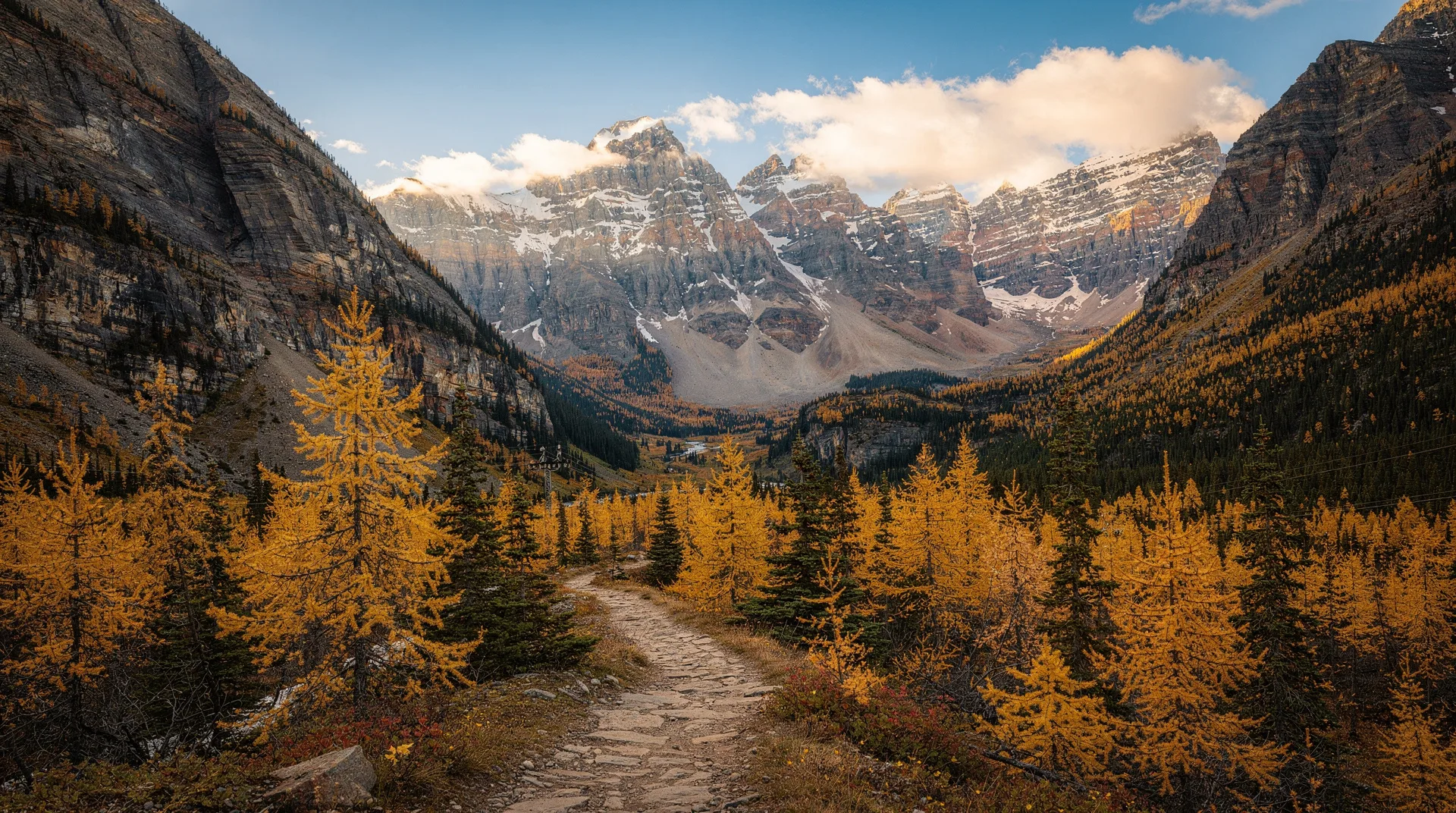
Larch Valley & Sentinel Pass hike: Banff fall classic
When is the best time to hike Larch Valley for fall colours?
The larches in Larch Valley typically peak between late September and the first week of October. The window lasts only 1–2 weeks and varies by year. Late September is the most reliable target; check trail condition reports closer to your visit.
| At a glance | |
|---|---|
| Where | Moraine Lake, Banff National Park, Alberta |
| Cost | Free to hike; a park pass is required plus around CAD $10-12 for the mandatory Moraine Lake shuttle |
| Time needed | 4-6 hours return for the full hike to Sentinel Pass |
| Getting there | Parks Canada or commercial shuttle from Lake Louise (private vehicles barred in peak season) |
| Best time | Late September to early October for larch colour; July-August for easier access with green larches |
There is a moment on the Larch Valley hike — usually around the 3 km mark, as the forest opens into the subalpine bowl — when the scale and colour of the scene stops you in your tracks. In late September and early October, the alpine larches that fill Larch Valley turn from summer green to brilliant gold. Against the grey limestone towers of the Ten Peaks, the blue sky of a clear fall day, and the teal reflection of Moraine Lake visible far below, the effect is one of the most photographed landscapes in Canada — and one of the few that lives up to every photograph you have ever seen of it.
The trail continues from Larch Valley to Sentinel Pass at 2,611 metres — one of the highest points reachable on a maintained trail in the Canadian Rockies. The view from the pass stretches north across the Valley of the Ten Peaks and south over a vast unnamed alpine basin. Getting here in autumn is a genuine pilgrimage, and understanding the logistics is essential.
Trail overview
Trailhead: Moraine Lake parking area (shuttle mandatory in peak season) Distance: 11.6 km return (to Sentinel Pass and back) Elevation gain: 725 m Difficulty: Moderate–strenuous Duration: 4–6 hours return Trail surface: Well-maintained to Larch Valley; increasingly rocky and loose scree on approach to Sentinel Pass Dogs: Permitted on leash (not recommended for the pass section)
The trail begins at the back of the Moraine Lake parking area. The first 1.7 km follows the Moraine Lake Rockpile Trail before branching uphill on the Larch Valley trail proper. This initial section gains elevation quickly through dense forest — switchbacks that are steep enough to make late-starters in July curse the heat but in September are invigorating in cool air.
At approximately 3 km, the forest transitions to subalpine and the larch zone begins. The wide bowl of Larch Valley opens ahead, ringed by peaks on three sides. The larches are scattered throughout the meadows — not a uniform forest but a mosaic of golden trees and open alpine meadow that changes light and character constantly as clouds move.
From the meadows, the trail continues 2.1 km to Sentinel Pass, climbing across open talus and a final steep scree approach. The pass itself is narrow and dramatic — a notch in the rock wall with a sheer drop on the Paradise Valley side.
The larch trees: what, why, and when
The trees that turn gold in Larch Valley are Lyall’s larch (Larix lyallii), the only deciduous conifer native to the subalpine and alpine zones of the Canadian Rockies. Unlike all other conifers, larches drop their needles annually — the needles turn from green to brilliant golden-yellow before falling, producing the autumn colour display that draws tens of thousands of visitors each fall.
Why deciduous needles? The larches grow at elevations where snow loads and extreme cold would destroy year-round needles. Dropping needles each autumn allows the tree to survive winters that would destroy other conifers.
Typical colour window: Late September through early October. The peak is usually 7–10 days long. The timing shifts by 1–2 weeks depending on summer temperatures and first frost timing. The best tool for timing a visit is the Parks Canada trail condition reports updated weekly in September.
What affects colour quality: Dry summers with cool nights produce the most vivid gold. Wet, warm autumns tend toward pale yellow. Early-season snowfall can knock needles off before peak colour — a risk that increases as October progresses.
The mandatory shuttle system
Moraine Lake Road has been closed to private vehicles during peak season since 2023. This is a permanent management change by Parks Canada, not a temporary measure. You cannot drive to Moraine Lake independently during peak season.
How to get there:
- Parks Canada shuttle from Lake Louise Ski Area: Book at reservation.pc.gc.ca. Shuttles start in mid-May and run through mid-October. During larch season they sell out weeks or months in advance. Book the earliest available shuttle for your target date.
- Brewster/Pursuit shuttle from Banff and Lake Louise: Commercial shuttle service running on fixed schedules.
More expensive than Parks Canada; book directly through Pursuit.
- Bicycle: Moraine Lake Road is open to cyclists even when closed to vehicles. From Lake Louise village it is approximately 14 km and 400 m elevation gain — a significant effort but a real option for fit riders.
- Hike in: From Lake Louise village via Consolation Lakes or via the Moraine Lake Road itself — roughly 18 km one-way. This is genuinely long; most people use the shuttle.
Booking reality during larch season: Parks Canada shuttle slots for late September dates are released months in advance and disappear within minutes of release. Set a calendar alert for the reservation opening date. If you miss the release, monitor for cancellations. Commercial shuttles have more availability but cost more.
Practical information
Best time of year
Late September (peak larch season): The reason most people come. Crowds are intense despite the shuttle system, but the colour justifies it. Book shuttle 2–3 months in advance.
July and August: Green larches but spectacular scenery. Easier shuttle access. More wildlife (bears are very active in this area). Good option if larch timing doesn’t align with travel.
Late June: Snow may remain on the upper trail and the pass approach. Microspikes useful. The valley itself is accessible before the shuttle season begins (check Parks Canada restrictions for the current year).
What to bring
- Sturdy hiking boots with good ankle support (the scree approach to Sentinel Pass is loose and unstable)
- Warm layers — the pass is exposed and temperatures at 2,611 m are significantly colder than at the trailhead
- Rain jacket (essential; weather changes rapidly at elevation)
- Wind layer (the pass is consistently windy)
- 2 litres of water per person (no water sources on upper trail)
- Trekking poles (strongly recommended for the scree descent)
- Bear spray (this area has frequent grizzly bear activity)
- Sun protection (UV is intense on the open upper section)
Wildlife
Larch Valley and the approaches to Sentinel Pass are active grizzly bear habitat. In late September, bears are in hyperphagia — feeding intensively before winter — and sightings near the trail are not uncommon. Travel in groups, make noise on blind corners, carry bear spray in an accessible holster (not buried in your pack), and know how to use it.
Pikas are abundant on the rocky talus sections — small, round mammals that live in rock piles and make a distinctive high-pitched call. Hoary marmots whistle from boulder fields. Golden eagles soar above the pass regularly in autumn.
Trail segment breakdown
| Segment | Distance | Elevation gain | Terrain |
|---|---|---|---|
| Trailhead to Rockpile junction | 1.7 km | Gradual | Forest switchbacks |
| Junction to larch zone start | 1.3 km | Steady | Dense forest, steepening |
| Larch zone to Larch Valley meadows | 1.0 km | Moderate | Opens to subalpine bowl |
| Meadows to Sentinel Pass | 2.1 km | Steep | Open talus and loose scree |
A park pass is required for the whole route since it lies inside Banff National Park — see our Banff park pass guide if you have not sorted one out. For a wider comparison of the two lakes this hike starts near, our Lake Louise vs Moraine Lake guide is a useful companion, and our dedicated Alberta larch season guide covers timing and alternative trailheads if Larch Valley’s crowds put you off.
Sentinel Pass: top of the trail
At 2,611 metres, Sentinel Pass is one of the highest points reachable by maintained trail in the Canadian Rockies. The notch offers a view directly north over the Valley of the Ten Peaks — the ten summits reflected in Moraine Lake visible far below — and south into the upper basin above Paradise Valley.
The pass is narrow and exposed. Wind is the rule rather than the exception. Eat, photograph, and admire — then descend before afternoon weather builds. Most hikers spend 15–30 minutes at the pass.
Paradise Valley extension: Experienced hikers can descend from Sentinel Pass into Paradise Valley and exit via the Paradise Valley trail to Lake Louise, making a long point-to-point of approximately 19 km. This requires a vehicle shuttle or prior arrangement. It is a serious day — allow 7–9 hours.
Safety considerations
Scree descent: The upper approach to Sentinel Pass covers loose, angular scree that is significantly harder to descend safely than it appears. Take small steps, keep weight centred, and use trekking poles. Scrambling on all fours on the steepest section is not embarrassing — it is safe.
Snow and ice: Even in September, overnight frost can leave the upper trail icy in morning shadow. Microspikes are worth carrying in September and October.
Crowds near the trailhead: The first kilometre of trail near Moraine Lake is extremely congested during larch season. Bear spray should still be carried and accessible despite the crowds — bears do not read visitor management plans.
Related trails and guides
- Lake Louise hikes overview — all major trails from the Lake Louise and Moraine Lake area
- Plain of Six Glaciers hike — the iconic glacier hike from Lake Louise’s opposite end
- Lake Agnes Tea House hike — the classic teahouse hike from Lake Louise
- Banff National Park guide — permits, parking, shuttle system overview
- Moraine Lake guide — everything about the lake itself, including photography tips
Frequently asked questions about Larch Valley & Sentinel Pass hike: Banff fall classic
Is Sentinel Pass suitable for beginners?
The trail to Larch Valley meadows (approximately 3–4 km from the trailhead) is accessible to beginners with reasonable fitness. The extension to Sentinel Pass is more demanding — the scree approach requires sure-footedness and comfort with exposure. If you are unsure of your ability, reach the meadows and return: the larch scenery rewards the effort entirely without the pass section.
How early should I start hiking during larch season?
As early as possible. The first shuttles leave early morning; aim for the 7–8 am departures. By 10 am the trail is extremely crowded. Starting at first light gives you the meadows in quiet, with the golden light of early morning illuminating the larches before the masses arrive.
Can I camp in Larch Valley?
There is a designated backcountry campsite (Sentinel Pass campsite) that requires a backcountry camping permit from Parks Canada. Camping here allows an early morning ascent to the pass before day hikers arrive — a significant advantage during larch season. Permits are competitive; book as soon as the reservation system opens in January.
What if the larches haven’t peaked yet when I arrive?
The partially-coloured transition from green to gold is beautiful in its own right. Some photographers prefer the mixed green-and-gold of early season or the sparse-but-vivid gold of peak plus a few days. The scenery in Larch Valley is outstanding at any point in September regardless of peak timing.
Do I need a park pass for Larch Valley?
Yes. The trailhead is inside Banff National Park, so a valid Parks Canada park pass (day pass or Discovery Pass) is required in addition to the Moraine Lake shuttle fare. See our Banff park pass guide for pricing.
Book shuttle and tour options from Moraine Lake