Canada honeymoon: 10 days of romance from the Rockies to Quebec City
Overview
Canada’s most romantic landscapes and cities compose an extraordinary honeymoon itinerary: glacially carved lakes of impossible blue in the Rockies, a fairytale château built at the water’s edge, the gentle flower-filled streets of Victoria, and the stone-walled, lantern-lit Old City of Quebec. This 10-day itinerary links these places with intentional pacing — the best honeymoon is not a rushed tour, but a sequence of places experienced deeply.
The itinerary begins in Banff and Lake Louise in the Canadian Rockies, crosses to Victoria on Vancouver Island, then travels east to Montreal and Quebec City. Internal flights keep transit efficient.
| Days | Destination | Romance factor |
|---|---|---|
| 1–3 | Banff & Lake Louise | Mountain château, hot springs, alpine lakes |
| 4 | Victoria arrival | Harbour at dusk, fine dining |
| 5 | Victoria | Butchart Gardens evening illuminations |
| 6 | Montreal | Old city cobblestones, French fine dining |
| 7–8 | Montreal | Plateau, cooking class, wine bars |
| 9–10 | Quebec City | Walled city, terrace dinners, sleigh ride |
Getting there: Fly into Calgary, connect onward via Victoria, Vancouver, and Montreal; a Via Rail Corridor train covers Montreal-Quebec City. Car required: Yes for the Rockies leg only; not needed in Victoria, Montreal, or Quebec City. Cost: Around CAD 15,000-25,000 per couple for 10 days including international flights, in peak season. Best time: September-October for warm days, autumn colour, and slightly lower rates; July-August for the warmest, liveliest version of every stop.
Days 1–3: Banff and Lake Louise — Rocky Mountain romance
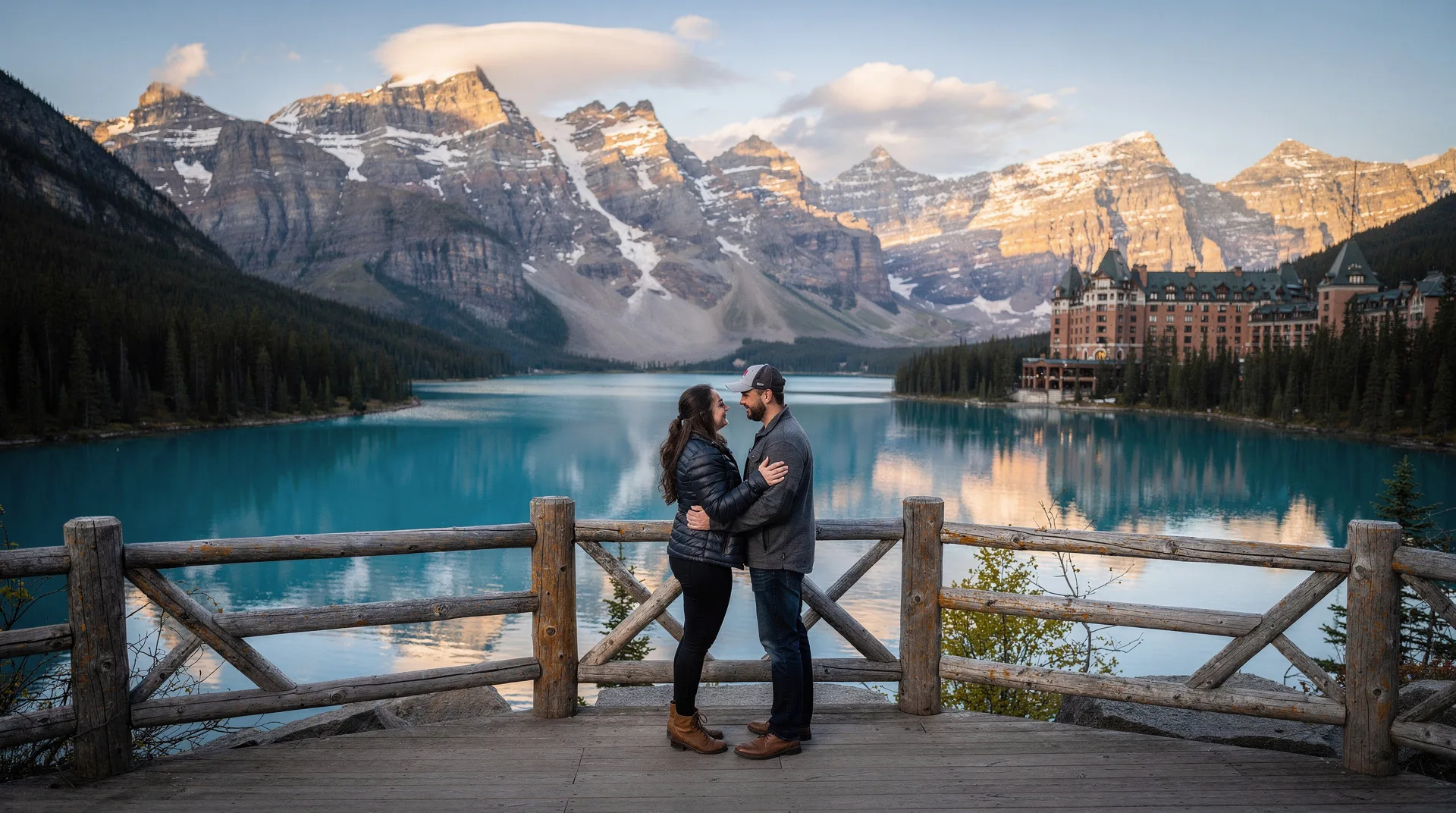
The Canadian Rockies are the setting of some of the most iconic and most genuinely romantic landscapes on earth. Turquoise glacial lakes reflecting jagged peaks. A century-old château built at the water’s edge. The aurora borealis tracing green across the winter sky above the valley.
Fly into Calgary and drive west on the Trans-Canada to Banff (90 minutes). Check into the Fairmont Banff Springs Hotel — the castle-like stone edifice that has anchored the town since 1888. Choose a Rockies-view room and allow an hour to simply stand at the window.
Day 1: The Banff Gondola carries you up Sulphur Mountain (2,281 m) at sunset — the light on the Bow Valley turns amber and the jagged horizon of peaks glows. Dinner at the Banff Springs’ Castello Ristorante or, more intimate, the Sky Bistro at the gondola summit. Then the Upper Hot Springs: soaking in 39°C water under a sky of stars in a heritage bathhouse is a memorable beginning.
Day 2: Drive to Lake Louise. Arrive before 7am — the early light on the Victoria Glacier and the mirror-flat lake before any other visitors is worth the early alarm. Rent canoes from the Chateau Lake Louise boathouse and paddle the length of the lake. Check into the Fairmont Chateau Lake Louise: the hotel sits directly at the lake’s edge, and its rooms overlooking the glacier and lake constitute one of the most romantic accommodation settings in the world. Afternoon: the Plain of Six Glaciers tea house trail above the lake — 5.5 km of alpine scenery with a century-old wooden tea house at the end that serves scones and hot drinks amid the glaciers.
Day 3: The Valley of the Ten Peaks. Moraine Lake’s shores at dawn, before the shuttle buses begin — the ten peaks reflected in the electric-blue water in complete stillness. Back at the Chateau, the Lakeview Lounge has floor-to-ceiling views and an afternoon tea service. Evening: the Chateau’s Fairview Restaurant for a formal dinner with the lake entirely to yourselves after the day visitors have departed.
Book the Lake Louise, Moraine Lake, gondola and hot springs experienceDay 4: Fly to Victoria — the garden city
Fly from Calgary to Victoria (2 hours direct, or via Vancouver with a short connection). Victoria, the capital of British Columbia, is a city of flowers, afternoon tea, and a harbour scene that is undeniably picturesque without being falsely manufactured.
Arrive and check into the Fairmont Empress, the grande dame hotel on the Inner Harbour whose exterior is covered in Virginia creeper that turns brilliant red in autumn. The harbour view from its upper floors, the Parliament Buildings illuminated in the evening, and the afternoon tea service in the Bengal Lounge are all appropriate for the occasion.
Evening walk along the Inner Harbour causeway — in summer, the waterfront is alive with musicians and the Empress hotel exterior is dramatically lit. Dinner at Olo or The Courtney Room, both of which represent Victoria’s emerging fine dining scene.
Day 5: Victoria — Butchart Gardens and the shoreline
Morning: Breakfast in the Empress dining room, then a walk through the Beacon Hill Park neighbourhood — the ocean viewpoint at Dallas Road, the Salish Sea below.
Afternoon into evening: Drive to Butchart Gardens (22 km north), timed to arrive around 3pm. The gardens are extraordinary in daylight; they are extraordinary in a different way after dark on summer evenings when the Sunken Garden and the Ross Fountain are illuminated. The Saturday evening fireworks display (summer only) set to music over the gardens is one of the more romantic experiences available in BC. The Italian Garden and Japanese Garden sections are less visited and more intimate than the central Sunken Garden.
Return for a late dinner — Canoe Brewpub on the waterfront for a more casual evening, or back to The Courtney Room for something more formal.
Day 6: Fly to Montreal — enter French Canada
Fly from Victoria or Vancouver to Montreal (5 hours direct from Vancouver). Arrive at Trudeau Airport and take the 747 express bus or taxi to the city centre.
Check into a hotel in Old Montreal: Le Mount Stephen (a converted Scottish bank in downtown) or Hotel Nelligan in Old Montreal are both excellent for a honeymoon. The stone building interiors, the careful restoration of historic architecture, and the neighbourhood’s cobblestone streets compose an atmosphere that feels genuinely European.
Evening in Old Montreal: The Rue Saint-Paul at dusk, the Vieux-Port lights reflecting on the St. Lawrence, the Basilique Notre-Dame illuminated. Dinner at Toqué (one of Canada’s finest restaurants), Maison Boulud in the Ritz-Carlton, or Le Local in Old Montreal for a romantic French-Canadian dinner.
Days 7–8: Montreal — pleasures of the Plateau
Montreal is romantic in the specific way of cities that have built their identity around pleasure: food, wine, design, architecture, and the particular French-Canadian cultural synthesis that makes even a casual lunch feel like an occasion.
Day 7: Morning in the Plateau-Mont-Royal neighbourhood — the exterior staircases, the wrought-iron balconies, Rue Rachel, Parc La Fontaine with the rowing lake. The Mile End neighbourhood for the best bagels in the world (St-Viateur and Fairmount are within 500 metres of each other; visit both) and some of the most interesting independent shops in the city.
Consider a cooking class in the afternoon — several Montreal cooking schools offer afternoon or evening sessions in French-Canadian and Quebec cuisine. Learning to make tourtière or crème brûlée with local maple syrup while sharing a glass of wine is a thoroughly appropriate Montreal activity.
Day 8: Mont Royal Park for the Belvedere Kondiaronk panorama over the skyline at sunrise (the view is better in the morning light). Then a self-paced walk through the Quartier des Spectacles and downtown. Afternoon: Musée des Beaux-Arts de Montréal — the collection is substantial and the building itself architecturally notable. Evening: the restaurant concentrations of Rue Saint-Denis and Rue Saint-Laurent, and the wine bars of the Plateau (Bar de Courcelle, Pullman, and Ile Flottante are all appropriate).
Book a full-day Montreal to Quebec City and Montmorency Falls tripDays 9–10: Quebec City — the most European city in North America
Take the Via Rail Corridor train from Montreal to Quebec City (3 hours). Arrive at Gare du Palais in the Basse-Ville — the station is itself a heritage building and the approach through the fortification walls is a memorable entry to the city.
Check into the Fairmont Le Château Frontenac: the hotel’s position atop the Cap-Diamant cliff overlooking the St. Lawrence and the Lower City is unrivalled. A suite with a river view is the appropriate choice. The Champlain Restaurant within the Frontenac serves contemporary French-Canadian cuisine at the standard of any serious European restaurant.
Day 9: The walled city at a romantic pace. Walk the Promenade des Gouverneurs along the cliff edge behind the Château — the St. Lawrence below, the île d’Orléans visible in the distance, the footpath carved from the rock face itself. The Terrasse Dufferin boardwalk in front of the Château is one of the great public spaces in Canada, with the river panorama and the Château looming behind. In winter, the terrasse becomes a toboggan run — a genuinely exhilarating five-second descent that no other city in North America can offer.
Evening: Rue du Petit-Champlain in the Basse-Ville after dark. The stone buildings, the lanterns, the street-level intimacy of the oldest commercial street in North America. Dinner at Initiale (consistently among the finest restaurants in Quebec) or Laurie Raphaël for a slightly more accessible take on haute cuisine.
Day 10: Montmorency Falls in the morning — the 83-metre waterfall is most dramatic after a storm or in spring snowmelt, but impressive year-round. In winter, the ice bridge that forms at the base is a natural wonder. Back for a final afternoon in the Old City: the Musée de la Civilisation in the Basse-Ville, a final walk along the fortification walls, and a late departure.
Where to stay — the romantic choices
Every accommodation in this itinerary has been selected for its specific romantic qualities:
Fairmont Banff Springs: One of the truly great hotel buildings in the world, a castle in the Rocky Mountain wilderness. Choose a Rundle Mountain view room.
Fairmont Chateau Lake Louise: Positioned directly at the edge of Lake Louise with the Victoria Glacier forming the backdrop. The lake-view rooms are worth the premium.
Fairmont Empress, Victoria: Heritage hotel with harbour views, afternoon tea, and the sense of occasion that comes with a building that has defined its city for over a century.
Hotel Nelligan or Le Mount Stephen, Montreal: Both in historic stone buildings in Old Montreal or downtown; both restore original architectural details rather than covering them.
Fairmont Le Château Frontenac, Quebec City: Arguably the most recognisable hotel in Canada, and from inside the rooms overlooking the St. Lawrence, the most dramatic hotel position in the country.
Budget guidance
This is a luxury itinerary by design. Honeymooners spending on this trip should expect:
- Fairmont hotels: CAD 400–900/night in peak season (June–September)
- Fine dining (per couple, per dinner): CAD 200–400 with wine
- Activities: CAD 100–200/person/day
- Internal flights (Calgary–Victoria, Vancouver–Montreal): CAD 400–700/person
- Via Rail Montreal–Quebec City: CAD 80–150/person in business class
Total for two persons over 10 days, including international flights: CAD 15,000–25,000 depending on season and specific room choices.
Best time for the Canada honeymoon
July and August: The warmest and most scenic period for Banff and the Rockies. Victoria is at its most flower-filled and sunny. Montreal and Quebec City are at their most lively. The main downside is that July and August are peak tourism months — some crowding at the most popular Rockies sites.
September and October: Our recommendation for honeymooners. The Rockies are still warm and clear; the autumn colour building in early October adds gold and amber to the turquoise lakes. Montreal and Quebec City are at their most atmospheric in fall. Hotel rates moderate slightly after Labour Day.
December to February: A winter honeymoon in Canada has particular magic — the ice palace atmosphere of Quebec City’s winter carnival, dog sledding near Banff, snowshoeing in the Rockies, and the aurora borealis above Lake Louise on clear nights. Requires warm clothing and a willingness to embrace cold weather as part of the experience.
Making the internal flights work
This itinerary crosses the country twice, so flight timing matters more than on a single-region trip. Calgary-Victoria and Vancouver-Montreal are the two long legs; both run several times daily on major carriers, but booking them alongside the Fairmont stays (rather than as an afterthought) avoids the awkward overnight layovers that can eat into a honeymoon day. If either of you would rather minimise flying, a shortened version dropping Victoria and adding an extra day each in the Rockies and Quebec City still delivers the romantic core of the trip — see our 7-day Atlantic Canada or Quebec 7-day itinerary for alternative eastern pairings if Victoria isn’t essential.
Extending or adjusting the trip
Couples with more time sometimes add a coastal extension from Victoria — Tofino on Vancouver Island’s west coast adds surf-town romance and rainforest scenery two to three hours’ drive away, though it requires an extra 2-3 days. On the eastern side, Charlevoix north of Quebec City is a natural add-on for couples who want a quieter, more rural finish than the city itself offers. For a shorter honeymoon, the Rockies-and-Quebec-City combination alone (dropping Victoria and Montreal) compresses well into 6-7 days.
Frequently asked questions about Canada honeymoon: 10 days of romance from the Rockies to Quebec City
Can we add a wildlife experience? Yes — consider adding a 2-night extension to Churchill, Manitoba for beluga whale watching (July–August) or polar bear viewing (October–November). It requires a specific side trip from Winnipeg but is unlike anything else in the world.
Is this itinerary suitable for October? October is excellent in the Rockies (snow possible but generally clear) and spectacular in Montreal and Quebec City for autumn colours. Some Rockies high-alpine trails may be closed by snow. The Butchart Gardens in Victoria are still beautiful in October.
Should we stay in the Fairmont hotels throughout? The Fairmont properties at Banff Springs, Lake Louise, and Quebec City are genuine landmarks that justify their prices for the setting and occasion. In Montreal and Victoria, several independent boutique alternatives offer comparable character at somewhat lower cost.
Do we need a car for the whole trip? No — a car is genuinely useful only for the Banff/Lake Louise leg and the Butchart Gardens excursion from Victoria. Montreal and Quebec City are both walkable and well-served by taxis and transit; renting a car there adds cost without adding convenience. See our Canada car rental guide for the Rockies portion.