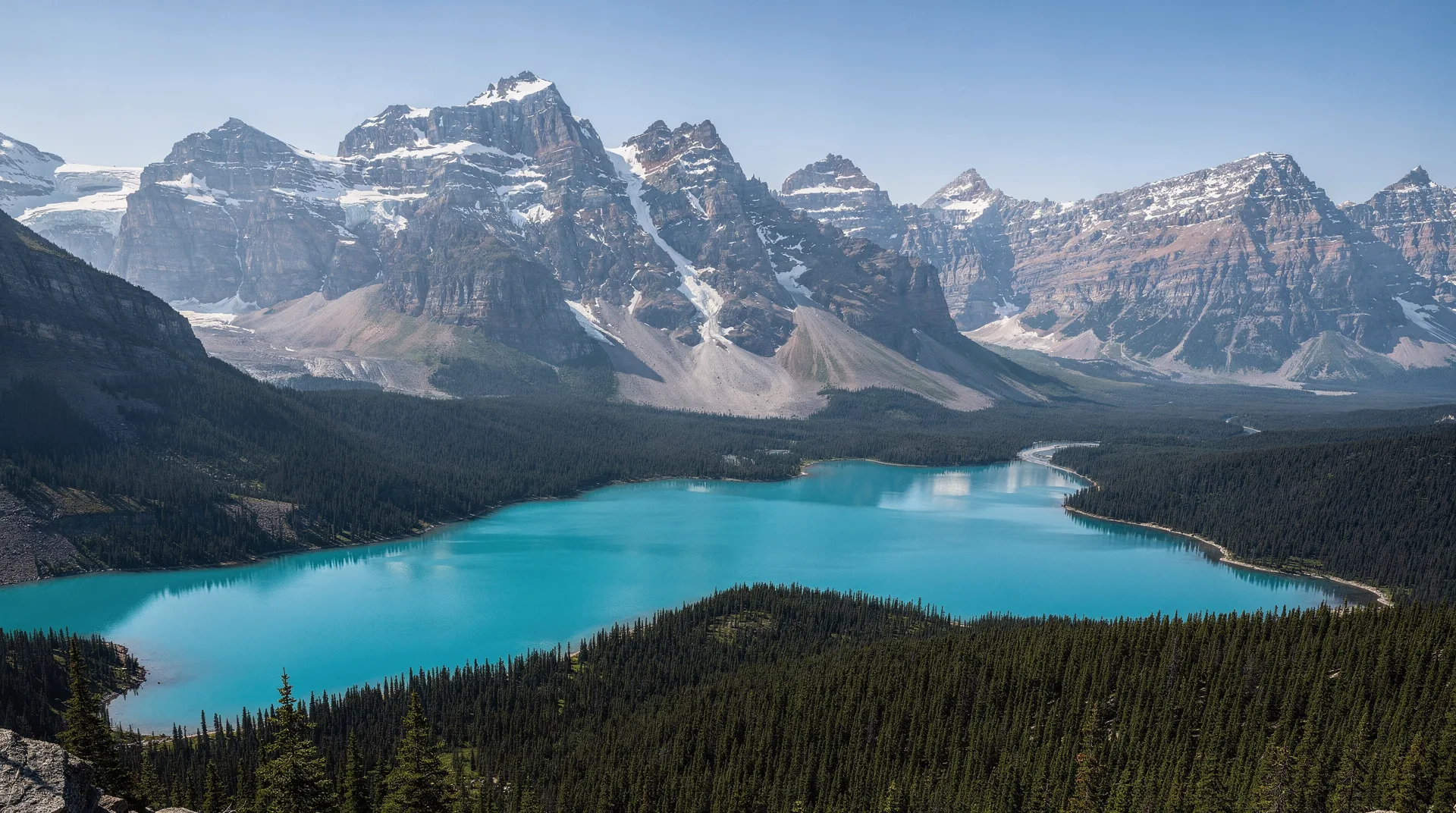
14 days in Banff and the Canadian Rockies: a day-by-day itinerary
Fourteen days is the length of trip the Canadian Rockies really reward. With two weeks you can see the famous lakes, drive the whole Icefields Parkway, spend real time in Jasper, add Yoho and Kootenay, and still keep a spare day for bad weather or a longer hike. Shorter trips force you to choose; this one lets you slow down.
The route below is a loop from Calgary. It uses four bases, Banff, Lake Louise, Jasper and Canmore, so you only pack up three times. A rental car is essential, and summer accommodation should be booked as early as possible.
At a glance
| Days | Base | Focus |
|---|---|---|
| 1-4 | Banff | Banff town, Johnston Canyon, Lake Minnewanka, Sunshine Meadows |
| 5-7 | Lake Louise | Lake Louise, Moraine Lake, Yoho National Park |
| 8 | Drive | Icefields Parkway north |
| 9-11 | Jasper | Maligne Lake, Jasper SkyTram, hikes and dark skies |
| 12 | Drive | Icefields Parkway south, Kootenay National Park |
| 13-14 | Canmore | Kananaskis, Grassi Lakes, return to Calgary |
Total driving: about 1,100 km
Best season: late June to late September
Essential bookings: accommodation, the Moraine Lake shuttle and any Lake O’Hara bus seat
Days 1-4: Banff
Day 1: Calgary to Banff
Pick up your car at Calgary airport and drive west on the Trans-Canada Highway. The run to Banff takes about 90 minutes, and our Calgary to Banff driving guide covers the best stops. Buy your Parks Canada pass at the park gate or online before you leave; with two weeks inside the parks, the annual Discovery Pass is almost always the cheaper choice.
Check in, walk Banff Avenue, and finish the day at Vermilion Lakes for sunset over Mount Rundle. Keep the first day light: jet lag and a long drive are enough.
Day 2: Sulphur Mountain and the town
Ride the Banff Gondola early, before the tour groups arrive, and walk the boardwalk to Sanson’s Peak. In the afternoon, visit the Cave and Basin National Historic Site, where the park was born, then soak at the Banff Upper Hot Springs. Bow Falls and the Surprise Corner viewpoint are a short walk from town.
Day 3: Johnston Canyon and the Bow Valley Parkway
Drive the Bow Valley Parkway, a slower road with better wildlife chances than the highway. Start at Johnston Canyon before 8 AM to walk the catwalks to the Lower and Upper Falls without crowds. Fit hikers can continue to the Ink Pots. Return via Castle Mountain viewpoint and keep your eyes on the verges for elk and black bears.
Day 4: Lake Minnewanka or Sunshine Meadows
Choose between a quiet day and a big one. The quiet option is the Lake Minnewanka loop: a boat cruise on the lake, Two Jack Lake for a picnic and an evening walk up Tunnel Mountain. The big option is Sunshine Meadows, reached by gondola in summer, with wildflower trails along the Continental Divide. If you prefer a guide, you can compare guided hikes and tours in Banff.
Days 5-7: Lake Louise and Yoho
Day 5: Lake Louise
Move to Lake Louise, 45 minutes north. Arrive early: the lakeshore parking fills soon after sunrise in summer, and the Parks Canada shuttle from the Park and Ride is the reliable alternative. Hike to the Lake Agnes Tea House and on to the Big Beehive, or take the flatter Plain of Six Glaciers trail. Our Lake Louise hikes overview compares the options.
Day 6: Moraine Lake
Private cars are not allowed on the Moraine Lake road, so you must use the Parks Canada shuttle or a commercial operator. Book the Moraine Lake shuttle the day reservations open. Climb the Rockpile for the famous view, then hike to Consolation Lakes, or in late September to Larch Valley for golden larches. Some travellers prefer an early-morning Moraine Lake tour that handles transport for them.
Day 7: Yoho National Park
Cross into British Columbia, 30 minutes west. Yoho National Park packs a lot into a small area: Emerald Lake with its canoe rentals, the Natural Bridge on the Kicking Horse River, the Spiral Tunnels viewpoint and Takakkaw Falls, one of the tallest waterfalls in Canada. If you won a seat on the Lake O’Hara bus through the lottery, this is the day to use it.
Day 8: The Icefields Parkway north
The 230 km drive from Lake Louise to Jasper is the highlight of many Rockies trips. Leave early and plan a full day. The essential stops are Bow Lake, Peyto Lake, Mistaya Canyon, the Columbia Icefield with the Athabasca Glacier, Sunwapta Falls and Athabasca Falls. There is no mobile signal for most of the road and only one fuel station, at Saskatchewan Crossing, so fill up in Lake Louise. Our Icefields Parkway stops guide lists them all in order.
Days 9-11: Jasper
Jasper National Park is larger and wilder than Banff, and the town is far quieter. Parts of the park and town burned in the July 2024 wildfire; most visitor services have reopened, but check Parks Canada for current trail closures before each hike.
Day 9: Maligne Valley
Drive to Maligne Canyon, then on along Medicine Lake, which drains through underground channels and can nearly disappear by late autumn. At Maligne Lake, take the boat cruise to Spirit Island, the only way to see it unless you paddle for most of a day. The road is one of the best places in the park for moose, and bears are often seen along it in early summer.
Day 10: Jasper SkyTram and the lakes
Ride the Jasper SkyTram up Whistlers Mountain for views across the Athabasca valley, and hike the last stretch to the summit if the trail is open. In the afternoon, visit Pyramid Lake and Patricia Lake, or rent a canoe at Lac Beauvert. Jasper is a Dark Sky Preserve, so if the sky is clear, drive out of town after dark for the stars. You can also browse tours and activities in Jasper.
Day 11: A longer hike
Use this day as your weather buffer. If it is clear, hike the Valley of the Five Lakes, or drive to Mount Edith Cavell for the Path of the Glacier trail when the road is open. If it rains, visit the Jasper Park Information Centre, take a slow lunch in town and save energy for the long drive tomorrow.
Day 12: Back south through Kootenay
Drive the Icefields Parkway south in the morning light, which shows the peaks from a new angle. Stop at whatever you missed on day 8. After Castle Junction, turn onto Highway 93 South into Kootenay National Park for Marble Canyon and the ochre Paint Pots. This is a long day, roughly 400 km, so if you are tired, skip Kootenay and drive straight to Canmore.
Days 13-14: Canmore and Kananaskis
Day 13: Canmore and Grassi Lakes
Canmore is a mountain town just outside the national park, with cheaper beds and a relaxed pace. Hike to Grassi Lakes in the morning: parking there requires a Kananaskis Conservation Pass, which is separate from your Parks Canada pass. In the afternoon, drive the Smith-Dorrien road into Kananaskis Country, or relax in town. Our Banff vs Canmore guide explains why many travellers base themselves here.
Day 14: Return to Calgary
Canmore is about an hour from Calgary airport. If your flight is late, visit Calgary’s Heritage Park or the Calgary Tower before you leave.
Budget breakdown
| Item | Per day for two people (CAD, approx.) |
|---|---|
| Mid-range hotel or lodge | 250-450 in summer |
| Car rental and fuel | 90-150 |
| Food | 120-200 |
| Activities and passes | 50-150 |
Summer prices in Banff and Jasper are among the highest in Canada. Staying in Canmore, booking early and self-catering some meals all help. See our Canada car rental guide for tips on one-way fees and insurance.
Booking tips
- Book Banff, Lake Louise and Jasper accommodation six to nine months ahead for July and August.
- Reserve the Moraine Lake shuttle as soon as the Parks Canada booking window opens.
- Apply for the Lake O’Hara lottery in the early spring if you want to go there.
- Pack layers for every day: the Columbia Icefield can be near freezing in July. Our packing list covers the essentials.
Variations
- Shorter: if you only have a week, follow our 7-day Banff and Jasper itinerary, or the 5-day Banff itinerary for a first look.
- Longer loop: add Mount Revelstoke and Glacier parks to the west for a 17- to 18-day loop.
- Autumn: from mid-September, swap the Sunshine Meadows day for Larch Valley and add an extra day in Jasper for the elk rut.
- From Vancouver: start in Vancouver and drive in over three days, as in our Canadian Rockies 10-day itinerary.
Wildlife and safety in the Rockies
You will very likely see elk, bighorn sheep and mountain goats, and there is a good chance of black bears and grizzlies from the road. Carry bear spray on every trail, hike in groups, and never stop on the highway to photograph wildlife. Our wildlife safety guide explains what to do if you meet a bear.
Frequently asked questions about 14 days in Banff and the Rockies
Is 14 days too long for Banff? Not if you include Yoho, Jasper and Kootenay. Two weeks lets you see the four connected parks at an easy pace, with time for longer hikes and a weather buffer.
Do I need a car for this itinerary? Yes. Buses link Calgary, Banff, Lake Louise and Jasper, but the Bow Valley Parkway, Yoho, the Maligne Valley and Kootenay are very hard to reach without a car.
When is the best time for two weeks in the Rockies? Late June to late September. July and August bring the warmest weather and every trail open; September brings fewer crowds and golden larches. See our guide to the best time to visit Banff.
How many nights should I spend in Jasper? Three nights is ideal. It gives you a full day in the Maligne Valley, a day around town, and a flexible day for a longer hike or bad weather.