Driving Calgary to Banff: Highway 1 road trip guide
How long does it take to drive from Calgary to Banff?
The drive is 128 km and takes approximately 1.5 hours without stops. With a stop in Canmore and the Banff park gate, allow 2-2.5 hours. The route runs west on the Trans-Canada Highway (Highway 1) and is straightforward for most drivers.
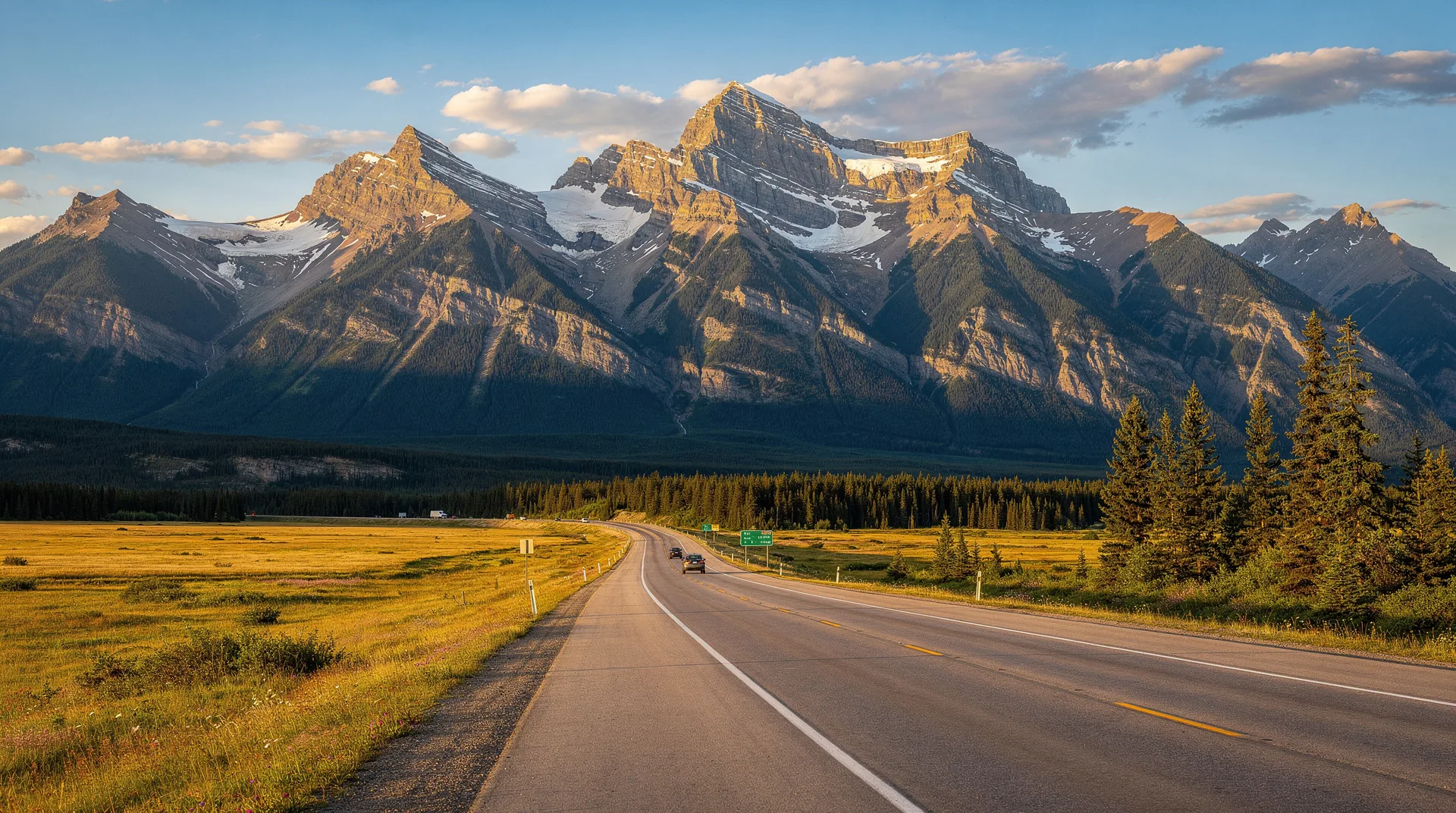
The drive from Calgary to Banff is one of the great short road trips in Canada — not because the 128-kilometre route is long, but because of what happens to the landscape over the course of 90 minutes. You leave a flat prairie city, cross the rolling foothills, and then the Rocky Mountain front ranges rise up ahead of you like a wall. By the time you pass through the park gate, you are somewhere else entirely.
This guide covers the route in detail, the best stops en route, what to expect at the park gate, and tips for making the most of this first leg of a Rockies road trip.
| At a glance | |
|---|---|
| Where | Trans-Canada Highway (Highway 1), Calgary to Banff, Alberta |
| Cost | Fuel plus the Banff park entry fee (around CAD $12.25/adult/day or a Discovery Pass) |
| Time needed | 1.5-2.5 hours depending on stops |
| Getting there | Rent a car at Calgary International Airport (YYC) or in the city |
| Best time | Year-round; weekday mornings avoid the worst summer traffic |
The route: Trans-Canada Highway (Highway 1)
The entire route runs on the Trans-Canada Highway (Highway 1) west from Calgary to Banff. The road is four lanes for most of its length, well-maintained year-round, and has no ambiguity — follow signs for Banff from the western outskirts of Calgary and you will arrive without needing navigation.
Distance: 128 km
Driving time (non-stop): Approximately 1 hour 20 minutes
Speed limit: 110 km/h for most of the highway; reduces through towns
Road quality: Excellent year-round; winter requires standard winter driving awareness
The highway climbs gradually from Calgary’s elevation (1,045 m) through the foothills before entering the mountain zone. The Trans-Canada is one of Canada’s busiest routes and can have significant weekend traffic in summer — Friday afternoon and Saturday morning outbound from Calgary, Sunday afternoon and Monday morning returning. If your schedule is flexible, mid-week travel is smoother.
Key stops en route
Cochrane (27 km from Calgary)
The first town west of Calgary, Cochrane sits in the foothills with its own small historic centre and the Rocky Mountains already visible to the west on clear days. Cochrane is best known for Mackay’s Ice Cream, which has been scooping since 1948 and has a devoted following that makes queuing at the drive-through a regional tradition. It is worth stopping if you are not in a hurry and the weather invites a roadside ice cream.
The Cochrane Ranche Provincial Historic Site at the edge of town marks one of the earliest large cattle operations in Western Canada. A short walk gives good foothills views.
Deadman’s Flats (100 km from Calgary)
A small service community just east of Canmore, Deadman’s Flats has a fuel station and fast food if you need a top-up before the park. It is less charming than Canmore but more practical for quick stops.
Canmore (106 km from Calgary)
Canmore is the last town before the park gate and one of the more appealing mountain towns in Canada. It sits 20 km east of Banff in the Bow Valley, outside national park boundaries, which means it has grown more freely than the park-regulated Banff townsite and now has a strong culinary and arts scene.
What to do in Canmore:
The Three Sisters peaks — three jagged summits that form the visual anchor of Canmore’s skyline — are best seen from the main valley near the town centre or from the Peaks of Grassi area to the east. On a clear morning, the views from Canmore’s main street are outstanding.
Canmore vs. Banff for accommodation: Canmore is significantly cheaper than Banff for accommodation, often by 30-50%. Many visitors base themselves in Canmore and drive the 20 minutes into the park each day. The trade-off is the commute; the saving is substantial for multi-night stays. See our comparison guide on Banff vs Canmore for a full breakdown.
Coffee and food in Canmore: Communitea Café on 8th Street is a local favourite for breakfast and lunch. The Rocky Mountain Bagel Company makes the case for a pause. For more substantial meals, Tavern 1883 and The Iron Goat have strong local followings.
Ha Ling Peak: The most dramatic short hike accessible from Canmore — a 6.4 km return trail that climbs 730 m to a summit with a panoramic view of the Bow Valley, the front ranges, and Banff to the west. Allow 3-4 hours return. Park at the Goat Pond parking area off the Spray Lakes Road.
The Banff park gate (118 km from Calgary)
You enter Banff National Park through a staffed gate on the Trans-Canada Highway, approximately 10 km west of Canmore. Have your Parks Canada Discovery Pass or payment ready. If it is your first visit, the gate staff are a good source of orientation information — current road conditions, closures, and wildlife activity are worth asking about.
Banff town is 8 km inside the gate. The road drops into the Bow Valley and the Cascade Mountain (2,998 m) and Rundle Mountain (2,949 m) fill the windscreen ahead as you approach the town.
Tips for the drive
Leave Calgary early. On summer weekends, the highway west from Calgary builds to significant congestion by mid-morning. Leaving before 8 AM avoids the worst of it. The reward is arriving at Banff in the morning light, which is the best time for photography and for beating crowds at major sites.
Fuel up in Calgary or Canmore. Fuel in Banff is available but significantly more expensive than in Calgary (around 15-20 cents per litre more). Fill up before you enter the park if cost is a consideration.
Wildlife near the highway. Between Canmore and the park gate, and along the Bow Valley Parkway inside the park, elk, deer, and occasionally bears are visible from the road. In September and October, elk are in rut and frequently seen in fields adjacent to the highway. Slow down when vehicles ahead of you are braking.
Winter driving. The Trans-Canada between Calgary and Banff is one of the better-maintained winter highways in Alberta — it is too commercially important not to be. However, conditions can deteriorate quickly. Winter tyres are strongly recommended from November through April. Check 511 Alberta (511.alberta.ca) for current road conditions.
Bow Valley Parkway (Highway 1A) alternative. Inside the park, consider returning to Calgary via the Bow Valley Parkway (Highway 1A) rather than the Trans-Canada. The older, slower road through the valley is one of the best wildlife corridors in Banff and takes only 15-20 extra minutes compared to the highway. Wolves, coyotes, elk, and deer are regularly seen. See our guide on the Banff to Jasper drive for more on using the Parkway as part of a longer itinerary.
Book a guided day trip from Calgary to Banff National ParkWheels for the Calgary to Banff run
Driving yourself lets you leave Calgary before the morning build-up, stop for wildlife along the Bow Valley Parkway and head back on your own schedule. Because the trip starts and ends in Calgary, collecting and returning the car in the same place keeps things simple, and an early collection time matters if you want to be on the highway ahead of the weekend traffic.
Between November and April, check that the vehicle you reserve comes with winter tyres, as they are strongly recommended on this road. Read the fuel policy too, since you will want to fill up in Calgary or Canmore before the park. You can compare cars and pick-up options on DiscoverCars for your Calgary start.
Calgary Airport to Banff
Most international visitors arrive at Calgary International Airport (YYC), approximately 20 km northeast of the city centre. The drive from the airport to Banff bypasses the city centre entirely — follow signs for Stoney Trail (Highway 201) westbound, then join the Trans-Canada (Highway 1) west.
Airport to Banff without entering Calgary city centre: approximately 128 km, 1.5 hours.
Car rental at Calgary Airport: All major rental companies operate from the consolidated rental facility adjacent to the terminal. Book in advance, especially for July and August — availability drops quickly and prices surge for last-minute bookings.
Without a car: The Brewster Express bus runs several daily departures from Calgary Airport to Banff (approximately 2 hours). The Banff Airporter operates a similar service at similar pricing. Both run door-to-hotel and are booked online in advance. See our ROAM Transit guide for getting around Banff once you arrive.
Route options compared
| Route | Time | Best for |
|---|---|---|
| Trans-Canada Highway (Hwy 1), direct | 1.5 hrs | Fastest option, best road quality, arriving with minimal fuss |
| Trans-Canada with a Canmore stop | 2-2.5 hrs | Coffee, a short walk, seeing the Three Sisters before the park gate |
| Via Kananaskis (Hwy 40 detour) | 3+ hrs | Travellers with an extra half-day who want quieter mountain scenery before Banff; see Banff vs Kananaskis |
| Return via Bow Valley Parkway (Hwy 1A) | +15-20 min | Best wildlife odds, recommended for the return leg rather than the outbound drive |
Deciding where to stay: Canmore or Banff
Because Canmore sits just 20 minutes short of the Banff park gate, many visitors reconsider their whole itinerary once they see it. If accommodation budget matters more than being inside the park boundary, basing yourself in Canmore and driving in daily is a legitimate strategy, not a compromise — see the full Banff vs Canmore comparison for the trade-offs on both sides. Either way, book accommodation well before arriving; rooms in both towns sell out on summer weekends.
If you decide to stay in Banff itself, note the drive from the park gate to Banff town adds another 8 km and roughly 10 minutes, with mountain views building the whole way — plan for that in tight schedules such as dinner reservations. Once you are settled, you can browse guided tours in Banff and book the activities you want ahead of time.
Extending the drive: Banff to Jasper
The Calgary to Banff drive is typically the first leg of a longer Rockies road trip. From Banff, most visitors continue north through Lake Louise (58 km from Banff) and up the Icefields Parkway to Jasper (288 km from Lake Louise). This is one of the world’s great scenic drives and is covered in detail in our Banff to Jasper driving guide.
Frequently asked questions about Driving Calgary to Banff: Highway 1 road trip guide
Is the Calgary to Banff drive easy for non-Canadians?
Yes. The Trans-Canada is a straightforward divided highway with clear signage. Driving is on the right side of the road (same as Europe, the US, and most of the world). The only unfamiliar element may be the scale of the road and the distances between services, but the Calgary-Canmore-Banff route has frequent enough services that this is not an issue.
Is there a toll on the Trans-Canada Highway between Calgary and Banff?
No highway toll. The only fee is the park entry charge at the Banff National Park gate ($12.25 per adult per day, or $24.50 per vehicle for families/groups, or covered by the Discovery Pass).
What is the best time to make the drive?
Morning is better than afternoon for the visual experience — morning light catches the front ranges ahead of you for much of the drive. Avoiding Friday afternoon and Saturday morning in summer also helps with traffic.
Can I stop at Canmore and still arrive in Banff for lunch?
Easily. A 90-minute stop in Canmore — coffee, a walk along the main street, views of the Three Sisters — still puts you in Banff before noon if you leave Calgary by 9 AM.
Are there electric vehicle charging stations en route?
Yes. Canmore has Level 2 and DC fast chargers. Banff town has several charging points. For a full list, use PlugShare or ChargePoint maps filtered for Alberta. The route is manageable for most modern EVs with 300+ km range.
Should I stop in Canmore on the way in or the way out?
Either works, but stopping on the way in means you arrive in Banff already having eaten and stretched your legs. Many visitors prefer stopping on the return leg instead, when there’s no pressure to reach Banff for check-in and Canmore’s dinner scene is a nice way to end the day.
For more planning, see our guides on best time to visit Banff, the Banff park pass, and our 3-day Banff itinerary.