Yoho National Park guide: Emerald Lake, Takakkaw Falls and the Burgess Shale
What is Yoho National Park known for?
Yoho is known for Emerald Lake (one of the most beautiful in the Rockies), Takakkaw Falls (Canada's second-highest waterfall), the Burgess Shale (a UNESCO-protected 505-million-year-old fossil site), and the exclusive Lake O'Hara backcountry area — all in a compact park on the BC side of the Continental Divide.
Yoho National Park is the quiet achiever of the Canadian Rockies national parks. Smaller than Banff or Jasper, less immediately famous, visited by far fewer people — and yet containing landscapes and experiences that rival anything the more celebrated parks offer. The park’s name comes from a Cree word expressing awe and wonder. Spend a day here and you will understand why the word applies.
Yoho covers 1,313 km2 on the British Columbia side of the Continental Divide, immediately west of Banff National Park along the Trans-Canada Highway. The park entrance is just 27 km west of the Lake Louise junction — a short drive that crosses into a different province and a landscape of its own distinct drama. Steep mountain walls, powerful glacial rivers, waterfalls that drop hundreds of metres, and the extraordinary stillness of Emerald Lake define Yoho’s character.
Together with Banff, Jasper, and Kootenay National Parks, Yoho forms part of the Canadian Rocky Mountain Parks UNESCO World Heritage Site — the largest protected mountain area in the world.
At a glance
| Where | BC side of the Continental Divide, 27 km west of Lake Louise on the Trans-Canada Highway |
| Cost | Requires a Parks Canada park pass; Lake O’Hara bus and Burgess Shale hikes are booked separately |
| Time needed | A full day covers Emerald Lake, Takakkaw Falls, and the Natural Bridge; add a second day for Lake O’Hara or the Burgess Shale |
| Getting there | Self-drive from Banff (about 55 minutes) or from Golden, BC |
| Best time | Mid-June to mid-October, when Emerald Lake Road and Takakkaw Falls Road are fully open |
Getting to Yoho National Park
Yoho is accessed via the Trans-Canada Highway (Highway 1) from the east (from Banff and Lake Louise) or from the west (from Golden, BC). The town of Field, inside the park, serves as the service hub — small (population about 200) but with the essential visitor centre, a few excellent restaurants, and access to the main park attractions.
From Banff: 85 km west on the Trans-Canada, about 55 minutes. From Vancouver: approximately 800 km east, about 8 hours.
The park requires a Parks Canada pass (the Discovery Pass covers all national parks and is strongly recommended for multi-park itineraries). A combined visit with Banff and Lake Louise, spending nights in Lake Louise village and day-tripping to Yoho, is the most common approach. Field itself has limited but characterful accommodation for those who want to base themselves inside the park.
Emerald Lake
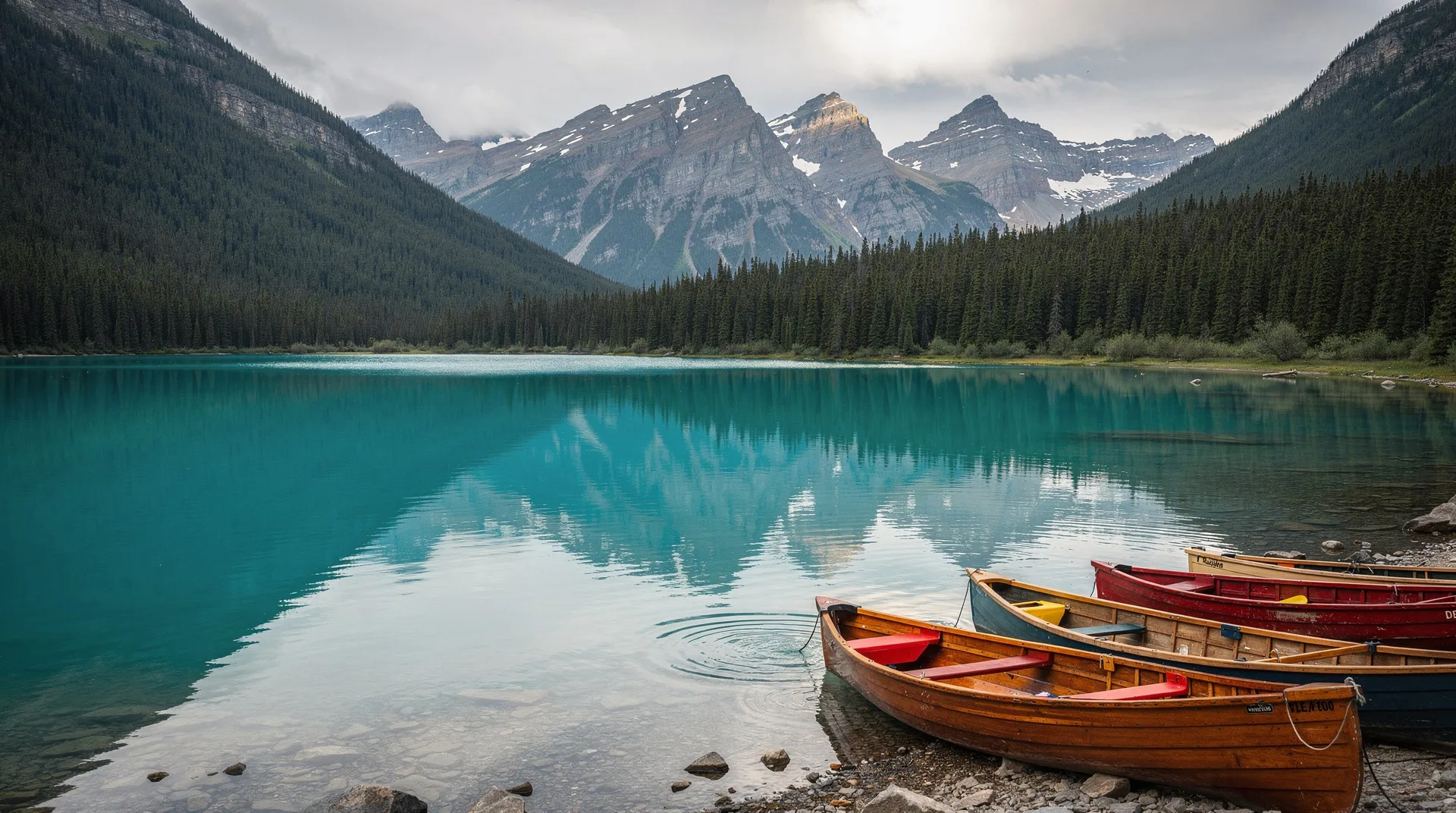
Emerald Lake is Yoho’s most visited destination and one of the most beautiful mountain lakes in Canada. The name is not metaphorical — the water is a vivid, almost electric green created by the refraction of light through glacial rock flour suspended in the meltwater from surrounding glaciers. On a calm morning, the lake reflects the peaks of the President Range with mirror-perfect clarity; in the afternoon breeze, the surface breaks up and the colour shifts to something closer to blue-green. Either version is extraordinary.
The lake is accessible via a 9-km road from the Trans-Canada (turn off at the Natural Bridge exit, west of Field). The Emerald Lake Lodge, a classic CPR-era mountain resort rebuilt in its current form in the 1980s, sits at the lake’s edge and is one of the finest places to stay in the Rockies. Even if you are not staying, the lodge is open for dining.
The Emerald Lake loop trail
A 5.2-km loop trail circles Emerald Lake entirely, passing through old-growth forest of Engelmann spruce and subalpine fir, crossing footbridges over the lake’s inlet streams, and offering continuous views of the mountains that frame the basin. The trail is largely flat and accessible, taking about 1.5-2 hours at a comfortable pace. Early morning (before 8 AM) or evening visits avoid the peak-hour crowds that accumulate in summer.
The trailhead for the more demanding Yoho Pass and Burgess Pass trails is also at the lake, for those wanting more elevation. If you would rather not drive yourself, you can compare guided tours across Canada that include the Rockies.
Canoeing on Emerald Lake
Canoe rentals are available at the lake from June through mid-October. Paddling on Emerald Lake — silently, at the level of the water, with the peaks rising directly above — is one of the most quietly spectacular experiences the Rockies offer. The colour seen from the canoe, looking straight down through the clear water, is different again from the lakeside view.
Takakkaw Falls
Takakkaw Falls is the second-highest waterfall in Canada, plunging 254 metres from the Daly Glacier above the Yoho Valley. The name means “it is magnificent” in Cree, and the designation is accurate. The falls drop in an unbroken column of white water visible from kilometres away, with the mist from the base creating a permanent rainbow on sunny afternoons.
Access is via Yoho Valley Road, a 13-km road that ascends the valley from the Trans-Canada to the falls parking area. The road includes a tight series of hairpin switchbacks — the Kicking Horse Pass zigzags — that are impassable for large RVs and trailers. A 10-minute walk from the parking area reaches the base of the falls, where the spray is heavy enough to require a rain jacket.
Takakkaw Falls Road is typically open from late June (after the snow clears) to mid-October. In the golden light of late afternoon or early morning, the falls and the surrounding peaks — the Chancellor Group, Isolated Peak — are extraordinary subjects for photography.
Yoho Valley trails from Takakkaw
The Yoho Valley, accessible from the Takakkaw Falls area, contains some of the park’s best hiking:
Twin Falls Trail (8.8 km one way): A relatively moderate trail up the valley floor past Laughing Falls to the dramatic Twin Falls, where two parallel streams drop 80 metres over a rocky ledge. The historic Twin Falls Tea House, operated by volunteers, serves simple meals and tea at the end of the trail.
Iceline Trail (21 km loop): One of the finest high-elevation day hikes in the Rockies, the Iceline traverses glacial moraines high above the valley floor with views of the Emerald and Little Yoho Glaciers. The loop combines the Iceline with the Yoho Valley Trail for a strenuous full-day outing. Elevation gain is approximately 700 metres.
Whaleback: A shorter detour (1.8 km from the valley trail) to a glacially-sculpted rock formation with excellent views back down the Yoho Valley to Takakkaw Falls.
The Burgess Shale: a window into ancient life
The Burgess Shale is one of the most significant fossil sites in the world — a 505-million-year-old Cambrian marine ecosystem preserved in extraordinary detail in the rocks of Mount Stephen and Wapta Mountain above Field. The site preserves the soft tissues of ancient sea creatures that very rarely fossilise, including Anomalocaris (the apex predator of the Cambrian seas), Pikaia (an early chordate and possible ancestor of all vertebrates), and hundreds of other species found nowhere else.
The Burgess Shale is a UNESCO World Heritage Site element within the Canadian Rocky Mountain Parks listing. The fossil beds cannot be visited independently — access requires a Parks Canada guided hike conducted by the Burgess Shale Geoscience Foundation. Two guided hike options are available:
Mount Stephen Trilobite Beds (5 km return): The shorter and less demanding option, accessing trilobite fossil beds above Field. About 5 hours return.
Walcott Quarry Hike (20 km return): The main Burgess Shale fossil site, requiring a full day and significant fitness. The hike gains 760 metres to the site where Charles Doolittle Walcott discovered the shale in 1909. This is one of the most intellectually extraordinary day hikes in Canada — standing at the fossil quarry, holding (briefly) a 500-million-year-old fossil, is a profound experience.
Guided hike reservations must be made in advance through the Burgess Shale Geoscience Foundation website. Both hikes run July through mid-September.
The Natural Bridge
Just off the Trans-Canada at the junction with the Yoho Valley Road, the Natural Bridge is a rock arch formed by the Kicking Horse River eroding through a limestone slab. The river still runs through the arch, and during high water (late June) the volume and force of the glacially-fed Kicking Horse is extraordinary.
The Natural Bridge viewpoint is a 5-minute walk from the parking area and is easily combined with the drive to Emerald Lake — they share the same access road. It is one of the more unusual geological features in a park full of geological drama.
Lake O’Hara: the most exclusive backcountry in the Rockies
Lake O’Hara is, by common consent among serious hikers, the finest backcountry destination in the Canadian Rockies. The small lake sits in a high alpine basin surrounded by peaks, glaciers, and an extraordinary network of trails connecting a dozen smaller lakes and subalpine meadows. The problem — and the feature that preserves its quality — is that access is severely limited.
Access to Lake O’Hara
The road to Lake O’Hara (11 km from the highway) is closed to private vehicles. Access is exclusively by a Parks Canada bus (pre-reservation only) or on foot via the 11-km road (a long but manageable day hike, though most visitors bus in and save their legs for the trails above the lake).
The bus reservation system opens in April for the full summer season, and places fill within hours. There is also a daily quota of walk-in hikers (about 12 per day from a first-come first-served waiting list at the trailhead — requiring a very early start and no guarantee of success). Reservations are made through the Parks Canada reservation system.
Hiking from Lake O’Hara
The trail network above Lake O’Hara is exceptional. Key routes include:
Lake O’Hara Lakeshore: A 2.8-km loop around the main lake that introduces the basin. The views from the far end of the lake, back toward the lodge with Cathedral Mountain behind, are classic.
Alpine Circuit (12 km): The full high-level circuit above the basin, traversing the Wiwaxy Gaps, Lake Oesa, the Yukness Ledge, and Opabin Plateau. One of the most rewarding full-day hikes in Canada, combining multiple lakes, glacial terrain, and consistent mountain scenery.
Lake Oesa: A 5.2 km return hike from Lake O’Hara to a higher lake below the Victoria and Lefroy Glaciers. The turquoise water of Lake Oesa against the grey quartzite headwall is exceptional.
Opabin Plateau: A high meadow east of the main lake with multiple glacial tarns, wildflower meadows in July, and extraordinary mountain views.
Staying at Lake O’Hara
The Lake O’Hara Lodge, a historic backcountry lodge operating since the 1920s, offers cabin accommodation for a maximum of about 30 guests. Reservations are by lottery in January for the full summer season. This is one of Canada’s most sought-after accommodation bookings — the combination of wilderness setting, superb hiking access, and good meals in a remote log-cabin environment is unmatched.
Parks Canada also operates an alpine campground at Lake O’Hara (also by reservation) for those who prefer to camp.
Which Yoho highlights to prioritize
With only a day or two, it helps to know how much time and effort each Yoho attraction actually requires before planning a route.
| Attraction | Effort | Time needed | Reservation? |
|---|---|---|---|
| Emerald Lake loop | Easy, flat trail | 1.5-2 hours | No |
| Takakkaw Falls viewpoint | Easy, short walk | 30-45 minutes | No |
| Natural Bridge | Easy, 5-minute walk | 15-20 minutes | No |
| Iceline Trail | Strenuous day hike | 6-8 hours | No |
| Mount Stephen Trilobite Beds | Moderate guided hike | About 5 hours | Yes, Burgess Shale Foundation |
| Walcott Quarry (Burgess Shale) | Strenuous guided hike | 7-10 hours | Yes, Burgess Shale Foundation |
| Lake O’Hara (bus access) | Easy access, hikes vary | Full day minimum | Yes, Parks Canada bus lottery |
For a first visit with limited time, Emerald Lake, Takakkaw Falls, and the Natural Bridge together make a satisfying and easily achievable single day, since none require reservations and all three are close together off the same access roads. Lake O’Hara and the Burgess Shale hikes need to be planned weeks or months ahead and are best treated as the anchor of a trip rather than an add-on.
Kicking Horse River and whitewater
The Kicking Horse River, which drains the Yoho Valley and runs through the park into Golden, BC, is one of the best whitewater rivers in Canada. The Golden section (outside the park to the west) is the most commonly run, offering Class IV rapids and multi-day float options. Several Golden-based operators run guided rafting and kayaking trips on the Kicking Horse, which can be combined with a Yoho visit for a high-energy day. To browse other organised excursions and activities, see these Canada tours and activities.
Where to stay in and around Yoho
Lake O’Hara Lodge (inside park, backcountry): Described above. Book by lottery in January.
Emerald Lake Lodge (inside park): A beautiful lakeside lodge with cabins, a fireplace-equipped main lodge, and one of the best settings of any hotel in the Rockies. Prices are high (comparable to Fairmont properties); the setting justifies them. Book months in advance.
Cathedral Mountain Lodge (Yoho Valley): Luxury riverside cabins along the Yoho Valley Road with excellent access to Takakkaw Falls and Yoho Valley trails.
Field, BC: The village inside the park has limited options. Truffle Pigs Lodge is a comfortable small inn; the owners operate one of the best small restaurants in the Rockies (Truffle Pigs Bistro, where the elk tenderloin and the locally-foraged mushroom dishes are outstanding).
Lake Louise Village: 27 km east in Banff, Lake Louise is the most practical base for day trips to Yoho. See our Banff National Park guide for accommodation options.
Combining Yoho with other parks
Yoho sits at the intersection of several major park experiences. The most logical combinations:
Yoho + Banff: The most common pairing. Yoho is a day trip from Lake Louise or Banff. Add a second or third Banff day for Moraine Lake, Johnston Canyon, and the Banff Gondola.
Yoho + Kootenay: Kootenay National Park begins just south of Yoho across the Continental Divide. The Marble Canyon and Paint Pots in Kootenay are excellent half-day additions.
Full Icefields Parkway loop: Combine Yoho, Banff, and the Icefields Parkway north to Jasper for a complete Rockies itinerary. See our 7-day Rockies itinerary for a detailed day-by-day plan.
For Rocky Mountain road trip planning, our Canadian Rockies 7-day itinerary covers the full route.
Planning Yoho around the rest of the Rockies
Yoho works best as one chapter of a longer mountain trip rather than a stand-alone destination. If Lake Louise is your base, the Lake Louise tours guide and the comparison of Lake Louise and Moraine Lake help you decide how to split your days between the two sides of the Continental Divide. Pairing a Yoho day with a hike such as the Lake Agnes Tea House walk gives you two very different lake experiences without much extra driving.
Travellers weighing where to spend their limited time can also read our overview of the Canadian Rockies and the Icefields Parkway, which together with Yoho form the classic Rockies loop. Anyone tempted by a fuller regional picture should look at Kootenay National Park and the nearby town of Golden, a useful stop for supplies, rafting and a night’s rest on the way in from the west.
If you are building a longer trip, the Banff and Jasper 7-day itinerary shows how a Yoho day can slot between the better-known stops, and the Banff destination page covers the practical base-camp details for the eastern side of the route.
Frequently asked questions about Yoho National Park guide: Emerald Lake, Takakkaw Falls and the Burgess Shale
Is Yoho National Park worth visiting if I am already going to Banff?
Yes, without question. Yoho is only 27 km from Lake Louise and can be covered in a day trip from your Banff base. Emerald Lake, Takakkaw Falls, and the Natural Bridge together justify a full day. If you can spend a night in Field or at the Emerald Lake Lodge, even better.
When is the best time to visit Yoho?
Mid-June to mid-October for full access to all attractions. Takakkaw Falls Road and Emerald Lake Road typically open in late June after snow clearing. July and August offer the warmest conditions and maximum services. Late September and October offer larch tree colour and significantly fewer visitors — arguably the best time for photography.
How difficult is the Burgess Shale hike?
The Walcott Quarry hike (the main fossil site) is demanding — 20 km return with 760 metres of elevation gain, taking 7-10 hours. Moderate fitness and proper footwear are required. The shorter Mount Stephen Trilobite Beds hike (5 km, steep) is more accessible. Neither hike can be done without a guide from the Burgess Shale Geoscience Foundation.
Can I visit Lake O’Hara without a reservation?
You can attempt to get a walk-in spot from the daily quota at the trailhead, or walk the 11-km access road. The walk-in quota is small (about 12 spots per day) and requires arriving at the trailhead by around 6 AM in summer. Walking the access road takes 2.5-3 hours each way and adds significantly to the day’s distance if you also want to hike the alpine circuit.
Is Emerald Lake crowded?
In July and August, the Emerald Lake parking area is busy from mid-morning onward and may be full by 10 AM. Arrive before 8 AM or after 4 PM for the best experience with fewer people and better light conditions. The loop trail thins out beyond the first kilometre from the parking area.
Are bears common in Yoho?
Both black bears and grizzly bears are present in Yoho. Bear activity is regularly reported on trails throughout the park. Carry bear spray (available for rent in Field, Banff, and Lake Louise), hike in groups of 3 or more, make noise on the trail, and follow Parks Canada’s current wildlife advisories. The Yoho Valley trail sees occasional temporary closures due to bear activity.
How many days should I spend in Yoho?
One full day covers the easy highlights well: Emerald Lake, Takakkaw Falls, and the Natural Bridge. Add a second day if you want to attempt Lake O’Hara or one of the Burgess Shale guided hikes, since both effectively consume a full day on their own and need advance reservations.