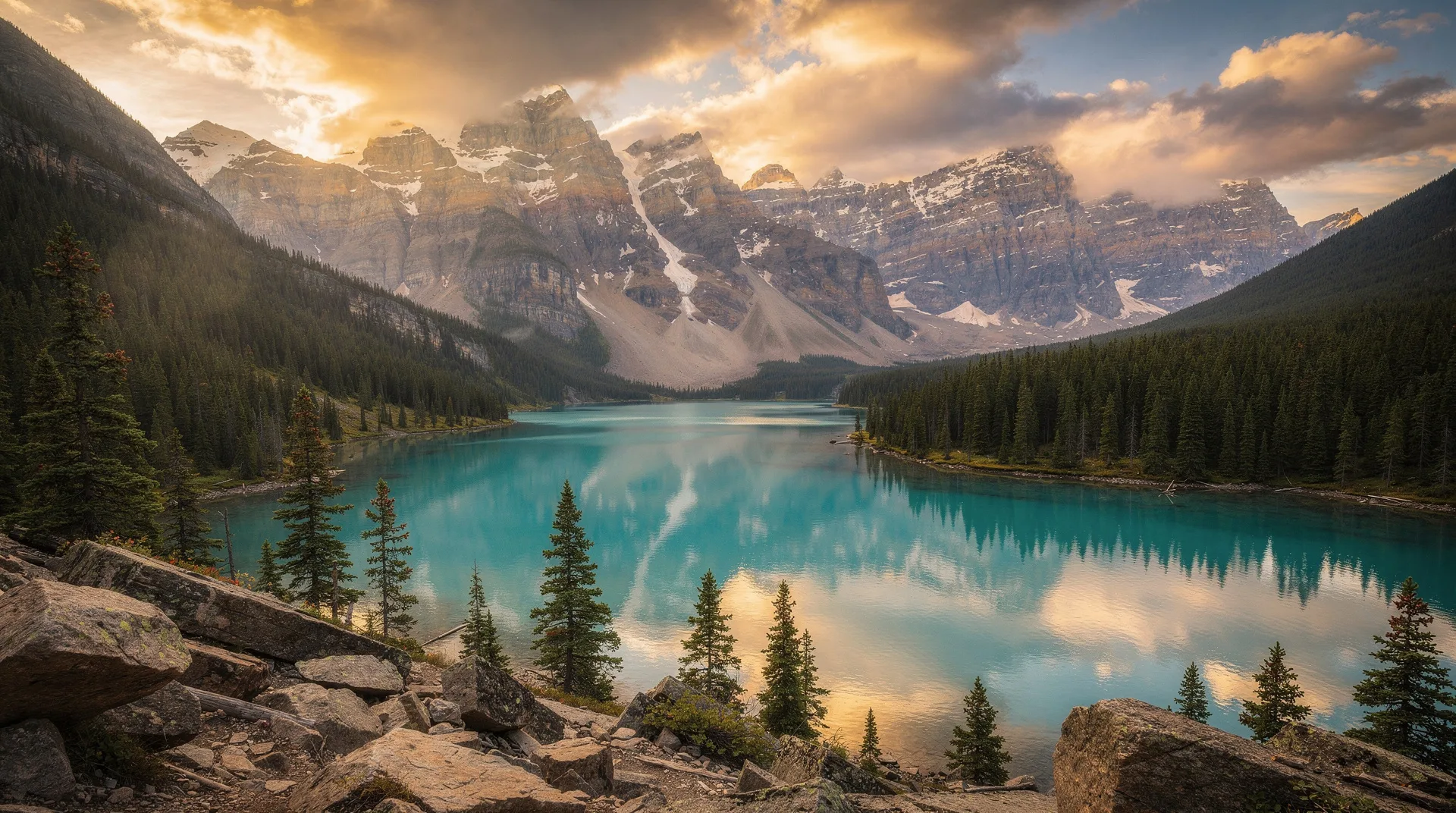
Quick facts
- Located in
- Banff National Park, Alberta
- Best fall weeks
- Mid-September to early October
- Larch peak
- Third and fourth weeks of September
- Days needed
- 4-6 days
Fall in Banff is the connoisseur’s season. The summer crowds thin dramatically after Labour Day, accommodation rates drop, the air turns crisp and clear, elk bugle through the townsite during the rut, and for a narrow two-week window the subalpine larch trees turn brilliant gold — an annual spectacle that draws photographers and hikers from around the world.
If you can arrange your schedule to visit in mid- to late September, you will experience what many repeat Banff visitors consider the most beautiful version of the park. This guide covers what to expect week by week, which hikes deliver the best fall colour, and how to navigate the one legitimate crowd surge of the fall season — Moraine Lake and Larch Valley during peak larch.
| At a glance | |
|---|---|
| Where | Banff National Park, Alberta — larch band roughly 1,800-2,400 m elevation |
| Cost | Standard Parks Canada Discovery Pass (around CAD $10.50/adult/day); no separate larch-season fee |
| Time needed | 4-6 days to combine a couple of larch hikes with lower-elevation sightseeing |
| Getting there | Same access as any Banff visit — see getting to Banff from Calgary Airport |
| Best time | Mid-September to early October for peak larch; late September for the reliable core |
Fall versus summer: what actually changes
The headline difference isn’t just the colour — it’s the crowd pattern. Outside the roughly two-week larch peak, fall Banff is dramatically quieter than July or August: shorter lines at the gondola, easier parking at trailheads, and accommodation rates that drop noticeably after Labour Day. During the larch peak itself, the pattern inverts sharply at a handful of specific spots — Larch Valley, Sentinel Pass, and the Moraine Lake shuttle queue see some of the heaviest crowding of the entire year, concentrated into roughly two weeks. Visitors who time a trip for the quieter fringes of fall (early September or early October) get most of the season’s benefits without competing for the same trailhead parking as the larch-peak crowds.
Early September (Labour Day through mid-month): The transition week. Summer services still running, most trails fully accessible, crowds noticeably lighter than August. Temperatures cool from summer highs of 22-24 degC to 15-18 degC. The lakes are still deep turquoise. Accommodation prices start dropping.
Mid to late September (roughly Sept 14-28): Larch season. The subalpine larch trees — distinctive conifers that shed their needles each winter — turn bright gold for approximately two weeks. The timing shifts a few days each year based on weather, but the third and fourth weeks of September are the reliable core. This is the most beautiful, most photographed, and briefly most crowded time of the fall.
Late September to early October: Larch colour at lower elevations, cooler nights (routinely sub-zero), morning frost on the meadows. Ski resorts begin preparing for winter. Crowds drop sharply after the larch peak.
Mid to late October: The quiet transition to winter. High-elevation trails close or become snow-covered. Temperatures drop toward freezing daytime highs. Some summer-only shuttles and services close. Snow begins accumulating at elevation. Photography conditions are spectacular when weather cooperates but logistics become more limited.
Larch season: what you need to know
The golden larches are the defining fall experience in Banff. Alberta’s larch season guide covers the full context; briefly:
What the trees are. The Alpine larch (Larix lyallii) grows in the subalpine zone between roughly 1,800 and 2,400 metres elevation — generally above continuous forest and below the true alpine. In September, their needles shift from green through yellow to brilliant gold before dropping for winter.
Where to see them. The famous location is Larch Valley and Sentinel Pass above Moraine Lake — the density and setting are extraordinary. Less crowded alternatives with equally fine larches: Healy Pass, Arnica Lake, Chester Lake (in Kananaskis), Saddleback Pass above Lake Louise, and the upper reaches of the Lake Agnes trail.
Timing the peak. The exact peak depends on summer and early-fall weather. Watch local sources (Banff & Lake Louise Tourism social media, Parks Canada updates) in early September for current colour reports. The period from approximately September 18 to September 30 reliably contains peak colour.
Moraine Lake Road in larch season. The shuttle system still applies — private vehicles are not permitted. Book your Moraine Lake shuttle the moment reservations open for fall dates. Commercial operators also run dedicated larch season day tours.
Fall hikes beyond the larches
Fall is an excellent hiking season even outside the larch band. Cooler temperatures make strenuous climbs more comfortable. Wildlife activity increases as animals feed actively before winter. Recommended fall hikes:
- Tunnel Mountain — accessible, short, great views, no crowds in fall
- Sulphur Mountain via the Banff Gondola — the gondola runs through October, giving you the option to descend on foot or by cabin
- Johnston Canyon — the canyon itself is atmospheric in fall fog and early frost
- Cascade Amphitheatre — longer but the bowl below Cascade Mountain holds golden light spectacularly
- Healy Pass — outstanding larches with a fraction of the crowds
Wildlife in fall
Fall is the best wildlife-watching season after summer peak. The elk rut — when bull elk bugle and spar to gather harems — peaks in mid-September through early October. Bugling elk are routinely heard and seen in the townsite, at Vermilion Lakes, and along the Bow Valley Parkway.
Bears are actively feeding before hibernation, a behaviour known as hyperphagia. Grizzlies focus on buffaloberry shrubs in the valley bottoms through early September, then move higher for pine nuts. Black bears can be observed feeding on berries along the Bow Valley Parkway.
Bighorn sheep move down from the alpine to lower elevations. Deer activity is noticeably higher. The colder air and sparser vegetation both improve wildlife sight-lines. See wildlife watching in Alberta for the full species and timing breakdown.
Weather and what to pack
Fall weather in Banff is highly variable. A warm sunny afternoon at 18 degC can be followed by overnight frost and a morning snow squall at elevation. Pack:
- Layered clothing spanning shorts-and-T-shirt through insulated jacket
- Rain and wind shell
- Warm hat and gloves (especially for early mornings and higher elevations)
- Waterproof footwear — trails can be muddy after rain, and early snow is possible on higher routes from late September
- Sunglasses and sun protection — high-altitude UV remains strong even as temperatures cool
Snow at elevation is routine from late September onward. High-elevation trails (Sentinel Pass, Healy Pass) can transition from dry to snow-covered within a 24-hour weather change.
Photography in fall
Fall is genuinely the best photography season in the Rockies. Reasons:
- Light quality. The lower sun angle produces warmer, softer light for longer periods each day. Magic hour lasts roughly 90 minutes rather than 20.
- Colour. Gold larches, yellow aspens, red dogwoods, and evergreen conifers create layered compositions impossible in summer’s uniform green.
- Atmospheric conditions. Morning fog in the Bow Valley, hoarfrost on vegetation, low clouds wrapping peaks — all routine in September and October.
- Fewer people. Sunrise at Moraine Lake still attracts the serious photographers but outside the larch peak, you can have classic viewpoints nearly to yourself.
Fall in Banff without hiking
For visitors less focused on trails, fall offers:
- Banff Gondola to Sulphur Mountain. Often excellent visibility and warm-coloured vegetation on the boardwalk at the summit.
- Lake Minnewanka cruise. The lake is less busy, the surrounding mountains often have fresh snow, and the interpretive cruises continue into October.
- Cave and Basin National Historic Site. The interpretive experience is pleasant in cooler weather.
- Banff town and Whyte Museum. Fall is the best time to actually linger in town without summer’s crowds.
- Upper Hot Springs. The outdoor pool is particularly atmospheric when the surrounding trees are gold and the air is crisp.
Booking strategy for fall Banff
Accommodation. Book 2-4 months ahead for larch peak weeks; 4-6 weeks for other fall dates. Outside larch peak, fall is often the best-value season of the year in Banff.
Moraine Lake shuttle. As competitive as summer during larch peak. Book as soon as reservations open on Parks Canada’s schedule.
Guided tours. Fall wildlife tours, photography workshops, and larch-season guided hikes are popular. Book 2-3 weeks ahead. Browse fall Banff tours for current availability.
Frequently asked questions about Banff in Fall: Larch Season & Autumn Guide
When exactly is larch season? Peak colour is usually September 18 to September 30, with some variation year to year. Monitor local colour reports in early September for current-year predictions.
Are the lakes still open in October? Yes — Moraine Lake Road typically stays open until Thanksgiving (Canadian Thanksgiving, mid-October), though exact dates depend on snowfall. Lake Louise is accessible year-round.
Is fall a good time for first-time visitors? Yes, with one caveat — if you have only a few days and want the classic summer Banff (canoeing on Moraine Lake under sun, long days, full services), summer is a better bet. For repeat visitors and photography travellers, fall is often preferred.
What about October specifically? Mid-October onward is genuinely shoulder season — quiet, cool, beautiful in its own way but less varied in activities. Great for a writing retreat pace; less ideal for a packed sightseeing itinerary.
Can I avoid the larch-season crowds and still see the colour? Yes — head to Healy Pass, Arnica Lake, or Chester Lake instead of Larch Valley. They deliver comparable golden larches with a fraction of the visitors, and none require a Moraine Lake shuttle reservation.
Is fall a good time to see wildlife in Banff? Yes, arguably the best. The elk rut peaks in mid-September through early October, and bears are actively feeding before hibernation, making sightings along the Bow Valley Parkway and at Vermilion Lakes more frequent than in summer.
Book Banff larch season and fall colours guided toursRelated pages
- Larch season in Alberta — deep dive on the phenomenon and best locations
- Larch Valley and Sentinel Pass hike — the classic fall hike
- Healy Pass hike — quieter larch destination
- Banff in summer — the alternative season
- Best time to visit Banff — month-by-month
- Banff photography — specific photo location guidance