Photography guide: best Instagram spots in Canada
I want to be honest upfront: this is not primarily a guide to getting photographs that look exactly like the ones you’ve seen on Instagram. It is a guide to the most photogenic places in Canada, when to be there for the best light, and how to get images that capture something real about those places rather than merely reproducing the canonical shot that exists already.
| At a glance | |
|---|---|
| Where | Nationwide — Rockies, Yukon, Newfoundland, Ontario, Quebec |
| Cost | Free at most viewpoints; park entry fees apply inside national parks like Banff |
| Time needed | A dedicated photography trip benefits from at least 7-10 days to cover a few regions properly |
| Getting there | Varies by location — the Rockies and Ontario/Quebec are drive-accessible, Yukon and Newfoundland usually require a flight |
| Best time | Depends on subject: June for Moraine Lake, September-October for foliage and larches, winter for aurora |
That said, the canonical shots exist for reasons. Moraine Lake is impossibly blue. The northern lights over Yukon tundra are genuinely spectacular. The coloured jellybean houses of St John’s row are among the most cheerful stretches of urban architecture on earth. There are real photographs to be made in all of these places, and understanding why they work helps you make yours.
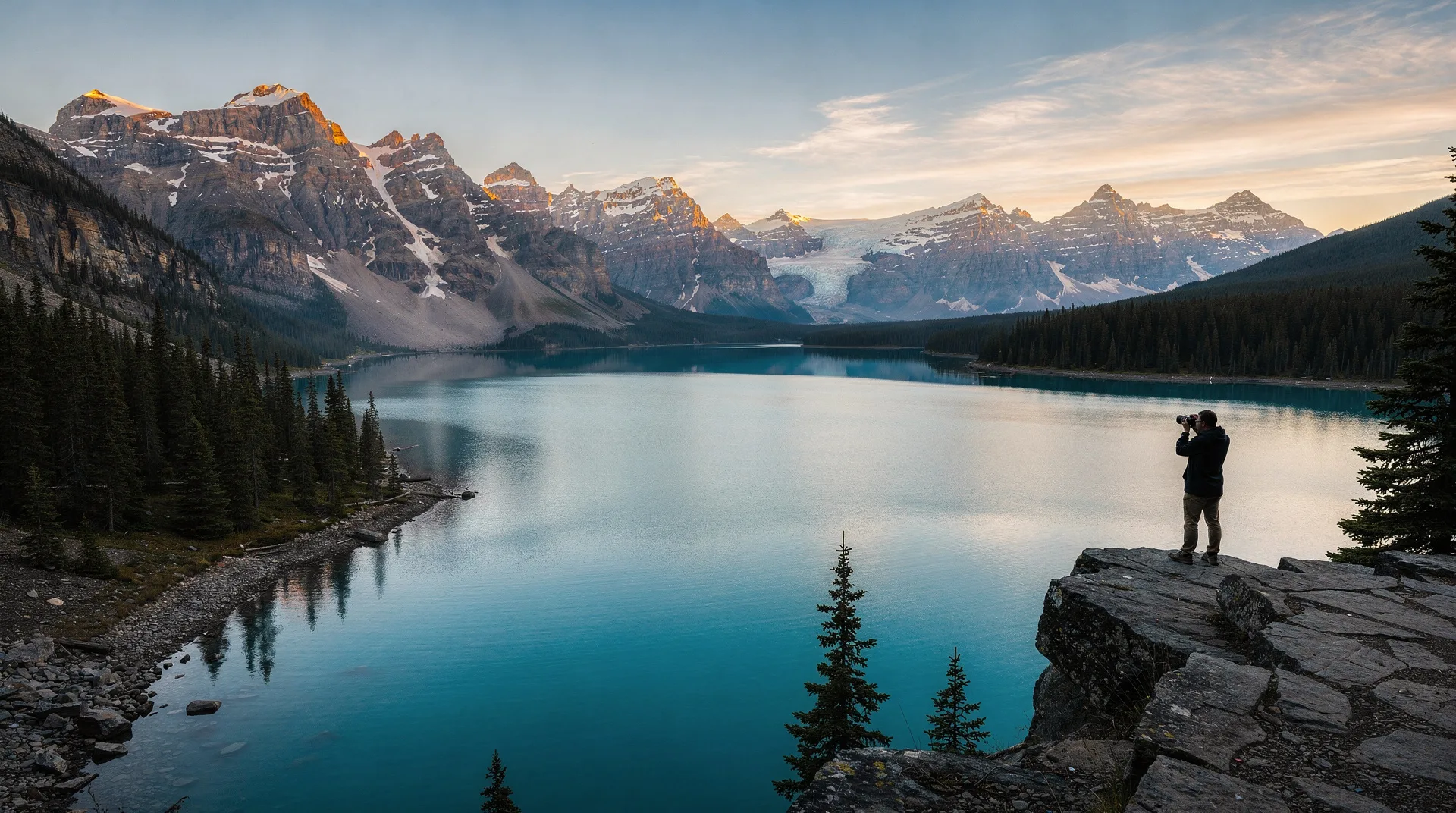
Moraine Lake at dawn
Let’s begin with the obvious. Moraine Lake in Banff National Park is, by some measures, the most photographed location in Canada — the old CAD twenty-dollar note used a view from the Rockpile above the lake as its reverse image for decades. The colour of the water — turquoise produced by glacial rock flour (silt) suspended in the meltwater — is most intense in June and July.
The photograph everyone wants is from the Rockpile: a 10-minute scramble over boulders above the parking area that delivers a view of the lake and the Valley of the Ten Peaks behind it. The problem is that this photograph is taken by several hundred people a day on peak summer mornings, and the difference between a unique and powerful image and a postcard reproduction is almost entirely about light and timing.
Dawn light. The lake turns gold-pink as the sun crests the peaks to the east. By 8 am, direct sunlight hits the water and the colour is at its most vivid. By 9 am, tour buses have arrived and you’re sharing the Rockpile with fifty other photographers. Arriving before 7 am — which now requires either the first Parks Canada shuttle or an extremely early drive — gives you the Rockpile with two or three other people on it and light that the midday crowd never sees.
In September, when the surrounding larch trees turn gold, the colour palette adds a frame of yellow to the blue of the lake and the grey of the peaks. This is the best photography month at Moraine Lake by a significant margin.
The northern lights over Yukon
Aurora borealis photography is technically different from landscape work and requires some specific preparation. You need a camera with manual controls, a wide-angle lens with a maximum aperture of f/2.8 or wider (ideally f/1.8 or f/1.4), a sturdy tripod, and a shutter release cable or the self-timer function to avoid camera shake.
The basic recipe: ISO 800–3200 (start at 1600 and adjust based on aurora intensity), aperture at its widest, shutter speed between 5 and 20 seconds. The right settings vary with the aurora’s brightness — a strong, fast-moving display needs shorter exposures (5–8 seconds) to retain the curtain structure; a faint glow benefits from longer exposures (15–25 seconds) that accumulate more light.
The best Yukon locations for aurora photography are dark sky areas away from Whitehorse’s light pollution: Kluane National Park’s wilderness areas, the tundra north of Whitehorse toward Tombstone Territorial Park, or the shores of Lake Laberge. Yukon aurora borealis viewing tours from Whitehorse take you to dark sky locations with guides who understand aurora forecasting — the KP index and solar wind data — and can position you well when activity begins.
The season runs from late August through mid-April. The equinoxes (late September and late March) statistically produce the strongest displays. Clear nights in mid-winter offer the best viewing conditions but require serious cold-weather preparation.
The coloured houses of St John’s
Jellybean Row — the nickname for the densely coloured Victorian row houses on Gower Street and surrounding streets in downtown St John’s, Newfoundland — is one of the most cheerful and recognisable urban streetscapes in North America. The colours are not heritage-mandated but are the result of individual homeowner choices accumulated over generations, producing combinations of pink, yellow, green, turquoise, orange, and red that photograph brilliantly in any light.
The best light is morning — the row is on the western side of streets that face east, so morning sun hits the façades directly. The Signal Hill neighbourhood above Gower Street gives elevated views over the row and the harbour behind. The photograph that appears most often shows three or four houses in a row with the harbour and the hills of the South Side visible in the background — this is taken from George Street or the streets immediately above it.
Don’t neglect Cape Spear, 11 km south of St John’s: the easternmost point of North America, where the lighthouse and rocky headland photographs well in any weather but is most dramatic in morning fog or when the sea is rough. The combination of St John’s coloured houses in the morning and Cape Spear in the afternoon makes a full photography day.
The Horseshoe Falls at Niagara
Niagara Falls is not subtle, and photography there is not subtle either. The challenge is finding an angle and a moment that distinguishes your image from the billions of photographs already taken of the falls — because the falls themselves are genuinely spectacular but are also among the most documented physical features on earth.
Useful approaches: The Hornblower boat cruise gets you into the mist at the base of the Horseshoe Falls, and the spray and scale photographed from water level is more powerful than the standard elevated view. A day trip from Toronto to Niagara Falls with the optional boat cruise includes both the elevated perspective and the boat access.
Winter Niagara — January and February when the mist freezes on the trees and railings surrounding the falls — produces photographs entirely unlike the summer crowds: blue-white ice, grey water, and a quiet that doesn’t exist in summer.
The falls are illuminated at night in rotating colours; a tripod and long exposures here produce better images than daytime with less competition.
The Quebec City walls at dusk
Quebec City’s fortification walls — the only intact city walls in North America north of Mexico — photograph best at dusk, when the stone catches the last warm light and the Château Frontenac above glows gold against a blue-dark sky. The Promenade des Remparts walk along the walls gives the best angles on both the Upper Town architecture and the view down to the Lower Town and the St Lawrence.
In winter, add snow to the stone and ice to the fountain in front of the Château Frontenac, and the whole scene takes on a quality that post-processing cannot manufacture — it simply exists if you’re there at the right time.
The Château Frontenac itself, photographed from Place d’Armes in the blue hour between sunset and darkness, is one of the most recognisable buildings in Canada and responds beautifully to the hotel’s exterior lighting.
Autumn foliage in Quebec and Ontario
The autumn colour season in eastern Canada — running from early September in the north to late October in the south — produces landscapes that are genuinely competitive with New England’s famous foliage and are far less crowded. The best photography spots are found where water mirrors the colour: the lakes of Algonquin Provincial Park in Ontario, the St Lawrence shoreline in Quebec’s Charlevoix region, the Estrie hills (Eastern Townships) south of Montreal.
Algonquin Park in early October: the combination of birch, maple, oak, and the dark green of the conifers against blue lake water produces colour combinations that are difficult to overshoot. The Highway 60 corridor through the park is accessible and good; the interior canoe routes, if you have the camping skills, give access to scenes without another human in the frame.
For aerial-style landscape photographs, Québec’s La Mauricie National Park in October, photographed from the La Wapizagonke Lake viewpoints, shows the rolling hills covered in mixed forest with the lake winding through — the type of image that looks heavily processed but requires no post-production adjustment if the light is right.
Banff townsite and the Vermilion Lakes
The famous mountain reflection photograph — jagged peaks, orange and pink sky, perfectly still water doubling the image — is most reliably made at the Vermilion Lakes, a series of lakes a few kilometres from the Banff townsite, early in the morning before wind disrupts the water surface.
Mount Rundle, which rises directly behind the townsite, provides the peak in most of these images. Spring ice-out (mid-to-late April) produces particularly good reflections before the surrounding vegetation fills in. Dawn in late September, when the alpenglow turns the peaks pink-orange and the larches below are gold, is perhaps the most compelling light of the year here.
The Banff National Park guide has a full section on photography locations and seasonal conditions.
Best month by subject
| Subject | Best months | Why |
|---|---|---|
| Moraine Lake turquoise | June-July | Glacial melt is at its peak, producing the most intense colour |
| Rockies larches | Mid-late September | The larch forests around Moraine Lake and Larch Valley turn gold for roughly two weeks |
| Yukon aurora | Late Aug-April, equinoxes strongest | Dark enough skies and statistically higher solar activity around the equinoxes |
| Eastern foliage | Late Sept (north) - late Oct (south) | Colour moves south through Quebec and Ontario over about six weeks |
| Niagara ice | January-February | Mist freezes on trees and railings, producing a scene absent in summer |
| Quebec City dusk walls | Year-round, best in winter snow | Warm stone light plus snow gives the strongest contrast |
Gear and access notes worth knowing before you go
A few practical points that save a wasted trip: drones are banned in every Canadian national park, so any shot involving Banff, Jasper, or similar needs to be made from the ground. Tripods are allowed almost everywhere but check specific site rules at popular spots like the Quebec City old town, where some areas restrict tripods during peak tourist hours. For aurora and other long-exposure work, a spare battery is not optional — cold drains batteries fast, and Yukon winter nights are genuinely cold.
If you’re combining photography with a first Rockies trip, pairing the Moraine Lake guide with a Banff versus Jasper comparison helps you decide how to split limited days between the two parks’ best light.
Final thoughts
The pattern across all of these locations is time of day and season. The cameras and phones available to most travellers today are capable of making excellent photographs in almost any conditions. What separates memorable images from average ones is almost always the light, which is almost always the result of being in the right place at the right time — which requires the willingness to set an alarm for 5 am and drive to a lake in the cold before sunrise.
The good news is that for most of Canada’s best photography spots, the same discipline that improves photographs also improves the experience: empty car parks, quiet trails, and landscapes at their most dramatic are all found in the hours that most tourists are still having breakfast.
Frequently asked questions about Photography guide: best Instagram spots in Canada
Do I need professional camera equipment for Canadian landscape photography?
No — modern smartphones and mirrorless cameras produce excellent results. For aurora photography you need manual controls (available on iPhone, Samsung, and most modern smartphones in pro mode) and a stable surface or tripod. For waterfalls and other long-exposure subjects, a tripod helps. The limiting factor is almost always timing and conditions, not equipment.
What is the best month for photography in Canada?
It depends on the subject. June for Moraine Lake’s peak turquoise colour. September–October for larch season in the Rockies and autumn foliage in the east. January–February for winter landscapes and northern lights. May for waterfalls and spring light with minimal crowds. There is no universally best month — each season offers something different.
Is drone photography allowed in Canadian national parks?
No. Drones are prohibited in all Canadian national parks, national historic sites, and most provincial parks. Violations carry significant fines. Drone photography is permitted on private land and some public lands outside park boundaries — check regulations for each specific location.
How early do I need to arrive at Moraine Lake for a good experience?
In peak summer (July–August), before 7 am if driving or on the first shuttle of the day. By 8:30–9 am, the Rockpile is crowded. In shoulder season (mid-September to early October), 7–8 am arrival is usually sufficient as crowds are significantly smaller.
Which single location gives the best photos for the least effort?
Vermilion Lakes near Banff townsite, for anyone short on time. It’s a short drive from town, requires no permit or shuttle booking, and reliably delivers a mountain reflection shot at dawn. Moraine Lake produces the more famous image but demands far more planning around the shuttle system.
Is it worth hiring a local photography guide?
For aurora photography and remote locations like Yukon’s dark-sky areas, yes — a guide’s forecasting knowledge and access to good vantage points saves wasted, freezing nights with nothing to show for it. For daylight landscape locations like Moraine Lake or Quebec City, a guide is optional; the main variable is simply being there at the right hour.