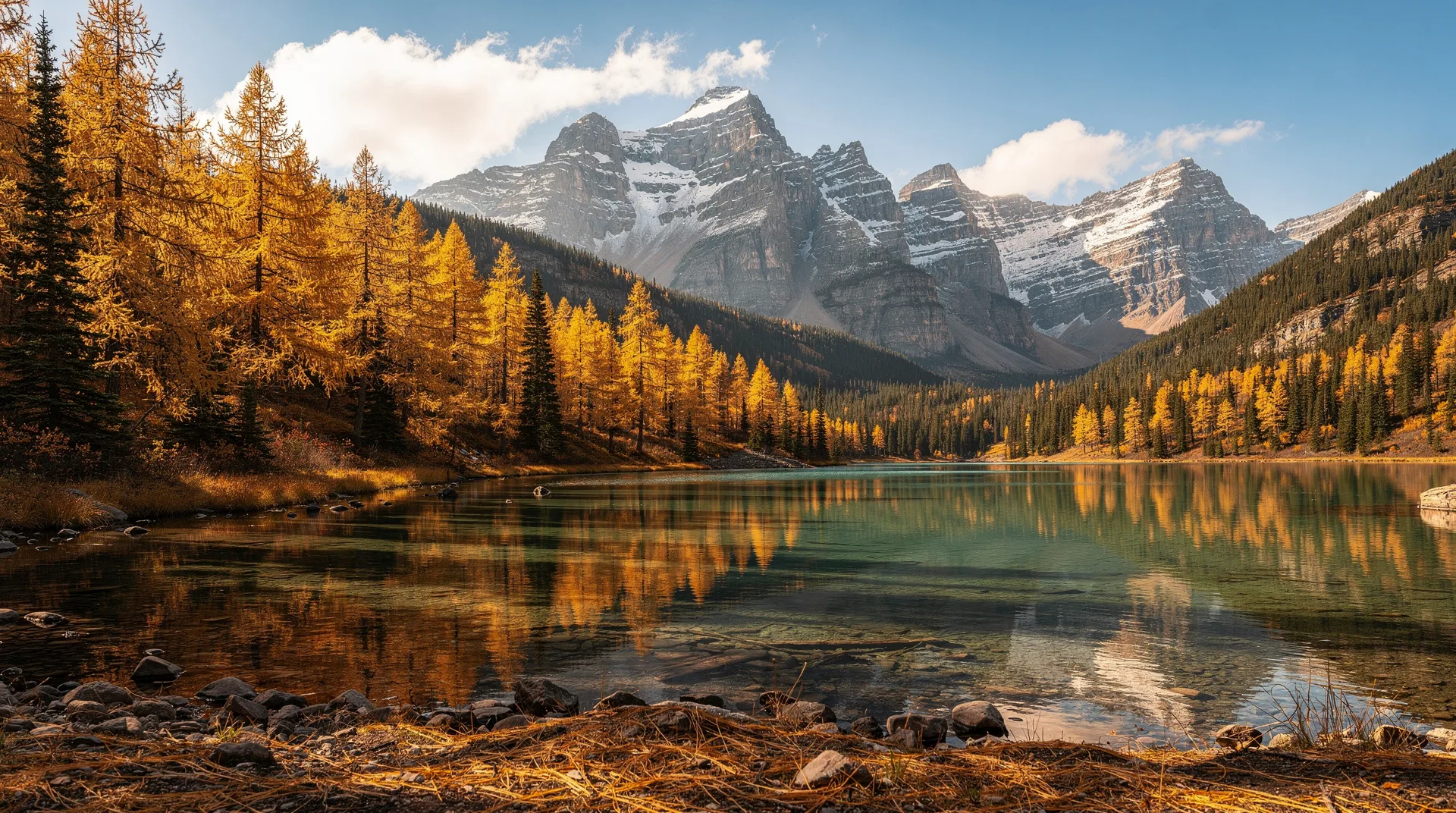
Alberta larch season: when, where and how to see the golden larches
When is larch season in Alberta?
Larch season in Alberta typically peaks in the last two weeks of September, usually September 20-30. The exact window varies by year and elevation. At around 2,200 metres (the Larch Valley above Moraine Lake), the colour peaks approximately 5-7 days earlier than at slightly lower elevations.
| At a glance | |
|---|---|
| Where | High alpine terrain above Banff and Lake Louise, Alberta, mostly 2,000-2,400 m elevation |
| Cost | Free to hike; a park pass is required for Banff National Park, and Larch Valley trips typically add a Moraine Lake shuttle fare of around CAD $10-12 |
| Time needed | A half-day hike minimum (3-6 hours depending on the trail chosen) |
| Getting there | Trailheads reached by car (Sunshine Village, Lake Louise) or by mandatory shuttle (Moraine Lake for Larch Valley) |
| Best time | Roughly September 15-30, peaking around September 20-25 in most years |
Subalpine larch trees are the great autumn surprise of the Canadian Rockies. While most conifers stay green year-round, the subalpine larch (Larix lyallii) is deciduous — it drops its needles every autumn, turning brilliant gold before it does. For two or three weeks each September, the high alpine terrain above Banff and Lake Louise is transformed by thousands of golden larch trees, creating one of the most spectacular autumn colour displays in Canada.
Most visitors to the Rockies come in summer and miss it entirely. Those who time their visit for late September often say it was the most beautiful thing they experienced in Alberta.
What are subalpine larches?
The subalpine larch is a conifer adapted to the harshest high-altitude environments in the Canadian Rockies. It grows above the main treeline at elevations of approximately 2,000-2,400 metres, in areas where most trees cannot survive — on rocky slopes, exposed ridges, and the edges of alpine meadows. The trees grow slowly (some specimens are several hundred years old), typically reaching only 5-10 metres in height.
Unlike most conifers, larches are deciduous. Each autumn, before the high-elevation winter arrives in earnest, the needles turn from green to gold and then drop. The display lasts approximately 2-3 weeks from the first colour change to complete needle drop.
The golden colour — a warm, luminous yellow-gold — is extraordinary against the dark rock faces, white glaciers, and blue sky of the Rockies in late September. Against the turquoise of Moraine Lake visible below, the effect is genuinely remarkable.
When does larch season happen?
Typical timing: Last two weeks of September — approximately September 15-30, peaking around September 20-25 in most years.
The variables: Larch colour timing depends on elevation, precipitation patterns, and temperature. A warm autumn with late first frosts will push the colour into early October. A cold August or early September snowfall accelerates the change and can shift peak colour to mid-September.
Lower elevations: Below the larch zone (below approximately 1,900-2,000 m), the aspens and other deciduous trees turn yellow and orange in early-to-mid October — a different and also worthwhile colour display, more like traditional fall foliage.
How to predict: Follow the Banff National Park social media accounts and the Parks Canada website in September — they post updates on larch colour conditions. Local photographers and hiking forums are equally reliable. The colour at Larch Valley is typically visible (at least beginning) by September 20 in most years.
Best larch viewing locations
Larch Valley — Moraine Lake (the prime location)
Larch Valley is the most famous and most visited larch location in Canada. The trail begins at the Moraine Lake parking area (shuttle access required during peak season) and climbs steeply through forest for the first 2 km before opening into a high cirque filled with larch trees. The combination of the larch gold, the surrounding peaks of the Ten Peaks, and the view back down to the turquoise Moraine Lake visible through the trees is exceptional.
Trail details: 11.6 km return (to Sentinel Pass), 725 m elevation gain. Allow 4-5 hours return. The larch trees are concentrated from approximately km 2 to km 5 of the trail, with the best displays in the Larch Valley cirque itself (km 3-4).
Access: By Parks Canada shuttle from the Lake Louise Park and Ride to Moraine Lake. Shuttle reservations must be pre-booked (see our Moraine Lake shuttle guide). During larch season, demand for shuttle reservations is at its annual peak — book the moment the April reservation window opens. Some organised tours include Moraine Lake access during larch season, and you can compare guided tours across Canada if you want a shuttle-free option.
Best time: Early morning on a clear day. The larch colour is illuminated from the east as the sun rises, and the Moraine Lake viewpoint is at its most vivid in the morning light.
Note: The trail to Sentinel Pass is at high elevation. Snow is possible on the trail from mid-September. Check conditions and dress for cold, with layers, waterproof shell, and warm gloves. The trail is well-used and signed.
Healy Pass — Banff/Sunshine Village area
The Healy Pass trail (18.4 km return, 655 m elevation gain from the Sunshine Village parking area) reaches a high meadow with extensive larch stands and mountain views in multiple directions. Less visited than Larch Valley, it requires a longer walk but rewards with solitude and a wilder atmosphere.
Access: Drive to the Sunshine Village ski area parking lot (20 km west of Banff on Highway 1, then 9 km on the Sunshine Road). The trailhead is at the parking lot.
Best for: Those who want larch colour without the Moraine Lake shuttle logistics or the crowds.
Plain of Six Glaciers and Lake Louise area
The upper sections of the Plain of Six Glaciers trail from Lake Louise enter larch territory above the teahouse, at approximately 2,200 metres. Fewer larch trees here than in Larch Valley or Healy Pass, but the combination of glacier views and larch colour is beautiful.
Access: Lake Louise lakeshore shuttle, then hike 6.9 km to the teahouse and beyond.
Skoki Valley (backcountry)
For those with backcountry camping experience and permits, the Skoki Valley east of Lake Louise has excellent larch stands accessible on the Skoki Valley trail (18 km to Skoki Lodge, various day loop options). The route traverses high alpine terrain through multiple larch zones. Permits are required for overnight stays (see our Parks Canada reservation system guide).
Book guided larch season hikes and Banff autumn toursPtarmigan Valley and Deception Pass — Lake Louise
The Ptarmigan Valley trail (18 km return, 760 m elevation gain) from the Temple viewpoint parking area at Lake Louise reaches high alpine terrain with good larch coverage and few visitors. A challenging full-day outing with excellent wildlife sighting potential for pikas, marmots, and ptarmigan (the latter in their autumn transitional plumage).
Comparing the main viewing locations
| Location | Distance/gain | Crowds | Best for |
|---|---|---|---|
| Larch Valley (Moraine Lake) | 11.6 km, 725 m | Very high | The classic view with the Ten Peaks and Moraine Lake below |
| Healy Pass (Sunshine) | 18.4 km, 655 m | Low-moderate | Solitude with nearly as much larch colour |
| Plain of Six Glaciers (Lake Louise) | 13.8 km+, 365 m+ | High | Combining larches with glacier views on a well-known trail |
| Skoki Valley (backcountry) | 18 km+, permit required | Very low | Multi-day trips and the most remote larch stands |
| Ptarmigan Valley / Deception Pass | 18 km, 760 m | Low | Wildlife (pikas, marmots, ptarmigan) with fewer people |
Larch season and crowds
Larch season has grown dramatically in popularity over the past decade. September was once the “quiet month” after the summer rush; now the last two weeks of September are among the busiest of the year at Larch Valley specifically.
The Moraine Lake shuttle at 6:30-7:00 AM in late September is as competitive as the peak summer shuttles — book months in advance. Parking at the Lake Louise Park and Ride fills early. The Larch Valley trail itself is busy through the day from mid-morning.
How to beat the crowds:
- Book the first shuttle of the day (6:30 AM) and be at the larch zone before 8:30 AM
- Visit on a weekday rather than the weekend if your schedule allows — Thursday or Friday in the final week of September are significantly quieter than Saturday or Sunday
- Consider Healy Pass instead of Larch Valley — the larch display is almost as good and the trail sees a fraction of the foot traffic
- Arrive slightly before peak (September 15-18) if you prefer partial larch colour with fewer people, or slightly after peak (late September/early October) when many visitors have moved on but some colour remains
What else makes late September special in Banff
Larch season coincides with two other outstanding natural events:
Elk rut: September is the peak of the elk rut. Bull elk bugle across the valleys — a haunting, resonant call that carries for kilometres in the clear autumn air. In the Banff townsite, elk are present most mornings and evenings; in the Bow Valley and along the Bow Valley Parkway, encounters with rutting bulls are common. The rut runs approximately September through mid-October.
Reduced crowds: After Labour Day (first Monday of September), crowd levels in Banff drop significantly. Hotels and restaurants become easier to book; parking is more available; the pace of the park is noticeably calmer. The combination of easier access and spectacular conditions makes late September the favourite time of many experienced Banff visitors.
Clear weather: September typically sees a continuation of summer weather patterns — clear, cool days with excellent visibility — before the autumn storms arrive in earnest. Daytime temperatures of 10-18°C are common in early September; cooler (5-12°C) but still often clear by late September.
What to bring for larch season hiking
- Warm layers: Temperatures at 2,200 m in late September can be near or below freezing at dawn, warming to 10-12°C by midday. Merino wool or synthetic base layer, insulating mid-layer, waterproof shell.
- Gloves and hat: Hands get cold on exposed ridges even in mild conditions.
- Waterproof hiking boots: Trails can be muddy or have patches of snow from early frosts.
- Trekking poles: Useful for the steep descent from Sentinel Pass on Larch Valley.
- Bear spray: Bears are active in September preparing for hibernation. Required equipment for all backcountry travel.
- Camera with extra battery: Cold kills batteries faster than you expect. Carry a spare charged battery in an inside pocket.
Getting the logistics right
A Parks Canada park pass is required for all of these hikes since they sit inside Banff National Park — see our Banff park pass guide if you have not bought one yet. If you are combining larch season with a wider stay, our best time to visit Banff guide and Banff in October guide cover what changes once larch season ends and the shoulder season sets in.
Frequently asked questions about Alberta larch season: when, where and how to see the golden larches
How long does larch season last?
The window from first noticeable colour to complete needle drop is approximately 3 weeks. Peak colour — the most vivid gold and the most trees at their best simultaneously — lasts roughly 7-10 days within that window. The exact timing shifts by 1-2 weeks depending on the year’s weather patterns.
Do I need to hike to see the larches?
Yes — subalpine larches grow above the main treeline at 2,000-2,400 m, which requires hiking. There is no road access to the larch zone. The shortest route to a good larch display is the Larch Valley trail from Moraine Lake (approximately 3 km to reach the larch zone). Budget at least 3 hours round trip for a minimal larch experience.
Can I see larches from the Icefields Parkway?
Not in significant quantities. The parkway does not pass through the primary larch zones. Bow Summit (the high point near Peyto Lake) is in the right elevation band but has relatively few larches visible from the road. The main larch displays require hiking.
Is Larch Valley accessible without the Moraine Lake shuttle?
By cycling (11 km from Lake Louise village to Moraine Lake, then hiking from there) or by joining an organised tour that includes Moraine Lake access during larch season. Walking in is also possible via the Moraine Lake connector from Lake Louise (approximately 11 km from the lake shore, a full-day backcountry undertaking). See our Moraine Lake shuttle guide for all options.
What if I miss peak larch colour?
The days just before and after peak are still excellent. Partial gold colour mixed with green needles (pre-peak) and the more muted tone of needles just beginning to drop (post-peak) are both beautiful in different ways. Even a week before peak, the Larch Valley hike is outstanding for the alpine scenery alone, with some colour visible.
Do I need a park pass to hike during larch season?
Yes. All of the trailheads listed here — Larch Valley, Healy Pass, Plain of Six Glaciers, Skoki Valley and Ptarmigan Valley — are inside Banff National Park, so a valid Parks Canada park pass is required. See our Banff park pass guide for current pricing.
For more autumn planning, see our guides on best time to visit Banff, the Moraine Lake shuttle, and our 5-day Banff itinerary.