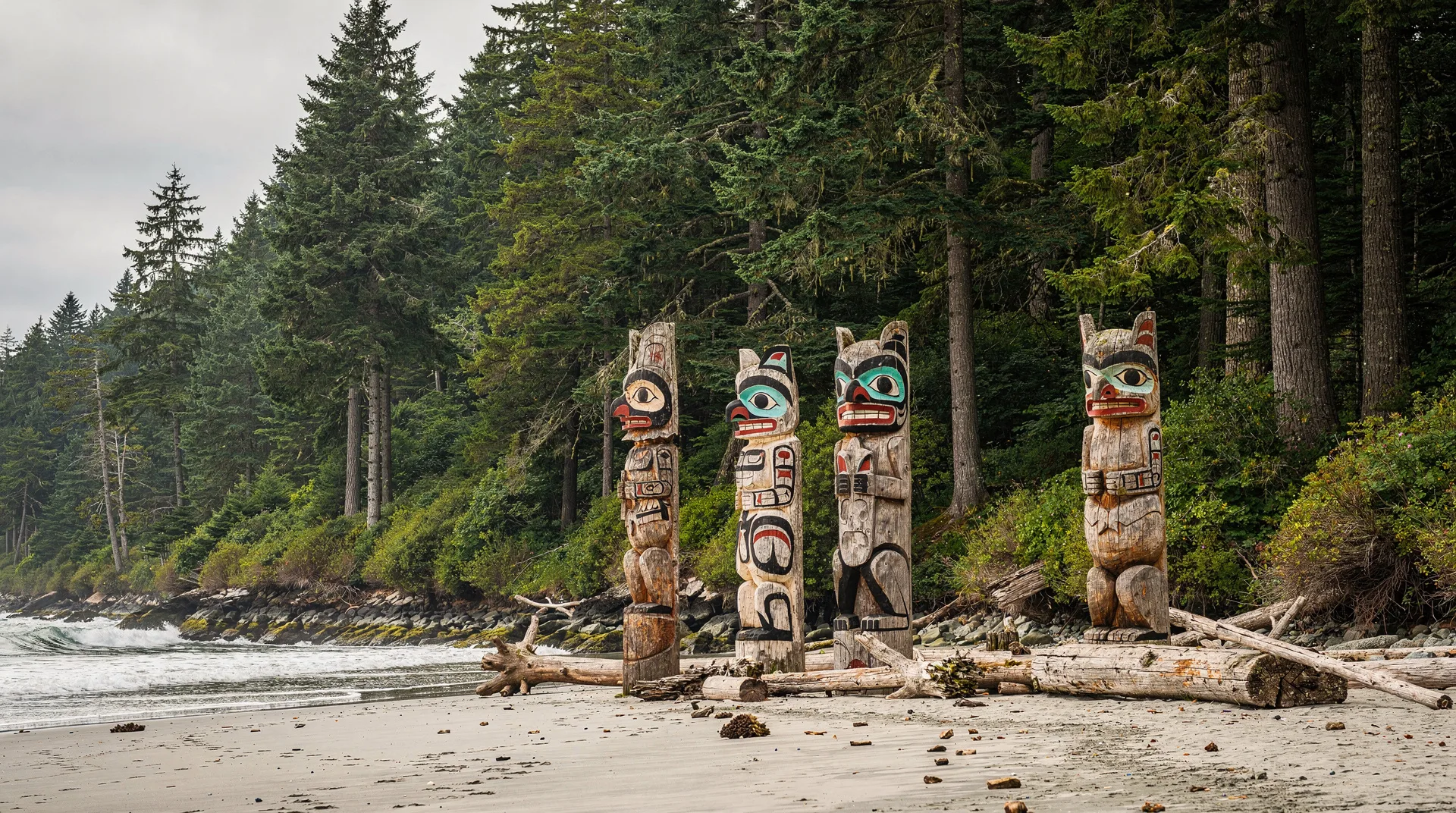
Indigenous tourism in Canada: a respectful visitor's overview
What is Indigenous tourism in Canada?
Indigenous tourism in Canada means experiences owned, operated or meaningfully led by First Nations, Inuit or Métis people. It ranges from cultural centres and heritage sites to food, art, wildlife tours and guided land experiences across every region.
A growing movement with deep roots
Indigenous tourism in Canada has grown rapidly over the past decade, fuelled by both increasing visitor interest and a national conversation about reconciliation, cultural revitalisation, and economic self-determination in Indigenous communities. For visitors, this means unprecedented access to authentic Indigenous-led experiences across the country — cultural centres, guided wilderness tours, traditional food, contemporary art, heritage sites, and homestays — almost all of which did not exist or were inaccessible to mainstream travellers twenty years ago.
This guide is an overview across regions, with a strong emphasis on visiting respectfully, supporting Indigenous-owned operators, and understanding the cultural and historical context that makes Indigenous tourism meaningful rather than superficial.
| Where | Every province and territory — strongest concentrations in BC, Quebec, Manitoulin Island (Ontario) and the North |
| Cost | Cultural centres often CAD 15-30 entry; guided land or wildlife tours from around CAD 80 to several hundred; multi-day northern experiences (floe edge, Churchill) run well into the thousands |
| Time needed | A single cultural centre visit is 2-3 hours; a proper regional focus (Wendake, Manitoulin, Haida Gwaii) deserves 1-3 days |
| Getting there | Most sites are reachable by car from a major city; Haida Gwaii, Nunavut and much of the North require flights and advance planning |
| Best time | Late May to September for most cultural centres and land tours; powwow season runs roughly June-September; some experiences (dog sledding, ice-related) are winter-only |
Understanding who we are talking about
Canada’s Indigenous peoples include three distinct constitutional groups:
First Nations — Diverse peoples living in what is now Canada prior to European contact, with approximately 630 communities and over 50 distinct nations speaking different languages. From the Mi’kmaq of Atlantic Canada to the Haida of BC, First Nations peoples maintain distinct cultures, languages, and territorial connections.
Inuit — Peoples of the Arctic regions of Canada, traditionally living across what are now the four Inuit regions (Nunavut, Nunavik, Nunatsiavut, and the Inuvialuit Settlement Region). Inuktitut remains a living language.
Métis — Peoples of mixed Indigenous and European (primarily French) ancestry with their own distinct culture, history, and political identity, primarily in the Prairies.
The collective term “Indigenous” acknowledges distinctions among these groups while recognising shared experiences and contemporary identities.
Experiences by region
British Columbia
BC has among the richest and most developed Indigenous tourism in Canada.
Haida Gwaii — Remote islands off the northern BC coast, home to the Haida Nation. Gwaii Haanas National Park Reserve requires an orientation session respecting Haida protocols. Watchmen guide visitors at ancient village sites. One of the world’s most spiritually powerful cultural travel experiences.
Spirit Bear country — Tours led by Kitasoo/Xai’xais and other nations along the central coast include wildlife viewing guided by Indigenous knowledge. See Spirit Bear tours.
Squamish and Lil’wat — The Squamish Lil’wat Cultural Centre in Whistler offers excellent introductory cultural experiences, exhibits, and guided tours.
Tofino — Tla-o-qui-aht operators run traditional food and cultural experiences in the Pacific Rim area.
Vancouver Island — Quw’utsun’ Cultural and Conference Centre near Duncan is a strong regional introduction.
See Indigenous experiences BC for a detailed regional breakdown.
Alberta and the Rockies
Painted Warriors (near Sundre, Alberta) — An Indigenous-owned outdoor adventure operator offering wilderness experiences with cultural context.
Head-Smashed-In Buffalo Jump — A UNESCO World Heritage Site interpreting Blackfoot buffalo hunting traditions. See Head-Smashed-In Buffalo Jump.
Metis Crossing (Alberta) — Cultural centre and lodge focused on Métis history and traditions.
Rocky Mountain House National Historic Site — Interprets the fur trade era and relationships with Indigenous peoples.
Prairies
Wanuskewin Heritage Park (near Saskatoon) — A major Indigenous cultural centre on Northern Plains archaeological sites, with experimental bison reintroduction and extensive programming.
Writing-on-Stone Provincial Park (Alberta) — Ancient Blackfoot rock carvings with guided interpretation. See Writing-on-Stone Provincial Park.
Manitoulin Island (Ontario) — Home to multiple Anishinaabe and Ojibwe communities. Great Spirit Circle Trail is an Indigenous tourism cooperative with powwows, cultural experiences, and homestays.
Ontario
Manitoulin Island (see above) — Ontario’s strongest Indigenous tourism destination.
Six Nations of the Grand River (near Hamilton) — One of Canada’s largest First Nations reserves, with cultural events and educational tours.
Fort William Historical Park (Thunder Bay) — Reconstructed fur trade post with strong Indigenous content.
Wikwemikong (Manitoulin Island) — Annual powwow each August is one of Canada’s largest.
Quebec
Odanak (near Trois-Rivières) — Abenaki community with cultural museum and traditional food experiences.
Wendake (near Quebec City) — Huron-Wendat community with Hotel-Musée Premières Nations, an Indigenous-owned hotel and museum; cultural experiences widely available.
Mashteuiatsh (Lac Saint-Jean) — Innu community with museum and guided experiences.
See Indigenous tourism Quebec and Quebec First Nations guide for detail.
Atlantic Canada
Mi’kmaq experiences (Nova Scotia and New Brunswick) — Cultural centres in Millbrook and Burnt Church offer introductions. Membertou Heritage Park in Cape Breton is a standout visit.
Beothuk Interpretation Centre (Newfoundland) — Interpretive site for the tragic history of the Beothuk people.
Norstead and L’Anse aux Meadows (Newfoundland) — Norse-era Indigenous contact site with both Viking and Indigenous content.
The North
Floe edge tours (Nunavut) — Inuit-guided expeditions at the edge of the sea ice, combining wildlife (narwhal, polar bear, beluga, seabirds) with Inuit culture. See floe edge tours Nunavut and narwhal viewing Nunavut.
Great Slave Lake and Yellowknife — Dene and Métis experiences including cultural tours, traditional food, and winter activities.
Yukon and Whitehorse — First Nations of Yukon tourism has grown rapidly, with experiences from Champagne and Aishihik, Kluane First Nation, and others. Kwanlin Dün Cultural Centre in Whitehorse is an excellent introduction.
Inuvik and the Mackenzie Delta — Inuvialuit experiences on the Arctic coast.
Types of experiences
Cultural centres and museums. The most accessible starting point — interpretive exhibits, sometimes guided tours, often with traditional food options. Found in most regions.
Guided land tours. Wildlife viewing, hiking, canoeing, and other outdoor activities guided by Indigenous people sharing traditional knowledge. Often the most meaningful experiences.
Food experiences. Traditional foods (bannock, fish, game), contemporary Indigenous cuisine (Kekuli Café in BC, Salmon n’ Bannock in Vancouver, Bannock in Toronto), and sometimes hands-on food preparation.
Powwows and cultural events. Public events where visitors can observe (and sometimes participate with permission) in traditional dance, song, and ceremony. See powwow experiences in Canada.
Art and craft. Contemporary Indigenous art is one of Canada’s strongest cultural exports — Inuit sculpture, Haida carvings, Woodland School painting, and contemporary works by artists like Norval Morrisseau and Kent Monkman are collected globally.
Homestays and community visits. Available in some communities on Manitoulin Island, Haida Gwaii, and elsewhere. Requires advance arrangement and genuine cultural preparation.
Browse Vancouver Indigenous culture toursHow to book authentic experiences
Indigenous Tourism Association of Canada (ITAC) maintains a directory of authenticated Indigenous-owned operators. This is the single best source.
Provincial Indigenous tourism associations (Indigenous Tourism Ontario, Indigenous Tourism BC, Indigenous Tourism Alberta, etc.) all maintain directories.
Ask directly about ownership. Many “Indigenous-themed” experiences are operated by non-Indigenous businesses. Authentic Indigenous tourism means Indigenous-owned, Indigenous-led, or significantly Indigenous-revenue-sharing operations.
Book in advance. Many experiences are small-scale, seasonal, and booked well in advance. Aim for 2-3 months lead time for popular experiences.
Cultural etiquette
Photography. Always ask before photographing people, ceremonies, or sacred objects. Many ceremonies prohibit photography entirely. Landscape and public-area photography is usually fine.
Respectful curiosity. Ask questions genuinely and respectfully. Indigenous hosts and guides are generally happy to share knowledge. Avoid treating cultural practices as novelties.
Acknowledge land. Many experiences begin with a land acknowledgement identifying the traditional territory. Listen and acknowledge this sincerely.
Be prepared to be moved. Residential school history, historical trauma, and contemporary struggles often come up. Engage thoughtfully.
Do not appropriate symbols. Wearing stylised Indigenous jewellery or headdresses is not appropriate except when invited as part of a specific ceremony.
Tipping. Standard Canadian tipping applies (15-20% at meals). Supporting Indigenous-owned businesses financially is itself a form of respect.
Alcohol. Many Indigenous communities have restrictions or preferences around alcohol. Respect local norms.
Find authentic Canadian cultural toursRecommended starter itineraries
BC Indigenous week (7 days):
- Days 1-2: Vancouver — Museum of Anthropology, Salmon n’ Bannock dinner
- Days 3-4: Haida Gwaii flight and orientation, village visits with Watchmen
- Days 5-7: Return via Squamish Lil’wat Cultural Centre en route to Whistler
Ontario-Quebec Indigenous experience (7 days):
- Days 1-2: Toronto — Royal Ontario Museum First Peoples galleries, Bannock restaurant
- Days 3-4: Manitoulin Island — Great Spirit Circle Trail, Wikwemikong
- Days 5-7: Wendake (Quebec City area) with Hotel-Musée Premières Nations
Northern Indigenous experience (7-10 days):
- Whitehorse — Kwanlin Dün Cultural Centre, First Nation cultural experiences
- Yellowknife — Dene experiences, Great Slave Lake tours
- Optional Nunavut floe-edge expedition (high-end, bucket list)
Planning a trip that puts Indigenous experiences at the centre
Most visitors currently treat Indigenous tourism as a single add-on stop within a larger trip — an afternoon at a cultural centre bolted onto a Rockies or Quebec City itinerary. That works, but a trip built around 2-3 regional anchors goes much deeper. Good combinations: Haida Gwaii paired with a Vancouver stopover; Wendake and Kahnawà:ke paired with Quebec City and Montreal; Manitoulin Island paired with Toronto and Georgian Bay. Building the itinerary around the Indigenous experience, rather than squeezing it into spare hours, changes the pace — and most of the strongest guides warn against rushing a cultural centre visit in under 90 minutes.
Budgeting time and money realistically. A cultural centre entry is usually inexpensive (comparable to a small regional museum), but the experiences that stay with people longest — a guided land tour, a Watchmen-led village visit on Haida Gwaii, a floe-edge expedition in Nunavut — cost more and need to be booked well ahead. Treat the cultural centres as the accessible entry point and the guided, land-based experiences as the splurge worth saving for.
Combining with mainstream sightseeing. Indigenous tourism sits naturally alongside general touring rather than competing with it. A day in Whistler or the Canadian Rockies pairs easily with a half-day at the Squamish Lil’wat Cultural Centre; a Toronto city break pairs with a Manitoulin Island detour if you have a car. See Indigenous experiences BC for how to slot BC options into a west-coast route.
Context you should know
Residential schools. Between 1870 and 1997, Indigenous children were systematically removed from families and placed in church-run schools where abuse and cultural destruction were widespread. This is recent history with living survivors. Many cultural centres and heritage sites include residential school education.
Truth and Reconciliation. The 2015 Truth and Reconciliation Commission’s 94 Calls to Action have shaped federal policy and public conversation. National Day for Truth and Reconciliation (September 30) is a federal statutory holiday.
Treaty and unceded territories. Most of southern Canada is covered by historical treaties; most of BC is unceded territory (treaties were never signed). This shapes contemporary legal and political context.
Contemporary challenges. Many Indigenous communities face drinking water issues, housing shortages, and health disparities. Tourism revenue can directly support community wellbeing.
Frequently asked questions about Indigenous tourism in Canada: a respectful visitor’s overview
What is the difference between First Nations, Inuit, and Métis?
First Nations are the original peoples of what is now Canada south of the Arctic. Inuit are the original peoples of the Arctic regions. Métis are peoples of mixed Indigenous-European heritage with their own distinct culture. The three are recognised together as Canada’s Indigenous peoples.
Can non-Indigenous people attend powwows?
Yes — many powwows welcome respectful visitors. Grand Entry and sacred dances have protocols; observation is fine but participation requires invitation. See powwow experiences in Canada.
Is it appropriate to buy Indigenous art?
Yes, when purchased directly from Indigenous artists or from authenticated dealers. Avoid mass-market “Indigenous-inspired” items that do not benefit Indigenous people.
How do I know if an operator is authentically Indigenous-owned?
The Indigenous Tourism Association of Canada’s directory authenticates operators. Provincial associations do the same. Ask directly about ownership when booking.
Are Indigenous tourism experiences expensive?
They range widely — from free cultural centres to multi-day wilderness expeditions that can cost thousands. Most guided experiences are priced comparably to equivalent non-Indigenous tours.
Can I visit a reserve as a tourist?
Some yes, some no. Many communities welcome visitors through organised tourism programmes; others prefer privacy. Work with Indigenous tourism organisations to identify welcoming communities.
Should I feel guilty about Indigenous tourism?
No — Indigenous-led tourism is explicitly designed for respectful visitor engagement and community benefit. Booking authentic experiences supports reconciliation and cultural revitalisation.
Where can I learn more before I go?
The Truth and Reconciliation Commission’s final report, Thomas King’s The Inconvenient Indian, and Bob Joseph’s 21 Things You May Not Know About the Indian Act are accessible starting points. The National Film Board of Canada’s online Indigenous film collection is excellent.
Do I need to book Indigenous experiences far in advance?
It depends on the experience. Cultural centres and museums are largely walk-in. Guided land tours, Haida Gwaii village visits and floe-edge expeditions are small-scale and seasonal, so book weeks to months ahead, especially for a July-August trip.
Can Indigenous tourism be combined with a Rockies or Quebec trip?
Yes, easily. Squamish Lil’wat Cultural Centre sits directly on the route to Whistler, and Wendake is a short detour from Quebec City — both slot into a standard itinerary without adding a full extra day.