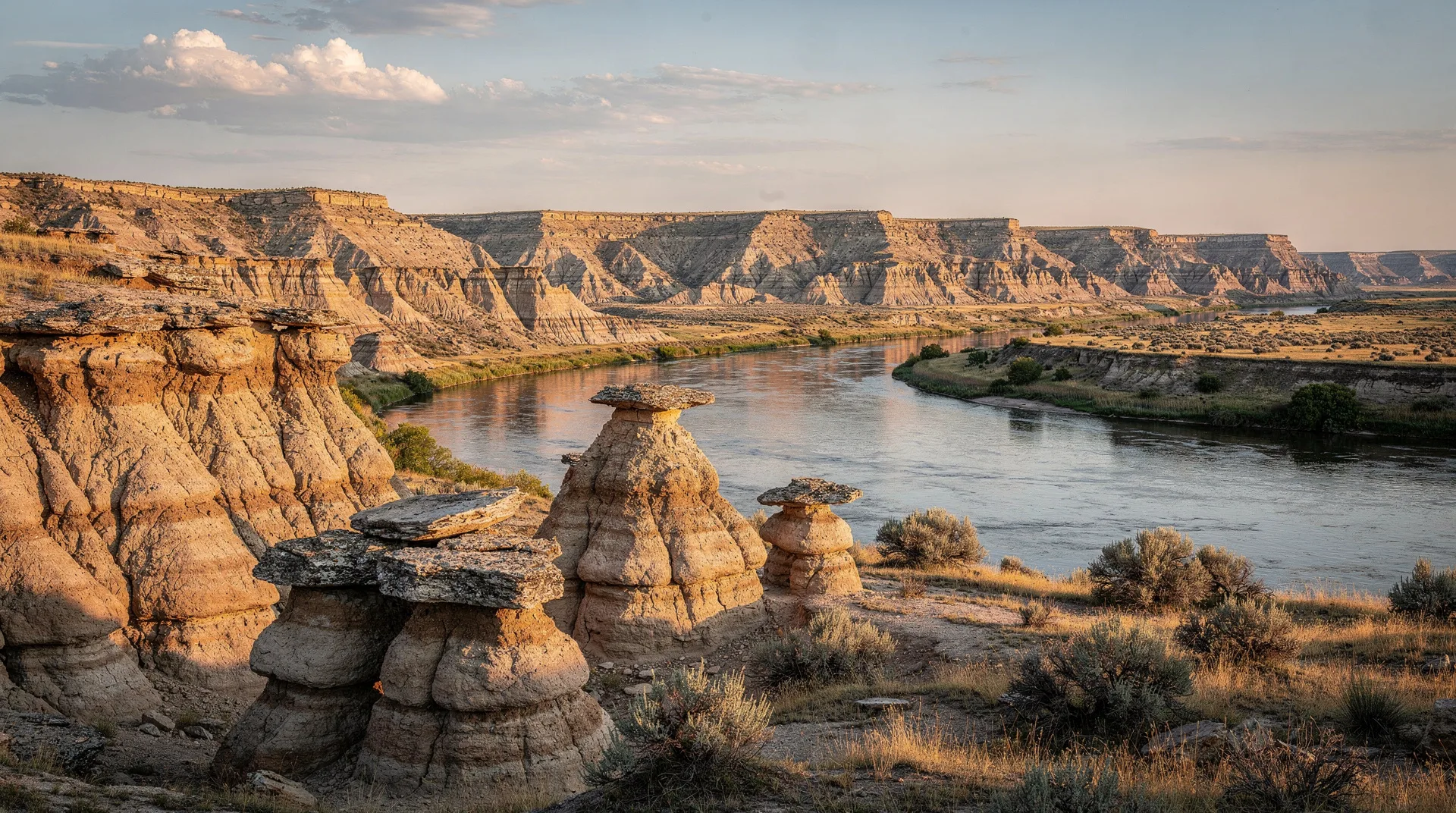
Writing-on-Stone Provincial Park: sacred landscape guide
What is Writing-on-Stone Provincial Park known for?
Writing-on-Stone is a UNESCO World Heritage Site in southern Alberta, sacred to the Blackfoot people, containing the largest concentration of Indigenous rock art (petroglyphs and pictographs) on the Great Plains of North America. The park also features dramatic hoodoo formations along the Milk River.
Few places in Canada carry as much spiritual weight as Writing-on-Stone Provincial Park (Áísínai’pi in Blackfoot, meaning “it is written” or “written on rock”). This remarkable park in extreme southern Alberta — less than 30 kilometres from the Montana border — sits along the Milk River in a valley of wind-carved sandstone hoodoos and dramatic coulees, and it contains the largest concentration of Indigenous rock art on the North American Great Plains.
The park was inscribed as a UNESCO World Heritage Site in 2019, recognising its outstanding universal value as a sacred landscape of the Blackfoot Confederacy. The petroglyphs and pictographs on the sandstone walls here were carved and painted over centuries by Blackfoot peoples — documenting battles, ceremonies, visions, and the spiritual relationship between humans and the land. The site remains deeply sacred to the Siksika, Kainai, Piikani, and Aamsskáápipikani nations today.
For travellers exploring southern Alberta, Writing-on-Stone is a singular destination — one of the most unique natural and cultural sites in the country, and still significantly undiscovered by international tourism.
At a glance
| Where | Extreme southern Alberta, about 100 km east of Lethbridge, near the Montana border |
| Cost | Alberta Parks day-use fee applies; guided rock art tours are booked separately at the visitor centre |
| Time needed | A half day covers the Hoodoo Trail and a guided rock art tour; a full day allows both plus the visitor centre |
| Getting there | Self-drive only, around 3.5-4 hours from Calgary or 1.5 hours from Lethbridge; no public transport |
| Best time | Late May to early September, when the visitor centre and guided tours run daily |
Location and how to get there
Writing-on-Stone Provincial Park is located approximately 100 kilometres east of Lethbridge and 220 kilometres southeast of Calgary. The park’s nearest town is Milk River, 26 kilometres north on Highway 4.
From Calgary: Drive south on Highway 2 to Lethbridge (2.5 hours), then east on Highway 4 toward Milk River. From Milk River, follow secondary road 501 east approximately 26 kilometres to the park entrance. Total journey: approximately 3.5–4 hours.
From Lethbridge: East on Highway 4 to Milk River, then south on Highway 4 and east on Road 501. Total: approximately 1.5 hours.
The park sits in an area with no fuel services nearby. Fill your tank in Lethbridge or Milk River before driving to the park.
The rock art
The park’s rock art is its most important feature — the primary reason UNESCO recognised this landscape and the reason it remains sacred to the Blackfoot people.
The carvings and paintings on the sandstone walls of the Milk River valley number in the thousands and date from approximately 500 years ago to the early 20th century. Subjects include warriors on horseback and on foot, hunting scenes, ceremonial figures, shields, weapons, and abstract geometric forms. Some images depict events that can be correlated with oral histories — specific battles, ceremonies, or encounters with powerful spiritual forces.
Access to the rock art is managed carefully to protect both the irreplaceable carvings and the sacred nature of the site. Access is via guided tours only — self-guided access to the main petroglyph site is not permitted. Parks rangers and Indigenous cultural interpreters lead tours departing from the visitor centre, typically multiple times daily in summer.
The guided tour experience is genuinely excellent. The interpreters — who include Blackfoot cultural knowledge keepers — provide context that transforms the experience from looking at marks on stone to understanding a living cultural record. This is not a museum display; it is a sacred landscape that remains in active use.
Book guided tours in advance at the Alberta Parks website during summer, as tours fill on busy weekends.
Hoodoos and landscape
Beyond the rock art, Writing-on-Stone contains one of the finest hoodoo landscapes in southern Alberta. The Milk River has carved through the soft sandstone and clay formations of the area, leaving behind wind and water-sculpted pillars, balancing rocks, and layered canyon walls in shades of cream, ochre, and rust.
The landscape feels genuinely otherworldly — different from the mountain hoodoos of Drumheller to the north, with a flatter, more arid character that recalls the American Southwest. The cottonwood trees along the Milk River provide shade and a vivid green contrast against the pale stone.
Hoodoo Trail: A short (2.5 km return) self-guided interpretive trail loops through the hoodoo formations from the main campground area. This trail does not require a guided tour and can be hiked independently. The trail provides excellent views of the hoodoos and the river valley. Interpretive signs explain the geology of the formations and the ecology of the riparian zone.
Wildlife in the park
Writing-on-Stone sits in the northern Great Plains ecosystem — a very different ecological zone from the mountains to the west. Wildlife reflects this:
Prairie rattlesnakes are present in the park and are something to be aware of, particularly on warm days when they sun themselves on rocks. Stay on marked trails, watch where you step, and never attempt to handle or approach a rattlesnake. Rattlesnake encounters in the park are not uncommon but bites are extremely rare when visitors exercise normal caution.
White-tailed deer are frequently seen along the Milk River corridor, particularly in early morning and evening. Mule deer inhabit the drier upland areas.
Prairie falcons and red-tailed hawks soar above the canyon walls. The riparian zone attracts a remarkable diversity of songbirds during spring migration — the park is known among birders as one of the best May birding locations in Alberta.
Burrowing owls — a species at risk in Canada — have been documented in the grassland areas around the park. Their ground-nesting habits make the park’s intact prairie ecosystem particularly important for their survival.
Camping at Writing-on-Stone
The park has a campground with 76 sites (both tented and RV sites with hookups), set among the cottonwood trees along the Milk River. Camping here is outstanding — the night skies are exceptionally dark (the park is within a designated dark sky preserve area), the sound of the river carries through the camp, and morning fog in the river valley creates a beautiful atmosphere.
Book well in advance for summer weekends through the Alberta Parks reservation system. The campground also has kitchen shelters, flush toilets, and playground facilities.
Camping tip: The park’s position in extreme southern Alberta makes it genuinely hot in summer (daytime temperatures of 30–35°C are common in July and August) but evenings cool pleasantly. Bring shade and sun protection; the hoodoo landscape offers little natural shade during peak sun hours.
Respectful visiting: why this is not a typical provincial park stop
Writing-on-Stone asks more of visitors than most Alberta parks, and that is by design. The rock art and the landscape it sits in remain sacred and actively used by the Blackfoot Confederacy — this is not a preserved relic but a living cultural site. Approaching it with the same casual energy as a scenic pullout misses the point of the place.
Practically, this means: stay with your guide on rock art tours rather than wandering ahead for a better photo angle, avoid touching any carved or painted surface (skin oils accelerate deterioration of markings that have survived centuries), and listen for the cultural context the interpreters provide rather than treating the tour as a quick checklist item. Visitors who slow down and engage with the interpretation consistently describe Writing-on-Stone as one of the most moving stops in southern Alberta — more so than the dramatic hoodoos alone would suggest.
If you are also interested in Indigenous tourism elsewhere in the province, the Indigenous culture in Canada guide and powwow experiences guide provide useful context before or after a Writing-on-Stone visit.
Combining Writing-on-Stone with a southern Alberta road trip
Writing-on-Stone pairs naturally with other southern Alberta heritage destinations as part of a 3–5 day road trip:
Head-Smashed-In Buffalo Jump (95 km west near Fort Macleod) — another UNESCO World Heritage Site, celebrating the Indigenous buffalo hunting practice of the Blackfoot people over 5,700 years
Lethbridge and the Nikka Yuko Japanese Garden (100 km west) — an unexpected cultural gem in downtown Lethbridge
Dinosaur Provincial Park (220 km northeast) — UNESCO World Heritage Site with the world’s richest Cretaceous fossil deposits
Waterton Lakes National Park (210 km northwest) — the Canadian section of Waterton-Glacier International Peace Park, UNESCO site, and one of Canada’s most beautiful national parks
This circuit of southern Alberta UNESCO sites is one of the most compelling and undervisited travel routes in western Canada. No competitor affiliate site has packaged it comprehensively.
Book guided southern Alberta and Indigenous heritage tours from CalgaryPractical information
Entry fee: A day use fee applies (Alberta provincial park). Annual park passes for Alberta parks can be purchased at the visitor centre.
Visitor centre: Open daily from Victoria Day (late May) through Labour Day; reduced hours in shoulder season. The visitor centre provides maps, trip planning assistance, guided tour bookings, and cultural interpretation.
Facilities: Visitor centre, campground, flush toilets (in campground), pit toilets (at day use area). No food service — bring all supplies.
Accessibility: The Hoodoo Trail and some picnic areas are accessible. The guided rock art tours involve uneven terrain and are not accessible to wheelchairs.
Pets: Permitted in the campground and some day use areas on leash. Not permitted on guided rock art tours.
Photography: Photography of the hoodoo landscape and river valley is permitted. Photography of the sacred rock art should be done with sensitivity — ask your guide for appropriate practice.
Frequently asked questions
Do I need to book the guided rock art tour in advance?
It is strongly recommended in summer. Tours depart from the visitor centre multiple times daily between late May and Labour Day, and weekend slots can fill, particularly in July and August. Booking ahead through the Alberta Parks website guarantees a spot; walk-up availability exists but is not reliable on busy days.
Can I visit Writing-on-Stone as a day trip from Calgary?
Yes, though it makes for a long day — around 3.5-4 hours each way, so 7-8 hours of driving alone. Most visitors who want more than a rushed visit combine it with an overnight in Lethbridge, at the park campground, or as part of a wider southern Alberta loop with Head-Smashed-In Buffalo Jump and Waterton Lakes National Park.