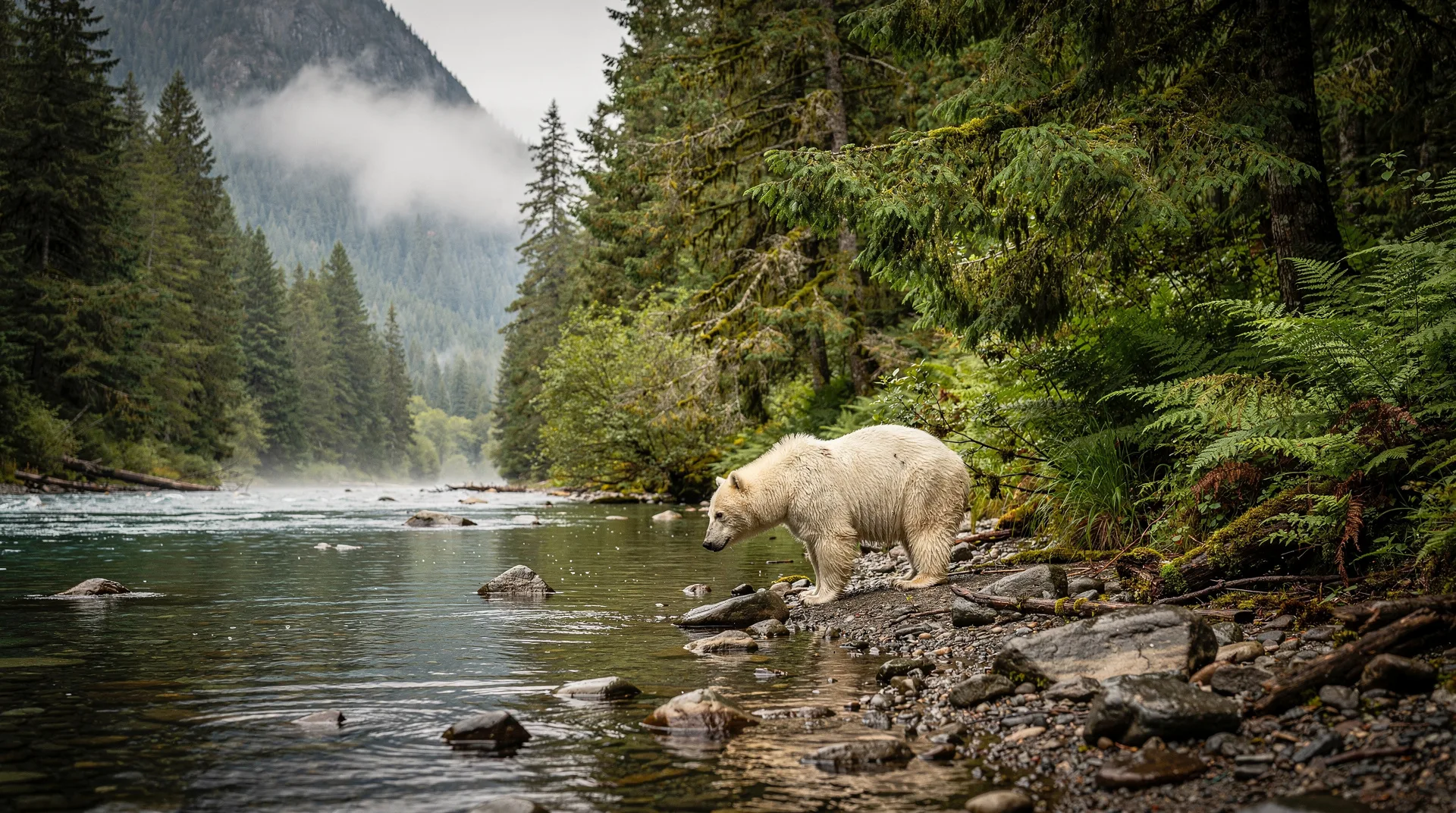
Spirit bear tours BC: finding the Kermode bear
Where can I see a spirit bear in BC?
Spirit (Kermode) bears are found only in the Great Bear Rainforest of BC's central and north coast, particularly on Princess Royal Island and Gribbell Island. The best access is through lodge-based wildlife tours operating from Bella Bella, Klemtu, or by small ship from Prince Rupert. The season is late August through mid-October during salmon runs.
| At a glance | |
|---|---|
| Where | Great Bear Rainforest — Princess Royal Island and Gribbell Island, BC central/north coast |
| Cost | Around CAD 2,500-4,000/person for a 3-day lodge tour |
| Time needed | Minimum 3 days; 5-7 days for a fuller expedition |
| Getting there | Floatplane from Vancouver (around 2 hrs) or BC Ferries from Port Hardy |
| Best time | Late August through mid-October, during the salmon run |
The spirit bear — Moksgm’ol in the Tsimshian language of the Gitga’at people, Kermode bear in the scientific record — is one of the rarest and most extraordinary wildlife encounters in North America. It is a black bear, genetically, but one that carries a recessive gene producing white or cream-coloured fur in approximately 10–20% of individuals in specific island populations. On Princess Royal Island and Gribbell Island in BC’s Great Bear Rainforest, spirit bears fish for salmon in clear coastal streams while the ancient temperate rainforest rises above them. They exist nowhere else on earth.
Seeing a spirit bear in the wild requires real commitment. There is no road that takes you to Great Bear Rainforest territory. No day trip from a major city. The journey involves floatplanes, small ships, or water taxis into one of the most remote coastal wildernesses in Canada. But for those who make it, the encounter — a white bear fishing in a salmon stream, surrounded by 800-year-old Sitka spruce, with the sounds of the rainforest and the smell of the ocean and decomposing salmon in the air — is one of the most profound wildlife experiences available anywhere.
What is a spirit bear?
The Kermode bear is not an albino — it lacks the pink eyes and complete pigment absence of true albinism. Rather, it carries two copies of a specific recessive allele that inhibits melanin production in the fur while leaving the nose, eyes, and skin normally pigmented. The result is a white or cream-coloured bear with dark eyes.
First Nations communities of the coast have known about and revered the spirit bear for thousands of years. The Gitga’at, Gitxaała, Wuikinuxv, and other coastal First Nations regard the Moksgm’ol as a sacred creature, connected to the ancestral time when the world changed from ice to forest. Some traditions hold that Raven made every tenth black bear white as a reminder of the glaciers.
The gene that produces the white colouration appears to be maintained in the population — despite the bears’ visibility making them seem disadvantaged for predation, research suggests spirit bears may actually catch more salmon than their black-coated counterparts. In clear-water streams in daylight, the white colouring is thought to reduce the shadow cast on the stream bottom by the approaching bear, making them less detectable to salmon.
Where spirit bears live
Spirit bears are found only in specific populations on the BC central and north coast. The highest concentrations are on Princess Royal Island (the largest island in the Great Bear Rainforest) and Gribbell Island, both accessible only by small boat or floatplane.
The reason these island populations have maintained the white gene is genetic isolation — the bears on these islands interbreed largely among themselves, and the recessive gene can persist in high frequency in a small, isolated population. On the mainland, where black bears are the majority and gene flow is unrestricted, the white gene is quickly diluted.
Estimates suggest there are approximately 100–400 spirit bears in existence, though the number is difficult to count precisely. BC law prohibits the hunting of spirit bears — they cannot be legally killed by hunters in BC, one of the few absolute protections given to an animal subspecies.
Great Bear Rainforest
The Great Bear Rainforest occupies approximately 6.4 million hectares of the BC coast between the northern tip of Vancouver Island and the Alaska border. In 2016, the BC government announced permanent protection of roughly one-third of the rainforest and sustainable management standards for the rest — the result of decades of advocacy by environmental organisations, First Nations, and international pressure.
The ecosystem is extraordinary in its own right. Old-growth Sitka spruce and western red cedar trees up to 1,000 years old. Salmon streams that feed nutrients from the ocean into the forest through bear, eagle, and wolf predation — the literal connection between marine and terrestrial ecosystems. Coastal wolves that swim between islands. Grizzly bears, black bears, and spirit bears sharing the same salmon streams. Humpback whales in the offshore channels. Pacific white-sided dolphins, Steller sea lions, and enormous variety of seabirds.
How to book a spirit bear tour
The practical access points for spirit bear tours are:
Klemtu and Spirit Bear Lodge: The Kitasoo/Xai’xais First Nation operates Spirit Bear Lodge in Klemtu, accessible by floatplane from Vancouver or by BC Ferries’ Discovery Coast Passage from Port Hardy. This is one of the most directly managed and community-benefiting Indigenous ecotourism operations in BC. Packages are multi-day and combine bear viewing with cultural experiences.
Bella Bella (Heiltsuk Nation): Bella Bella is accessible by BC Ferries from Port Hardy and by floatplane. Several tour operators work out of Bella Bella for Great Bear Rainforest experiences, and the Heiltsuk Nation is actively involved in wildlife tourism management in the surrounding area.
Small ship expeditions: Several small expedition ship operators (typically 8–16 passengers) run multi-day or multi-week Great Bear Rainforest cruises from Prince Rupert or Vancouver. These itineraries combine spirit bear viewing with grizzly bear watching, whale watching, and cultural site visits. They provide the deepest experience but are the most expensive option.
Floating lodges: Some operators use floating lodges (barges converted to accommodation) moored in remote inlets, which provide a base for daily wildlife excursions by Zodiac. These offer flexibility and allow access to areas that cannot be reached by small ship.
Browse wildlife and nature tours across Canada on GetYourGuideBest season for spirit bear viewing
Late August–mid-October is the optimal window, coinciding with the Pacific salmon run in the coastal streams of Princess Royal Island and surrounding areas.
Bears concentrate at salmon streams during the run, providing the most reliable sightings and the most dramatic viewing conditions — bears fishing in clear water, surrounded by salmon, with old-growth forest as the backdrop. The fall timing also means some colour change in the deciduous understorey and relatively settled weather.
Earlier in summer (June–July), bears are present but dispersed across a wider landscape and harder to locate. The salmon run concentrates wildlife dramatically.
What a tour involves
A spirit bear viewing session typically involves:
- Travel by boat or Zodiac up a salmon stream or inlet to a known bear area
- Waiting quietly on a designated viewing platform or riverbank (guides know where to position)
- Bears fishing: Black bears, grizzly bears, and spirit bears often share the same streams and are seen fishing side by side
- Photography: The bears are accustomed to viewers on the established platforms and approach remarkably closely — 5–20 metres is common. Professional cameras with 100–400mm lenses produce extraordinary images.
- Guide interpretation: Indigenous guides typically lead these tours, combining wildlife knowledge with cultural and ecological storytelling that enriches the experience
Sessions typically run 3–5 hours (a morning session, a return to the lodge for lunch, and an afternoon session in the same or different location).
Responsible wildlife viewing
The spirit bear’s rarity and cultural significance place a particular responsibility on tourism operators and visitors. The best operations:
- Limit group sizes to 4–8 people per session
- Use designated viewing platforms that do not require approaching bears off-trail
- Follow strict no-food protocols near wildlife
- Are led by Indigenous guides with community connection to the bears and the land
- Use revenue to directly fund First Nations governance and conservation
Avoid operations that promise spirit bear sightings with large groups, that do not mention Indigenous partnership, or that operate from outside the region without community connection.
Costs
Spirit bear tours are premium wildlife experiences. Prices reflect the remoteness, small group sizes, and operational costs of running in the Great Bear Rainforest.
| Package type | Typical cost (CAD) |
|---|---|
| 3-day lodge-based tour (Klemtu) | $2,500–4,000/person |
| 5-day lodge-based tour | $4,500–7,000/person |
| Small ship expedition (7–10 days) | $8,000–15,000/person |
| Floatplane access (each way) | $400–800 per person |
Many packages include floatplane transfers, all accommodation, meals, and guiding. Some require you to reach the departure point (Vancouver or Prince Rupert) independently.
Combining spirit bears with other Great Bear Rainforest wildlife
The Great Bear Rainforest is not a single-species destination. A spirit bear trip will likely also include:
- Grizzly bears (sharing salmon streams with spirit bears and black bears)
- Wolves (coastal wolf sightings are regular in some areas — see the grizzly bear viewing guide for related context)
- Humpback whales (in the offshore channels — extremely common)
- Orcas (transient pods in the channels and offshore)
- Bald eagles (present in enormous numbers during salmon runs)
- Indigenous cultural sites (totem poles, village sites, burial grounds — properly visited with Indigenous guides)
Planning around the rest of a BC trip
The Great Bear Rainforest is remote enough that most visitors treat a spirit bear tour as a standalone expedition rather than a stop on a wider itinerary — the floatplane or ferry access points (Vancouver, Prince Rupert, Port Hardy) are themselves multi-hour journeys from the rest of BC. If you’re combining this with a broader trip, Vancouver Island makes a natural bookend before or after, since Port Hardy sits at the island’s northern tip. Travellers building a longer BC wildlife itinerary sometimes pair a spirit bear trip with grizzly bear viewing in the Bella Coola or Knight Inlet area, on a separate leg rather than the same days.
Other wildlife and regions to pair with the coast
A spirit bear expedition suits travellers who already care about wildlife, and the rest of the country offers plenty of ways to extend that interest. The bear watching in Canada guide compares the main bear destinations, while the Canadian wildlife guide and the wildlife itineraries help you think about what else to fit around a coastal trip. For a very different bear story, the Churchill polar bears guide covers the far north, and the Great Bear Rainforest destination page gives more background on the region itself.
If your route continues down the coast, the Prince Rupert page is useful for understanding the northern departure point, and the Vancouver Island destination page covers the southern bookend. The Inside Passage ferry guide is worth reading if you like the idea of arriving by water rather than by air.
Respecting the wildlife and the people
Because the experience depends on the goodwill of coastal communities, it is worth reading the Canada wildlife safety guide before you go, and the Indigenous tourism in Canada overview to understand why community-led operators matter. Travelling in a way that supports local governance is part of the point of the trip, not an optional extra.
Lodge-based vs small ship: which to choose
| Format | Group size | Cost | Best for |
|---|---|---|---|
| Lodge-based (Klemtu, Bella Bella) | Small, fixed lodge groups | CAD 2,500-7,000/person, 3-5 nights | Deepest single-location experience, strongest Indigenous community connection |
| Small ship expedition | 8-16 passengers | CAD 8,000-15,000/person, 7-10 days | Broadest wildlife range (whales, orcas, multiple bear species) across several sites |
| Floating lodge | Small, moored barge | Varies, typically multi-day | Flexibility to reach areas boats and fixed lodges can’t |
Related guides
- Grizzly bear viewing in BC guide — for brown bear context and comparison
- Indigenous cultural experiences in BC — for the cultural dimension of Great Bear Rainforest visits
- Whale watching in Victoria — for cetacean watching accessible from a major city
Frequently asked questions about Spirit bear tours BC: finding the Kermode bear
Is seeing a spirit bear guaranteed?
No wildlife sighting is guaranteed. However, the best operators and seasons (August–October, established streams on Princess Royal Island) have sighting rates of 70–90% for spirit bears specifically, and near-100% for bears generally (black bear and grizzly are very reliably seen on salmon streams).
How do I get to Klemtu?
Klemtu is accessible by floatplane from Vancouver (approximately 2 hours, year-round) or by BC Ferries Discovery Coast Passage from Port Hardy (a full day’s sailing). The floatplane is more practical for most visitors.
Are children suitable for spirit bear tours?
The remote, boat-heavy nature of these tours makes them better suited for children aged 10 and above who are comfortable in small boats and with extended nature observation. Smaller children tend to find the waiting difficult. Some operators set minimum age requirements.
Is this an Indigenous tourism experience?
The best spirit bear tours are operated by or in direct partnership with First Nations communities of the coast. Spirit Bear Lodge in Klemtu is owned and operated by the Kitasoo/Xai’xais Nation. Choosing Indigenous-operated or partnered tours ensures cultural authenticity and community economic benefit.
What camera equipment should I bring?
A DSLR or mirrorless camera with a telephoto lens of 100–400mm equivalent is ideal. The bears often come within 5–20 metres on established platforms, so you do not need extreme reach — but longer lenses allow cropped framing and versatility. Bring extra memory cards and batteries; the days are long and opportunities are frequent.
How much walking or hiking is involved?
Very little. Most spirit bear viewing happens from boats, Zodiacs, or fixed riverside platforms reached by short, easy walks. This makes the experience accessible to a wide range of fitness levels, though the boat travel and long days require reasonable mobility and comfort with small watercraft.