Floe Edge Tours Nunavut: Arctic Wildlife at the Ice's Edge
What is a floe edge tour in Nunavut?
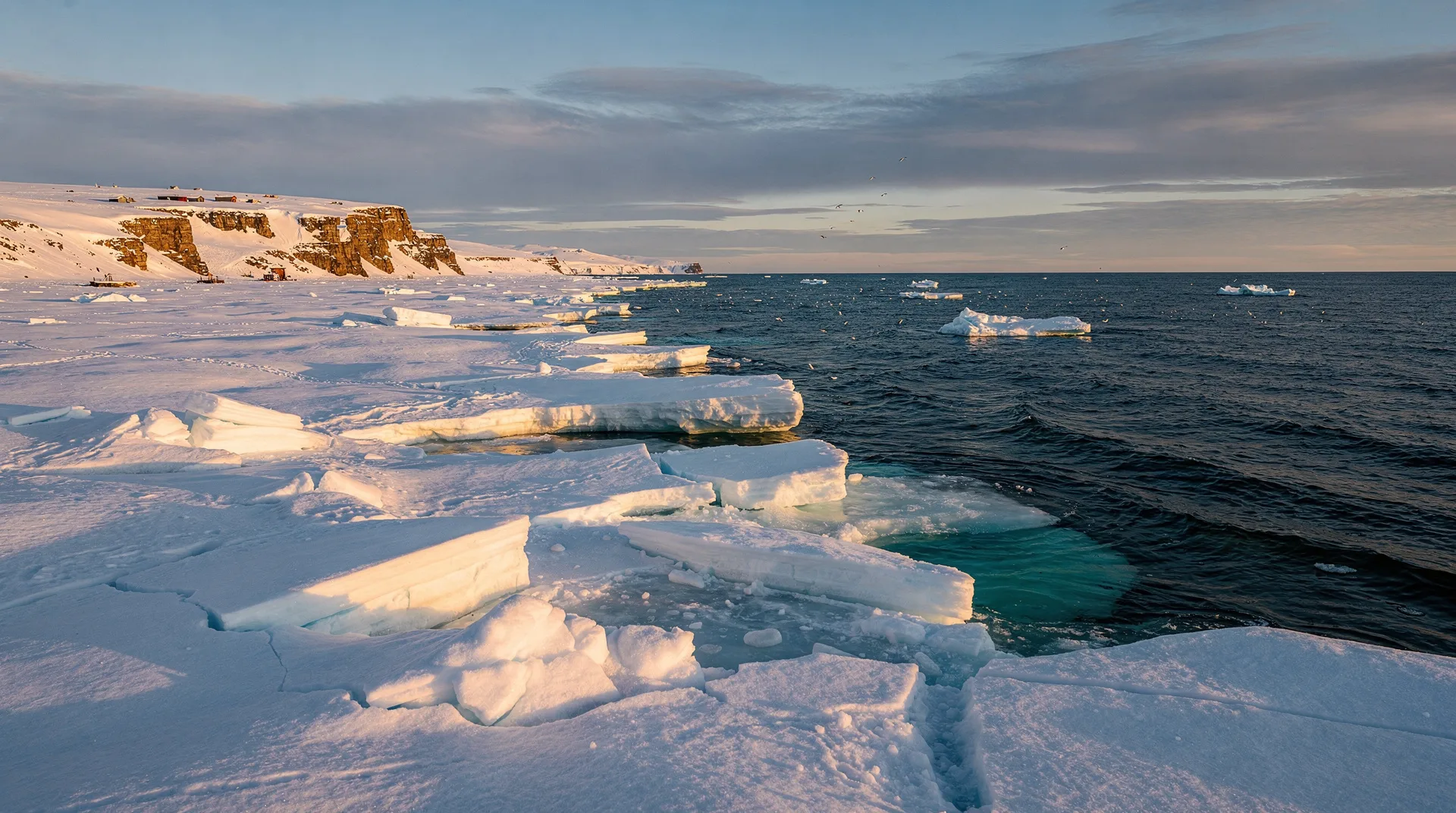
A floe edge tour travels by snowmobile across stable sea ice to the boundary between fast ice and open water — one of the most productive wildlife viewing locations in the Arctic. Narwhals, beluga whales, polar bears, walrus, and thousands of seabirds concentrate at this boundary in May and June.
The floe edge is one of the most productive wildlife environments on earth — and one of the least visited. It is the boundary between the stable land-fast sea ice (the ice attached to shore) and the open water beyond, where ocean currents and wind action have prevented or broken up the ice. At this boundary in the Canadian High Arctic in late May and June, the marine productivity of the recently opened water concentrates wildlife that has spent the entire winter under and near the ice.
The result is a wildlife spectacle that few places in the world approach: narwhals breathing at breathing holes cut through the ice edge, pods of beluga whales visible as white shapes moving through the dark water, walrus surfacing among ice floes and hauling out to rest, polar bears stalking seals on the remaining ice, and seabirds — hundreds of thousands of thick-billed murres, dovekies, king eiders, and Arctic terns — feeding in the turbulent boundary water.
Inuit hunters have known and used the floe edge for thousands of years; wildlife scientists recognise it as one of the most important ecological junctions in the Arctic; and visitors who make the journey here generally describe it as among the most remarkable experiences of their lives.
At a glance
| Where | Baffin Island, Nunavut — Pond Inlet, Arctic Bay or Clyde River |
| Cost | Around CAD 3,500-6,000/person for the guided camp, CAD 6,500-11,000 total with flights |
| Time needed | 4-5 days at the floe edge, 7-9 days total trip |
| Getting there | Fly Ottawa or Iqaluit to Pond Inlet, then snowmobile to the ice edge |
| Best time | Late May to mid-June (later, into July, at Arctic Bay) |
Understanding the floe edge
The ecology of the boundary
The floe edge’s extraordinary wildlife concentration has a straightforward ecological explanation. Through the Arctic winter, the marine ecosystem continues operating beneath the sea ice — phytoplankton grows under the ice in areas where light penetrates, zooplankton feed on it, fish feed on zooplankton, and seals and polar bears maintain the predator layer. But the diversity and abundance of surface wildlife is compressed by the ice covering.
When the ice begins to break up in spring — starting at the seaward edge and progressing inward toward shore — the line between ice and open water becomes a zone of extraordinary transition. The upwelling of nutrients at the ice edge creates dense phytoplankton blooms almost immediately. Arctic cod aggregate at the boundary feeding on the zooplankton. Seals concentrate in the area of high fish density. Narwhals and belugas move into the recently opened water, following the food. Polar bears follow the seals. And the first open-water seabirds of the season arrive from their southern wintering grounds to feed at the productive boundary.
The floe edge moves inward over time as the season progresses and the ice breaks up. In May, the floe edge near Baffin Island communities may be 30–80 km from shore over the sea ice. By late June, it may be 10–20 km. By July, the sea ice has typically broken up enough that the concept of a single floe edge dissolves into open water with scattered ice.
Why it requires specialist access
Reaching the floe edge requires travelling across sea ice that may be 1–3 metres thick and structurally reliable, but with all the hazards of a dynamic frozen surface: pressure ridges (raised sections where ice sheets have collided), leads (cracks and channels of open water cutting through the ice), and the knowledge that the ice edge itself — where you will be spending time — is at the interface of open ocean and floating ice.
Inuit guides who have navigated this ice their entire lives understand it in a qualitative, experiential way that no GPS-based navigation can replicate. They know which ice types are safe to cross, where leads are likely to open, and when conditions are deteriorating in ways that require returning to shore. For visitors, the practical message is simple: floe edge travel is not appropriate for independent self-guided visitors, regardless of backcountry experience. Qualified Inuit guides are not optional — they are the reason the experience is possible at all.
Floe edge tour locations in Nunavut
Pond Inlet (Mittimatalik)
Pond Inlet, on the northern tip of Baffin Island at 72.7° North, is the most established and accessible floe edge tour base in Nunavut. The community of approximately 1,600 people has several licensed guides and operators offering floe edge tours, with the sea ice on Eclipse Sound providing access to the ice edge in May and June.
Eclipse Sound’s floe edge is reliably productive for narwhals — the sound is one of the principal narwhal summering areas in the eastern Arctic. The Bylot Island shoreline on the north side of the sound provides additional wildlife habitat; the seabird colonies on Bylot Island’s coastal cliffs are visible from the ice.
Access: Scheduled Canadian North flights from Iqaluit to Pond Inlet (approximately 1.5 hours), 3–4 times per week. Charter flights are available. Accommodation at the Mittimatalik Hotel (pre-book months in advance for June).
Best timing: Late May through mid-June for floe edge access by snowmobile.
Arctic Bay (Ikpiarjuk)
Arctic Bay, at 73° North, is further north than Pond Inlet and has a slightly later peak season (June and sometimes early July). The town sits at the end of Admiralty Inlet — a long fjord cutting deeply into the Baffin Island interior — and the adjacent waters of Adams Sound are prime narwhal and beluga habitat.
The Arctic Bay floe edge can be exceptional for narwhal concentrations — the inlet’s geography funnels animals into predictable areas that experienced guides know well. The more northerly location means more stable ice in early June (potentially safer travel to the edge) and longer travel distances by snowmobile.
Access: Charter flight only from Iqaluit or Pond Inlet — no scheduled service. This adds cost but provides access to a less visited and arguably more spectacular floe edge location.
Clyde River (Kangiqtugaapik) and northeast Baffin
Clyde River, on Baffin Island’s eastern coast at 70° North, has emerging floe edge and sea ice tourism. The community’s Inuit guides are increasingly well-known for wildlife-focused sea ice travel, with connections to the narwhal and polar bear habitat of the Clyde Inlet and Baffin Bay area.
Access: Scheduled Canadian North service from Iqaluit.
Browse Canada Arctic wildlife expedition tours including Nunavut floe edge experiencesWildlife at the floe edge
Narwhals
The dominant wildlife encounter for most floe edge visitors. Narwhals in May and June are at or near the ice edge — breathing at leads and moving through the open water channels that develop at the boundary. They appear at the surface and roll slowly, occasionally showing the tusk (adult males). Groups can range from a few animals to pods of 50–100 or more.
The sounds of narwhals at the floe edge — audible when the wind drops and the ice is quiet — include clicks and tonal calls that carry through thin ice sections. Experienced guides can detect narwhal presence by sound before the animals surface.
Beluga whales
Beluga whales often appear at the floe edge in large groups — dozens to hundreds of white animals visible in the blue-black open water. They are vocal (audible from above the ice surface), highly social, and occasionally curious about humans on the ice edge. A pod of belugas milling in open water beside you, their white backs occasionally breaking the surface, has an almost surreal quality in the High Arctic setting.
Polar bears
The floe edge is prime polar bear habitat — the bears are there because the seals are there. Encounters at the floe edge range from watching a bear hunt from 500 metres to much closer encounters that the guide manages carefully. On a multi-day floe edge camp, polar bear encounters should be considered expected rather than exceptional.
Guides carry rifles and are experienced with bear behaviour. The polar bears at the floe edge are working hunters in their natural habitat; they are not habituated to humans and can respond unpredictably. Guides determine safe distances and manage encounters accordingly — this is not a situation where visitors have significant autonomous decision-making about proximity.
Walrus
Walrus haul out on remaining ice floes and surface in the water near the edge, often in groups of many animals. The smell of a walrus haul-out is distinctive and will be smelled before they’re seen. At close range, the size (males up to 1,700 kg) and the social density of a walrus haul-out create an impression of extraordinary biological productivity.
Seabirds
The seabird spectacle at the floe edge in late May and June is overwhelming in the literal sense — the scale of the numbers is difficult to process. Thick-billed murres arrive from their Atlantic wintering grounds to breed on Bylot Island and feed at the floe edge; hundreds of thousands of birds can be in view simultaneously. Dovekies (little auks) appear in similar numbers further north. King eiders, long-tailed ducks, Arctic terns, ivory gulls, and glaucous gulls complete a bird list that no other single location in Canada approaches.
Choosing between the three floe edge bases
| Base | Peak window | Access | Character |
|---|---|---|---|
| Pond Inlet | Late May-mid June | Scheduled flights, 3-4x/week | Most established, easiest logistics |
| Arctic Bay | June-early July | Charter flight only | Fewer visitors, strong narwhal concentrations |
| Clyde River | June | Scheduled flights | Emerging, less packaged |
Planning a floe edge tour
Booking logistics
Operators: Nunavut Tourism maintains a list of licensed operators for floe edge tours. Pond Inlet-based operators include Nanu Travel and local guide-owned operations. Contact Nunavut Tourism (nunavuttourism.com) for current operator information and recommendations.
Booking timing: June floe edge tours from Pond Inlet are in high demand relative to capacity. Book 6–12 months in advance for the June window. If you want to compare other trips while you plan, see these Canada guided tours and activities.
Accommodation: Pre-book the Mittimatalik Hotel in Pond Inlet for your Pond Inlet nights. Do not assume availability — the hotel has limited rooms and tourism operators often block them in advance.
What a floe edge tour includes
A standard 4–5 day Pond Inlet floe edge tour typically includes:
- Snowmobile transport from Pond Inlet to the floe edge camp (1–3 hours each way)
- Camping on the sea ice — tents, sleeping on ice/snow surface, cold conditions
- 24-hour access to the floe edge (wildlife is active at all hours in continuous daylight)
- Meals — prepared on camp stoves by guides; simple, substantial northern food
- Guide expertise — wildlife identification, ice safety, cultural interpretation
- Emergency equipment — radios, first aid, rescue equipment
What it does not typically include: flights to Pond Inlet, accommodation in Pond Inlet before/after the camp, personal photography equipment, or specialised gear.
What to bring
Sleeping system: A sleeping bag rated to -20°C minimum (-30°C recommended). You will be sleeping in a tent on sea ice; insulating pad essential beneath the sleeping bag.
Clothing layers: Base layers (wool or synthetic), insulating mid-layers, and a windproof shell. Boots rated to -40°C. Mitts. Balaclava. Everything required for -15 to -25°C with variable wind.
Camera equipment: Wide-angle lens for seabird and landscape compositions; telephoto (300–500mm equivalent) for bears and distant narwhals; extra batteries (cold destroys battery life).
Personal medications and prescriptions: No pharmacies accessible from the floe edge.
Cost breakdown
- Guided floe edge tour (4–5 days, including camping, guides, food): CAD 3,500–6,000/person
- Return flights Ottawa to Iqaluit: CAD 900–1,600
- Return flights Iqaluit to Pond Inlet: CAD 800–1,400
- Accommodation in Pond Inlet (pre/post camp): CAD 200–280/night
- Total estimated cost, 7–9 day trip: CAD 6,500–11,000 per person
This is not a budget experience. It is an experience at a level of ecological significance and rarity that few places in the world can offer, and its cost reflects the genuine expense of operating in one of the most remote and logistically demanding environments in Canada.
Health, insurance and entry practicalities
Comprehensive travel insurance with medical evacuation coverage is not optional here — see the Canada travel insurance guide — since the nearest hospital-grade care is a chartered flight away. International visitors also need to confirm entry requirements before booking domestic connections north; check the Canada eTA and visa guide. Pack according to the Canada packing list as a baseline, then add the cold-camping items listed above — nothing on this trip is available to buy once you leave Pond Inlet.
Related guides
For narwhal-specific information, see the narwhal viewing guide. The Baffin Island guide covers the island’s communities and wider planning. The Iqaluit guide covers the territory’s entry point and base. For Nunavut travel planning more broadly, the Nunavut destination guide covers practical realities of territory-wide travel.
Frequently asked questions about Floe Edge Tours Nunavut: Arctic Wildlife at the Ice’s Edge
Is the floe edge safe? With an experienced Inuit guide who knows the local ice, floe edge travel is managed safely — these guides have worked this ice their entire lives. The risks are real (open water, polar bears, changing ice conditions) and are actively managed by the guide rather than hidden from the visitor. Approach it as a guided wilderness expedition, not a packaged tour.
Can I photograph polar bears at the floe edge? Yes — polar bears are present at the floe edge in May and June. Distances vary; guides manage bear encounters based on bear behaviour and safety. The possibility of photographing a polar bear in natural sea ice habitat — hunting, moving, interacting with its environment — rather than in a tundra buggy on managed terrain is one of the reasons serious wildlife photographers make the floe edge journey.
What is the difference between a floe edge tour and a narwhal tour? A floe edge tour takes place on the sea ice and accesses the full floe edge wildlife community — narwhals, belugas, polar bears, walrus, and seabirds simultaneously. A narwhal tour is generally a summer boat tour focused specifically on narwhals in open water. The floe edge provides more varied and concentrated wildlife; the boat tour is logistically simpler and available later in the season.
Do I need previous Arctic experience? No, but you need genuine comfort with cold camping, remote environments, and reduced control over circumstances. Experienced guides manage safety; your role is to stay warm, follow instructions, and engage with what’s in front of you. Previous backcountry camping experience in cold conditions is helpful. A willingness to be genuinely remote and genuinely cold is essential.
How does a floe edge tour compare in cost to other Arctic wildlife trips? It sits at the expensive end of Canadian wildlife travel — broadly comparable to a multi-day Churchill polar bear tundra buggy trip, and more expensive than a summer narwhal boat tour. The cost reflects charter flights, specialist guiding, and the logistics of operating on sea ice rather than from a lodge.
Do I need Arctic clothing I don’t already own? Almost certainly yes, unless you already own serious cold-weather gear. Start from the general Canada packing list and add the -20C sleeping system, -40C boots, and windproof shell layers described above; most visitors buy or rent at least some of this specifically for the trip.