Narwhal Viewing in Nunavut: Floe Edge & Arctic Bay Tours
Where and when can I see narwhals in Nunavut?
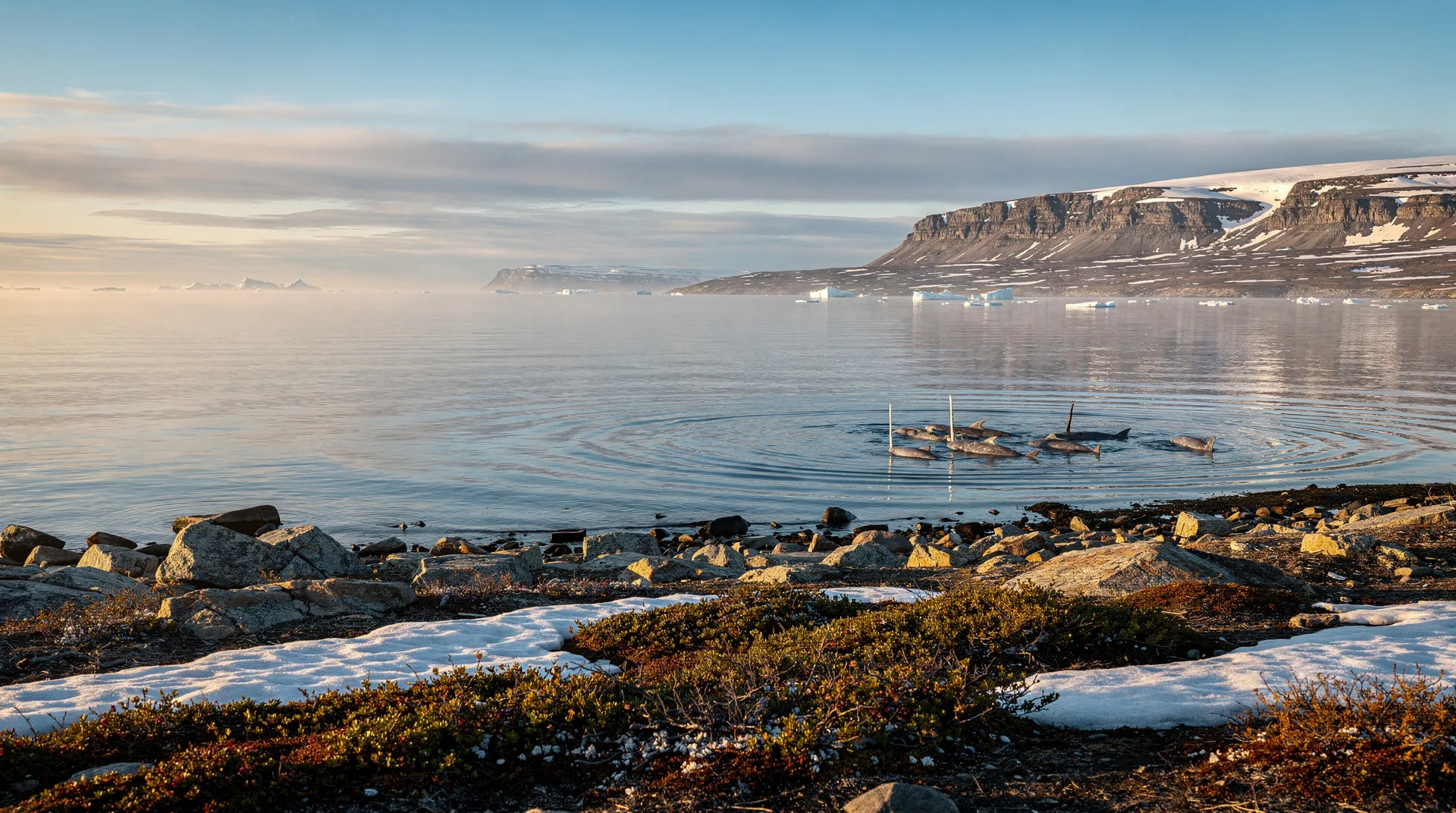
The best narwhal viewing in Nunavut is from Pond Inlet and Arctic Bay in June and July, when narwhals gather in Eclipse Sound and the adjacent fjords. Floe edge tours in late May and June position you at the ice edge where narwhals, beluga whales, and walrus congregate in extraordinary concentrations.
The narwhal — Monodon monoceros, the “unicorn of the sea” — is one of the most distinctive mammals in the world. The male’s spiral tusk (actually a modified tooth that can reach 3 metres in length) has accumulated more mythology per kilogram than any other biological structure: traded as unicorn horn in medieval Europe, used as ornamentation by Inuit hunters, studied by scientists who only recently understood its sensory function as a highly innervated probe sensitive to water pressure, temperature, and salinity.
Narwhals are real, abundant by Arctic cetacean standards, and concentrated in specific locations in Nunavut in summer in numbers that make viewing encounters reliably achievable. A narwhal is also more than a tusk — the animals are highly vocal, form complex social groups, perform coordinated hunting behaviour, and migrate seasonally across the eastern Arctic in patterns the Inuit have understood for generations. Watching a pod of 50 narwhals surface in a high-Arctic fjord, their tusks occasionally breaking the surface on a roll, is one of the genuine wildlife spectacles available in Canada.
At a glance
| Where | Pond Inlet and Arctic Bay, northern Baffin Island, Nunavut |
| Cost | Around CAD 6,000-12,000 per person for a full trip (tour, flights, gear) |
| Time needed | 7-10 days realistically, including weather buffer days |
| Getting there | Fly Ottawa or Iqaluit to Pond Inlet or Arctic Bay via scheduled or charter flights |
| Best time | June for floe edge tours; July-August for open-water boat tours |
Where narwhals live in Nunavut
Approximately 85% of the world’s narwhal population — estimated at 80,000–170,000 animals — spends summer in the eastern Canadian Arctic, primarily in Nunavut. The specific summer aggregation areas include:
Eclipse Sound and Admiralty Inlet (Pond Inlet area): This is the narwhal’s most reliably accessible viewing area in Canada. Eclipse Sound, separating the northern tip of Baffin Island from Bylot Island, receives significant narwhal concentrations in July and August as the ice breaks up. Guided small-boat tours from Pond Inlet regularly encounter pods of dozens to hundreds of animals.
Arctic Bay (Ikpiarjuk): Located on the northern end of Baffin Island at 73° North, Arctic Bay’s adjacent waters — particularly Adams Sound and the Navy Board Inlet area — are premier narwhal habitat. In June, before the sea ice fully breaks up, the floe edge near Arctic Bay is one of the most productive narwhal viewing areas in the world.
Somerset Island waters: The waters around Somerset Island, particularly near Cunningham Inlet (accessible by charter from Resolute), host significant beluga whale concentrations and some narwhal in July–August.
Foxe Basin communities: Communities including Igloolik and Hall Beach have access to narwhal habitat; Foxe Basin narwhals are less well studied than Baffin Island populations but present through the summer.
Floe edge tours: the premier narwhal experience
The floe edge — the boundary between open water and stable land-fast sea ice — is the single most productive wildlife viewing location in the Canadian Arctic. As spring arrives (May–June), open water penetrates the ice from offshore, creating a boundary zone where the marine productivity of open water concentrates wildlife that has spent winter under and near the ice.
At the floe edge in late May and June:
- Narwhals appear at the ice edge breathing holes and in the leads
- Beluga whales travel in groups of hundreds through the open water channels
- Walrus haul out on ice floes and surface in the water at close range
- Ringed seals and bearded seals rest on ice floes
- Polar bears patrol the edge hunting seals
- Seabirds — dovekies, murres, eider ducks — concentrate in the open water by the tens of thousands
The combination of wildlife density at the floe edge is unmatched anywhere in Canada. An experienced Inuit guide at the right floe edge location in the right week of June provides encounters that no managed wildlife reserve can replicate.
Pond Inlet floe edge tours
Pond Inlet (Mittimatalik) is the primary base for floe edge tours on Baffin Island’s north coast. The floe edge in Eclipse Sound is accessible by snowmobile from the community — typically a 1–3 hour travel depending on ice conditions — and the wildlife concentration can be extraordinary. Inuit guides from Pond Inlet have navigated this ice for generations; their knowledge of safe ice travel, wildlife behaviour, and the floe edge location is accumulated over lifetimes.
Format: Groups depart by snowmobile from Pond Inlet, travelling over the sea ice to the floe edge location. Camping on the ice is the standard overnight arrangement — tents on the sea ice, the open water and its wildlife accessible continuously. Groups of 4–8 are typical; guides-to-client ratios of 1:2 or 1:3.
Timing: Late May through mid-June. The ice edge is further from the community in May (longer snowmobile travel) and closer as June progresses and the ice breaks up. By late June, the ice has usually broken up enough that snowmobile travel to the floe edge is no longer practical — boat access replaces it.
Cost: Floe edge tours from Pond Inlet typically cost CAD 3,500–5,500 per person for 3–5 days including transport, guiding, food, and camping on the ice. The total trip cost including flights from Ottawa to Iqaluit to Pond Inlet adds CAD 2,000–4,000 per person in airfare.
Arctic Bay floe edge tours
Arctic Bay, further north than Pond Inlet at 73°N, has a later floe edge season (peak June, sometimes extending into early July) and access to slightly different wildlife concentrations. Arctic Bay’s local guides have deep knowledge of the Adams Sound narwhal aggregations and are particularly experienced with narwhal behaviour.
The community’s isolation — no scheduled service, charter flights only from Iqaluit or Pond Inlet — makes logistics more complex and expensive than Pond Inlet. But the northerly location and the wildlife concentrations in Adams Sound reward visitors who make the additional effort.
Cost: Arctic Bay floe edge tours typically cost CAD 4,000–7,000 per person for 4–6 days. Charter flights from Iqaluit to Arctic Bay add CAD 600–1,200 per person.
Browse Canada Arctic wildlife expedition experiencesSummer narwhal boat tours from Pond Inlet
After the ice breaks up in late June and July, small-boat tours replace snowmobile floe edge access. Open water in Eclipse Sound allows zodiac or small motorised boat tours into narwhal habitat — following pods at respectful distances, watching surfacing behaviour, and occasionally having narwhals approach the boats out of curiosity.
July and August are the most accessible months for boat-based narwhal viewing because weather is typically more stable, the sea ice is absent, and the narwhals are concentrated in Eclipse Sound’s warmer surface waters. The viewing is typically less intensive than at the floe edge (more distance, less ice-concentrated wildlife) but more accessible logistically — a 3–4 day boat tour from Pond Inlet can be arranged through local operators.
Cost: Summer boat-based narwhal tours from Pond Inlet typically cost CAD 2,000–3,500 per person for 3–4 days.
Pond Inlet vs Arctic Bay: which base to choose
| Pond Inlet | Arctic Bay | |
|---|---|---|
| Season peak | Late May-mid June (floe edge) | June-early July (floe edge) |
| Access | More flight options, larger community | Charter-only from Iqaluit or Pond Inlet |
| Cost | Around CAD 3,500-5,500 for 3-5 days | Around CAD 4,000-7,000 for 4-6 days |
| Strength | Most established operator base, more accommodation | Deep local knowledge of Adams Sound narwhal aggregations |
| Best for | First-time Arctic wildlife travellers | Visitors prioritising narwhal density over convenience |
Both are legitimate choices; Pond Inlet is the easier logistical entry point, while Arctic Bay rewards travellers willing to accept more complex charter logistics for a slightly more concentrated narwhal experience. Read the full floe edge tours Nunavut guide before choosing between them, and see the Baffin Island travel guide for how either base fits into a broader Arctic itinerary.
What to expect: narwhal behaviour
Narwhals are not whale-watched in the conventional sense. They don’t breach or perform; they surface, breathe, and descend. The tusk (present on most adult males; some females also have a tusk) may or may not be visible depending on the surfacing angle. Groups of males sometimes engage in “tusking” — a behaviour in which they cross tusks at the surface in a slow, deliberate interaction that appears social rather than aggressive.
The sound of narwhals is one of the most surprising elements — they are extremely vocal animals, producing clicks, whistles, and pulsed tones that are audible underwater and occasionally above it. Guided tours with underwater hydrophones allow visitors to hear narwhal vocalisations directly; some guides carry basic equipment for this.
The pods seen from the floe edge or from boats range from a few individuals to groups of several hundred. Large aggregations tend to be segregated by sex — bachelor male groups (pods of tusked males) and mixed female-and-calf groups travel separately for much of the summer. The most spectacular aggregations include both sexes and can extend hundreds of metres across a sound.
Practical realities of narwhal viewing in Nunavut
Total cost: A dedicated narwhal viewing expedition — floe edge or summer boat, from Ottawa through Iqaluit to Pond Inlet — realistically costs CAD 6,000–12,000 per person for a 7–10 day trip. This is not a budget wildlife experience by any measure.
Booking lead time: Pond Inlet has limited accommodation (the Mittimatalik Hotel has a small number of rooms) and limited guide capacity. Book 6–12 months in advance for June floe edge tours. July and August boat tours have more capacity but still require advance booking. To compare other northern options, you can look at Canada wildlife tours and experiences before you commit.
Weather windows: Arctic weather in May–June can ground travel for 2–3 days at a time. Build 2–3 extra days into any floe edge itinerary as weather buffer. Flights between Iqaluit and Pond Inlet are cancelled regularly for weather; flexibility is a practical requirement.
Cultural context: Narwhals are hunted by Inuit in Pond Inlet and other communities under Nunavut Wildlife Management Board quotas. The narwhal harvest is a legitimate and culturally significant practice; guide operators in these communities navigate the intersection of tourism and traditional harvest with experience. Approach the cultural context of your visit with respect for Inuit subsistence practices.
Planning around the expedition
A narwhal trip rarely stands alone, and the preparation around it matters as much as the days on the ice or water. Start with the Nunavut destination page for the wider territory, then read the domestic flights guide to understand how northbound connections work and why schedules need slack. Because weather can delay or cancel departures, a policy covering interruptions is worth considering; the Canada travel insurance guide explains what to look for.
Clothing and kit deserve their own attention on the sea ice. The packing list is a useful starting point, though your operator’s gear list should always take priority for cold-weather layers. Spend some time with the Canada wildlife safety guide as well, since polar bears patrol the floe edge and your guides’ instructions are not optional.
The light also shapes the trip. In the high Arctic the sun barely sets during the viewing season, which is covered in the midnight sun in Canada guide; it means long, flexible days on the water but also makes sleeping in a tent on the ice a matter of eye masks and routine.
Where narwhals fit in the wider picture
If this trip appeals, you may want to compare it with other marine wildlife experiences. The whale watching in Canada overview covers the more conventional options, which are far cheaper and easier to reach. For a southern Arctic-edge alternative with belugas, see the beluga kayaking Churchill guide. Travellers who want to extend their time on Baffin Island can look at Auyuittuq National Park, and the Indigenous tourism in Canada guide offers context for travelling with community-run operators.
Related guides
For the full floe edge wildlife context — which extends well beyond narwhals — see the floe edge tours Nunavut guide. Baffin Island travel guide covers the communities and broader planning. For Iqaluit as the entry point, see the Iqaluit guide.
Frequently asked questions about Narwhal Viewing in Nunavut: Floe Edge & Arctic Bay Tours
When is the best month to see narwhals in Nunavut? June for floe edge tours (best wildlife density; ice travel required). July for open-water boat tours (more accessible; good narwhal concentration in Eclipse Sound). May is the earliest month for floe edge access but requires longer snowmobile travel and carries higher weather risk.
How likely am I to see narwhals on a Pond Inlet tour? On a 3–5 day floe edge tour in June with an experienced guide, narwhal sightings are expected on most days. The floe edge concentrates wildlife in a way that makes sightings nearly certain over a multi-day trip. Summer boat tours have a lower per-trip probability on any given day but good overall odds over 3–4 days.
Are narwhal viewing tours appropriate for beginners? The floe edge tours require tolerance for cold, camping on sea ice, and significant travel by snowmobile. They are not technically demanding but do require fitness and comfort with genuinely remote conditions. Summer boat tours are more accessible. Neither requires wildlife viewing experience; both require appropriate physical preparation.
Is there a weight or fitness requirement? The snowmobile transport on floe edge tours typically has weight limits per machine (check with your specific operator). Beyond this, cold tolerance and general fitness are the main requirements. Discuss any health concerns with your operator before booking.
Is it possible to see narwhals without booking a multi-day floe edge tour? Summer boat tours from Pond Inlet (late June through August) are shorter and less expensive than floe edge expeditions, typically 3-4 days at CAD 2,000-3,500 per person, and still offer good narwhal sighting odds in Eclipse Sound, though the wildlife density is generally lower than at the floe edge.
Should I choose Pond Inlet or Arctic Bay for my first trip? Pond Inlet is the more practical choice for a first Arctic wildlife trip, with more accommodation, more flight options, and a larger, more established tour operator base. Arctic Bay suits travellers who have researched the trip carefully and are prioritising narwhal concentration over convenience.