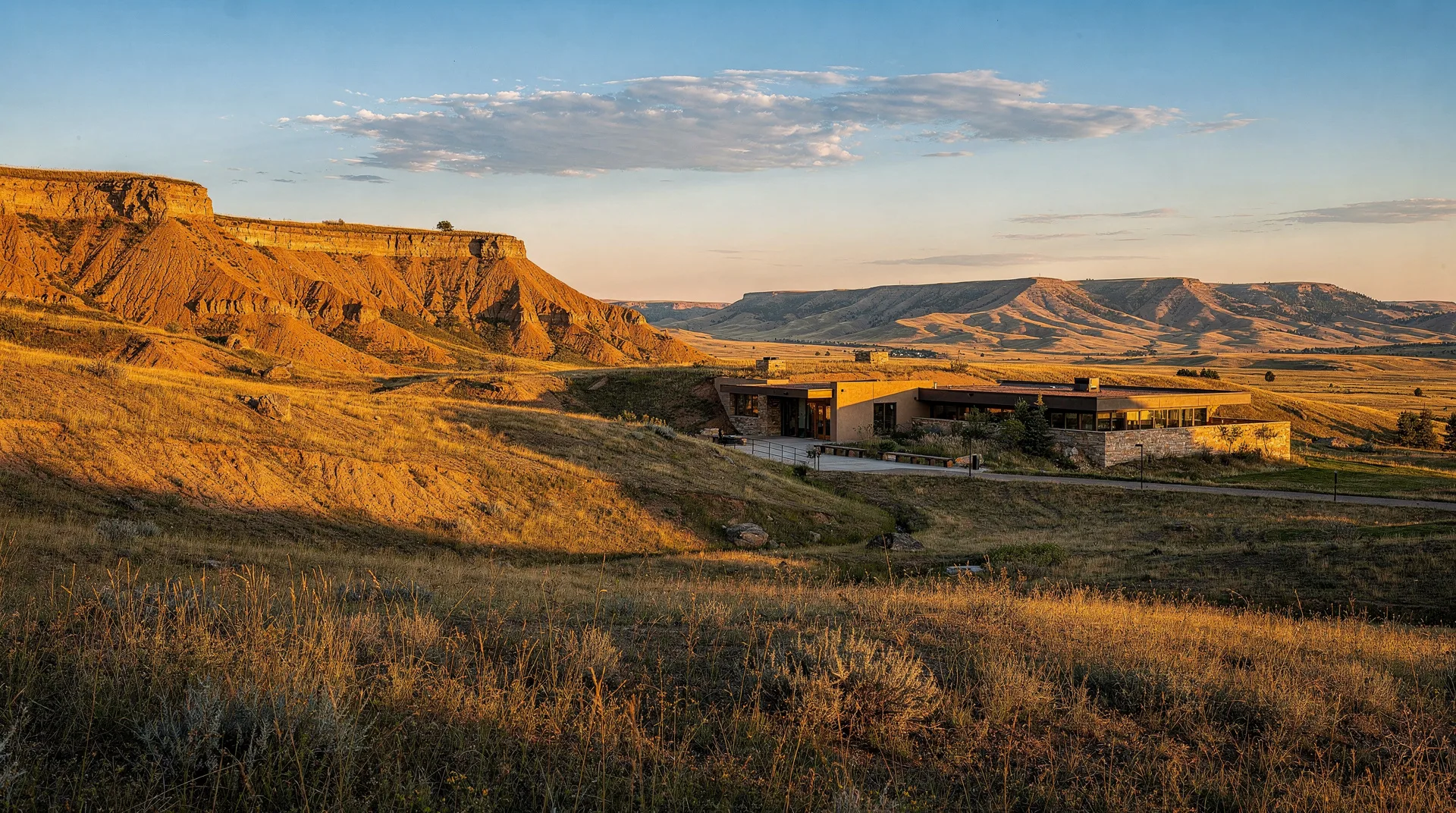
Head-Smashed-In Buffalo Jump: Alberta's UNESCO wonder
What is Head-Smashed-In Buffalo Jump?
Head-Smashed-In Buffalo Jump is a UNESCO World Heritage Site near Fort Macleod in southern Alberta — one of the world's oldest and largest buffalo jump sites, used by Blackfoot peoples for over 5,700 years to hunt bison by driving them off a cliff. An outstanding museum built into the cliff interprets this history.
Head-Smashed-In Buffalo Jump is one of the most extraordinary heritage sites in North America — and one of the least known internationally. For over 5,700 years, the Blackfoot people of the Great Plains used this carefully chosen cliff edge in the Porcupine Hills of southern Alberta to drive large herds of bison (buffalo) over the precipice, providing food, clothing, shelter, and spiritual sustenance for their communities. The site’s exceptional preservation — the bone deposits at the base of the cliff are up to 10 metres deep — and its extraordinary antiquity led UNESCO to inscribe it as a World Heritage Site in 1981, one of the first sites in western Canada to receive this designation.
The interpretive centre built into the cliff face at Head-Smashed-In is one of the finest Indigenous cultural museums in Canada. It presents the buffalo hunt not as a historical curiosity but as a sophisticated, ecologically sound practice that sustained Plains peoples for millennia — a perspective that challenges and enriches any visitor’s understanding of pre-contact Canada.
| At a glance | |
|---|---|
| Where | 18 km northwest of Fort Macleod, southern Alberta, on Secondary Highway 785 |
| Cost | Adult and family admission fees apply; check the Alberta Culture site for current rates |
| Time needed | Around 2–3 hours, 3–4 hours with a guided interpretive tour |
| Getting there | Car required, around 2.5 hours from Calgary or 1 hour from Lethbridge |
| Best time | Open year-round; summer (Victoria Day to Labour Day) has the fullest program |
The site and what the name means
The name comes from a Blackfoot legend. A young man wanted to watch the buffalo plunge over the cliff from the base and found himself trapped as the herd thundered over the edge. When the hunters descended after the drive, they found him crushed beneath the heap of bison — his skull smashed. The Blackfoot name for the site is Estipah-skikikini-kots, meaning “where he got his head smashed in.”
The cliff itself drops approximately 10 metres from the prairie above to the killing ground below. This seems modest for a jump, but the impact of hundreds of panicked bison falling and piling upon each other at the base was lethal. The layers of bones preserved over thousands of years are testimony to the scale and efficiency of the hunt.
How the buffalo jump worked
The buffalo jump was not a simple act of chasing animals off a cliff — it was a sophisticated, community-wide operation requiring detailed knowledge of bison behaviour, topography, and wind patterns.
Gathering the herd: Runners — sacred practitioners known as buffalo runners — would locate a herd and, using knowledge of bison psychology, gradually move them toward the drive lanes. They wore wolf skins, moved downwind, and exploited the bison’s tendency to move away from perceived threats.
The drive lanes: Networks of cairns (stone piles) and brush fences arranged in a V-pattern funnelled the herd toward the cliff edge from up to 10 kilometres away. These drive lane features are still visible on the prairie above the jump.
The stampede: Once the lead bison were close enough to the cliff edge that their momentum could not be stopped, the community would emerge, shouting and waving robes, triggering the final panicked rush over the edge.
Processing the kill: The killing ground below the cliff was where the real work began — hundreds of animals needed to be butchered quickly before decomposition, with every part used: meat dried and pounded into pemmican, hides tanned for clothing and shelter, bones rendered for marrow and fat, horns and sinew used for tools and weapons, even the bladders used as water carriers.
The interpretive centre
The Head-Smashed-In Buffalo Jump Interpretive Centre is built directly into the cliff face in a design that minimises its visual impact on the landscape. From the prairie above, the building is largely invisible; from the killing ground below, it blends into the sandstone layers. The architecture is genuinely thoughtful and has won several design awards.
Inside, five levels of exhibition trace the Blackfoot way of life in the context of the buffalo hunt — from the ecological relationship with the plains environment through the spiritual dimensions of the hunt, the technology of the drive, and the processing and use of the kill.
The exhibits are among the best in western Canada for Indigenous cultural content. Blackfoot elders and cultural knowledge keepers contributed to the interpretation, and the voice of the presentation reflects an Indigenous perspective rather than a colonial ethnographic approach. Artefacts including ancient stone tools, preserved bone material, and reconstructed objects from the site provide tangible connection to the history.
The rooftop viewing area overlooks the drive lanes on the prairie above the cliff — you can stand where the bison stood in the final moments before the stampede and look back along the funnel toward the gathering horizon. This perspective is uniquely powerful.
Guided tours with Blackfoot cultural interpreters are available and strongly recommended. The interpretation comes alive with a knowledgeable guide who can answer questions and provide context that the exhibits alone cannot.
Why this site matters beyond the museum
Head-Smashed-In is significant not only as a preserved archaeological site but as a rare case where the interpretation is led substantially by the descendant community itself. Visitors coming from other Plains heritage sites in North America often note the difference: rather than a third-person ethnographic account, the exhibits explain buffalo-jump hunting on its own sophisticated terms, as ecological knowledge refined over roughly 6,000 years of continuous use — one of the longest continuously used archaeological sites anywhere on the continent.
For travellers building a broader Indigenous history itinerary in Alberta, this pairs naturally with the rock art at Writing-on-Stone Provincial Park and with wider bear watching and wildlife-focused trips through the province’s grasslands and foothills.
Seasonal visiting conditions
| Season | Conditions | Crowds |
|---|---|---|
| Summer (Jun–Aug) | Full interpretive program, warm prairie heat, guided tours running regularly | Busiest, especially weekends |
| Autumn (Sep–Oct) | Reduced hours begin, cooler and often clearer light for photography | Light |
| Winter (Nov–Mar) | Reduced hours, closed on major holidays, snow-swept prairie views | Very light |
| Spring (Apr–May) | Reduced hours transitioning to summer schedule, changeable weather | Light |
Getting there
Head-Smashed-In Buffalo Jump is located 18 kilometres northwest of the town of Fort Macleod on Secondary Highway 785. Fort Macleod is 170 kilometres south of Calgary on Highway 2.
From Calgary: 2 hours south on Highway 2 to Fort Macleod, then 18 km northwest on Highway 785. Total: approximately 2.5 hours.
From Lethbridge: 50 km north on Highway 2 to Fort Macleod, then 18 km northwest. Total: approximately 1 hour.
From Waterton Lakes National Park: 70 km northeast — an excellent combination visit.
There is no public transit to the site. A car is required.
Combining with a southern Alberta road trip
Head-Smashed-In pairs naturally with other southern Alberta sites for a multi-day itinerary:
Fort Macleod Historic District (18 km east) — the original NWMP (North-West Mounted Police) fort of 1874, reconstructed as a living history site. The Fort Museum in Fort Macleod town operates summer musical ride demonstrations by costumed interpreters.
Waterton Lakes National Park (70 km southwest) — Canada’s newest UNESCO World Heritage Site (as part of the Waterton-Glacier International Peace Park) and one of the most scenically spectacular national parks in the country.
Writing-on-Stone Provincial Park (95 km southeast) — the UNESCO-inscribed sacred landscape with thousands of Blackfoot rock art images along the Milk River.
These three sites together — Head-Smashed-In, Waterton, and Writing-on-Stone — form a remarkable UNESCO circuit through southern Alberta that can be done in 3–4 days from Calgary.
Book guided southern Alberta and Indigenous heritage tours from CalgaryPractical visitor information
Hours: The centre opens daily in summer (Victoria Day to Labour Day), typically 9am–5pm. Reduced hours in spring and fall; closed major winter holidays. Check the Alberta Culture website for current hours before visiting.
Admission: Adult and family admission fees apply. The site is operated by Alberta Culture and Tourism; an annual museum pass covers entry.
Facilities: Excellent — indoor washrooms, café serving Blackfoot-influenced food, gift shop with Indigenous-made crafts and books, accessible ramps and elevator through all five floors of the centre.
Photography: Photography of the exhibits and landscape is permitted. Photography policies for sacred cultural items may vary — follow interpreter guidance.
Time needed: Allow 2–3 hours minimum for the exhibits and rooftop viewpoint. If taking a guided interpretive tour, allow 3–4 hours total.
Best season: The site is open year-round (reduced winter hours) and the landscape is striking in all seasons. Summer is the peak season with the fullest interpretation program. The prairie landscape around the jump in winter — swept by wind, snow covering the drive lane cairns — is hauntingly beautiful.
Frequently asked questions
Is Head-Smashed-In Buffalo Jump suitable for children? Yes — the exhibits are visual and hands-on in places, and the rooftop walk is an easy, level path. The subject matter (a hunting site) is handled respectfully but is factual rather than sanitized, which some families prefer to know in advance.
Can you combine Head-Smashed-In with a day trip from Calgary? It’s possible but tight — roughly 5 hours round trip driving alone, plus 2–3 hours on site, makes for a full day. Many visitors prefer to combine it with an overnight in the Fort Macleod or Waterton area rather than a rushed single day from Calgary.