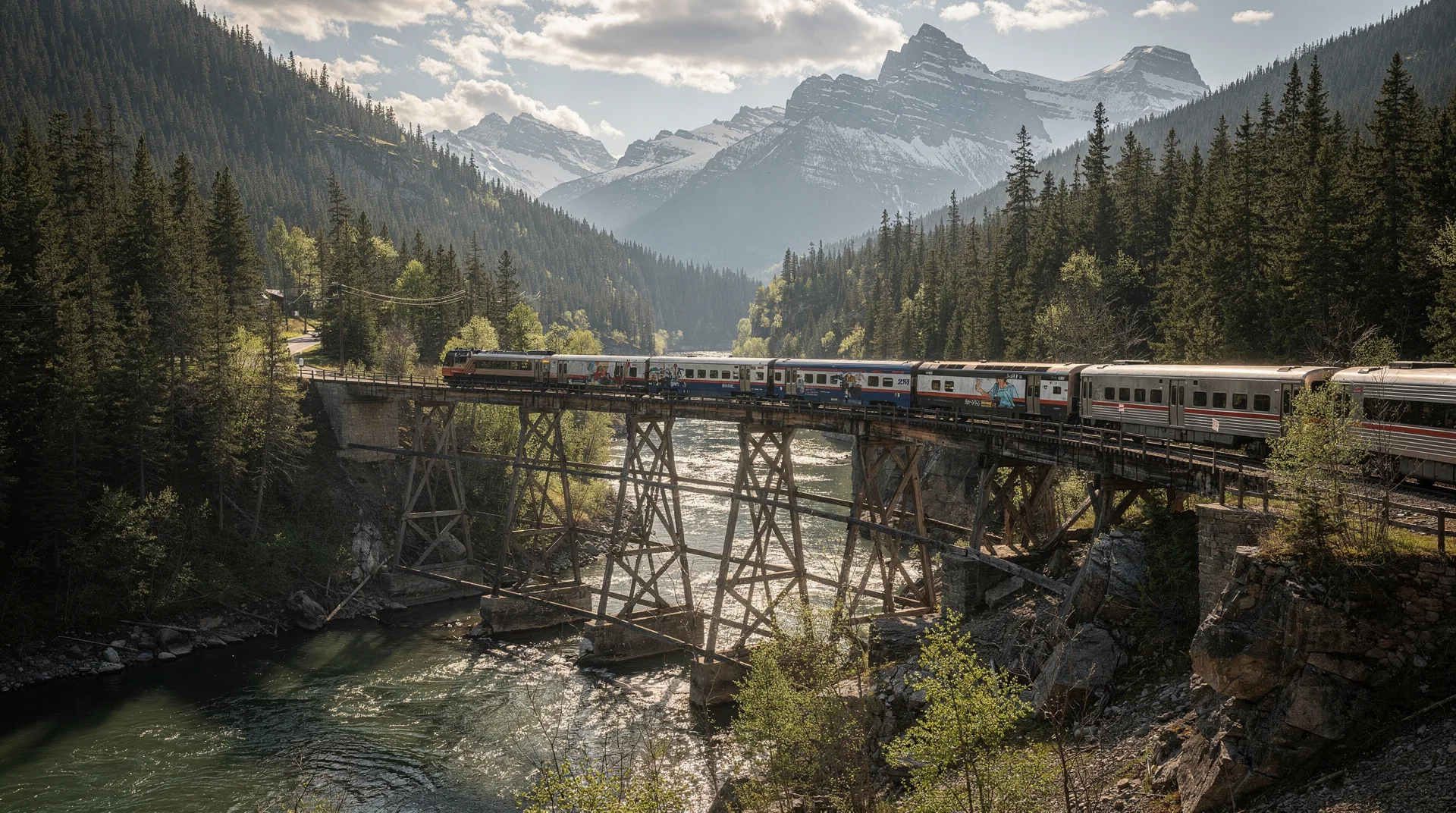
Best scenic train routes in Canada: complete ranking
What is the best scenic train route in Canada?
The Rocky Mountaineer is Canada's premier luxury scenic train for mountain scenery. The VIA Rail Canadian is the best complete transcontinental experience. The Agawa Canyon Tour Train offers the finest fall colour rail trip. Each leads its category.
Canada has more to offer rail travellers than almost any country on earth. The landscape is vast, varied and largely intact — from the subarctic Hudson Bay Lowlands to the Pacific coastal ranges, from the fog-wrapped Atlantic shore to the flat infinite Prairies. The trains that traverse this landscape do not all compete on the same terms: a luxury dome car journey through the Rockies serves a completely different purpose from a community rail service to a road-inaccessible subarctic town. This ranking acknowledges those differences and rates each experience within its category while pointing you toward the right train for your specific interests.
The ranking uses four criteria: scenery (how visually compelling is the journey?), experience quality (how well is the on-board experience delivered?), value (is the quality commensurate with the price?), and uniqueness (how distinctive is this journey in a global context?).
| At a glance | |
|---|---|
| Where | Coast-to-coast: BC/Alberta Rockies, transcontinental, Yukon, Northern Ontario, Atlantic Canada |
| Cost | From around CAD $75 (Agawa Canyon) to CAD $2,800+ one-way (Rocky Mountaineer GoldLeaf) |
| Time needed | A few hours (White Pass) to 3.5 days (VIA Rail Canadian) |
| Getting there | Fly into the route’s start city — Vancouver, Toronto, Skagway/Whitehorse, Sault Ste Marie, Halifax |
| Best time | Summer for most routes; late September for Agawa Canyon fall colour; winter for a quieter VIA Rail Canadian |
Choosing between the top routes
The most common decision travellers face is Rocky Mountaineer versus VIA Rail Canadian, and the honest answer depends on budget and priorities rather than which is objectively “better.” If your goal is a short, curated, guaranteed-daylight mountain experience and cost is not the deciding factor, the Rocky Mountaineer delivers a more polished result.
If your goal is to actually cross Canada and experience the country’s geographic scale — Shield, Prairies, mountains, Pacific rainforest — in one journey at a fraction of the price, the VIA Rail Canadian wins decisively. Neither is a mistake; they answer different questions. See our dedicated Rocky Mountaineer vs VIA Rail comparison for a category-by-category breakdown.
1. Rocky Mountaineer — gold standard mountain scenic rail
Category: Luxury scenic excursion
Routes: Vancouver–Banff (First Passage to the West), Vancouver–Jasper (Journey through the Clouds), Vancouver–Whistler–Quesnel (Rainforest to Gold Rush)
Duration: 2 days (daytime only)
Price: CAD $1,100–$2,800 per person one-way
The Rocky Mountaineer wins the top position not because it is the longest or the most historic Canadian train experience, but because it does one specific thing better than any other rail service in the world: it delivers British Columbia and Alberta’s mountain scenery as a focused, curated, premium event. The bi-level glass dome coaches, the daytime-only schedule, the calibrated pace through dramatic sections, the included meals and narrated commentary — every element serves a single purpose, and that purpose is maximising the scenic experience.
Scenery score: 10/10. The Fraser Canyon, the Thompson River valley, the mountain approaches to Banff and Jasper, the Kicking Horse Canyon — this is a highlight reel of Rocky Mountain scenery assembled into a two-day package.
Experience quality: 9/10. Consistently professional, attentive, and well-run. GoldLeaf is close to the finest passenger train environment in North America.
Value: 6/10. Expensive. For the experience delivered, the price is defensible, but it represents a significant investment that not all travellers can justify.
Uniqueness: 9/10. Nothing else quite like it in the world. The daytime-only dome car experience in the Canadian Rockies is singular.
Best for: Couples, milestone celebrations, luxury travellers, first-time Canada visitors with limited time who want the maximum mountain impact.
See our complete Rocky Mountaineer guide and our Rocky Mountaineer vs VIA Rail comparison.
Browse Vancouver to Banff Rocky Mountain tour packages2. VIA Rail Canadian — the great transcontinental experience
Category: Transcontinental passenger service
Route: Toronto to Vancouver (via Winnipeg, Saskatoon, Edmonton, Jasper)
Duration: Approximately 86 hours (3.5 days)
Price: CAD $350–$2,500 per person one-way depending on class
The VIA Rail Canadian is what all transcontinental passenger trains aspire to be. It crosses the full breadth of Canada — from the Great Lakes to the Pacific Ocean — on the same route the CPR pioneered in 1885. It passes through six provinces, crosses the Continental Divide, and delivers passengers through Precambrian Shield, Prairie, Mountain and Pacific rainforest landscapes in a single unbroken journey.
The Canadian earns the second position because of scope: no other rail experience in Canada provides this breadth of the country in one continuous journey. The mountain section through Jasper is spectacular; the Prairies at dawn are transcendent; the Shield in Northern Ontario is wild and beautiful and completely empty. Each landscape segment is worth experiencing in its own right, and the train strings them together into a coherent cross-country narrative.
The on-board experience is good-to-excellent depending on class. The dome car is democratic and social; the dining car is a genuine meeting place; the 1950s rolling stock has a romance that modern trains cannot replicate. At Sleeper Plus prices, the value is considerably better than the Rocky Mountaineer.
Scenery score: 8/10. The mountain section is world-class when experienced in daylight. The other landscape sections — Shield, Prairies, Fraser Canyon — are all genuinely beautiful and extensive. Points deducted for the scheduling uncertainty that can place the Rockies in darkness.
Experience quality: 7/10. Comfortable but not luxurious in Sleeper Plus. The dining car and dome car compensate with social warmth that the Rocky Mountaineer, with its curated approach, does not replicate.
Value: 9/10. At Sleeper Plus prices with meals included for a 4-day journey, the VIA Rail Canadian is one of the world’s great rail travel values.
Uniqueness: 9/10. One of the world’s few remaining transcontinental passenger rail services. Irreplaceable.
Best for: Independent travellers, railway enthusiasts, budget-conscious visitors, anyone who wants to understand Canada’s actual geographic scale.
See our complete VIA Rail Canadian guide.
Book a Banff day tour to add to your Jasper stop on the Canadian3. White Pass and Yukon Route — finest historic narrow-gauge in North America
Category: Heritage scenic excursion
Route: Skagway, Alaska to White Pass Summit / Fraser BC / Carcross / Bennett YT
Duration: 3–8 hours depending on excursion
Price: USD $175–$350 per person
The White Pass and Yukon Route is one of the most audacious pieces of railway engineering in North American history. Built in 1898–1900 through terrain that experienced engineers declared impossible, it achieved a climbing rate and a route alignment through the Coast Mountains that still impresses engineers 125 years later. It is an International Historic Civil Engineering Landmark — in the same category as the Eiffel Tower.
The scenery is world-class: vertical granite walls, hanging glaciers, summit lake reflections, and a coastal mountain environment that transitions from rainforest to alpine tundra within 26 miles. The Gold Rush historical context adds narrative depth that natural scenery alone cannot provide.
The White Pass ranks third because its primary audience (Alaska cruise passengers on short port calls) means the dominant product is a 3–4 hour excursion rather than a longer journey. The full one-way option to Carcross or Whitehorse is a superior experience but logistically complex.
Scenery score: 9/10. The summit environment and the cliffside track sections are among the most dramatic in North America.
Experience quality: 8/10. Well-narrated, historically rich, excellent rolling stock. The open-air observation platforms are a highlight.
Value: 7/10. USD pricing at Alaska prices makes it more expensive than it looks; the core experience is good value for what is delivered.
Uniqueness: 10/10. There is no other rail journey like this in North America. The combination of engineering feat, Gold Rush history, and mountain scenery is singular.
Best for: Alaska cruise passengers, Yukon visitors arriving or departing by rail-bus combo, history and engineering enthusiasts.
See our White Pass and Yukon Route guide.
Explore Whitehorse tours to combine with your White Pass arrival4. Agawa Canyon Tour Train — Canada’s finest fall colour rail experience
Category: Day excursion, wilderness access
Route: Sault Ste Marie to Agawa Canyon, Northern Ontario
Duration: Full day (approximately 10 hours)
Price: CAD $75–$90 per person round trip
For sheer fall colour spectacle combined with wilderness access, no other train in Canada matches the Agawa Canyon Tour Train in late September. The Canadian Shield’s thin-soiled maple and birch forest produces fall colour of extraordinary intensity; the train is the only access to a canyon with no road connection; and the combination of accessible wilderness, manageable day trip format, and remarkable value makes it a genuinely democratic great train journey.
The Agawa Canyon ranks fourth overall because outside the fall colour window (approximately late September to early October), it is a good rather than great rail experience. The canyon is always worth visiting, but the scenery relies heavily on the forest colour rather than dramatic geological or mountain features. In summer, it is a pleasant wilderness day trip rather than an unmissable rail experience.
In fall colour season, however, it rises to the level of the trains above it. A late-September Agawa Canyon departure may be the single best-value scenic rail day in Canada.
Scenery score: 7/10 in summer; 9/10 in peak fall colour
Experience quality: 7/10. Functional rather than luxurious, but well-run and with genuine wilderness access.
Value: 10/10. CAD $75–$90 for a 10-hour wilderness rail day is extraordinary value by any comparison.
Uniqueness: 8/10. Canyon access by rail only, in a landscape type found nowhere outside the Canadian Shield.
Best for: Ontario-based travellers, fall colour chasers, families seeking accessible wilderness, value-conscious rail travellers.
See our Agawa Canyon Tour Train guide.
5. Polar Bear Express — subarctic wilderness to a road-inaccessible community
Category: Regional community/scenic service
Route: Cochrane to Moosonee, Ontario
Duration: Full day excursion or multi-day
Price: CAD $100–$140 round trip (excursion service)
The Polar Bear Express occupies a unique position in Canadian rail: it is both a tourism experience and a genuine community lifeline. The train reaches Moosonee — a community of 1,800 with no permanent road access — through 300 kilometres of Hudson Bay Lowlands wilderness, one of the world’s largest and most carbon-rich wetland ecosystems.
The scenery is not dramatic in the mountain sense: the lowlands are flat, vast, and defined by subtle colour changes and enormous skies rather than vertical relief. But this subtlety has its own power. The transition from Canadian Shield to subarctic lowland bog, experienced at train pace, is a landscape education unlike anything available from a highway. The moose sightings are frequent, the waterfowl impressive, and the silence at the canyon end of the journey is extraordinary.
It ranks fifth because the landscape, while genuinely special, requires patience and contextual understanding to fully appreciate. The most dramatic element is the destination — Moosonee and nearby Moose Factory Island — rather than the journey itself.
Scenery score: 6/10. Subtle and rewarding for the patient observer; not dramatic for visitors expecting mountain or coastal scenery.
Experience quality: 6/10. Basic community rail service — functional, clean, without luxury.
Value: 9/10. CAD $100–$140 for access to a genuinely remote community and subarctic wilderness is remarkable value.
Uniqueness: 10/10. There is no other experience in Canada remotely like reaching a road-inaccessible subarctic community by train.
Best for: Adventure travellers, wilderness enthusiasts, First Nations cultural tourism, travellers seeking off-the-beaten-path Canada.
See our Polar Bear Express guide.
6. VIA Rail Skeena — the Rockies’ hidden side
Category: Scenic passenger service
Route: Jasper to Prince Rupert, British Columbia
Duration: 2 days (overnight in Prince George)
Price: CAD $180–$400 per person one-way (economy to Sleeper Plus)
The Skeena is VIA Rail’s least-known great journey. Running west from Jasper to the Pacific coast at Prince Rupert, it traverses the Bulkley and Skeena river valleys through the Hazelton Mountains — terrain that receives a fraction of the tourist traffic of the Banff/Jasper corridor despite offering comparable mountain river valley scenery.
The Gitxsan and Wet’suwet’en First Nations cultural heritage of the Skeena watershed adds a dimension not present on the more-visited Rocky Mountain routes. The arrival at Prince Rupert — a coastal fishing city on the edge of the BC rainforest — is a distinctly different experience from arriving in a mountain resort town.
The Skeena ranks sixth because it is less well-known, less frequently operated, and less supported with tourism infrastructure than the routes above it. But for travellers seeking a VIA Rail journey with genuine wilderness, mountain scenery, and an authentic Pacific coast endpoint, it is the most underrated rail route in Canada.
Best for: Independent travellers extending a Jasper visit westward; passengers connecting to Haida Gwaii or Southeast Alaska; travellers using the Canada Rail Pass to extend their itinerary.
7. VIA Rail Ocean — Atlantic Canada to Montreal
Category: Long-distance overnight service
Route: Halifax to Montreal (or reverse)
Duration: 22 hours
Price: CAD $120–$600 per person one-way depending on class
The Ocean connects Canada’s Atlantic coast with Quebec, running through the Maritime provinces (New Brunswick, Nova Scotia) and into Quebec. The Bay of Fundy approach through Sackville and the Tantramar Marshes is genuinely beautiful; the Nova Scotia coast section delivers Atlantic scenery unavailable from any other train in Canada.
The Ocean is the gateway to Atlantic Canada for rail travellers and combines naturally with the transcontinental Canadian as part of a coast-to-coast journey. Toronto to Halifax via Montréal — using both the Ocean and the transcontinental — represents a complete crossing of Canada.
Best for: Atlantic Canada visitors arriving by rail; travellers extending a cross-Canada itinerary to include the Maritimes; VIA Rail Pass holders building a complete Canadian rail map.
8. Rocky Mountaineer Rainforest to Gold Rush — the unusual third route
Category: Luxury scenic excursion
Route: Vancouver to Quesnel via Whistler and Lillooet
Duration: 2 days
Price: CAD $1,200–$2,400 per person one-way
The least-known Rocky Mountaineer route delivers a completely different experience from the mountain routes. Day one runs through the Sea to Sky corridor to Whistler — the most dramatic coastal mountain rail section in Canada, with Howe Sound fjord on one side and the Coast Mountains on the other. Day two continues through the Fraser Canyon gold rush country to Quesnel in the BC Interior.
This route suits travellers who have already taken the Rocky Mountaineer mountain routes, or who specifically want the coastal and Interior BC experience rather than the Rockies. It ranks eighth because the scenery, while excellent, does not reach the mountain drama of the First Passage or Journey through the Clouds routes.
Best for: Rocky Mountaineer repeat visitors; travellers with specific interest in the Gold Rush history of the Fraser Canyon; those routing through Whistler and wanting to extend the journey north.
Summary ranking table
| Rank | Train | Best for | Price (approx) | Duration |
|---|---|---|---|---|
| 1 | Rocky Mountaineer (mountain routes) | Luxury mountain scenery | CAD $1,100–$2,800 | 2 days |
| 2 | VIA Rail Canadian | Transcontinental experience | CAD $350–$2,500 | 3.5 days |
| 3 | White Pass and Yukon Route | Historic engineering, Yukon | USD $175–$350 | 3–8 hours |
| 4 | Agawa Canyon Tour Train | Fall colour, wilderness access | CAD $75–$90 | 1 day |
| 5 | Polar Bear Express | Subarctic, off-grid destination | CAD $100–$140 | 1–2 days |
| 6 | VIA Rail Skeena | Hidden BC wilderness | CAD $180–$400 | 2 days |
| 7 | VIA Rail Ocean | Atlantic Canada | CAD $120–$600 | 22 hours |
| 8 | Rocky Mountaineer Rainforest | Coastal + Gold Rush | CAD $1,200–$2,400 | 2 days |
How to combine trains for a complete Canada rail experience
For the traveller who wants to experience the breadth of Canadian scenic rail in a single extended trip, the following 18–21 day itinerary covers the major experiences:
Optimal Canada scenic rail itinerary:
- Days 1–2: Rocky Mountaineer, Vancouver to Banff (GoldLeaf or SilverLeaf)
- Days 3–6: Banff and Jasper National Parks exploration
- Days 7–10: VIA Rail Canadian, Jasper to Toronto (transcontinental, Sleeper Plus)
- Day 11: Toronto (rest, city exploration)
- Days 12–13: Fly or train to Sault Ste Marie; Agawa Canyon Tour Train (day 13 in late September)
- Days 14–16: VIA Rail Ocean, Montreal to Halifax (with Montreal day in between)
- Day 17: Halifax and the Nova Scotia coast
This itinerary requires booking components in strict order: Rocky Mountaineer first (most constrained), VIA Rail Canadian second, Agawa Canyon third, VIA Rail Ocean fourth.
See our booking guide for the complete strategy on advance booking, pricing and pass options for this type of multi-train itinerary.
Bookend the rail trip with a few days in the start and end cities rather than treating them as pure transit points: Vancouver and Whitehorse both reward a two- or three-night stay, as do Toronto, Halifax and Montreal along the eastern legs, and Sault Ste Marie is worth an overnight before an early Agawa Canyon departure.
Explore 8-day Rockies tour packages combining the best of Banff and JasperFrequently asked questions about Best scenic train routes in Canada: complete ranking
Is the Rocky Mountaineer really worth the cost compared to VIA Rail?
Yes, for the specific experience it delivers. The Rocky Mountaineer’s guaranteed daytime mountain scenery in a luxury dome car is a different product from VIA Rail — not a better train in all respects, but a better mountain scenery experience. If your primary interest is the Canadian Rockies specifically, the Rocky Mountaineer justifies its premium. If you want to traverse Canada, VIA Rail is better value. Our full comparison guide covers every dimension of this decision.
Which Canadian scenic train has the most dramatic scenery?
The White Pass and Yukon Route has perhaps the most vertiginous, technically astounding scenery for the distance covered. The Rocky Mountaineer has the most consistently spectacular scenery over two full days. The VIA Rail Canadian has the widest variety of scenery. “Most dramatic” depends on what type of drama you mean.
Can I do a scenic train trip in winter in Canada?
VIA Rail operates year-round including the transcontinental Canadian. The Polar Bear Express runs regular winter service. The Rocky Mountaineer, Agawa Canyon Tour Train, and White Pass are seasonal (summer/fall only). A winter VIA Rail transcontinental through snow-covered Northern Ontario and the white Prairies is genuinely beautiful and very underrated.
Are any Canadian scenic trains free or heavily discounted?
No Canadian scenic train is free. The most affordable are the Ontario Northland services (Agawa Canyon at CAD $75–$90, Polar Bear Express at CAD $100–$140 round trip), which represent excellent value for the experiences they provide. VIA Rail Escape fares periodically offer very low prices on corridor trains.
How does Canada compare to other countries for scenic rail travel?
Very favourably. The Swiss Alpine network is more comprehensive; Japan’s Shinkansen is faster; India’s Darjeeling Himalayan Railway has historical romance. But for sheer wilderness scale and landscape variety in a single country’s rail network, Canada is among the world’s top three rail travel destinations alongside Switzerland and Norway.
Do I need to book scenic trains far in advance?
Yes for the Rocky Mountaineer and VIA Rail Canadian Sleeper Plus in summer — popular departures sell out months ahead. Agawa Canyon and Polar Bear Express have more flexible booking, though the peak fall colour week for Agawa Canyon still sells out quickly.
Can I combine a scenic train with a Rockies road trip?
Yes, and it’s a common strategy: take the Rocky Mountaineer or VIA Rail Canadian one-way through the mountains, then rent a car in Banff or Jasper for flexible day-tripping before flying home from Calgary or Edmonton.