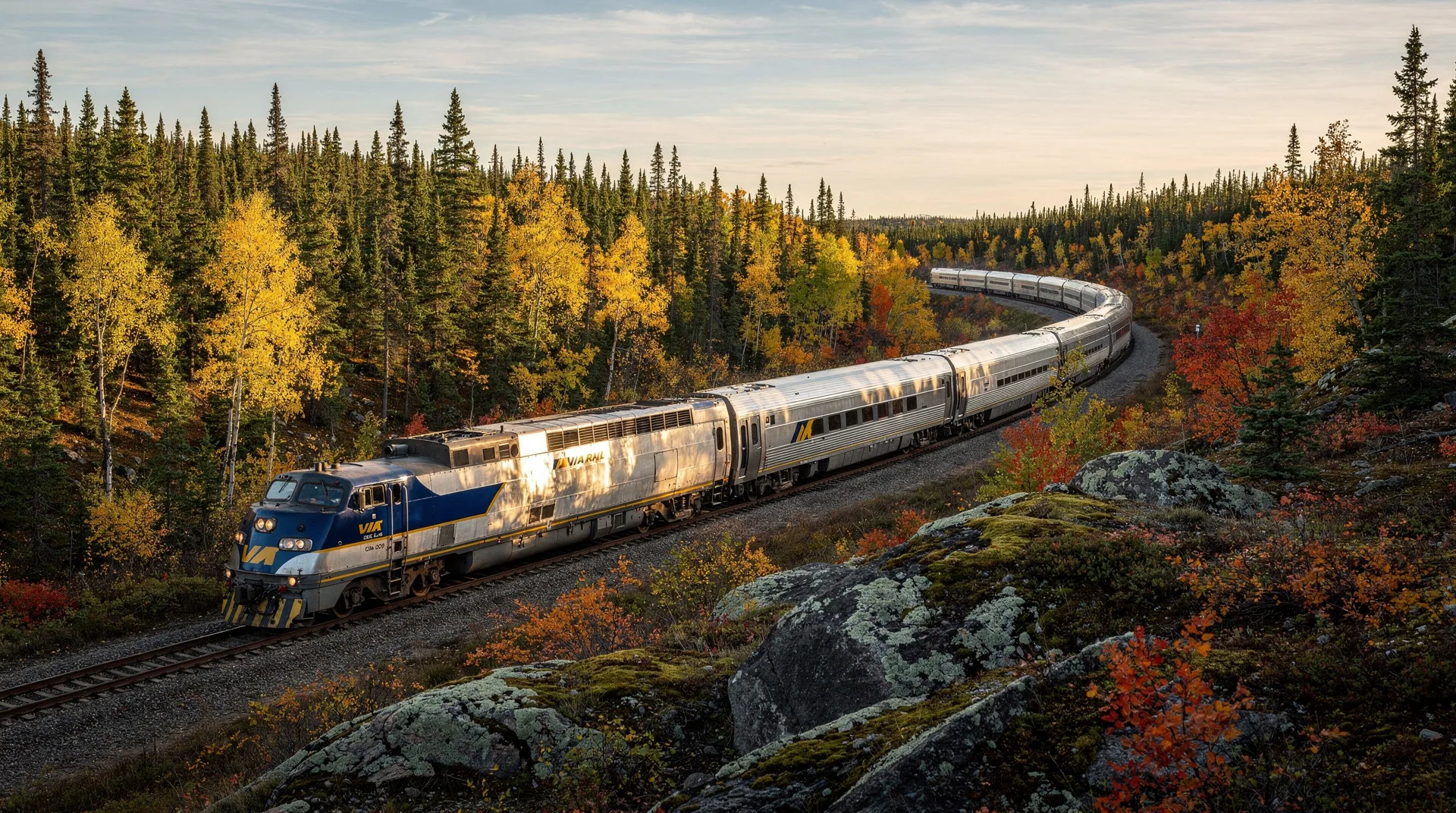
VIA Rail Canadian: Toronto to Vancouver by train
How long does the VIA Rail Canadian take from Toronto to Vancouver?
The VIA Rail Canadian covers the 4,466 km between Toronto and Vancouver in approximately 86 hours — around three and a half days. The train runs three times per week in each direction and passes through Winnipeg, Saskatoon, Edmonton and Jasper.
The VIA Rail Canadian is one of the last great transcontinental passenger trains in North America. On a continent where long-distance rail travel has been largely surrendered to the automobile and the airplane, the Canadian stubbornly maintains its four-day crossing from Toronto to Vancouver, threading through the Precambrian Shield, the Prairies, the Rockies and the Pacific ranges. It is not a luxury experience — it is a genuine cross-country rail journey that connects real places and real people across one of the world’s largest countries.
The train covers 4,466 kilometres, stopping at dozens of communities along the way. Some of those communities have no road access — the Canadian is their only land link to the wider world. That functional reality gives the train a weight that luxury excursions cannot replicate. Riding the Canadian, you are participating in something that has shaped the country: the railway that made Canada a coast-to-coast nation.
For international visitors, the Canadian offers a panoramic traverse of landscapes impossible to experience any other way in this time frame: the vast boreal forests of Northern Ontario, the flat infinity of the Prairies, the Rocky Mountain approach through Jasper, and the descent through the Rockies to the Pacific coast. The price is accessible by transcontinental train standards, the sleeper cars are comfortable, and the dining car still serves meals at a table with strangers who become, over three days, something like fellow travellers.
| At a glance | |
|---|---|
| Where | Toronto Union Station to Vancouver Pacific Central Station, 4,466 km |
| Cost | Economy around CAD $350-650; Sleeper Plus roomette CAD $900-1,800; bedroom CAD $1,400-2,500; Prestige CAD $2,500-4,000 |
| Time needed | Around 86 hours (roughly 3.5 days), plus typical freight delays |
| Getting there | Departs three times weekly each direction from Toronto and Vancouver |
| Best time | Late June-August for daylight; May and September for lighter crowds and fall colour |
Why the Canadian deserves its place on your itinerary
The case for taking the train from Toronto to Vancouver rests on a simple proposition: there is no other way to see what the train shows you. Flying the same route takes five hours and delivers you to Vancouver having seen nothing. Driving takes five to seven days minimum and focuses your attention on the road rather than the landscape. Only the train puts the landscape in front of you while you eat, read, sleep and talk.
The Canadian also fills in the parts of Canada that most international visitors miss. While the Rockies rightly draw crowds, the boreal forests of Northern Ontario, the sweeping wheat fields of Saskatchewan, and the wild river valleys north of Edmonton are equally authentic expressions of what Canada is. The train crosses them at a speed that allows them to register — not as a blur through an airplane window but as an actual landscape with depth, texture and weather.
For rail enthusiasts specifically, the Canadian is a pilgrimage. The original transcontinental railway completed in 1885 was the engineering and political event that cemented Confederation; the tracks the Canadian uses today trace much of the same route. Riding it is a form of historical participation that no tour can manufacture.
The route: what you pass through
Toronto to Winnipeg (approximately 35 hours)
Departing Toronto’s Union Station, the train initially travels north before swinging northwest. The first hours pass through suburban Ontario and the first glimpse of the Canadian Shield — the ancient Precambrian rock that forms the geological core of the continent. By evening the train is deep in the boreal forest of Northern Ontario, a vast and largely uninhabited landscape of spruce, birch, lake, and muskeg.
Sudbury, Capreol, Hornepayne, Sioux Lookout — the stop names read like a geography of the isolated. At night the train crosses the empty northern interior; passengers in sleeper cars wake to find themselves still in the same endless forest, the rhythm of the tracks unchanged. Winnipeg arrives on the second morning, a welcome city after the wilderness.
Winnipeg is a brief stop — typically 45 to 90 minutes — enough to step onto the platform, stretch your legs and sense the shift from the Canadian Shield to the Prairies. The Forks, where the Red and Assiniboine rivers meet, is visible from the station.
Winnipeg to Edmonton (approximately 24 hours)
West of Winnipeg the landscape changes completely. The boreal forest ends and the Prairies begin: flat, impossibly wide, uninterrupted to the horizon in every direction. This is the section that tests some travellers’ patience and rewards others’ contemplation. The sky is enormous — weather systems visible from 80 kilometres away, sunsets that run for an hour, stars at night that are extraordinary in their density.
The train passes through Portage la Prairie, Brandon, and into Saskatchewan. Saskatoon, reached in the late afternoon or evening, is the major stop on the Prairies — another 30–60 minute platform break. Beyond Saskatoon the train crosses into Alberta, passing through small agricultural towns before reaching Edmonton late at night or in the early morning.
Edmonton to Jasper and the Rockies (approximately 6 hours)
This section, covered typically in early morning, is where the landscape undergoes its most dramatic transformation. The train follows the North Saskatchewan River west, and the Rockies begin to appear on the horizon as a low, dark line that grows steadily larger. Edson, Hinton, and then the mountain front — the transition is abrupt and thrilling.
The Canadian enters Jasper National Park through the Yellowhead Pass, the lowest rail crossing of the Continental Divide. Jasper arrives in late morning, with the dramatic mountain scenery that has been building for hours suddenly fully revealed. Most passengers on this leg have been at the windows for the last two hours.
Jasper is a scheduled stop of 90 minutes to two hours — enough to walk through the small downtown and glimpse the Athabasca River. Jasper National Park is worth a dedicated stay; many travellers use the Canadian as the arrival or departure for a Jasper trip rather than as a through journey.
Jasper to Vancouver (approximately 21 hours)
West of Jasper the train descends through the mountains on the Canadian National main line, following the Fraser River system through British Columbia. The Mount Robson section — where the highest peak in the Canadian Rockies towers above the track — is one of the most visually dramatic on the entire journey. Blue River, Clearwater, Kamloops follow.
The Fraser Canyon section in the afternoon or early evening (depending on day and direction) mirrors the Rocky Mountaineer’s famous passage: vertical granite walls, the jade-green Fraser far below, tunnels and bridges through terrain that defeated engineers for decades. Arriving in Vancouver’s Pacific Central Station in the evening, after three and a half days of continuous Canada, is an arrival that feels genuinely earned.
Classes and prices
Economy class
Economy seats are large, reclining chairs with reasonable legroom — comparable to business class on short-haul flights. Seats can be rotated to face each other for group travel. There is no sleeper accommodation; overnight travel is in the seat. The economy car has large windows and overhead baggage storage. Meals are available for purchase in the dining car.
Economy prices: approximately CAD $350–$650 per person one-way Toronto to Vancouver, depending on season and advance booking. The Canada Rail Pass (see our Canada Rail Pass guide) can offer significant savings for multi-trip itineraries.
Sleeper Plus class (Touring class)
Sleeper Plus is the essential upgrade for the full transcontinental experience. Options include:
Roomette: A private compartment for one or two passengers with two facing seats that convert to upper and lower berths at night. A small folding table, reading lights, and a curtain or door provide privacy. Bathroom and shower facilities are shared at the end of the car.
Bedroom: Larger than the Roomette, with a dedicated in-room toilet, a small sofa that converts to beds, and a bit more storage space. The most comfortable overnight option for two passengers.
Cabin for one: A single-occupancy sleeper compartment — rare and valuable for solo travellers who want privacy without paying for a double room.
All Sleeper Plus passengers receive three meals per day included in the fare, served in the dining car at assigned seatings. Meals are shared-table style — a four-top where you sit with other passengers you may not know. This is not a bug but a feature; the dining car produces some of the journey’s most memorable social encounters.
Sleeper Plus prices: approximately CAD $900–$1,800 per person one-way for a Roomette, CAD $1,400–$2,500 for a Bedroom. Prices vary significantly by season, direction, and departure date. Book at least 60–90 days ahead for the best availability in summer.
Prestige class
Prestige is VIA Rail’s top tier, offering the largest private compartments with in-room bathrooms and showers, premium meal service, and exclusive access to the Prestige dining area. Available on transcontinental and some corridor routes, Prestige suits travellers who want maximum privacy and the highest on-board comfort.
Prestige prices: approximately CAD $2,500–$4,000 per person one-way. At this level the Canadian competes directly with the Rocky Mountaineer on comfort, though not on the curated scenery-first experience.
What to expect on board
The Canadian’s coaches date from the 1950s and have been refurbished over the decades without losing their character. The stainless-steel streamlined exterior is a design classic; inside, the materials are functional rather than luxurious but the bones of the original design — wide windows, curved ceilings, the sensory experience of the wheels on the rails — remain intact.
The dome car is the social heart of the train. An upper-level glass-enclosed observation dome runs above a standard coach, accessible to all passengers regardless of class. In the dome, seats fill quickly at any scenic section; a social norm of sharing the best views and rotating positions develops naturally over three days. Conversational orbits form here that persist through the journey.
Meals in the dining car — included for sleeper passengers — are served at fixed times with assigned seatings. The quality is consistent with a mid-range restaurant: not Rocky Mountaineer standard, but genuinely satisfying. A full breakfast, lunch and dinner are served; the menus change each day. Alcohol is available for purchase.
Internet connectivity is limited to none for most of the journey. This is not an accident to work around — it is, for many passengers, a primary attraction. Three days with no Wi-Fi, no work email, and no social media scrolling, in a comfortable seat watching Canada go by, produces a kind of decompression that most travellers report as unexpectedly valuable.
Scenic highlights
Spanish River valley (Northern Ontario): A long section of track follows the Spanish River through deep Canadian Shield terrain — Precambrian rock faces, beaver ponds, boreal forest. It is wild and empty and very beautiful.
The Prairies at sunrise or sunset: The flat horizon means that sunrise and sunset are visible as complete events — the sun leaving or entering a sky that stretches from edge to edge. Worth setting an alarm for.
Mount Robson: Towering 3,954 metres above the track, Robson is the highest peak in the Canadian Rockies and commands a presence that makes even jaded passengers look up from their books. Cloud-wrapped most of the time; when clear, overwhelming.
Yellowhead Pass: The crossing of the Continental Divide at Yellowhead is gentle compared to the dramatic passes on the Rocky Mountaineer route, but the sense of crossing the roof of the continent — from Atlantic watershed to Pacific watershed — is powerful.
Fraser Canyon: Shared with the Rocky Mountaineer route but typically traversed in lower light on the Canadian. Still dramatic, particularly the Hells Gate section where the canyon narrows and the river surges between vertical rock walls.
Best time to travel
Late June through August is peak season: maximum daylight on the Prairies means you see everything, and mountain wildflowers are at their best. Book early — sleeper accommodation sells out for July and August departures.
May and September offer lower prices and thinner crowds. The Prairies are green in May; September delivers golden Prairie fields, larch colour in the Rockies, and the best mountain photography light. These are arguably the finest months to ride.
October through April sees reduced frequency and less tourist traffic. Winter crossings — with snow-covered Prairies and ice-crystal forests — have a particular atmosphere, but some scenery is best in season. Off-peak fares can be very competitive.
How to book
Book directly through VIA Rail’s website (viarail.ca) or by phone. The booking system shows availability by car and class. For Sleeper Plus, the specific room type matters — Roomettes and Bedrooms often sell separately and at different paces.
VIA Preference loyalty program: Free to join, earns points on tickets, and provides early access to seat selection on some routes. Worth signing up before booking.
Multi-city bookings: If planning stops at Jasper or Winnipeg en route, book as separate segments. VIA Rail allows this and you can secure your preferred accommodation type in each segment. See our plan your trip guide for multi-city routing tips.
Discounts: VIA offers youth, senior, and student discounts. The Escape fares, released periodically for specific dates, offer significant reductions on unreserved seats and occasionally on sleepers. Sign up for the VIA Rail email list for Escape fare notifications.
Browse Vancouver tours to add to your VIA Rail arrival Book a Banff day tour from Lake Louise to Moraine Lake for your Jasper stopWhere to stay at start and end points
Toronto: Union Station is in the heart of downtown. The Fairmont Royal York, directly connected to the station, is the classic pre-departure choice. The Marriott City Centre and Intercontinental Toronto Centre are strong alternatives at comparable prices. Budget travellers can use the excellent transit connections to stay in Midtown or the West End.
Vancouver: Pacific Central Station is in the Mount Pleasant neighbourhood, a short cab or SkyTrain ride from downtown. See our Vancouver guides for full accommodation coverage. Arriving after three days on the train, you will appreciate a hotel with a good shower and a restaurant within walking distance.
Jasper (for stopover travellers): The Fairmont Jasper Park Lodge is the benchmark choice; the Crimson Jasper is a well-regarded mid-range option in town. See our Jasper National Park guide for full coverage.
Alternatives and comparison
Rocky Mountaineer: The luxury alternative for the mountain section specifically. The Rocky Mountaineer is more expensive, daytime-only, and focused entirely on the scenery experience. The Canadian provides a complete transcontinental journey at lower cost. See our full comparison.
Amtrak connections: VIA Rail and Amtrak do not share a booking system, but travellers can connect from the Canadian to Amtrak’s Cascades service (Vancouver–Seattle–Portland) for an extended Pacific Coast rail itinerary. A full Pacific rail loop — fly into Toronto, train to Vancouver, continue south to California — is a feasible and rewarding itinerary.
Flights: Air Canada and WestJet cover Toronto to Vancouver in approximately 5 hours from CAD $200–$500. If time is the constraint, flying is rational. If the journey is part of the experience, the train is in a completely different category.
Options compared
| Option | Duration | Typical cost (one-way) | Best for |
|---|---|---|---|
| VIA Rail Canadian, Sleeper Plus | ~86 hours | CAD $900-2,500 | Full transcontinental journey at moderate cost |
| VIA Rail Canadian, Economy | ~86 hours | CAD $350-650 | Budget travellers comfortable sitting overnight |
| Rocky Mountaineer | 2 days (daytime only, mountain section) | Significantly higher than Sleeper Plus | Luxury, scenery-focused mountain travel |
| Flight (Air Canada/WestJet) | ~5 hours | CAD $200-500 | Travellers for whom time is the constraint |
If your main interest is the prairie section specifically rather than the whole crossing, our prairie crossing guide covers what to expect between Winnipeg and Saskatoon in more depth, and the booking guide covers class options and fares in more detail than this overview.
Frequently asked questions about VIA Rail Canadian: Toronto to Vancouver by train
Does the Canadian run every day?
No. The Canadian operates three times per week in each direction — typically departing Toronto on Tuesday, Thursday and Saturday westbound. Check the VIA Rail website for the current schedule, which changes seasonally.
Is there a shower on the Canadian?
Yes, but only in Sleeper Plus and Prestige cars. Shower facilities are shared in Sleeper Plus (typically one shower per car, bookable in time slots). Prestige passengers have in-room showers. Economy passengers have no shower access.
Can I bring my own food and alcohol?
You can bring your own non-alcoholic food and drinks. VIA Rail’s policy on personal alcohol varies — check current guidelines before departure. The dining car and snack car serve alcohol for purchase throughout most of the journey.
What happens if the train is delayed?
The Canadian runs on freight railway tracks for much of its route (Canadian National and Canadian Pacific lines), and freight trains have priority. Delays of several hours are not uncommon, particularly on the Northern Ontario section. Budget buffer time at either end of the journey and do not book connecting flights the same day as your arrival.
Is the Canadian accessible for passengers with mobility needs?
VIA Rail provides accessible accommodation including wheelchair-accessible bedrooms on the Canadian. Book well ahead as accessible space is limited. Call VIA Rail directly to discuss specific requirements.
What is the time change across the journey?
Travelling westbound from Toronto, you gain three hours by the time you reach Vancouver. The train changes local time at provincial borders, which can affect meal service times and arrival estimates.
Can I get off the train at intermediate stops?
Yes. The Canadian makes scheduled stops at dozens of communities; passengers can board and disembark at any stop. Some stops are brief platform pauses; others (Winnipeg, Saskatoon, Edmonton, Jasper) allow 30–90 minutes of exploration.
Is the VIA Rail Canadian better than the Rocky Mountaineer?
They serve different goals. The Canadian is a genuine transcontinental journey at a lower cost, covering Toronto to Vancouver; the Rocky Mountaineer is a daytime-only, more expensive, scenery-focused experience through the Rockies alone. See our full comparison for which suits your trip.
How far ahead should I book the Canadian?
For Sleeper Plus in peak summer (June-August), book as early as possible — popular room types, especially bedrooms, sell out months ahead on the Toronto-Vancouver route. For spring and autumn, 60-90 days ahead is usually enough. Economy rarely sells out that early.