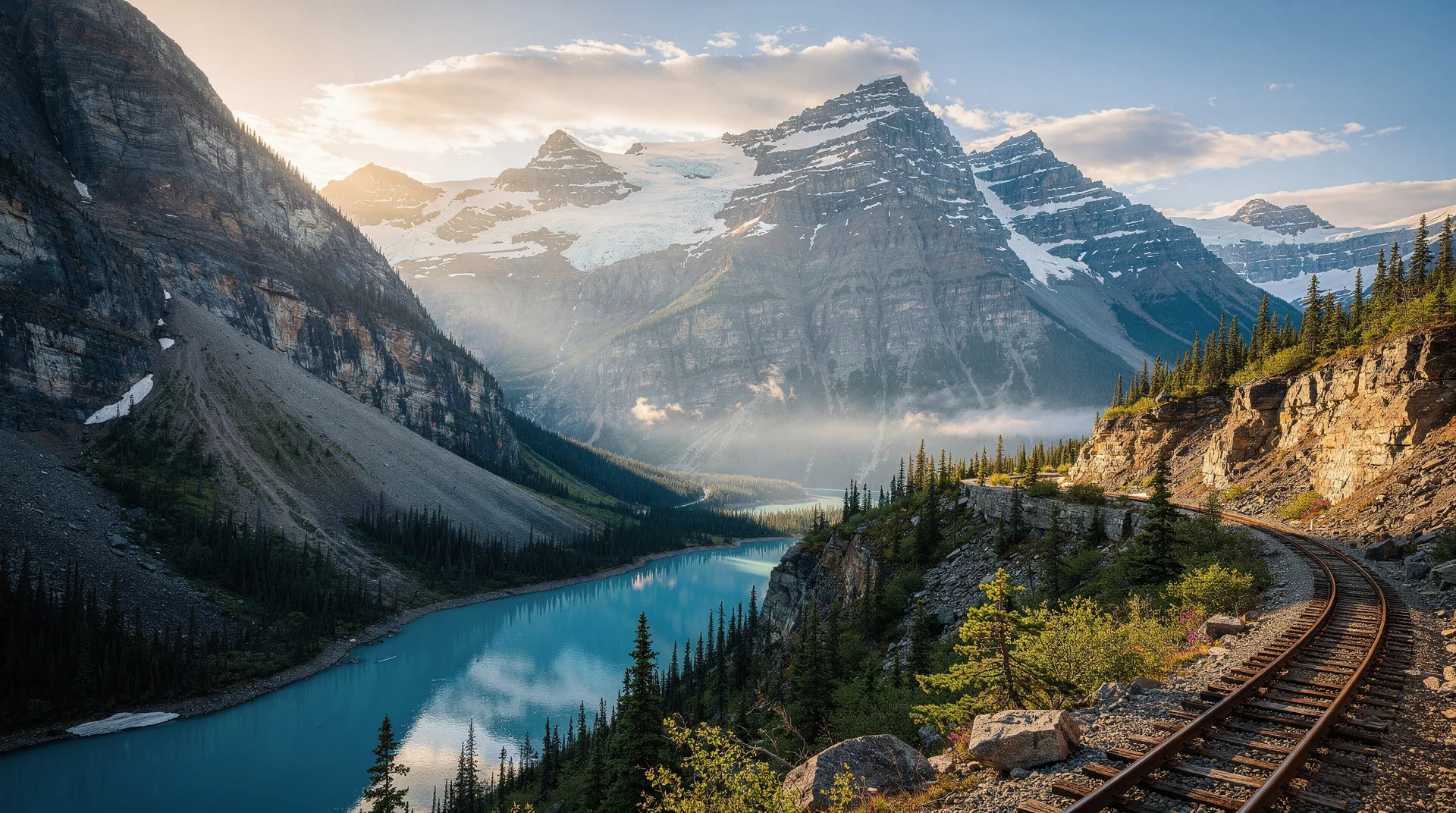
White Pass and Yukon Route: Skagway to Yukon
What is the White Pass and Yukon Route?
The White Pass and Yukon Route is a historic narrow-gauge railway built in 1898–1900 during the Klondike Gold Rush. Today it operates scenic excursions from Skagway, Alaska through the Coast Mountains to the BC–Yukon border and beyond, offering some of North America's most dramatic mountain railway scenery.
In the summer of 1898, tens of thousands of prospectors struggled up the White Pass Trail and the Chilkoot Trail through the Coast Mountains, driven by the feverish hope of Klondike gold. The pass defeated many of them — steep, slippery, packed with desperate men and their exhausted horses, with a summit at 873 metres where Arctic weather could arrive without warning at any time of year. A railway engineer named Michael Heney looked at the same terrain and declared it buildable. Twenty-seven months later, the White Pass and Yukon Route was complete, threading a narrow-gauge track through seemingly impossible mountain terrain to connect the Alaskan port of Skagway with Whitehorse in the Yukon.
More than 125 years after its construction, the railway still operates. Freight service ended in the 1980s, but the scenic excursion service that launched in the 1980s has grown steadily into one of Alaska and Canada’s premier historic railway experiences. The train climbs through the same mountains that broke the Klondike stampeders, past the same granite faces and glaciers and summit lakes, on the same track. It is a journey through engineering audacity, Gold Rush history, and mountain wilderness that rewards anyone with even a passing interest in railways, history, or North American scenery.
At a glance
| Where | Skagway, Alaska, climbing to the BC/Yukon border and on to Whitehorse |
| Cost | Around USD $175-350 per person depending on excursion |
| Time needed | Around 3-4 hours (summit) up to a full day (Skagway-Whitehorse) |
| Getting there | Cruise ship, Alaska Marine Highway ferry, or drive from Whitehorse via the Klondike Highway |
| Best time | Mid-May to late September; July-August busiest, September for fall colour |
Why the White Pass route earns its reputation
The statistics are compelling on their own. In 26.5 miles (42.6 km) from Skagway to White Pass summit, the railway climbs from sea level to 873 metres — a gradient that defeated many proposals before Heney’s team achieved it using the most advanced blasting and tunnelling technology of the time. The result is a track that clings to granite cliffs hundreds of metres above valley floors, crosses bridges over gorges that would test modern engineers, and passes through rock tunnels cut from living granite with black powder charges.
The International Historic Civil Engineering Landmark designation (the same category as the Eiffel Tower and the Panama Canal) reflects the achievement. The route was named a National Historic Landmark in both the United States and Canada — one of very few sites with that dual designation. Riding it, you are inside an engineering monument.
The scenery is independent justification. The Coast Mountains between Skagway and the Yukon interior are among the most vertical and dramatic in North America. Hanging glaciers, waterfalls, and snow-capped peaks are standard elements of the view; dead trees from the 1898 Gold Rush era’s horse massacre at Dead Horse Gulch remain eerily preserved in the cold. The summit environment — alpine tundra, granite, lingering snowpack — feels genuinely arctic even in summer.
The route and excursion options
Summit excursion (most popular)
The signature trip runs from Skagway to White Pass Summit and back, approximately 3–4 hours round trip. Passengers board in Skagway, climb through the Coast Mountains past Dead Horse Gulch, over the international border at the summit, and return to Skagway. This covers the most dramatic terrain and is the right choice for cruise ship visitors with limited time.
The summit excursion operates multiple departures per day during the Alaska cruise season (May through September). Trains fill to capacity on busy cruise days — book at minimum a week ahead, preferably further.
Fraser Loop excursion
A longer option extending the journey to Fraser, BC, just across the Canadian border in British Columbia. Fraser allows passengers to see the Tunnel Mountain section and the dramatic Summit Lake views in addition to the White Pass summit. Round trip from Skagway, approximately 5–6 hours.
Through service to Carcross and Bennett (seasonal)
On certain days, the full train service operates to Bennett, BC (a ghost town at Bennett Lake where the stampeders built their boats) and to Carcross, Yukon (a small Tagish First Nation community). These trips operate in coordination with motorcoach connections for travellers moving between Skagway and Whitehorse, allowing a one-way train journey from Skagway to Carcross followed by a bus to Whitehorse (or vice versa).
This one-way option is the best choice for travellers incorporating the White Pass into a broader Alaska or Yukon itinerary rather than using Skagway as a base. Booking the combined train-bus service as a through product simplifies logistics.
Skagway to Whitehorse (combined rail and motorcoach)
A full-day product covering the entire historic route: train from Skagway to Carcross, motorcoach from Carcross to Whitehorse. This is approximately 8 hours total and crosses from Alaska through British Columbia into Yukon. Prices are higher than the summit excursion but the experience is a genuine cross-border adventure. This is recommended for travellers arriving in Skagway by cruise ship and proceeding to Whitehorse for a Yukon road trip.
Fares (2026 approximate)
All fares are priced in USD as the railway is based in Alaska. For Canadian visitors, note the exchange rate.
- Summit excursion (return): USD $175–$215 per person
- Fraser Loop (return): USD $195–$235 per person
- Bennett Lake round trip (selected dates): USD $215–$260 per person
- Skagway to Carcross one-way: USD $200–$250 per person
- Full Skagway–Whitehorse combined (train + bus): USD $275–$350 per person
Children (3–12) typically receive a 40–50% discount. Under 3 free if not occupying a seat.
Book directly through the White Pass and Yukon Route website (wpyr.com). Third-party booking is available through cruise line shore excursion programs at higher prices. Booking direct saves money and provides more flexibility.
What to expect on board
The White Pass trains use vintage-style coaches with large windows, wooden interiors, and open-air observation platforms at the end of each car. The observation platforms are the most popular positions in good weather — standing outside on the rear platform of a coach as the train inches around cliff-face curves above the Skagway River valley is an experience that cannot be replicated from inside.
Narration is provided throughout the journey by on-board hosts who cover both the engineering history of the railway and the human story of the 1898 Gold Rush. The narration is genuinely interesting — the history of this railway is among the most compelling in North America, and a good host brings it alive against the actual landscape you are passing through.
Seating is on reversible coach benches plus some forward-facing window seats. There is no dining car or meal service on most excursions — snacks and beverages are available. The journey is short enough that a meal is not necessary for most passengers.
Dress code is casual and functional. The temperature at White Pass summit can be 10–15°C cooler than Skagway, and the observation platform has direct wind exposure. A warm layer and windproof jacket are essential even in July.
Historical context: the Klondike Gold Rush
Understanding the White Pass route requires a brief orientation to the Gold Rush it was built to serve. In 1896, prospectors discovered gold in the Klondike region of Yukon, near present-day Dawson City. By 1898, an estimated 100,000 people were attempting the journey from Seattle and San Francisco to the Klondike — most of them via the Alaskan panhandle ports of Skagway and Dyea.
The Canadian North-West Mounted Police required each person crossing into Canada to carry one year’s worth of supplies — approximately 1,000 pounds of food and equipment per person. Getting that weight over the mountain passes was a desperate physical challenge. The Chilkoot Trail, the other main route from Dyea, required a near-vertical climb over its summit; the White Pass Trail, while longer, was less steep but infamous for the treatment of pack horses, thousands of which died on the trail in 1897 and 1898. Dead Horse Gulch, visible from the railway, takes its name from these animals.
The railway solved the supply problem instantly when it opened. Within a year of completion, the worst of the Gold Rush was over — the Klondike goldfields had been mechanised and most individual prospectors had moved on — but the railway remained essential for Yukon’s mining and freight needs for the following century. The ghost town of Bennett, at the far end of the navigable portion of the trail, was abandoned almost overnight when the railway opened; it is one of the most atmospheric remnants of the Gold Rush era.
Scenic highlights
Brackett Wagon Road: Visible in the valley below the early section of track, the original wagon road built by entrepreneur George Brackett in 1897 runs parallel to the railway. It is a reminder that the railway replaced an existing (and highly competitive) infrastructure.
Dead Horse Gulch: A deep ravine where the bones of hundreds of pack horses are interred, plus preserved equipment and trail remnants from 1898. The railway passes an interpretive viewpoint here. Sobering and historically significant.
Rocky Cut and Glacier Gorge: Where the railway enters solid granite on a ledge above a gorge, with a waterfall visible below. This section gives the clearest sense of the engineering achievement — the track is literally carved out of a cliff face.
International boundary at the summit: White Pass Summit is the Alaska-BC border, clearly marked. The summit environment is open alpine tundra with views in all directions. Snow lingers here well into summer; weather can change rapidly.
Summit Lake and Fraser: Just over the summit, Summit Lake reflects the peaks and offers one of the most photographed views on the route. The small settlement at Fraser, BC, is the first Canadian ground on the journey.
Bennett Lake (for those on extended excursions): A vast, cold mountain lake at the end of the Chilkoot Trail. The stampeders built their boats here in 1898 from timber cut in the surrounding forest; the site is now a Parks Canada heritage area with interpretive displays.
Best time to travel
The White Pass and Yukon Route operates exclusively in the summer season, typically mid-May through late September. The peak Alaska cruise season drives scheduling.
June: Excellent weather, good availability compared to July–August, and wildflowers at their best. The summit snowpack is still significant on shaded north-facing slopes in early June. Daylight is extraordinary — up to 20 hours at this latitude.
July: Peak season, maximum crowds (particularly on days when multiple large cruise ships are in Skagway), but the most reliable weather. Book well ahead — popular departures sell out weeks in advance.
August: Similar to July. Late August begins the transition toward fall; berry plants on the alpine tundra turn red and gold by late August.
September: The best month for fall colour and the least crowded. Some excursion options may have reduced schedules in late September. The season typically ends in late September or early October.
How to get to Skagway
Cruise ship: The majority of White Pass passengers arrive by cruise ship in Skagway, which is a major Alaska Inside Passage port. Most major cruise lines (Princess, Holland America, Royal Caribbean, Norwegian, Disney) stop here. The ship docks within walking distance of the train station.
Alaska Marine Highway: The Alaska state ferry system connects Skagway with other Southeast Alaska communities (Juneau, Ketchikan, Prince Rupert BC, Bellingham WA). A scenic and practical way to arrive without a cruise ship. If you are weighing other coastal crossings, our Inside Passage ferry guide gives useful background on travelling this stretch of coast by boat.
Drive from Whitehorse: Skagway is approximately 180 km south of Whitehorse via the Klondike Highway (Hwy 2) to Carcross and then the South Klondike Highway (Hwy 2) south to Skagway. The drive is approximately 2.5 hours each way and is spectacular in its own right, passing through the Ibex Valley and along the Tutshi and Tagish lakes. Doing the drive one way and the train the other is the ideal itinerary for Whitehorse-based visitors.
Where to stay in Skagway
Skagway is small (permanent population approximately 1,000) with accommodation that expands significantly for the summer cruise season.
The Skagway Inn: A restored Victorian B&B in a National Historic District building. The most atmospheric choice in town and close to the station.
Westmark Inn Skagway: A larger, more conventional hotel option with reliable comfort and a restaurant. Popular with cruise passengers staying overnight.
Skagway Mountain View RV Park: For self-contained travellers, the RV park at the edge of town is well-positioned for early morning train departures.
Note that Skagway accommodation fills completely on peak cruise days. If overnighting in Skagway, book at least two to three months ahead for July and August.
Browse Yukon tours and experiences to extend your White Pass journey Explore Whitehorse tours and excursions from the Yukon capitalExtending your trip into the Yukon
The White Pass is a natural gateway to the Yukon. Travellers arriving in Whitehorse via the train-bus combination can continue north to Dawson City (530 km on the Klondike Highway), explore the Kluane National Park region to the southwest, or travel the Alaska Highway west toward Alaska.
Whitehorse itself — the Yukon capital with approximately 28,000 people — offers the Miles Canyon historic site, the SS Klondike sternwheeler, and excellent wilderness tour operators for river trips, wildlife viewing, and Aurora Borealis viewing in autumn. See our broader Yukon destination page for planning resources.
If the long summer light appeals, our guide to the midnight sun in the Yukon explains what the season feels like on the ground, and the northern lights in the Yukon guide covers the darker months for those who return later. Winter visitors will find a very different North in our Yukon dog sledding guide.
Before the road north, the small community of Carcross is worth a slow stop, since it sits right on the rail and road corridor between Skagway and Whitehorse.
Dawson City, the Klondike Gold Rush capital at the confluence of the Klondike and Yukon rivers, is the historical climax of any Gold Rush itinerary. The Parks Canada historic sites in Dawson City — the dredges, the recreation of Front Street, Diamond Tooth Gertie’s — recreate the boom-town atmosphere of 1898 with impressive authenticity.
Comparison and alternatives
Chilkoot Trail: The other Gold Rush route from Dyea (near Skagway) to Bennett is a 53 km multi-day hiking trail managed by Parks Canada and the US National Park Service. The most historically authentic Gold Rush experience available — you walk the route the stampeders walked, carrying your own pack. Permits are required and limited; book a year ahead for summer access. The White Pass train and the Chilkoot Trail are complementary rather than competitive: do one in each direction.
Rocky Mountaineer: The other major luxury scenic train option in western Canada, operating in British Columbia and Alberta. The Rocky Mountaineer is more expensive, more comfort-focused, and covers a completely different landscape. Both are worth doing; they serve different purposes. Our Rocky Mountaineer guide covers that journey in detail, and the Rocky Mountaineer vs VIA Rail comparison helps if you are choosing between trains in the Rockies. See our best scenic train routes comparison.
Alaska Railroad: From Anchorage or Fairbanks, the Alaska Railroad provides comparable mountain rail scenery with a different character. The Denali Star and Coastal Classic routes are the most scenic. A full Alaska rail loop combined with the White Pass provides one of the finest rail journeys in North America.
Budget and logistics tips
Booking direct through wpyr.com rather than a cruise line shore-excursion desk typically saves money and gives you more flexibility on departure times. If you are building a wider Yukon trip, pair the train with a night or two in Whitehorse — Miles Canyon and the SS Klondike sternwheeler are both easy half-day additions — before continuing north to Dawson City for the full Gold Rush story, or southwest toward Kluane National Park for glacier and wildlife scenery.
Visa-exempt travellers flying into Canada or the US should check entry requirements well ahead; Canadian-bound air travellers usually need an eTA (see our Canada eTA and visa guide).
Travellers chasing the aurora can extend a Yukon trip into late August or September, when the northern lights start to become visible again after the long summer daylight; see our Yellowknife aurora guide for the broader northern-lights picture across the North.
Frequently asked questions about White Pass and Yukon Route: Skagway to Yukon
Do I need a passport for the White Pass and Yukon Route?
Yes. Even the shorter summit excursion crosses from Alaska into British Columbia, so a valid passport (or equivalent travel document) is required for all passengers, including children.
Can I combine the train with a Yukon road trip?
Yes, and it is one of the most popular ways to use the route. Take the train (or the combined train-bus service) one way between Skagway and Whitehorse, then rent a car in Whitehorse to continue north toward Dawson City or southwest toward Kluane National Park.
Is the White Pass and Yukon Route in Alaska or Canada?
Both. The route begins in Skagway, Alaska, and crosses into British Columbia at White Pass Summit. The extended excursions continue into British Columbia and Yukon. Depending on your excursion, you may cross international borders in both directions during the same trip. Canadian visitors need a passport or equivalent travel document.
How long is the summit excursion?
Approximately 3 to 4 hours round trip. The train climbs from Skagway to White Pass Summit, pauses for views, and returns. It is an ideal excursion for cruise passengers with a limited port day.
Can I take just a one-way trip?
Yes, on certain departures. One-way service from Skagway to Carcross or Bennett is available on selected dates; the return leg is by motorcoach to Whitehorse or Skagway depending on your itinerary. Check the White Pass website for one-way availability on your travel dates.
Is the train affected by weather?
The White Pass summit can receive heavy snow, fog, or high winds at any point in the summer season. The railway has protocols for weather delays and occasionally truncates trips. Most passengers experience the full journey, but it is worth building schedule flexibility on either side of your train day.
Are pets allowed on the train?
Service animals with appropriate certification are permitted. Pet dogs and other animals are generally not permitted in passenger coaches, though policies can change. Contact White Pass and Yukon Route directly to confirm current pet policy.
Does the train run on diesel or steam?
Regular scheduled services use diesel locomotives. Steam locomotive excursions are offered on special occasions and can be booked when available — these are popular and sell out quickly. Check the White Pass website for special steam event dates.
What is the gauge of the track?
The White Pass and Yukon Route uses 914 mm (3 ft) narrow gauge — the same gauge it has operated on since 1900. The coaches and locomotives are specifically built for this gauge, which contributes to the vintage character of the experience.