Polar Bear Express (Ontario Northland)
What is the Polar Bear Express?
The Polar Bear Express is a passenger train operated by Ontario Northland between Cochrane and Moosonee in Northern Ontario. It crosses 300 km of Hudson Bay lowlands — one of the world's largest wetlands — to reach Moosonee on the James Bay coast, a community with no road access.
At the end of the provincial road system in Northern Ontario, where the forest thins and the bogs begin and the roads simply stop, the Polar Bear Express picks up where the highways leave off. This Ontario Northland passenger train runs 300 kilometres north from the end of the road at Cochrane to Moosonee on the James Bay coast — a community of approximately 1,800 people that has no road connection to the rest of Ontario. For the people of Moosonee and the nearby Moose Cree First Nation community of Moose Factory, the train is not a scenic attraction. It is a lifeline.
That dual identity — functional community service and extraordinary wilderness journey — is what makes the Polar Bear Express unlike any other tourist train in Canada. You are not riding a purpose-built excursion train through a preserved landscape. You are riding a real regional service through one of the world’s largest and least-visited wilderness areas: the Hudson Bay Lowlands, a vast subarctic wetland that stretches across 325,000 square kilometres of Northern Ontario, Manitoba and Quebec. UNESCO recognises the lowlands as one of the world’s most significant natural areas, and you cross 300 kilometres of them while eating a sandwich in a rail coach.
This guide covers the train’s route, what you will actually see, how to extend the trip into Moosonee, and how this experience compares to other Northern Ontario wilderness options.
| Where | Cochrane to Moosonee, Northern Ontario (about 780 km / 7 hours’ drive north of Toronto to Cochrane) |
| Cost | Summer excursion around CAD $100-$140 return; regular one-way service around CAD $50-$80 |
| Time needed | A full day for the summer excursion (around 10-11 hours Cochrane-Moosonee-Cochrane); 2 days if staying overnight |
| Getting there | Drive Highway 11 to Cochrane, or take the Ontario Northland bus from Toronto (around 10-11 hours) |
| Best time | July-August for reliable service and wildlife; September for tamarack colour; deep winter for an advanced, cold-weather trip |
Why the Polar Bear Express is unlike any other Canadian train
The credentials are simple and extraordinary: this train goes somewhere that cannot be reached any other way. When the seasonal winter road across the frozen lowlands closes in spring, the train is the community’s only surface transport connection until the ice returns. No other passenger train in Southern or Central Canada serves a road-inaccessible destination.
The landscape it crosses is equally extreme. The Hudson Bay Lowlands are one of the world’s most carbon-rich ecosystems — a vast, flat terrain of peatland, muskeg, boreal forest, and wetland that stores an estimated 30 billion tonnes of carbon in its soils. It is also one of the last extensive wilderness areas accessible with essentially no backcountry experience required. You board a train in the morning and arrive in the subarctic by afternoon.
The wildlife connection to the name deserves context: despite what the name implies, you will not see polar bears from this train. The polar bear population of the region is centred on Churchill, Manitoba, far to the west (see below). However, the bears do occasionally enter the southern James Bay area in winter and early spring when the sea ice extends south. The “Polar Bear Express” name dates from the 1980s and reflects the train’s proximity to polar bear habitat in the broader sense.
What you are genuinely likely to see: black bears, moose (very commonly), Canada geese and other waterfowl in enormous numbers, eagles, and the pristine boreal and subarctic landscape that supports these populations.
The route: Cochrane to Moosonee
Cochrane
Cochrane is a town of approximately 5,500 people at the junction of Highways 11 and 655, about 780 km north of Toronto. It serves as the southern terminus of the Polar Bear Express and the northern limit of the provincial highway network in this part of Ontario. The Ontario Northland Railway station in Cochrane is the departure point.
Cochrane is a functional small Northern Ontario town, not a tourist centre. The Polar Bear Habitat and Heritage Village in town is worth a brief visit — it houses one of the few establishments in the world where captive polar bears can be observed (they were rescued and rehabilitated rather than wild-caught). It is an appropriate orientation to the bear culture of the region before boarding the train.
The journey north (approximately 5 hours)
The train departs Cochrane in the morning (check current schedule, as times vary seasonally). The initial section runs through boreal forest: black spruce, tamarack, jack pine on thin soil over the Canadian Shield. Within the first hour the Shield gives way to the lowlands — the terrain flattening, the trees shortening and thinning, the forest interspersed with increasingly frequent muskeg and wetland.
The transition is gradual but unmistakable. By the time the train is a few hours north, the classic boreal forest has been replaced by open bog and fen, scattered stands of stunted spruce, and an enormous horizon that stretches without interruption in every direction. The sky becomes the dominant feature of the landscape.
Rail stops include Otter Rapids (with a small white-water section of the Abitibi River visible from the train) and several flag stops for communities and wilderness users. The final approach to Moosonee crosses the Moose River flats — flat wetland with massive skies that can deliver extraordinary northern light effects on clear days.
Moosonee
Moosonee is a Cree community and the northernmost town in Ontario reachable by rail. It sits on the south bank of the Moose River, two to three hours’ canoe journey from where the river meets James Bay. The community has a small downtown, several services, and a strong Moose Cree First Nation presence. If you want to build a longer trip around the region, you can browse guided tours across Ontario to add to your itinerary.
Moose Factory Island: Across the Moose River from Moosonee lies Moose Factory Island, one of the oldest continuous European settlements in Ontario (a Hudson’s Bay Company trading post established in 1673). Access is by water taxi (summer) or snowmobile across the ice (winter). The Anglican Church of St Thomas on Moose Factory, with its decorated interior and beaded altar cloths, is one of the most beautiful small churches in Northern Ontario. The Cree cultural heritage of the island adds significant depth to the visit.
James Bay: With more time, a boat trip from Moosonee down the Moose River to the James Bay coast is possible (arrange with local operators in Moosonee). The coast itself is flat and wind-swept — not dramatic in a mountain sense, but genuinely wild and very far north.
The train returns to Cochrane the same day on the excursion service (see below) or the following day on the regular service. Most tourist visitors take the day excursion; those wanting more time in Moosonee stay overnight.
Service types and fares
Polar Bear Express excursion service (summer)
The summer excursion service operates on selected dates from late June through early September. It departs Cochrane in the morning and returns the same afternoon/evening, giving passengers approximately three to four hours in Moosonee before the return journey.
This is the primary option for most visitors. The excursion fare (approximately CAD $100–$140 per person return) includes the day trip. Check Ontario Northland’s website (ontarionorthland.ca) for current dates and pricing.
Regular service
The regular Polar Bear Express service runs on a separate timetable (typically fewer departures) and allows passengers to stay overnight in Moosonee before returning. This is recommended for visitors wanting to cross to Moose Factory Island or explore the area more thoroughly.
Regular service one-way fares: approximately CAD $50–$80 per person. Overnight accommodation in Moosonee is limited — book well ahead if planning an overnight stay.
Classes
The Polar Bear Express is not a luxury service. Standard coach seating with upright chairs is the primary accommodation. There are no sleeper options. Bring reading material, a camera, and sufficient food for the day.
An on-board snack service and occasional souvenir sales are part of the summer excursion package. Cultural programming — First Nations presentations, wildlife commentary — is sometimes offered on excursion departures. Check Ontario Northland for current programming details.
What to expect on board
The coaches are functional Ontario Northland equipment — comfortable but not luxurious. Large windows are the key asset. At low speeds through the lowlands, photography from the window is easy. Wildlife appears frequently enough that keeping a camera ready from the moment the lowlands begin is worthwhile.
The train is not air-conditioned in the conventional sense. In summer (July–August), temperatures in the coaches can be warm. In June and September they are comfortable. Layers are useful; the lowlands can be significantly cooler than the departure point in Cochrane even in summer.
Baggage can be checked in the luggage car; carry-on to your seat. Most passengers travel light for the day excursion.
Scenic and natural highlights
The Shield-to-Lowlands transition: An hour or two into the journey, the moment when the Canadian Shield’s rocky terrain gives way to flat lowland bog is a landscape shift visible in real time. The world flattens, the trees shrink, the sky expands. It is a tangible crossing into a different natural realm.
Muskeg and peatland: The lowlands look featureless from a distance but reveal extraordinary detail at train speed: sphagnum moss in every shade of green, ochre and red; carnivorous plants (pitcher plants, sundews) in the wetter sections; the geometric patterns of polygon bogs visible from slight elevation. A naturalist guide — if offered on your departure — adds interpretive value here.
Moose: Moose density in the lowlands is high. Sightings from the train are common, particularly in early morning and evening. Cows with calves are frequently seen in June and July near marshy edges.
Waterfowl: The lowlands are an important staging area for Canada geese and other waterfowl. During spring and fall migration (April–May and September–October), the numbers of geese visible from the train can be extraordinary — flocks of thousands moving across the sky above the bogs.
Northern skies: At this latitude in June, the sky is still light well past 9:00 pm. The quality of the light over flat, treeless lowland — long golden hours, enormous cloud formations, occasional northern horizon glow — is a photographer’s environment.
Best time to travel
July and August: The prime visitor season. The full excursion service runs, weather is reliable, and the lowland vegetation is at full expression. Bugs can be significant in July — bring insect repellent. Water temperatures in the river reach swimmable levels.
June: Excellent for wildlife (calves, migratory birds), lower crowds than peak summer, and the longest daylight. Some services may still be on spring schedules. Check Ontario Northland for exact start dates.
September: The lowlands begin their autumn colour in early September — the tamaracks turn gold before any other tree, creating a landscape element unique to northern Canada. One of the most distinctive seasonal signatures in Ontario. Temperatures drop quickly; warm layers are essential.
Winter (January–March): The regular service runs in winter for community access. The landscape is frozen, white, and extraordinary. This is an advanced visitor option requiring cold-weather preparation and advance accommodation arrangements in Moosonee. The winter ice road season, when it operates, is worth timing a trip around.
Seasonality at a glance
| Season | Conditions | Crowds |
|---|---|---|
| June | Long daylight, calving moose, some spring scheduling | Lower |
| July-August | Peak excursion service, warm, biting insects | Busiest |
| September | Tamaracks turning gold, cooling fast | Moderate |
| Winter (Jan-Mar) | Regular service only, deep cold, possible ice-road window | Lowest |
Combining the trip with other Northern Canada wildlife travel
Travellers building a wider Northern Ontario and Manitoba wilderness trip often pair the Polar Bear Express with a genuine polar bear encounter in Churchill, reachable via Via Rail’s Canadian route network or by flight from Winnipeg. For the rail-focused traveller, our best scenic train routes in Canada guide sets this trip alongside the Agawa Canyon Tour Train and VIA Rail’s long-distance services, and the Agawa Canyon guide is the closest comparable day trip if Moosonee’s logistics feel like too much for a first visit.
How to get to Cochrane
Drive: From Toronto, Highway 11 north to Cochrane is approximately 650 km — about 7 hours. From Timmins (the nearest significant city), Cochrane is about 120 km north.
Ontario Northland bus: Ontario Northland operates bus services from Toronto to Cochrane, with connections from North Bay, Timmins, and other Northern Ontario centres. The bus journey from Toronto is approximately 10–11 hours. Check ontarionorthland.ca for routes and schedules.
Fly to Timmins: Timmins Airport (YTS) receives regular Air Canada service from Toronto. From Timmins, rent a car or take the Ontario Northland bus north to Cochrane.
Where to stay
In Cochrane: The Northern Lites Motel and Arctic Bear Hotel are the primary accommodation options for visitors arriving the night before the train. Both are functional and affordable. Book in advance in summer as availability is limited.
In Moosonee: The Taska Motel and Moosonee Lodge provide basic accommodation for overnight visitors. Moosonee is not set up for mass tourism — accommodation is limited, advance booking is essential, and expectations should be set accordingly. This adds to the authenticity of the experience.
Related wilderness experiences
The Polar Bear Express is not the only way to encounter Northern Canada’s wilderness by rail, but it is among the most accessible. For comparison with the Churchill, Manitoba polar bear experience — which offers genuine polar bear encounters in a subarctic setting — see below.
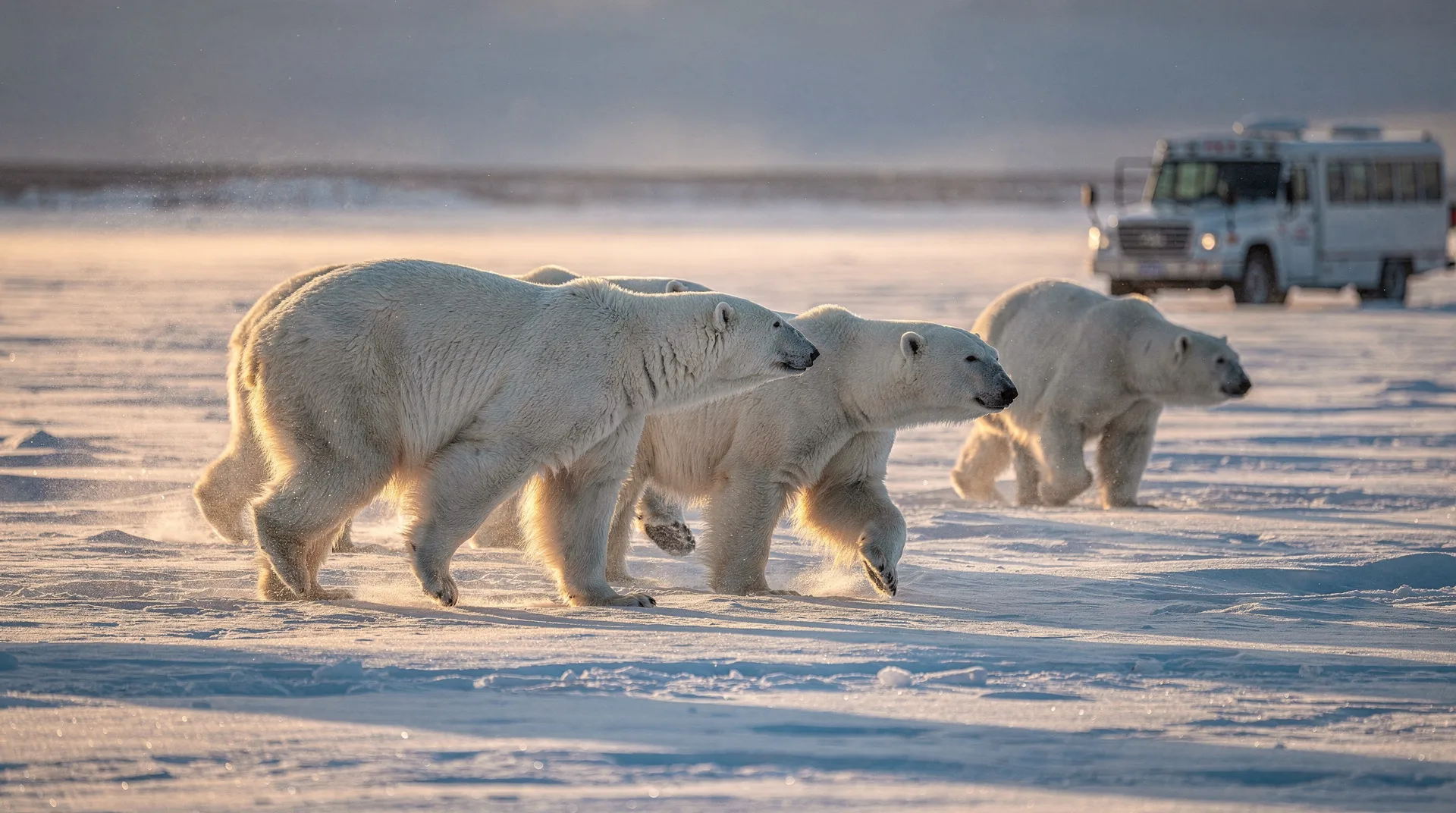
Book a Churchill Tundra Buggy day trip for a genuine polar bear encounterChurchill, Manitoba is the world capital of accessible polar bear viewing, with tours running October through November when bears gather at Hudson Bay waiting for the ice to form. It is not reachable by the Polar Bear Express — but a combined Northern Canada itinerary that includes both Moosonee and Churchill creates one of the most authentic wilderness travel experiences available on the continent.
Comparison with other northern train experiences
VIA Rail Canadian through Northern Ontario: The transcontinental train covers part of Northern Ontario’s terrain but at night and at higher speed. The Polar Bear Express is a deliberate, slow journey specifically into the lowlands — a fundamentally different experience.
Agawa Canyon Tour Train: Both are Ontario rail experiences into Canadian Shield and boreal wilderness, both are day excursions, and both serve destinations unreachable by road. The Agawa Canyon trip is more visually dramatic (canyon scenery, waterfalls, fall colour); the Polar Bear Express goes further north, crosses more remote terrain, and reaches an inhabited community at the end. See our Agawa Canyon guide for comparison. Our best scenic train routes ranking covers both.
Frequently asked questions about Polar Bear Express (Ontario Northland)
Will I see polar bears from the train?
Almost certainly not. Polar bears are found along the Hudson Bay coast and are most visible in Churchill, Manitoba, approximately 1,000 km west of Moosonee. The train name is aspirational rather than literal. Black bears and moose are common sightings.
Is Moosonee a First Nations community?
Moosonee has a mixed population including Moose Cree First Nation members and non-Indigenous residents. The nearby Moose Factory Island is a Moose Cree community with deep historical roots. Visitors should approach the community with respect; it is a real place where people live, not a cultural attraction.
Can I drive to Moosonee?
No. There is no permanent road to Moosonee. A seasonal winter ice road provides vehicle access when conditions allow (typically January–March), but it cannot be relied upon for tourism planning. The train is the all-season option.
How do I book the Polar Bear Express?
Through Ontario Northland (ontarionorthland.ca) online or by phone. Summer excursion dates are listed on the website from early in the year; book early for July departures.
Is there much to do in Moosonee for a few hours?
The town itself is small. A visit to the waterfront, the Cree cultural displays at the local heritage centre, and a water taxi trip to Moose Factory Island (allow 2–3 hours for Moose Factory alone) are the primary activities. The Revillon Frères trading post ruins on Moose Factory are historically significant. For a fuller experience, stay overnight and explore more thoroughly.
Is the Polar Bear Express suitable for children?
Yes, with appropriate preparation. Children who can sit contentedly for five-hour train journeys and who are engaged by wildlife sightings do very well. Bring entertainment for younger children for the less active portions of the journey.
What is the weather like in Moosonee in summer?
Summers in Moosonee are surprisingly warm — July highs average 23°C. However, the lowlands are humid, biting insects are active, and weather can change rapidly. A mix of T-shirt weather, rain gear, and bug protection covers most eventualities.
Is the Polar Bear Express the same as going to see actual polar bears in Churchill?
No. They are separate trips roughly 1,000 km apart. The Polar Bear Express is a rail journey through the Hudson Bay Lowlands to a road-inaccessible community; genuine polar bear viewing happens around Churchill, Manitoba, reached by air or the Winnipeg-Churchill VIA Rail service, roughly October to November.
Do I need to book the Polar Bear Express far in advance?
For the summer excursion, booking a few weeks to a couple of months ahead is sensible, especially for July and August departures and for Moosonee overnight accommodation. It is less pressured than Churchill’s polar bear season, but seats and rooms are limited on a small, remote service.