Rocky Mountaineer vs VIA Rail: which scenic train to choose
Rocky Mountaineer or VIA Rail Canadian — which is better?
Rocky Mountaineer is the premium choice for maximum mountain scenery and luxury service in the Rockies, costing CAD $1,500–$2,800. VIA Rail Canadian is the complete transcontinental journey at CAD $900–$1,800 for a sleeper, covering more of Canada at lower cost. The right choice depends on your priorities.
Two trains. One mountain landscape. Very different propositions.
The Rocky Mountaineer and the VIA Rail Canadian both travel through some of the same Canadian Rockies scenery — the mountains between Vancouver, Banff, Jasper and the Pacific coast — but they do so with different purposes, different pricing, and different passenger experiences. Choosing between them is one of the most common planning decisions for visitors to western Canada, and the answer is not as simple as “one is better than the other.”
This comparison covers price, scenery, comfort, scheduling, and the specific situations where each train is the right choice. By the end you should be able to make the decision confidently — or discover that you want to do both.
| Where | Between Vancouver, Kamloops, Banff/Jasper (Rocky Mountaineer) or Toronto-Vancouver (VIA Rail Canadian) |
| Cost | Around CAD $1,100-2,800 one-way (Rocky Mountaineer) vs CAD $350-1,800 one-way (VIA Rail) |
| Time needed | 2 days (Rocky Mountaineer, with a Kamloops overnight) vs up to 4 days (VIA Rail full transcontinental) |
| Getting there | Rocky Mountaineer departs Vancouver or Jasper/Banff; VIA Rail departs Toronto or Vancouver |
| Best time | April-October for Rocky Mountaineer (it doesn’t run in winter); VIA Rail runs year-round |
The essential difference
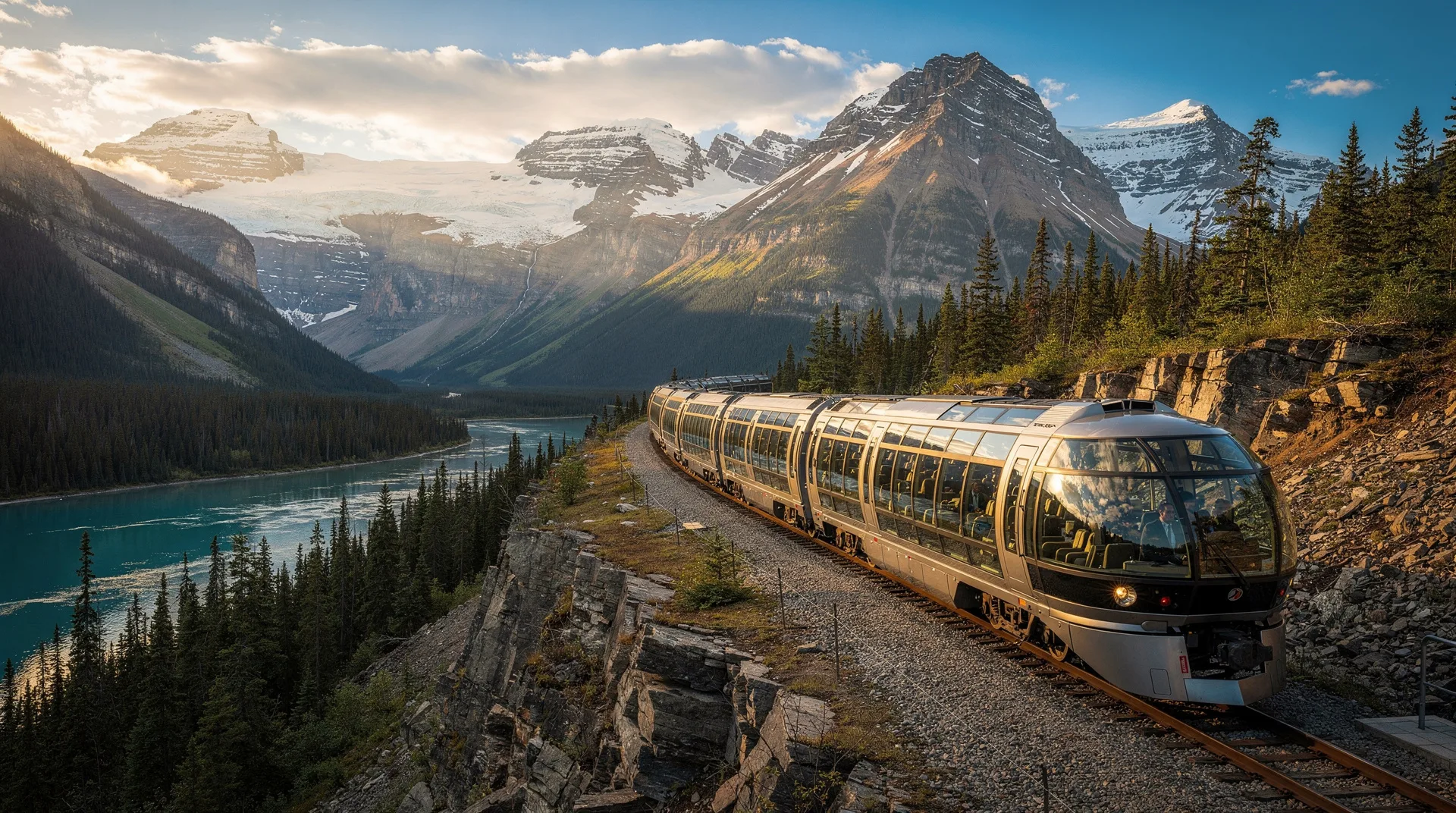
The Rocky Mountaineer is a luxury scenic experience designed around the scenery. It runs only during the day so nothing is missed, uses purpose-built dome coaches, includes meals and drinks, employs on-board hosts who narrate the landscape, and prices itself accordingly. It is an event as much as a journey — the train is the destination.
The VIA Rail Canadian is a transcontinental passenger service that happens to pass through spectacular scenery. It runs 24 hours a day, covers 4,466 km from Toronto to Vancouver, costs significantly less, and serves dozens of communities along the way. The Rockies section is one of several landscapes the train passes through. It is a journey in the traditional sense — a way of crossing the country.
If you want the mountain scenery experience delivered as a curated luxury product, the Rocky Mountaineer is the answer. If you want to experience the vastness of Canada by rail and the Rockies are a section of a longer journey, the VIA Rail Canadian is the answer. Many experienced travellers eventually do both.
Price comparison
Rocky Mountaineer
- SilverLeaf Service (one-way, 2-day route): CAD $1,100–$1,800 per person
- GoldLeaf Service (one-way, 2-day route): CAD $1,800–$2,800 per person
- Meals: Included in both classes
- Alcohol: Included in GoldLeaf; extra cost in SilverLeaf
- Hotels along the route: Additional cost unless booking a package
- Total budget for Vancouver to Banff including Kamloops overnight: CAD $1,800–$3,500+ per person
VIA Rail Canadian (Vancouver to Toronto, full transcontinental)
- Economy (seat only, one-way): CAD $350–$650 per person
- Sleeper Plus Roomette (one-way): CAD $900–$1,800 per person
- Sleeper Plus Bedroom (one-way): CAD $1,400–$2,500 per person
- Prestige (one-way): CAD $2,500–$4,000 per person
- Meals: Included for sleeper classes; extra cost in economy
- Total for transcontinental sleeper trip including meals: Sleeper fare only
For the mountain section alone — say, Jasper to Vancouver or Vancouver to Jasper on the VIA Rail — the pricing is lower still, since you are booking a single segment rather than the full transcontinental fare.
Verdict on price: VIA Rail is less expensive at every comparable tier. For the Rockies section specifically, a VIA Rail Sleeper Plus Roomette from Jasper to Vancouver costs roughly 40–60% of the equivalent Rocky Mountaineer SilverLeaf fare. The gap widens in GoldLeaf territory.
Scenery and the daytime experience
Rocky Mountaineer’s advantage
The Rocky Mountaineer’s daytime-only schedule means you see everything. The Fraser Canyon, the Thompson River valley, the mountain approach to Banff or Jasper — all experienced in daylight, at a pace calibrated for viewing. The route is also structured so that the most dramatic sections (the mountain approach on day two) are specifically saved for maximum daylight. The dome coaches place you inside the landscape rather than merely adjacent to it.
The on-board narration adds interpretive value that the VIA Rail Canadian’s unstructured format cannot match. Hosts explain the geological history of the canyons, the engineering stories behind the trestles, and the wildlife you are looking at as you look at it. This is particularly valuable for first-time visitors who don’t know what they’re seeing.
VIA Rail’s scheduling reality
The VIA Rail Canadian travels overnight through much of Northern Ontario and the Prairies — neither of which suffer from this arrangement, since both are best slept through. The issue is the Rockies. Depending on the direction of travel and the departure day, the most scenic mountain sections between Jasper and the BC interior can fall in late evening or early morning with reduced light.
Travelling westbound (Toronto to Vancouver), the train typically passes through Jasper and the mountains in late afternoon and evening — which can deliver excellent light but guarantees nothing. Travelling eastbound, the Vancouver-to-Jasper section is overnight. This is the VIA Rail Canadian’s most significant limitation for travellers whose primary motivation is mountain scenery: you may see much of it in darkness or low light.
Verdict on scenery: Rocky Mountaineer wins decisively for the dedicated mountain scenery experience. VIA Rail’s mountain sections are potentially outstanding but depend on timing and weather in ways that the Rocky Mountaineer, with its curated daytime schedule, eliminates.
Comfort and on-board experience
Rocky Mountaineer
The bi-level glass-dome GoldLeaf coaches are among the most impressive passenger railway vehicles in the world. The upper-deck seating in a fully enclosed glass dome — clear panels above, curved glass on both sides — creates an immersive visual environment that standard train coaches cannot approach. Even SilverLeaf’s glass-top roof section is more impressive than most scenic train offerings.
The included full breakfast and multi-course lunch in GoldLeaf, served in a dedicated dining room by experienced staff, is genuinely excellent. SilverLeaf’s at-seat meal service is solid and the food quality is consistent.
The trains are new and purpose-maintained. Air conditioning, comfortable seats, and attentive hosts create an experience that is consistently smooth.
VIA Rail Canadian
The Canadian’s coaches are historic — the stainless-steel streamliners date from the 1950s and have been refurbished multiple times but retain their original proportions and character. This is a feature for railway enthusiasts and a potential concern for those expecting modern comfort. The windows are large by contemporary standards and the overall riding experience is smooth.
The Sleeper Plus Roomette is a two-person space — functional, private, and perfectly comfortable for sleeping, but not spacious. The Bedroom upgrade provides more room and an in-room bathroom. For the three-plus nights of the transcontinental journey, a Bedroom is the more comfortable choice even at the higher cost.
Meals in the dining car are shared-table service (sitting with strangers at a four-top), which some travellers love and others find awkward. The food is a mid-range restaurant standard — satisfying and varied across the days.
The dome car on the Canadian is a highlight: a glass-enclosed upper level accessible to all passengers, where the best views happen and where the social life of the train concentrates. It is not a private dome but a shared experience, which produces its own pleasures.
Verdict on comfort: Rocky Mountaineer for premium experience and curated comfort, particularly in GoldLeaf. VIA Rail Canadian for authentic historic rail travel with comfortable sleeper options. They are not directly comparable because the experiences they offer are different in kind.
Duration and what you see beyond the Rockies
Rocky Mountaineer: 2 days, mountains only
The Rocky Mountaineer covers the mountain corridor in 2 days (with an overnight stop at Kamloops hotel). When it is done, you are in Banff or Jasper — a mountain town. The experience is focused and complete.
VIA Rail Canadian: 4 days, all of Canada
The Canadian takes 86 hours from Toronto to Vancouver and covers terrain that the Rocky Mountaineer does not approach: the Precambrian Shield, the Prairies, the boreal forest. If you want to understand Canada’s scale — to sit in a train seat and watch the country go by for three and a half days — the Canadian is irreplaceable. The Rocky Mountaineer cannot give you this.
For international visitors making their first major Canada trip, the transcontinental Canadian provides a geographical education that no amount of reading can substitute. The shift from the Shield to the Prairies to the mountains to the coast, experienced sequentially over days, permanently calibrates your sense of the country’s size.
Verdict on scope: No contest. VIA Rail Canadian for breadth; Rocky Mountaineer for mountain depth.
Booking and logistics
Rocky Mountaineer
Book at least 4–6 months ahead for July–August. The train runs April to October only. Prices are fixed — no last-minute deals. Book through the Rocky Mountaineer website or a travel agent. Hotels at overnight stops are separate arrangements. See our Rocky Mountaineer guide for full booking detail.
VIA Rail Canadian
Book through viarail.ca. Sleeper accommodation fills in summer but less dramatically than Rocky Mountaineer. Economy seats are available much closer to departure. Escape fares (periodic discounts on specific dates) can reduce costs significantly — sign up for email alerts. The Canadian runs three times per week in each direction. See our VIA Rail Canadian guide for full booking detail.
For managing the Canada Rail Pass in conjunction with the Canadian, see our Canada Rail Pass guide.
Who should take the Rocky Mountaineer
- Travellers for whom the Canadian Rockies scenery is the primary reason for the trip
- Those willing to invest CAD $1,500+ per person for a premium curated experience
- Couples celebrating an occasion who want the highest-comfort mountain rail option
- Travellers with limited time who want to maximise scenery per day spent
- Anyone specifically interested in luxury train travel as an experience category
Who should take the VIA Rail Canadian
- Travellers interested in experiencing Canada’s full geographic scale by rail
- Budget-conscious travellers who want the mountain scenery at lower cost
- Solo travellers who enjoy the social atmosphere of the dining car and dome car
- Railway enthusiasts drawn to the historic 1950s rolling stock and the transcontinental tradition
- Travellers already at either end of the continent (Toronto or Vancouver) who want a scenic crossing
- Those with more time and an interest in Winnipeg, Jasper, or intermediate destinations
Can you do both?
Yes, and increasingly travellers are building itineraries that incorporate both. A typical combined itinerary:
- Fly to Vancouver
- Rocky Mountaineer eastbound to Banff (2 days)
- Three to five days in Banff/Jasper
- VIA Rail Canadian from Jasper westbound back to Vancouver (or eastbound to Winnipeg/Toronto)
This approach delivers the curated mountain scenery experience on the Rocky Mountaineer and the transcontinental perspective on the VIA Rail, with the Rockies explored on foot in between. It is a 10–14 day itinerary and a substantial investment, but it produces one of the finest Canada trips available.
For the time in Banff and Jasper, our Banff and Jasper 7-day itinerary and driving Banff to Jasper guide both work well as the “in between” section of a combined rail trip. Note that VIA Rail’s transcontinental route serves Jasper directly but not Banff — if Banff itself is on your list, you’ll connect from Calgary or use the Rocky Mountaineer leg to get there.
Book a 2-day Banff and Jasper tour to pair with either train journey Browse Vancouver to Banff Rocky Mountain tour packagesQuick decision guide
| Factor | Rocky Mountaineer | VIA Rail Canadian |
|---|---|---|
| Price (one-way mountain section) | CAD $1,100–$2,800 | CAD $350–$1,800 |
| Journey duration | 2 days | 4 days (full) |
| Scenery timing | Guaranteed daytime | Variable |
| Meals included | Yes (all classes) | Sleeper+ only |
| Historic rolling stock | No (purpose-built) | Yes (1950s) |
| Transcontinental scope | No | Yes |
| Social atmosphere | Curated/hosted | Organic/casual |
| Booking ease | Very straightforward | Slightly more complex |
| Off-season availability | No (Apr–Oct only) | Year-round |
| Suitable for solo travellers | Yes | Particularly good |
Frequently asked questions about Rocky Mountaineer vs VIA Rail: which scenic train to choose
Is the Rocky Mountaineer faster than the VIA Rail?
The Rocky Mountaineer covers the Vancouver to Banff route in 2 days; the VIA Rail Canadian covers the Vancouver to Jasper section in approximately 21 hours (westbound, overnight). For the mountain section specifically, the VIA Rail is actually faster in elapsed time. The Rocky Mountaineer takes 2 days because it travels only by day and overnights in Kamloops.
Does VIA Rail go to Banff?
No. VIA Rail’s transcontinental route passes through Jasper, not Banff. Banff is served by the Rocky Mountaineer and by bus connections from Calgary. If Banff is your specific destination, the Rocky Mountaineer is the direct rail option.
Are GoldLeaf and Prestige class comparable?
VIA Rail’s Prestige class is comparable in comfort to GoldLeaf in terms of private space and meal quality. Prestige is not a glass dome experience; GoldLeaf’s bi-level dome coach is unique. The experiences are premium in different ways.
Can I take the train one way and fly the other?
Yes, and this is a common and practical itinerary. Many travellers fly westward to Vancouver and take the train east (or vice versa), using the train as the scenic component of a point-to-point journey. One-way train tickets are available for both options.
Which train is better for photography?
Rocky Mountaineer, definitively. The guaranteed daylight schedule, the dome coach elevation above the tracks, the calibrated speed through scenic sections, and the variety of lighting conditions across the two-day mountain journey all favour photography. VIA Rail offers excellent photo opportunities but the uncertain timing of mountain sections at night is a significant limitation.
Should I book directly or through a travel agent?
Both trains can be booked directly through their own websites, and both also work well through a travel agent, particularly for a combined itinerary involving hotels, park passes, and connecting transport. See our VIA Rail booking guide for the step-by-step direct-booking process, including how to catch Escape fare discounts.