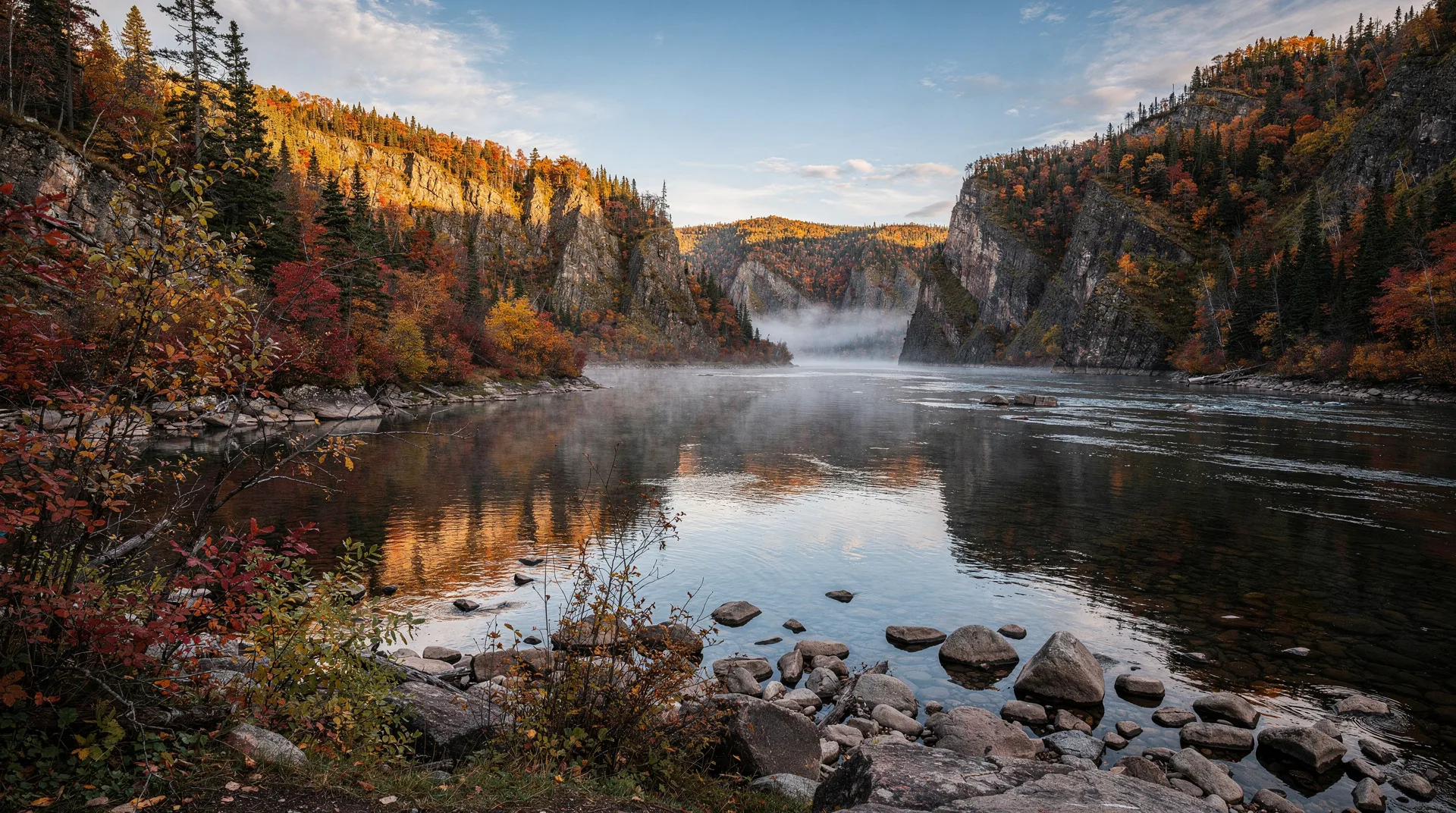
Agawa Canyon Tour Train (Sault Ste Marie)
What is the Agawa Canyon Tour Train?
The Agawa Canyon Tour Train is a one-day excursion from Sault Ste Marie, Ontario, through 183 km of Canadian Shield wilderness to Agawa Canyon. It is one of Canada's best fall foliage experiences, running July through October with peak colour in late September.
| At a glance | |
|---|---|
| Where | Sault Ste Marie, Northern Ontario, running 183 km into Agawa Canyon on the Algoma Central Railway |
| Cost | Around CAD 75-90 adult round trip, plus CAD 15-25 for dome car upgrade if available |
| Time needed | A full day, roughly 8am departure to 6pm return, plus 1-2 nights in Sault Ste Marie |
| Getting there | Fly into Sault Ste Marie (YAM) from Toronto, or drive around 7 hours from Toronto |
| Best time | Late September for peak fall colour; book 4-6 weeks ahead for that window |
There is a train journey in Northern Ontario that most Canadians have heard of but surprisingly few have taken. The Agawa Canyon Tour Train departs Sault Ste Marie at dawn and spends the day threading through 183 kilometres of Canadian Shield wilderness to a canyon that has no road access, no permanent human settlement, and no way in or out except this railway. The experience is one of Canada’s most genuine wilderness encounters delivered by rail — and in late September, when the maple and birch turn, it is one of the finest fall foliage trips in North America.
The train is operated by the Algoma Central Railway, a line built in the early twentieth century to access the timber and mineral wealth of Northern Ontario’s interior. The railway carved a route through terrain that genuinely resisted it — across trestle bridges over wild rivers, through rock cuts blasted through Precambrian granite, and down into a canyon that drops 150 metres below the surrounding plateau. The freight railway still operates; the tour train is a passenger service layered on top of it, and that industrial heritage gives the journey an authenticity that purpose-built scenic railways sometimes lack.
This guide covers the train’s schedule, what the day actually involves, how to experience the fall colours at their best, and practical advice for making the most of a day that requires some planning to execute well.
Why Agawa Canyon belongs on your Ontario itinerary
Ontario is not generally associated with dramatic scenery in the international imagination — Niagara Falls excepted. The province’s great wilderness lies north of Highway 17, in the boreal and mixed-forest Canadian Shield terrain that stretches from Sudbury to the Manitoba border. The Agawa Canyon Tour Train is one of the most accessible windows into this wilderness, and it requires no backcountry experience, no special equipment, and only a single day.
The canyon itself is the destination’s centrepiece. The Agawa River drops through a ravine cut in the Precambrian granite, and the canyon walls rise sharply above the valley floor. At the two-hour stop at the canyon base, passengers can walk to a series of waterfalls, climb a 300-step staircase to a lookout point above the canyon rim, or simply sit on the rocks beside the river while the wilderness asserts itself around them. Black bears are sometimes spotted near the canyon; bald eagles are common. The silence — when the train has pulled up the track away from the station — is complete.
The fall colour display in the Algoma region is exceptional for a specific reason: the Canadian Shield’s thin, acidic soil supports a higher proportion of maple and birch than other forest types, and those trees produce the most intense autumn colour. The display peaks in late September, typically between the 20th and 30th, though it varies year to year. Tourism Sault Ste Marie monitors the colour progression weekly and posts updates — checking these before booking your specific date adds measurably to the experience.
The route in detail
Sault Ste Marie to Agawa Canyon (depart ~8:00 am)
The train departs Sault Ste Marie’s Agawa Canyon Tour Train station at 8:00 am (confirm current departure time when booking — it varies slightly by season). The initial section runs through the northern suburbs before entering the boreal forest proper.
The first major landmark is the Montreal River Trestle, a steel bridge spanning the Montreal River valley at a height of 40 metres and a length of nearly 500 metres. From the train, the view down the river valley into Georgian Bay’s North Channel is spectacular; this is the moment most passengers reach for their cameras. The trestle is a stop-and-photograph moment on the journey back as well.
As the train climbs into the Shield country, the landscape becomes progressively wilder. Wetlands, beaver ponds, rivers and lakes multiply. The forest thickens. Rock cuts appear where the railway blasted through the granite. In fall, this section becomes a corridor of red, orange, yellow and gold extending to every horizon.
The descent into Agawa Canyon — a steep grade that the conductor announces before the train begins it — delivers passengers to the canyon floor and the two-hour stop.
The canyon stop (approximately 2 hours)
Passengers disembark at a basic platform and picnic area. There are pit toilets and a small covered shelter. There is no food service, no souvenir shop, and no infrastructure beyond the basics — which is entirely the point. Bring your lunch; the train’s snack bar closes during the canyon stop.
The walking options from the platform:
- Bridal Veil Falls: 10-minute walk, a graceful cascade over a granite ledge into a pool
- Black Beaver Falls: 15-minute walk, a larger, more powerful fall with a viewpoint ledge
- Canyon lookout staircase: 300 steps (approximately 15–20 minutes up), delivers a birds-eye view of the canyon from the rim. This is the best single viewpoint and worth the climb for any reasonably mobile passenger. Allow 45–60 minutes round trip at a comfortable pace.
- Riverside walk: Following the Agawa River bank through the canyon floor, with opportunities to find a quiet spot and simply sit with the wilderness
Two hours passes quickly. Prioritise the lookout staircase and one waterfall walk; the riverside can fill remaining time.
Return to Sault Ste Marie (depart ~1:30 pm, arrive ~6:00 pm)
The return journey covers the same track but in different light. Afternoon light illuminates the western slopes in gold, which is actually preferable for fall colour photography. The Montreal River Trestle is revisited. Dinner service (light snacks and beverages) runs on the return. Passengers arrive back in Sault Ste Marie around 6:00 pm.
Fares and booking
2026 fares (approximate)
- Adult: CAD $75–$90 per person (round trip)
- Senior (60+): CAD $65–$80
- Child (5–12): CAD $35–$45
- Child under 5: Free (no seat allocated)
- Family packages available; check the Agawa Canyon website for current pricing
Fares are lower than most comparable scenic train experiences because the operation is regional rather than luxury-focused. This remains one of Canada’s best-value scenic train tickets.
Seat classes
Standard coach seating is the default. Reserved seats are available; unreserved cars exist but are first-come-first-served on boarding. On fall colour peak weekends, unreserved cars fill quickly — arriving 30–40 minutes early is advisable.
Dome cars: On some departures (check availability when booking), enclosed dome car seats offer elevated views. These sell out weeks ahead during peak colour season and cost an additional CAD $15–$25 per person above the standard fare.
When to book
For late September fall colour departures, book at minimum four to six weeks ahead. Peak colour weekends (the last two weekends of September) sell out entirely, sometimes months in advance for dome car seats. Snow Train (February) and summer departures have more availability.
Book directly through the Algoma Central Railway website (agawacanyontourtrain.com).
The Snow Train
A separate Winter Excursion Train operates on select Saturdays in January and February, traversing the same route through the snow-covered wilderness. The canyon stop is briefer in winter (cold) but the snow-draped Canadian Shield forest is beautiful in its own way. An underrated option for visitors already in Northern Ontario in winter.
What to bring
The canyon stop is outdoors for two hours with no shelter from weather. Pack accordingly:
Fall (late September): Temperatures in the canyon can be 5–10°C even on a warm day. A warm layer, windproof jacket, and comfortable walking shoes with grip are essential. Gloves and a hat are advisable for early morning and the return journey.
Summer (July–August): Bug spray is the most important item. Northern Ontario’s insect season peaks in July; blackflies and mosquitoes can be significant in the canyon. A light rain layer is worth carrying regardless of the forecast.
Camera and power: The journey takes about 10 hours total. Bring extra batteries or a power bank if you are shooting with a DSLR or mirrorless camera. In fall colour season, you will shoot more than you expect.
Lunch and snacks: The train has a snack bar (sandwiches, hot drinks, snacks), but it is limited in range and closes during the canyon stop. Bring a packed lunch for the canyon and snacks for the train. There is a small coffee and beverage service car.
Cash: Some on-board services are cash only. A modest amount is useful.
Best time to travel
Late September (fall colour peak): The primary reason most visitors make the trip. The display is at its best for roughly seven to ten days; check Tourism Sault Ste Marie’s weekly colour reports to target your visit. The 25th–30th September window is historically the most reliable, though it advances or retreats by a week depending on the weather pattern.
Early October: Colours transition from peak to late stage, with more muted tones but fewer crowds and lower-cost accommodation in Sault Ste Marie. Still worth doing if you have missed the peak.
July and August (summer): The train runs in summer to a different schedule (check the current timetable). The summer experience emphasises the wilderness landscape and waterfall access; wildflowers are at their best, and the canyon is accessible without weather concerns. Bugs are the main caveat.
February (Snow Train): The winter excursion for visitors interested in boreal forest in snow. A niche but genuinely memorable experience; the silence in a snowy Canadian Shield landscape is extraordinary.
How to reach Sault Ste Marie
Sault Ste Marie is accessible by:
Air: Sault Ste Marie Airport (YAM) receives regular service from Toronto (Air Canada and Porter Airlines, typically one to two flights per day). Flight time is approximately 90 minutes. Fly in the day before your train trip; the train departs at 8:00 am.
Drive: From Toronto via Highway 400/69/17, approximately 7 hours. From Sudbury, approximately 2.5 hours. The drive from Toronto through Georgian Bay country is scenic in its own right.
VIA Rail: A separate VIA Rail service connects Sudbury to White River (passing through Sault Ste Marie) on a less frequent schedule. Check viarail.ca for the Sudbury–White River route.
Where to stay in Sault Ste Marie
Most visitors to the Tour Train spend one or two nights in Sault Ste Marie. It is a mid-size Northern Ontario city with a modest but functional range of accommodation.
Quattro Hotel and Conference Centre: The most comfortable mid-range option in the city, with well-maintained rooms and a restaurant. A short drive from the Tour Train station.
Comfort Inn Sault Ste Marie: Reliable, affordable, and well-positioned. Consistent reviews from Tour Train visitors.
Holiday Inn Express: A solid choice near the city centre with good breakfast service.
For a longer stay, the area around Lake Superior’s northern shore has wilderness lodges. Goulais River Lodge and White Pines Wilderness Lodge are worth researching for a multi-day wilderness experience.
Browse Toronto tours to combine with a Sault Ste Marie tripAlternatives and comparison
Algoma Central Wilderness Tours: The same railway offers multi-day wilderness lodge packages where you ride the train to a remote stop, spend two to three nights in a backcountry lodge, and return by train. These provide a much deeper wilderness experience than the day trip. Check the Algoma Central website for availability.
Algonquin Park fall colour: Southern Ontario’s most famous fall colour destination is the alternative for Toronto-based travellers who cannot reach Sault Ste Marie. Algonquin is accessible in a day from Toronto; the colour display peaks slightly earlier (mid-September) and the infrastructure is more developed. Less dramatic than Agawa Canyon but far easier to reach.
Autumn on VIA Rail: The VIA Rail Canadian passes through Northern Ontario wilderness in the same season. For travellers already on the transcontinental route, the Agawa Canyon trip provides a worthwhile complement if you can overnight in Sault Ste Marie.
See our best scenic train routes in Canada for how Agawa Canyon ranks against other Canadian rail experiences.
Planning the rest of your Northern Ontario trip
Sault Ste Marie sits between Lake Superior and Lake Huron, and a train-focused visit is easy to extend. If you have an extra day, the drive north along Lake Superior’s shore toward Lake Superior Provincial Park adds more of the same Canadian Shield scenery the train passes through, without the schedule constraints. Travellers coming from Toronto who cannot fit Sault Ste Marie into their itinerary sometimes substitute Algonquin Provincial Park for fall colour instead — closer, but with a different, gentler landscape than the Shield country north of Superior. If you are building a longer trip, you can also browse guided tours across Canada to add other excursions.
For a wider comparison of when fall colours peak across the province, the Ontario fall colours guide is useful for deciding whether to time a trip around Agawa Canyon, Algonquin, or both.
Building a longer Ontario fall trip around the train
The Tour Train works best as the anchor of a wider route rather than a stand-alone day. Our Ontario fall colours guide and the Ontario fall road trip both show how to chain Shield country, lakeshore towns and southern forests into one autumn itinerary. If you are thinking about the season more broadly, Canada in September and Canada in October explain what to expect from weather and crowds on either side of peak colour.
Travellers who want to see more of the north before or after the train can read the northern Ontario guide and the 10-day northern Ontario itinerary, which place Sault Ste Marie within a longer loop. The city itself has its own page under Sault Ste Marie, useful for deciding how many nights to book around your departure.
Because the train leaves early and returns in the evening, it helps to plan the surrounding days with some slack. Pair it with a lakeside stop at Lake Superior Provincial Park, or compare it with the shoreline drive described in Lake Superior vs Lake Ontario. For ideas on getting between regions, getting around Canada and Canada car rental cover the practical side of linking flights, drives and rail.
Finally, if the train sparks an appetite for rail travel, the scenic trains itinerary collects the other great Canadian journeys in one place, and scenic trains: how to book explains how to approach reservations for them.
Frequently asked questions about Agawa Canyon Tour Train (Sault Ste Marie)
Is the Agawa Canyon Tour Train the same as VIA Rail?
No. The Agawa Canyon Tour Train is operated by Algoma Central Railway, a separate company. VIA Rail is the national passenger rail service; the Tour Train is a regional excursion service. They operate different routes and booking systems.
Can I visit the canyon without taking the train?
No. There is no road access to Agawa Canyon. The train is the only way in. Canoeists occasionally reach the canyon via a very long backcountry water route, but this is a multi-day wilderness journey — not an option for casual visitors.
How strenuous is the canyon walk?
The 300-step lookout staircase is moderately demanding — equivalent to climbing a 15-storey building, with uneven steps on a steep incline. Most passengers in reasonable health can manage it in 15–20 minutes. If you have knee or heart concerns, the waterfall walks are flat and easily accessible alternatives.
Is there food service on the train?
Yes, a snack car offers sandwiches, soups, hot and cold drinks, and snack items. Meals are not included in the ticket price. The snack car does not operate during the canyon stop. Bringing your own lunch for the canyon is strongly recommended.
What if the fall colours are not at peak when I travel?
Peak colour dates vary by year and cannot be guaranteed in advance. Tourism Sault Ste Marie (saulttourism.com) publishes weekly colour reports from September onward. If you arrive slightly before or after peak, the canyon and Shield forest are still beautiful — the experience is not entirely dependent on perfect colour. Pre-peak (early-to-mid September) shows early colour on some trees with full green still dominant; post-peak (early October) shows more muted tones and some bare branches mixed with colour.
Can I take the train one way and explore the backcountry?
Yes, with significant planning. The Algoma Central operates as a flag stop service on some timetables — passengers can be dropped at remote locations and picked up on a later train. This is primarily used by hunters, canoeists, and wilderness campers. It requires pre-arrangement with the railway and proper backcountry preparation.
How accessible is the Tour Train for passengers with mobility issues?
The train has basic accessibility features and staff who assist passengers boarding. However, the canyon stop is on natural terrain — gravel, uneven ground, and natural pathways. The 300-step lookout is not accessible. The waterfall walks have some challenging terrain. Contact Algoma Central Railway directly to discuss specific accessibility needs before booking.
Is Agawa Canyon better than Algonquin Park for fall colours?
They offer different experiences rather than a straightforward better-or-worse comparison. Agawa Canyon’s Canadian Shield terrain and canyon setting are more dramatic and the train journey is part of the appeal, but it requires a flight or long drive to Sault Ste Marie. Algonquin Provincial Park is far more accessible from Toronto and has its own strong colour display, just with gentler scenery.
How far in advance should I book for peak fall colour?
Four to six weeks minimum for a standard seat; for dome car seats on the last two weekends of September, book as early as possible, since these can sell out months ahead.