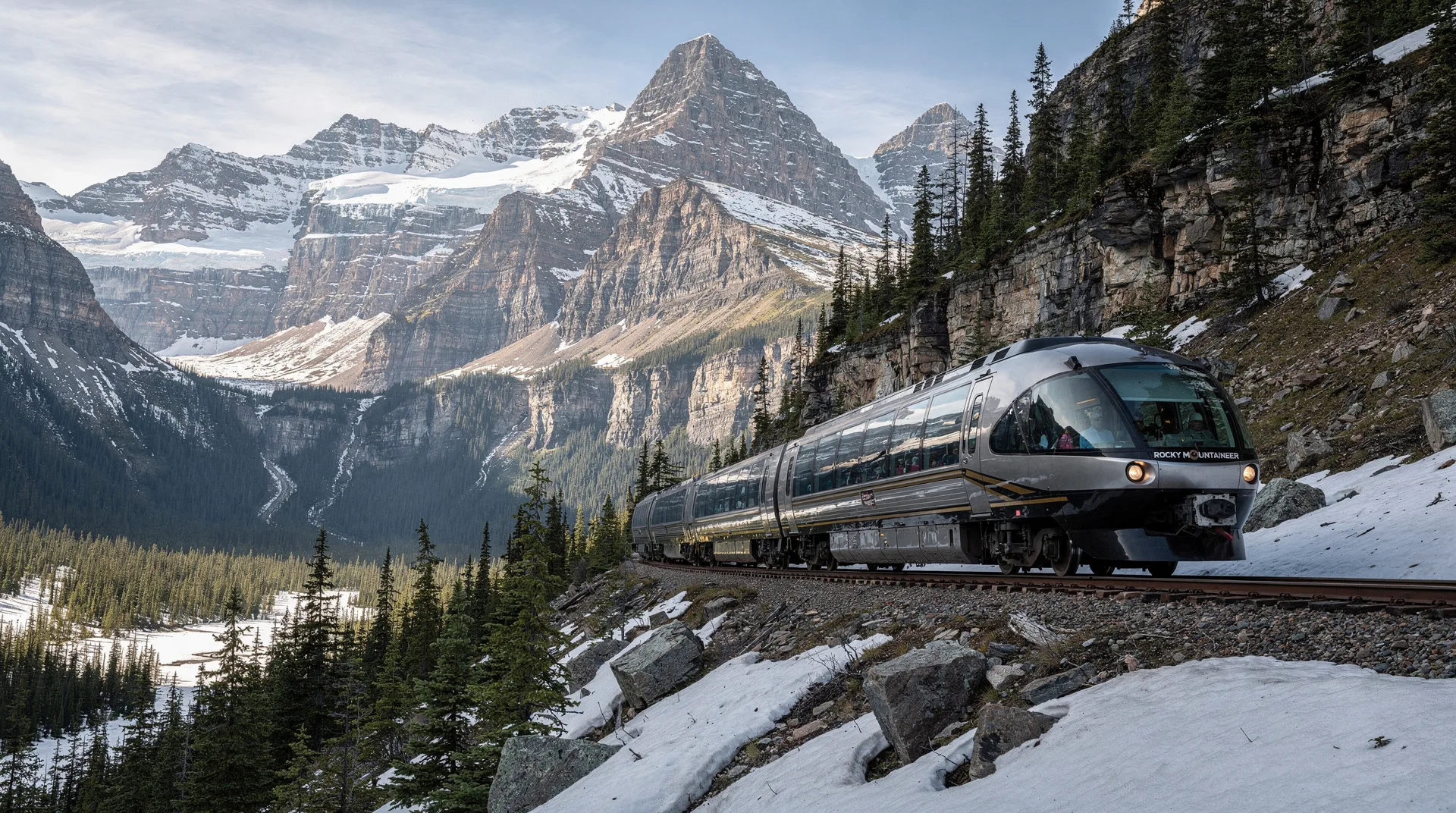
Rocky Mountaineer: complete booking guide
What is the Rocky Mountaineer?
The Rocky Mountaineer is a luxury daytime train operating through the Canadian Rockies between Vancouver, Banff, Jasper and Whistler. It runs only by day so passengers never miss a moment of scenery, and overnight stays are in hotels along the route.
Few train journeys on earth have earned the reputation of the Rocky Mountaineer. Since its inaugural run in 1990, this privately operated luxury service has carried millions of travellers through the spine-tingling mountain scenery of British Columbia and Alberta — past glaciers, across towering trestles, through river canyons and alongside turquoise lakes that look painted rather than real. No other mode of transport delivers the Canadian Rockies the way this train does: slowly, panoramically, and with a glass of wine in hand.
The Rocky Mountaineer operates only by day, a deliberate design choice that means every kilometre of spectacular landscape is experienced awake rather than slept through. Overnight stops at destination hotels allow passengers to rest before each new day of scenery begins. This is not mass-market rail travel — it is a curated journey that markets itself, correctly, as one of the world’s great train experiences.
This guide covers everything you need to plan your trip: the four routes, the two service classes, what prices to expect, what the on-board experience is actually like, and practical booking advice to help you get the best value on what is a significant investment.
At a glance
| Where | Between Vancouver, Whistler, Kamloops, Banff and Jasper, BC/Alberta |
| Cost | Around CAD $1,100 to $2,800+ per person, one-way, two-day route |
| Time needed | 2 days on the train, plus arrival/departure days at each end |
| Getting there | Departs Pacific Central Station, Vancouver, or Banff/Jasper stations depending on direction |
| Best time | Late June-July for long daylight, May-June or September for value and colour |
Why the Rocky Mountaineer stands apart
Most scenic rail journeys ask you to choose between comfort and scenery. The Rocky Mountaineer refuses that trade-off. The trains are purpose-built for sightseeing, with bi-level glass-dome coaches that flood the interior with light. Passengers sit in wide, rotating seats positioned close to the windows. The upper deck of a GoldLeaf dome coach feels almost like riding in the open air — sky above, mountains on both sides, rivers below.
The daytime-only schedule is the experience’s defining feature. Departures happen at dawn or early morning, and the train reaches its overnight stop before dinner. Between those bookends, the landscape does not stop performing. The Fraser Canyon section alone — a wall of vertical rock with the jade-green Fraser River boiling hundreds of metres below — is worth the ticket price for many passengers. Add the approach to Kamloops, the morning run through the Thompson River valley, and the final climb into Banff or descent to Jasper, and you have two full days of scenery that would be impossible to compress into any other format.
The company also operates its trains at a speed calibrated for viewing rather than speed. Where conventional passenger trains hurry through mountain terrain, the Rocky Mountaineer lingers, slows on the best curves, and occasionally holds position to allow passengers time with a particularly dramatic sight. The commentary from on-board hosts adds geological, historical, and wildlife context to what you are seeing.
The four routes
First Passage to the West
The signature route runs between Vancouver and Banff (or Kamloops for shorter segments). Day one takes passengers from Vancouver’s Pacific Central Station through the Fraser Canyon and the dry sage-and-pine terrain of the Interior to Kamloops, where passengers overnight. Day two resumes through the high desert, into the mountains proper, over Rogers Pass approaches, and delivers passengers to Banff by mid-afternoon.
Distance: approximately 1,000 km over two days. This is the most popular route and the one most directly associated with the Rocky Mountaineer brand.
Journey through the Clouds
Also departing from Vancouver but heading northeast to Jasper rather than southeast to Banff, this route shares the day-one track to Kamloops before branching into the North Thompson River valley on day two. The terrain is wilder and less visited than the Banff route: ancient cedar forests, steep river gorges, and the long valley approach to Jasper. Jasper is a quieter, less commercialised base than Banff, and this route suits travellers who want a less crowded Rocky Mountain experience.
Rainforest to Gold Rush
This is the most unusual route, running from Vancouver north through the Coast Mountains to Whistler on day one (using the Sea to Sky corridor — one of the world’s most dramatic coastal rail sections), then continuing north through Lillooet and the Fraser Canyon to Quesnel on day two. It is a very different trip from the mountain routes: coastal rainforest gives way to the dry Interior Plateau, and the historical angle shifts from railway engineering to Gold Rush heritage. Passenger numbers are lower on this route, which some travellers prefer.
Rockies to the Red Rocks
Launched in 2021, this route connects Banff with Moab in Utah via a mix of rail and road. It is a significant departure from the original concept and suits travellers combining a Canadian Rockies trip with the American Southwest.
Service classes and what they include
GoldLeaf Service
GoldLeaf is the top tier. Passengers travel in a bi-level glass-dome coach: the upper level is entirely enclosed glass for sightseeing, with wide seats and panoramic views; the lower level contains a dedicated dining room serving full breakfast and multi-course lunch, prepared fresh on board. Meals are included in the ticket price, as are all soft drinks, beer, wine and spirits throughout the journey.
GoldLeaf prices typically run from CAD $1,800 to $2,800 per person for a two-day route (one-way), depending on season and booking date. Prices have risen significantly over recent years; expect to budget at least CAD $2,200 per person in peak season (July–August).
Off-peak shoulder season (May, early June, late September) rates can drop to around CAD $1,500–$1,800 per person and represent the best value window.
SilverLeaf Service
SilverLeaf uses single-level coaches with a glass-top roof section that runs most of the carriage length. Seats are wide and comfortable. Breakfast and lunch are served from a smaller menu at your seat rather than in a dedicated dining car. Alcoholic drinks cost extra.
SilverLeaf prices run from approximately CAD $1,100 to $1,800 per person one-way for a two-day route. The scenery is identical; the difference is dining formality, the dining-room experience, and the all-inclusive drinks policy.
For most travellers, SilverLeaf represents better value per dollar spent. The glass roof still delivers excellent views, and the meals are substantial and well-prepared. GoldLeaf is worth the premium for those who value the dining room experience or are celebrating a significant occasion.
GoldLeaf vs SilverLeaf at a glance
| GoldLeaf | SilverLeaf | |
|---|---|---|
| Coach | Bi-level glass dome, upper deck sightseeing | Single-level, glass-top roof section |
| Dining | Dedicated dining room, plated multi-course meals | At-seat tray service |
| Drinks included | Yes, throughout the journey | Non-alcoholic only; alcohol extra |
| Typical price (2-day, one-way) | Around CAD $1,800-2,800+ | Around CAD $1,100-1,800 |
| Best for | Special occasions, dining-room atmosphere | Best value, still excellent views |
What to expect on board
Boarding begins early, typically 7:15–7:45 am. On departure the host team introduces the route and explains what to expect at each notable point. The atmosphere in the coaches is quiet and attentive in the first hour as the city gives way to countryside — most passengers are at their windows before the train clears the suburbs.
Breakfast is served once the train is underway: eggs, smoked salmon, fruit, pastries, coffee. The quality consistently surprises first-time passengers expecting airline-style food. Lunch, served as the train approaches its mid-day landmark section, is more formal: typically two or three courses with tableside service in GoldLeaf and a tray service of equal quality in SilverLeaf.
Between meals, passengers move freely between seats and the observation area. There is no Wi-Fi, no entertainment screens, and no urgency — the only agenda is what is happening out the window. In peak season the coaches are full; in shoulder season it is possible to have significant stretches of space. Luggage is limited to hand baggage in the coaches; main bags travel ahead by road to your next hotel.
Dress code is smart-casual. Nobody dresses formally, but the experience is upscale enough that activewear feels slightly out of place in GoldLeaf. SilverLeaf is more relaxed.
Scenic highlights by route section
Lower Fraser Canyon (both Vancouver routes): The train enters the canyon below Hope, where the Fraser River narrows between walls of granite hundreds of metres high. Tunnels and bridges thread through impossible terrain — the Hell’s Gate section is particularly dramatic, with the river compressed to a roaring torrent below.
Thompson River valley (First Passage and Journey through the Clouds): Arid sage grassland and red clay hoodoos line the river between Lytton and Kamloops. This Interior landscape surprises travellers expecting mountain scenery — it is the driest landscape in Canada, crossing desert conditions before the mountains reassert themselves.
Spiral Tunnels approach (First Passage to the West): Near Field, BC, the original railway engineers solved the problem of the steep Big Hill grade by boring two spiral tunnels through the mountains. The Rocky Mountaineer uses the same tunnels; watching the front of the train emerge from a tunnel while the rear is still entering it is a memorable engineering spectacle.
Kicking Horse Canyon: The steep drop from the Continental Divide into the Kicking Horse River valley is one of the most vertigo-inducing sections of track in North America. The river has cut a deep gorge and the railway hugs the canyon wall hundreds of metres above the water.
North Thompson River valley (Journey through the Clouds): Wilder and less photographed than the southern routes, this section offers ancient cedar stands, mist-draped peaks, and the long, remote approach to Jasper through terrain that feels genuinely untouched.
Sea to Sky corridor (Rainforest to Gold Rush): The first day’s run north from Vancouver to Whistler follows the edge of Howe Sound and then climbs through the Coast Mountains. The combination of ocean fjord and mountain scenery is unlike anything on the interior routes.
Best time to travel
The Rocky Mountaineer runs from April through October, with peak season in July and August.
May and early June offer the best combination of value and scenery. Wildflowers carpet the mountain meadows, waterfalls are at peak volume from snowmelt, and wildlife is highly active. Prices are 20–30% lower than July peak. The risk is variable weather — it can snow at elevation as late as June.
Late June through July is the premium window. Long daylight hours (up to 17 hours in late June) mean maximum viewing time. Snowpack is mostly gone from lower elevations and the high country is accessible. This is also peak price season.
August delivers reliable warm weather and the most consistent conditions, but prices match July and bookings are tightest. Book at least six to nine months ahead for July and August departures.
September is arguably the finest month for photography. Larch trees turn gold in mid-to-late September, creating one of North America’s most spectacular fall colour displays. Temperatures are cooler, crowds are reduced from peak, and prices begin to drop. The first dusting of snow on high peaks by late September adds drama.
Early October sees the last departures of the season. Prices are at their lowest, larches are at peak colour, and the light is exceptional. However, some sections of mountain highway may have weather complications for the overnight hotel transfers.
Avoid planning around specific wildlife sightings — bear sightings from the train are common but not guaranteed. The best window for grizzlies is May and September when they are most active at lower elevations.
Combining the trip with the wider Rockies
Most travellers do not treat the Rocky Mountaineer as a standalone trip — it is usually one leg of a longer Canadian Rockies itinerary. A common pattern is to fly into Vancouver, spend a few days exploring the city and maybe Whistler, ride the train to Banff or Jasper, then spend several more days touring the Icefields Parkway between the two by rental car or guided tour before flying home from Calgary or Edmonton.
Because the train only covers roughly 1,000 km of a much larger region, budgeting an extra 4-7 days beyond the train journey itself is normal for a first Canadian Rockies trip. Check our guide to visa and eTA requirements well before booking, since most visa-exempt travellers need to apply for an eTA before flying in.
Because the train is a fixed, pre-booked schedule, it works well as the backbone of a trip that is otherwise flexible — book the train first, then build hotel nights and rental-car days around its two fixed departure dates.
What luggage and connections to plan for
Only soft-sided hand luggage travels with you in the coach; larger suitcases are transported by road to your next hotel and are not accessible during the day, so pack a day bag with anything you need on board (medication, camera gear, a layer, snacks). If you are connecting to a cruise out of Vancouver or a further rail journey on VIA Rail’s Canadian, build at least one buffer day into your schedule — the Rocky Mountaineer’s daytime-only operation means arrival times at each end are predictable, but weather delays in the mountains do happen and a same-day connection is risky.
How to book
The Rocky Mountaineer sells exclusively through its own website (rockymountaineer.com) and through authorised travel agents. There is no third-party discounting. Prices are the same regardless of booking channel, so use a travel agent if you want itinerary support at no extra cost.
Book early: For July and August, the best seats in GoldLeaf sell out six to nine months ahead. April and early May departures have more availability and can sometimes be booked within a few weeks of travel, but do not count on last-minute options in summer.
Direction matters: Both routes can be booked westbound or eastbound. Most passengers travel eastbound (Vancouver to Banff/Jasper) because this direction delivers the most dramatic scenery in the best light — you approach the mountains after a day of anticipation rather than leaving them. Westbound is less expensive and offers a different visual experience, with the mountains revealed in morning light on day one.
Standalone train or package: The Rocky Mountaineer sells the train journey as a standalone product. Hotels at overnight stops (typically Kamloops) and destination hotels are booked separately unless you book a full package through a travel agent or the Rocky Mountaineer’s own vacation packages.
Position matters in GoldLeaf: Request seats on the right side of the upper dome when travelling eastbound for the best Fraser Canyon views. On the left side you get the Thompson River more directly; both are excellent. Call the reservations line to discuss seat preferences when booking.
Browse Vancouver to Banff Rocky Mountain tour packages Explore 2-day Banff and Jasper tours combining train and sightseeingWhere to stay at start and end points
Vancouver: The Rocky Mountaineer departs from Pacific Central Station, a short cab or SkyTrain ride from downtown. The Fairmont Waterfront and the Rosewood Hotel Georgia are natural choices for travellers starting their journey in style. Budget-friendly options near the station include the Howard Johnson by Wyndham Vancouver Downtown.
Kamloops (overnight stop): Kamloops is a functional rather than scenic city. The hotel used for most Rocky Mountaineer overnights is the Delta Hotels by Marriott Kamloops. It is comfortable and well-positioned. Explore the riverfront and downtown for dinner — Kamloops has better restaurants than its reputation suggests.
Banff: The train arrives at the Banff station and most passengers are transferred to hotels in town. The Fairmont Banff Springs is the iconic choice; the Rimrock Resort Hotel offers a quieter, more elevated setting. For mid-range, the Moose Hotel and Suites delivers excellent comfort close to the main strip. See our Banff National Park guide for full accommodation coverage.
Jasper: The Journey through the Clouds terminates at Jasper, a smaller and less commercialised mountain town than Banff. The Fairmont Jasper Park Lodge sits on a lake 5 km from town and is one of Canada’s finest resort hotels. In town, the Crimson Jasper and Pyramid Lake Resort are strong mid-range choices. See our Jasper National Park guide for details.
Alternatives and comparison
VIA Rail Canadian: The transcontinental sleeper train covers similar terrain between Vancouver and Banff/Jasper but travels overnight through many of the most scenic sections and does not offer the same dedicated luxury experience. It costs roughly 40–60% less and suits independent travellers who want to cross the continent rather than focus on the mountain scenery. See our Rocky Mountaineer vs VIA Rail comparison.
Self-drive: The Trans-Canada Highway and Icefields Parkway cover similar territory with total flexibility. A rental car and three to five days between Vancouver and Jasper can match many Rocky Mountaineer highlights at a fraction of the cost. What it cannot replicate is the elevated perspective from the dome car, the absence of driving stress, or the social experience of a guided journey.
Helicopter tours: For a radically compressed version of Rocky Mountain scenery, helicopter flightseeing from Banff, Canmore or Jasper delivers an hour of mountain spectacle. It complements a Rocky Mountaineer trip rather than replacing it.
Explore an 8-day Best of the Rockies tour from Banff and JasperFrequently asked questions about Rocky Mountaineer: complete booking guide
How far in advance should I book the Rocky Mountaineer?
For July and August departures, book at least six months ahead to secure GoldLeaf seats. May, June, September and October can often be booked two to four months ahead. Last-minute availability exists occasionally in shoulder season but is never guaranteed.
Is the Rocky Mountaineer worth the price?
For most passengers who take it, yes. The experience consistently receives exceptionally high satisfaction scores. The caveat is that it is a two-day luxury sightseeing event, not a transportation service — it needs to be treated as a destination experience rather than a way to get from A to B. If mountain scenery is the primary motivation for your Canada trip, it is worth the investment. If you are budget-conscious or would rather explore independently, consider VIA Rail or a road trip instead.
What is the cancellation policy?
Rocky Mountaineer cancellations made more than 60 days before departure receive a full refund less an administration fee. Between 30–60 days, 50% is refunded. Within 30 days, no refund is available. Travel insurance is strongly recommended given the investment involved.
Can I do the Rocky Mountaineer as a round trip?
Technically yes, but the company prices both directions separately and there is no round-trip discount. Most travellers do a one-way journey and return by a different route — fly back from Banff/Jasper, drive the Icefields Parkway, or connect with VIA Rail for the transcontinental trip home.
Does the Rocky Mountaineer run in winter?
No. The service operates April through October only. Winter closures are due to weather and operational conditions in the mountain passes.
Are children welcome on the Rocky Mountaineer?
Children are welcome and there is a child pricing tier (typically up to age 15 at a reduced rate). That said, the experience is oriented toward adults — there is no children’s entertainment program and the appeal of sitting in a glass dome watching scenery for eight hours is not universal among younger children.
How many passengers are on each train?
A typical Rocky Mountaineer consist carries 400–500 passengers across multiple coaches. In practice, each coach holds around 70–100 passengers and has its own host team. The atmosphere is intimate within each coach, even when the train itself is at capacity.
What should I pack for the journey?
Pack a light layer for the coach (it is climate-controlled but can feel cool when the mountain passes are in cloud), comfortable seated clothing, a camera with a fast lens if you use dedicated equipment, sunglasses for glare inside the dome, and any personal snacks or reading material for quieter landscape sections. The company asks passengers to limit coach carry-on luggage; main bags go to the destination hotel by road.
Does the Rocky Mountaineer stop for photos?
The train does not make dedicated photo stops, but it slows noticeably on the most scenic curves and through canyons, and hosts often point out approaching highlights with enough notice to get the camera ready. For close-up photography at specific landmarks like the Columbia Icefield or Moraine Lake, plan a separate day with a rental car or guided tour, since those sites are not directly on the rail line.
How does it compare to touring Banff and Jasper by tour bus?
A multi-day guided coach tour of Banff and Jasper covers similar ground at a much lower cost and usually includes stops at viewpoints the train cannot access, but trades away the elevated dome-car perspective and the unhurried pace. See our best tours in Banff roundup for guided alternatives if the train’s price is the deciding factor.