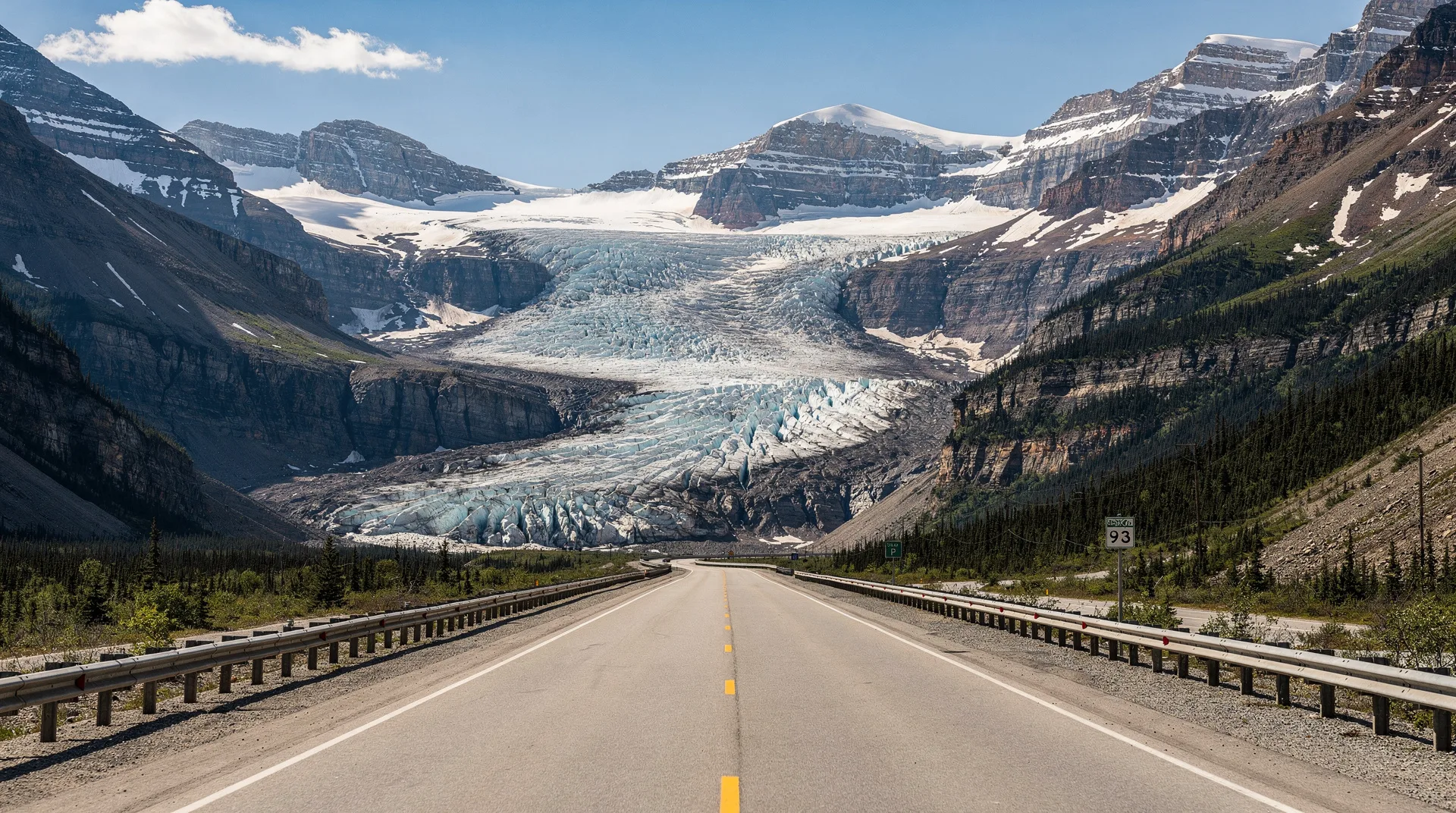
Icefields Parkway in one day: the perfect drive itinerary
At a glance
| Where | Highway 93, Lake Louise to Jasper, Alberta |
| Distance | 232 km (Lake Louise to Jasper), 288 km from Banff town |
| Time needed | Full day, 9-10 hours including stops |
| Car required | Yes |
| Park pass | Parks Canada Discovery Pass or day pass, required |
| Best time | June-September for full access; check winter conditions Oct-May |
The Icefields Parkway in a single day is genuinely possible and genuinely worthwhile — but only if you approach it correctly. The 232-km drive from Lake Louise to Jasper (288 km from Banff town) takes 3.5 hours without stops, which leaves plenty of time for the essential viewpoints. The risk is stopping at too many minor pullouts and arriving at the Columbia Icefield or Peyto Lake in poor light with no time to appreciate them.
This itinerary is built around five essential stops and realistic timing — including the walk to Peyto Lake viewpoint, time at the Columbia Icefield, and the waterfalls. Leave Banff by 7:00 AM and you will arrive in Jasper by early evening with time to spare.
The logic of a one-day drive
A one-day Icefields Parkway drive makes sense in two situations:
-
Point-to-point: You are driving from Banff (or Calgary) to Jasper and want to spend the drive day well rather than just transit. One-way car rental or Brewster Express bus (as a guided version) both work.
-
Day trip from Banff: Drive north to the Columbia Icefield, turn around, and return to Banff the same day. This covers the southern half of the parkway — the most dramatic section — and returns you to your Banff base.
This itinerary covers the full point-to-point from Banff to Jasper (the better of the two options).
Before you leave: the essentials
Fuel: Fill up in Banff or Lake Louise before joining the parkway. The only fuel between Lake Louise and Jasper is Saskatchewan River Crossing (108 km from Lake Louise). Do not leave Lake Louise with less than half a tank.
Food and water: Pack a substantial lunch and snacks. The Saskatchewan River Crossing has a basic cafeteria but options are limited and overpriced. Outside of that stop, there is nothing until Jasper.
Start time: Leave Banff by 7:00 AM. Leave Lake Louise (if starting there) by 7:30 AM. This gives you:
- Peyto Lake in good morning light before crowds arrive
- The Columbia Icefield mid-morning before the tour bus rush
- Athabasca Falls in the early afternoon
- Arrival in Jasper by 5:00-6:00 PM
Download offline maps: Mobile coverage on the parkway is intermittent. Google Maps offline works reliably; so does Maps.me. Share your itinerary with someone before departing.
The route: Banff to Jasper
Distance from Banff town: 288 km
Distance from Lake Louise: 232 km
Recommended driving time including 5 key stops: 9-10 hours
7:00 AM — Leave Banff
Drive north on Highway 1 from Banff to Lake Louise (58 km, 45 minutes). If you want a first stop, the Bow Valley Parkway (Highway 1A) runs parallel to the Trans-Canada and is excellent for wildlife in the early morning. Elk, coyotes, and deer are common.
Fill fuel at Lake Louise village if needed. Join Highway 93 North (the Icefields Parkway) at the junction north of the Trans-Canada.
8:30 AM — Crowfoot Glacier viewpoint (33 km from Lake Louise)
The first significant pullout on the parkway. Crowfoot Glacier, named for its bird-foot shape, has retreated significantly — one of its three “toes” has disappeared in recorded history. The comparison with historical photographs at the viewpoint is a good introduction to the glacial retreat story that continues throughout the drive.
Time needed: 15 minutes. Park, walk to the viewpoint (2 minutes), absorb the view, drive on.
8:50 AM — Bow Lake (36 km from Lake Louise)
The headwaters of the Bow River — the same river that flows through Banff 200 km to the south. The lake is turquoise from glacial rock flour; the Bow Glacier above reflects in it on calm mornings. The Num-Ti-Jah Lodge on the north shore, built in 1937, is one of the most atmospheric buildings in the Rockies.
Park and walk along the south shore for 10-15 minutes. The full reflection of the Bow Glacier above the lake is best from about 200 metres west of the parking area.
Time needed: 20-30 minutes.
9:30 AM — Peyto Lake viewpoint (77 km from Lake Louise)
This is the most important stop on the entire drive. Do not rush it and do not skip it. The parking area at Bow Summit is at 2,069 metres — the highest point on the parkway. From here, a 2.5-km return walk (easy terrain, 45-60 minutes, 100 m elevation gain to the platform) leads to the overlook above Peyto Lake.
The lake is shaped like a wolf’s head (or a cartoon mitten, depending on your imagination) and is an electric turquoise-to-emerald colour that shifts with the light. In the morning — which is when you should be here — the angle of the sun illuminates the water from the east and the colour is at its most vivid. On a clear July or August morning, the view is extraordinary.
The parking area fills by 9:30-10:00 AM on peak summer days. Arriving at the parking area by 9:15 AM is the target. If it is already full, park on the roadside and walk from there.
Time needed: 60-90 minutes including the walk.
If Peyto Lake whets your appetite, our Peyto Lake destination page and the Icefields Parkway stops guide go deeper on the viewpoint and the other pullouts worth knowing about.
Book a guided Banff to Jasper Icefields Parkway tour11:00 AM — Mistaya Canyon (100 km from Lake Louise)
Often missed by visitors in a hurry, and one of the most rewarding 15-minute stops on the drive. A 500-metre path descends from the highway to Mistaya Canyon — a narrow slot carved by the Mistaya River through limestone bedrock. The canyon is swirling, sculpted, and deep; the river disappears into dark apertures of under a metre wide. Think Johnston Canyon’s visual character but without the crowds.
Time needed: 15-20 minutes.
11:30 AM — Saskatchewan River Crossing (108 km from Lake Louise)
Fuel stop if needed. The cafeteria is basic but functional for a quick lunch or snack. The Crossing Resort is the only fuel and food between Lake Louise and Jasper.
The landscape opens dramatically here — the North Saskatchewan River valley spreads wide toward the eastern plains, and the convergence of three valleys creates a panoramic view that is quite different from the enclosed mountain corridors elsewhere on the route. Elk are often visible in the floodplain.
Time needed: 20-30 minutes.
12:15 PM — Parker Ridge (118 km from Lake Louise)
The finest hike accessible from the parkway in a day-drive context. The 4.8-km return trail (250 m elevation gain, 1.5-2 hours) climbs steeply through alpine terrain to a ridge above the Saskatchewan Glacier — the longest and most visible arm of the Columbia Icefield. From the ridge, the glacier fills the valley below in a sweep of grey-white ice, crevasses and moraines visible from above. It is a genuine bird’s-eye view of a glacier and is unlike any other perspective on the drive.
This hike is optional if time is tight, but it is strongly recommended for those with the energy. The trail can be snowy from October and may be inaccessible in poor conditions.
Time needed: 90-120 minutes.
Our Parker Ridge hike guide describes the trail in more detail, and if you would rather save your legs for a different viewpoint, the Wilcox Pass hike is another option from the same stretch of road.
2:00 PM — Columbia Icefield Discovery Centre (126 km from Lake Louise)
The Columbia Icefield is the largest sub-polar accumulation of ice in North America outside of Alaska. The Athabasca Glacier, the most accessible arm of the icefield, is visible from the Discovery Centre parking area — its grey toe visible across the road.
The 1.5-km interpretive trail to the glacier’s toe (free) takes 20-30 minutes and passes marker posts showing the glacier’s position in past decades. The glacier has retreated more than 1.5 km since 1870; the most recent retreat markers are stark.
If you have pre-booked the Ice Explorer tour (large ATVs onto the glacier surface, approximately 1.5 hours total): this is the best time to do it. Book in advance through the Pursuit website; the tour frequently sells out in July and August.
The Glacier Skywalk (6 km north on the parkway) is a glass-floored observation platform above the Sunwapta Valley. Separate ticket; adds 45 minutes.
Time needed (trail only): 30 minutes. With Ice Explorer: 90-120 minutes.
For more on the ice itself, see the Columbia Icefield destination page, the Athabasca Glacier page and our Columbia Icefield Skywalk guide.
4:00 PM — Sunwapta Falls (175 km from Lake Louise)
The Sunwapta River drops over quartzite ledges in two distinct falls. The upper falls (5-minute walk from the parking area) are dramatic; the lower falls (1.7 km one-way) are less visited and equally worthwhile if time allows. Afternoon light suits the falls well.
Time needed: 20-30 minutes for upper falls; 60 minutes for both.
4:45 PM — Athabasca Falls (198 km from Lake Louise)
The final major stop before Jasper. The full volume of the Athabasca River is forced through a narrow quartzite gorge — the result is one of the most powerful waterfalls in the Rockies. Multiple viewpoints and bridges allow different perspectives. The most dramatic is directly above the gorge from the south side. The afternoon light from the west works well here.
Time needed: 30-45 minutes.
5:30-6:00 PM — Arrive Jasper
Drive the final 30 km north from Athabasca Falls to Jasper town. Check in to accommodation and reward yourself with dinner at the Jasper Brewing Company or the Bear’s Paw Bakery (for those who prefer a quieter evening after a long driving day).
With the drive behind you, the Jasper destination page and the Jasper 3-day itinerary help you plan what to do next, and the Jasper National Park guide covers the park as a whole.
Book Jasper National Park experiences and guided toursPrefer to sit back and let someone else drive? The best Jasper tours and best Lake Louise tours pages list guided ways to see the same scenery, and the Calgary to Jasper Icefields itinerary shows how to start from the airport side.
Itinerary at a glance
| Time | Stop | Duration |
|---|---|---|
| 7:00 AM | Leave Banff | — |
| 8:30 AM | Crowfoot Glacier viewpoint | 15 min |
| 8:50 AM | Bow Lake | 30 min |
| 9:30 AM | Peyto Lake viewpoint | 75 min |
| 11:00 AM | Mistaya Canyon | 20 min |
| 11:30 AM | Saskatchewan River Crossing (fuel) | 25 min |
| 12:15 PM | Parker Ridge hike | 2 hours |
| 2:30 PM | Columbia Icefield | 60-90 min |
| 4:00 PM | Sunwapta Falls | 30 min |
| 4:45 PM | Athabasca Falls | 40 min |
| 5:30-6:00 PM | Arrive Jasper | — |
Practical tips
- The parkway is paved and in excellent condition in summer. Any standard car handles it without issue.
- Wildlife (bears, elk, bighorn sheep) appear on or near the road, particularly in the morning and evening. Slow down when cars ahead are braking.
- Mobile coverage is intermittent throughout. Download offline maps and inform someone of your itinerary.
- Start early: Peyto Lake crowds arrive by 10 AM; the Columbia Icefield fills by noon. An early start keeps you ahead of the bus tour rush.
- The return drive (Jasper to Banff) shows the same views from a different direction and in different light — equally worthwhile in reverse.
If you’d rather not drive it in one push
Doing the parkway in a single day is efficient, but it is also a long day of driving with a lot packed into it. If your schedule allows, splitting the drive with an overnight at Saskatchewan River Crossing or in Jasper before doubling back gives more breathing room at Peyto Lake and the Columbia Icefield without the clock pressure. Our driving Banff to Jasper guide covers the multi-day version, and the Banff and Jasper 7-day itinerary builds the parkway into a fuller Rockies trip with time for Jasper’s own hikes and Maligne Lake.
Wildlife and driving conditions
The parkway corridor has some of the best roadside wildlife viewing in the Rockies — bighorn sheep, elk, and black bears are commonly seen from the car, and grizzly bears occasionally cross in the Sunwapta Valley section. Slow down whenever other cars are stopped or braking; this is usually wildlife, not an obstacle. If you plan to get out and walk any of the trails mentioned above, a look at our Canada wildlife safety guide is worth the five minutes, particularly for bear awareness on the Parker Ridge and Mistaya Canyon trails.
Frequently asked questions about Icefields Parkway in one day: the perfect drive itinerary
Can I do the parkway as a day trip from Banff and back?
Yes — a round trip to the Columbia Icefield and Athabasca Falls covers the most dramatic section of the drive. Leave Banff by 7:00 AM and return by 7:00-8:00 PM. You miss the northern section (Sunwapta Falls, Athabasca Falls, the Jasper area) but see Peyto Lake and the Columbia Icefield, which are the highlights of the southern half.
Is the Icefields Parkway open year-round?
Yes, but in winter it requires winter driving competence, winter tyres, and awareness of changing conditions. Black ice and blowing snow are genuine hazards between October and May. Check 511.alberta.ca before driving in winter.
Do I need a Parks Canada pass for the parkway?
Yes. The parkway passes through both Banff and Jasper national parks. A Parks Canada Discovery Pass covers both. A daily vehicle pass purchased at one gate does not necessarily cover the other. See our Parks Canada Discovery Pass guide.
Can I rent a car one-way between Banff and Jasper?
Yes, most major rental agencies allow one-way rentals between Banff/Calgary and Jasper, though a drop fee usually applies. See our Canada car rental guide for what to expect.
For a multi-day version, see our driving Banff to Jasper guide and our Banff and Jasper 7-day itinerary.