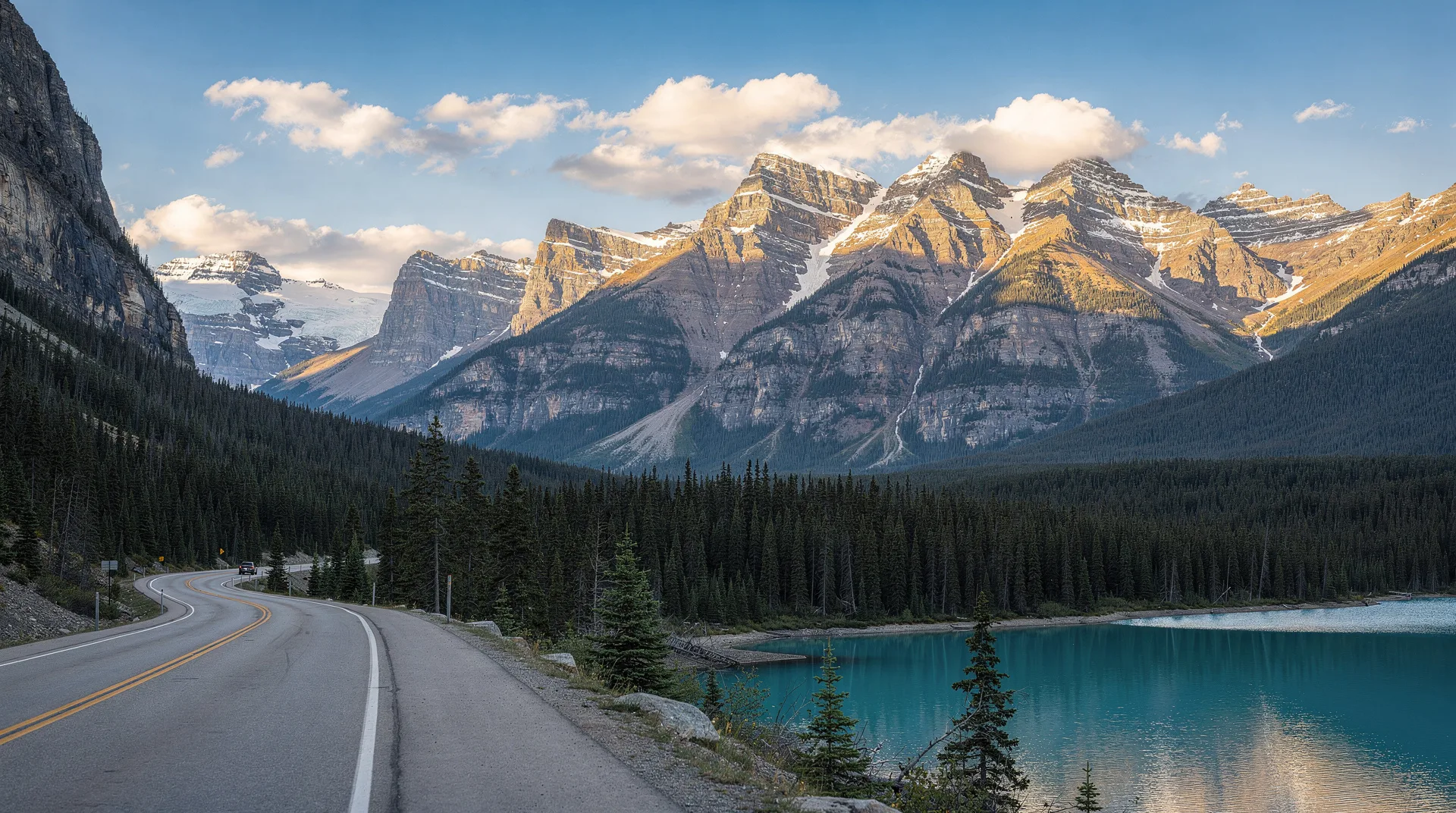
Driving Banff to Jasper along the Icefields Parkway
How long does the drive from Banff to Jasper take?
The drive is 288 km via the Icefields Parkway (Highway 93 North) and takes about 3.5 hours non-stop. Realistically, allow a full day (8-10 hours) including stops at Peyto Lake, the Columbia Icefield, Sunwapta Falls, and Athabasca Falls. Start early from Banff.
The Icefields Parkway drive from Banff to Jasper is not just a road — it is the reason many people come to Canada. Highway 93 North runs 232 kilometres from the junction at Lake Louise to the town of Jasper (288 km if you are driving from Banff town itself), passing through two UNESCO World Heritage national parks, skirting the edge of the largest ice field in the Rocky Mountains south of Alaska, and delivering a continuous panorama of peaks, glaciers, waterfalls, and turquoise lakes. On any fair assessment of the world’s great scenic drives, this belongs near the top.
This guide covers the full drive from Banff town to Jasper, every worthwhile stop, practical logistics, and how to plan your day.
| At a glance | |
|---|---|
| Where | Highway 93 North, Banff to Jasper via Lake Louise, Alberta |
| Cost | Park pass required (CAD $12.25/adult day pass or a Discovery Pass) plus fuel |
| Time needed | Full day (8-10 hours) if driving one-way with stops |
| Getting there | Rent a car in Calgary, Banff or Lake Louise — no public transit covers the full route with stops |
| Best time | Mid-June through September for full access; winter needs winter tyres and daylight planning |
The basics
Total distance (Banff town to Jasper): 288 km
Drive time non-stop: approximately 3.5 hours
Recommended time with stops: 8-10 hours (full day)
Direction: Drive north (Banff to Jasper) to keep viewpoints on the driver’s side
Fuel: Available in Banff, Lake Louise, and Jasper. The only option between Lake Louise and Jasper is Saskatchewan River Crossing (108 km into the Icefields Parkway). Do not miss this stop if your tank is less than half full.
When to make this drive: Mid-June through September. Moraine Lake Road (accessed from Lake Louise) opens in late May; the parkway itself stays open year-round but winter conditions (October through May) require winter tyres and care. The Icefields Parkway in January is beautiful and almost empty, but black ice is a genuine hazard.
Banff to Lake Louise: the warm-up (58 km)
Most Rockies itineraries begin the Icefields Parkway drive from Lake Louise, driving out from Banff in the morning. But the stretch of Highway 1 between Banff and Lake Louise is worth treating as the start of the journey, not just a prelude to it.
Bow Valley Parkway (Highway 1A): This slower, older road parallels the Trans-Canada between Banff and Lake Louise and is consistently better for wildlife spotting. Wolves, bears, elk, and deer use the valley corridor regularly. The 55-km drive takes about 1 hour without stops and passes Castle Junction, a good base if you prefer quieter accommodation than Banff or Lake Louise.
Johnston Canyon: Whether you take the Trans-Canada or the Bow Valley Parkway, Johnston Canyon (accessed from Highway 1A, 18 km west of Banff) is the strongest reason to make an early start. The canyon trail follows metal catwalk bridges above the creek to Lower Falls (1.1 km) and Upper Falls (2.7 km). Arrive before 9 AM in July and August.
Lake Louise to Jasper: the Icefields Parkway proper (232 km)
Leaving Lake Louise
Fill your fuel tank in Lake Louise village before joining the Icefields Parkway junction north of the Trans-Canada interchange. The next fuel is 108 km north at Saskatchewan River Crossing.
The parkway begins with a long straightaway through mixed forest before the first of the major viewpoints appears.
Crowfoot Glacier viewpoint (33 km from Lake Louise)
The first major pullout. Crowfoot Glacier, named for its three-toed bird-like shape, is visible high on the mountain above — one “toe” has retreated significantly in living memory. The comparison with historical photographs at the viewpoint is a vivid introduction to glacial retreat visible along the entire drive.
Bow Lake (36 km from Lake Louise)
The headwaters of the Bow River, which flows east through Banff and ultimately into the prairie river system. Bow Lake’s turquoise colour — produced by rock flour from the Bow Glacier above — is among the most intense on the parkway. The historic Num-Ti-Jah Lodge on the lakeshore, built in 1937 by legendary mountain guide Jimmy Simpson, is one of the most charming structures in the Rockies. A trail from the parking area leads 6.4 km return to the base of Bow Glacier Falls.
Allow 30-60 minutes including a lakeshore walk.
Peyto Lake viewpoint (77 km from Lake Louise)
The most photographed single viewpoint on the entire drive, and the most likely to exceed expectations. Peyto Lake sits in the Mistaya Valley below Bow Summit (2,069 m, the highest point on the parkway). From the viewpoint platform, reached by a 2.5-km return walk from the parking area, the lake reveals its extraordinary wolf-head shape and electric blue-green colour.
The colour is at its most vivid in July and August when glacial melt from the Waputik Icefield above is at maximum. The parking area fills very early on summer mornings — aim to arrive before 8:30 AM.
Allow 1-1.5 hours including the walk.
Mistaya Canyon (100 km from Lake Louise)
A 500-metre walk from the highway leads to a narrow limestone slot canyon where the Mistaya River carves through swirling patterns of sculpted rock. The canyon is narrow, deep, and dramatic — one of the most impressive short stops on the drive for the time investment. Allow 20-30 minutes.
Saskatchewan River Crossing (108 km from Lake Louise)
The only fuel and food between Lake Louise and Jasper. Refuel here. The landscape opens dramatically at the confluence of the North Saskatchewan, Howse, and Mistaya rivers — a wide flat floodplain with views toward the eastern plains. Elk often graze in the valley in late afternoon.
Book a guided one-way Banff to Jasper Icefields Parkway tourParker Ridge (118 km from Lake Louise)
A 4.8-km return trail (250 m elevation gain, about 1.5-2 hours) climbs to a ridge above the Saskatchewan Glacier — the longest arm of the Columbia Icefield. The bird’s-eye view of the glacier filling the valley below is extraordinary and rare. This is one of the finest short hikes accessible directly from the parkway. Do not skip it if conditions and energy allow.
Columbia Icefield Discovery Centre (126 km from Lake Louise)
The centrepiece of the drive. The Athabasca Glacier, the most accessible arm of the Columbia Icefield, is visible from the Discovery Centre parking area. A 1.5-km interpretive trail leads to the glacier’s toe — posts along the route mark where the ice reached in past decades, graphically illustrating its retreat. The glacier has retreated over 1.5 km since 1870.
Ice Explorer tour: Large all-terrain vehicles drive onto the glacier surface; passengers step out and walk on the ice. Book well in advance — this is one of the most popular experiences on the parkway and sells out in peak season.
Glacier Skywalk: A 1-km interpretive trail leading to a glass-floored observation platform 280 m above the Sunwapta Valley. A separate ticket from the Ice Explorer tour; the two can be combined.
Allow 1-3 hours at the icefield depending on whether you do the Ice Explorer tour.
Sunwapta Falls (175 km from Lake Louise)
The Sunwapta River drops over quartzite ledges into a canyon in two distinct falls. The upper falls are visible from a short 5-minute walk from the parking area; the lower falls (1.7 km one-way) are less visited and equally impressive. The sunwapta canyon has excellent photographic light in the afternoon. Allow 30-45 minutes.
Athabasca Falls (198 km from Lake Louise)
The most powerful waterfall in the Canadian Rockies. The full volume of the Athabasca River is forced through a narrow quartzite gorge, producing a roaring cascade of surprising violence given the modest height. A network of paths and bridges allows multiple viewing angles. The most dramatic viewpoint is directly above the canyon from the south side. Allow 30-45 minutes.
From Athabasca Falls, it is 30 km north to Jasper town.
Mount Edith Cavell (detour, 27 km from Jasper)
The road to Mount Edith Cavell branches west from Highway 93A (the older parkway road). The access road is restricted to vehicles under 9 m and runs up a dramatic narrow canyon. At the parking area, a 3.8-km return trail leads to the Angel Glacier, which hangs from the mountain’s north face above a milky turquoise pond of meltwater. Add 2 hours to your day. Worth it.
Park pass, wildlife and what to book ahead
Both Banff and Jasper are Parks Canada national parks — a Discovery Pass or a daily park pass is required for the entire drive, not just at the entrances to individual sites. Buy it at the Banff or Lake Louise gate before you start; there is no need to stop again at a separate Jasper gate for the pass itself. See our Banff park pass guide for current pricing and whether the annual Discovery Pass pencils out for your trip.
Wildlife sightings are common along the whole corridor — elk, bighorn sheep, and occasionally bears grazing roadside verges, especially around dawn and dusk. Slow down for any roadside pullout of parked cars; it usually means an animal is visible. Bear spray is worth carrying if you plan any of the short trailside walks (Parker Ridge, Mount Edith Cavell); see our bear watching Canada guide for safety basics.
If Moraine Lake is on your radar as a side trip from Lake Louise, note that private vehicles are no longer allowed on the Moraine Lake road — access is by shuttle, park-and-ride bus or guided tour, and shuttle seats sell out on summer mornings. Book ahead using the details in our Moraine Lake guide.
Photography note: the parkway’s turquoise lakes (Peyto Lake especially) look their best around midday when the sun is directly overhead and the glacial-flour colour reads brightest — an unusual case where midday light beats golden hour.
A one-way rental from Banff to Jasper
This drive starts in one town and ends in another, so the car has to be returned in Jasper rather than where you collected it. That changes what you should check before paying: whether the quoted total already includes a one-way drop-off charge, whether Jasper is offered as a return location, and whether the mileage allowance is unlimited, since roadside pullouts and trailhead detours at Parker Ridge or Mount Edith Cavell add distance to the main route.
Collect the car in Banff on the morning you leave, so the pass can be bought at the Banff or Lake Louise gate on your way out. For the drive itself, you can compare one-way rentals from Banff to Jasper through DiscoverCars for this route.
Arriving in Jasper
Jasper town (population approximately 4,500) is smaller and more relaxed than Banff. The townsite is set in the wide Athabasca Valley with mountains visible in all directions. Check into accommodation, then take a short evening drive on the Pyramid Lake Road north of town — elk are nearly certain, and the lake at dusk is beautiful.
Book guided Jasper National Park tours and experiencesPractical timing
| Stop | Distance from Lake Louise | Recommended time |
|---|---|---|
| Crowfoot Glacier viewpoint | 33 km | 15 min |
| Bow Lake | 36 km | 30-60 min |
| Peyto Lake viewpoint | 77 km | 60-90 min |
| Mistaya Canyon | 100 km | 20-30 min |
| Saskatchewan River Crossing (fuel) | 108 km | 20 min |
| Parker Ridge hike | 118 km | 90-120 min |
| Columbia Icefield | 126 km | 60-180 min |
| Sunwapta Falls | 175 km | 30-45 min |
| Athabasca Falls | 198 km | 30-45 min |
| Arrive Jasper | 232 km | — |
Recommended start time: Leave Banff by 7:00-7:30 AM to reach Peyto Lake before crowds and still have time for the Columbia Icefield and Athabasca Falls without rushing.
Frequently asked questions about Driving Banff to Jasper along the Icefields Parkway
Do I need a separate pass for Jasper?
A Parks Canada Discovery Pass covers both Banff and Jasper. If you purchased a Banff-only daily pass, you will need to pay separately at Jasper. The Discovery Pass is the better option for any itinerary covering both parks. See our Parks Canada Discovery Pass guide.
Can I do the drive in reverse (Jasper to Banff)?
Yes, and some views are equally good or better in the southbound direction. The key difference is that northbound (Banff to Jasper) puts the driver’s window closer to the major viewpoints. Southbound drivers find Peyto Lake on their left — still accessible, but the parking areas are designed for northbound traffic.
Is the drive safe in October?
October can be excellent — fewer crowds, autumn light, and larch colour in the high alpine areas. But snow is possible at any time from October onward, and some facilities (Glacier Skywalk, Ice Explorer) close by mid-October. Check Parks Canada for current conditions.
Where should I stay en route?
The Columbia Icefield Glacier View Lodge (at the icefield itself) is the only hotel on the parkway between Lake Louise and Jasper. Num-Ti-Jah Lodge at Bow Lake is the most charming option. Most visitors make the drive as a day trip from Banff to Jasper.
Do I need to book anything in advance for this drive?
The drive itself needs no reservation, but the Ice Explorer tour and Glacier Skywalk at the Columbia Icefield sell out in July and August, and Moraine Lake access (if added as a detour) requires a shuttle booking since private vehicles are banned from that road.
Is the Icefields Parkway open in winter?
Yes, it stays open year-round and is genuinely beautiful with almost no traffic, but conditions are serious: winter tyres are required, daylight is short, and some facilities close from mid-October. Check road conditions before committing to a winter drive.
For more Rockies road trip planning, see our 7-day Banff and Jasper itinerary, the Icefields Parkway one-day drive itinerary, and our guide to the Parks Canada reservation system.