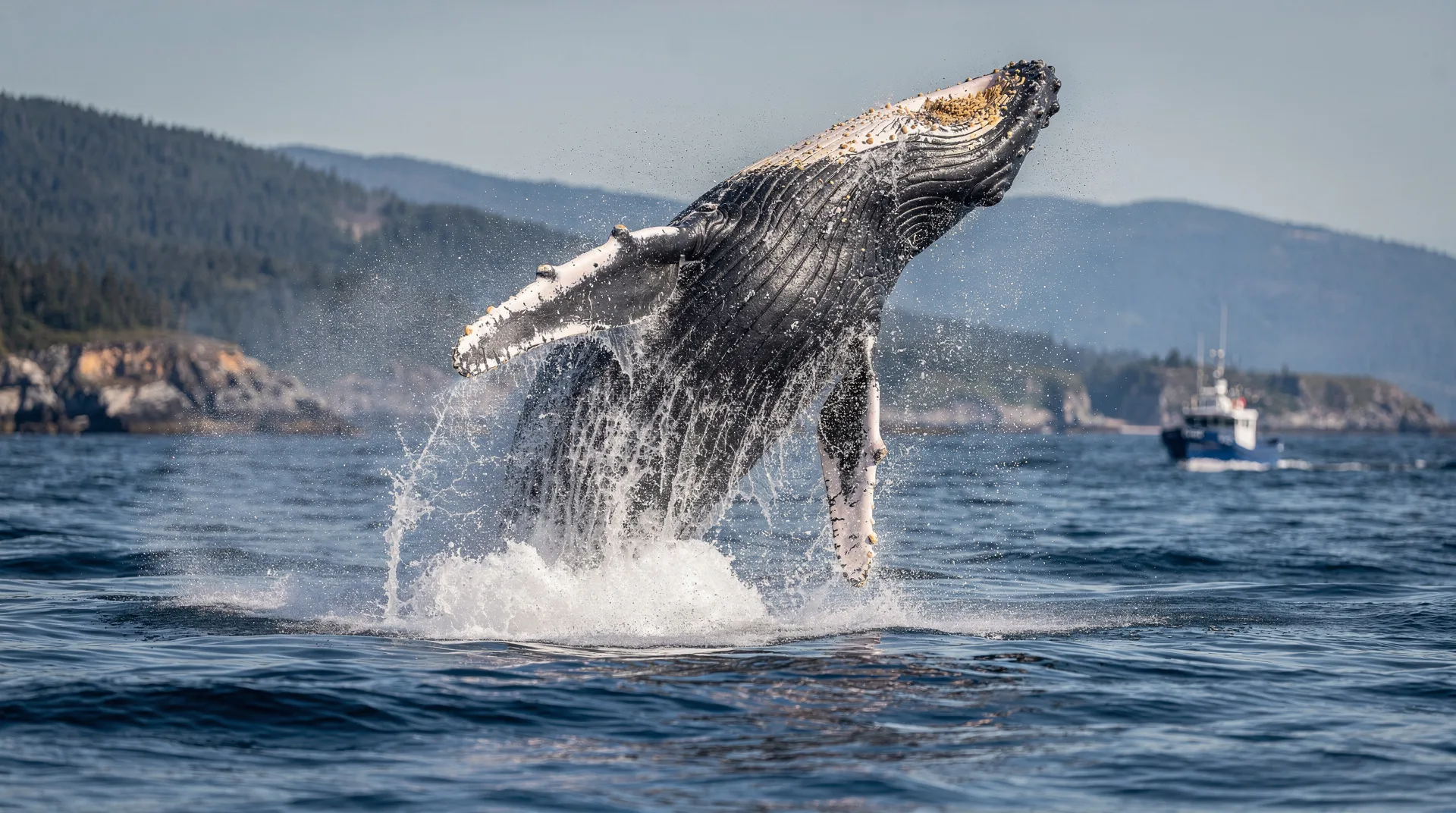
Whale watching Atlantic Canada: complete guide
Where is the best whale watching in Atlantic Canada?
Newfoundland (from St. Anthony and Twillingate) offers the most dramatic humpback encounters combined with icebergs. The Bay of Fundy (Brier Island, NS and Grand Manan, NB) is the best place to see endangered right whales. Cape Breton's Pleasant Bay is excellent in summer.
Atlantic Canada sits at the confluence of cold, nutrient-rich subarctic water and the warmer Gulf Stream, a meeting that creates some of the most productive marine ecosystems in the North Atlantic. For whales, this abundance is magnetic: the region hosts a remarkable diversity of species from late spring through autumn, from the acrobatic humpback to the critically endangered North Atlantic right whale, from the enormous fin whale to the compact and curious minke.
This guide compares whale watching across the region’s four provinces, helping you decide where to go based on species interest, travel logistics, and the kind of experience you’re looking for.
| At a glance | |
|---|---|
| Where | Nova Scotia, New Brunswick, PEI and Newfoundland coastlines |
| Cost | Around CAD 60-100 per adult for a typical 2-4 hour boat tour |
| Time needed | Half a day per location; a dedicated whale-focused trip runs 7-14 days across regions |
| Getting there | Self-drive between regions; Halifax and St. John’s are the main airport hubs |
| Best time | July and August for the widest overlap of species and operators |
Atlantic Canada’s whale species at a glance
Before choosing a location, it helps to know what you’re likely to encounter:
Humpback whale: The most watched and most theatrical of Atlantic Canada’s whales. Grows to 16 metres; known for breaching, lobtailing, and bubble-net feeding. Present throughout Atlantic Canada from June through October.
Fin whale: The second-largest animal on earth at up to 27 metres. Fast, majestic, and identified by its asymmetrical jaw colouring. Common in the Bay of Fundy and off Newfoundland.
Minke whale: Smallest of the regularly seen baleen whales; compact and curious. The most common species across the region. Present May through October.
North Atlantic right whale: Critically endangered; approximately 350 individuals remaining. A stocky, slow-moving whale with distinctive white callosities on its head and no dorsal fin. The Bay of Fundy, particularly around Grand Manan, is a critical feeding ground.
Blue whale: The largest animal ever to live on Earth — up to 30 metres. Rare but regularly encountered in the Gulf of St. Lawrence, particularly around the Mingan Islands and off Tadoussac (Quebec). Occasional sightings in Atlantic Canada waters.
Sperm whale: The largest toothed whale. Dives to extreme depths hunting giant squid. Occasionally seen in deep offshore waters, particularly off Newfoundland.
Pilot whale: Technically a large dolphin rather than a whale, but grouped here for convenience. Grows to 6 metres. Common off the Cape Breton coast and in Newfoundland waters, often in pods of dozens.
Harbour porpoise, white-sided dolphins, white-beaked dolphins: Smaller cetaceans common in nearshore Atlantic Canadian waters throughout summer.
Newfoundland: icebergs, whales, and dramatic scenery
Whale watching in Newfoundland combines two of the province’s signature wildlife experiences — because the same Labrador Current that carries icebergs south also concentrates the fish and krill that feed humpbacks, finbacks, and minkes. From late May through September, you can watch humpback whales breach against a backdrop of drifting icebergs, a combination found nowhere else on earth.
Northern Peninsula and St. Anthony
The northern tip of the island, accessed via the Viking Trail (Route 430), is the earliest productive whale watching area in the province. Humpbacks arrive in the waters around St. Anthony in late May as the iceberg season peaks, and they remain through the summer.
Fishing Point Park in St. Anthony offers some of the most dramatic shore-based whale watching in Atlantic Canada — the combination of proximity, the framing cliff, and the regular presence of icebergs creates genuinely extraordinary conditions. Boat tours from St. Anthony Harbour get within extraordinary proximity.
Combine this with the Viking Trail and L’Anse aux Meadows for a complete northern Newfoundland experience.
Twillingate and Notre Dame Bay
The waters around Twillingate are productive for humpbacks and minkes from June through August. Several operators combine whale watching with iceberg viewing in season; see our iceberg viewing guide for the best months for ice.
The Avalon Peninsula
The waters off the eastern Avalon Peninsula, particularly around Witless Bay Ecological Reserve (south of St. John’s), host significant numbers of humpbacks in summer. Witless Bay is also the location of North America’s largest Atlantic puffin colony — combination puffin-and-whale tours from Bay Bulls are among the most productive wildlife watching tours in the province.
Browse Newfoundland whale watching and wildlife toursBest months for Newfoundland: June through August for the optimal overlap of whale numbers and iceberg potential (icebergs thin out in July but the combination still occurs in June).
Nova Scotia: the Bay of Fundy and Cape Breton
Brier Island and Digby Neck
The outer Bay of Fundy, accessible from the southern tip of Digby Neck, is one of the finest whale watching areas in the Western Hemisphere. The extreme tidal mixing of the bay creates exceptional nutrient concentrations that support large populations of humpbacks, finbacks, minkes, and the critically endangered right whale.
Brier Island Whale & Seabird Cruises is the benchmark operator for this area — knowledgeable naturalist guides, a strong track record, and the advantage of departing from the closest Nova Scotia point to the productive outer bay waters.
See our detailed Bay of Fundy whale watching guide for species, operators, and timing.
Cape Breton Island
Pleasant Bay, on the western coast of Cape Breton near the Cape Breton Highlands National Park, is an excellent whale watching base during the Cabot Trail season. Pilot whales are remarkably common here — pods of dozens of animals regularly feed in the Gulf of St. Lawrence waters below the Skyline Trail headland.
Small operators in Pleasant Bay and Cheticamp run tours that combine whale watching with the spectacular coastal scenery of the northern Cape Breton coast. The proximity to the Skyline Trail makes a day that begins with a highland hike and ends with a whale watching tour an entirely realistic proposition.
Browse Nova Scotia whale watching toursBest months for Nova Scotia: July through September for Bay of Fundy right whale encounters; June through October for Cape Breton pilot whales.
New Brunswick: Grand Manan and St. Andrews
Grand Manan Island
Grand Manan sits in the outer bay, 28 km from the New Brunswick mainland, at the intersection of cold Fundy water and the Gulf of Maine. This convergence zone is critical habitat for North Atlantic right whales, which feed here on concentrations of copepods in late summer.
Grand Manan Whale & Seabird Research Station combines genuine scientific research with exceptional public tours. The opportunity to participate in photo-identification of individual right and humpback whales — contributing to long-term population databases — makes these tours distinctively educational.
The island itself is worth a visit for birding (it sits on a major migration flyway), its fishing heritage, and its extraordinary isolation.
St. Andrews
The historic resort town of St. Andrews-by-the-Sea offers more comfortable basing facilities than Grand Manan, with excellent Victorian-era accommodation and restaurants. Tours from St. Andrews reach productive waters in 30-60 minutes; species commonly encountered include humpbacks, finbacks, and minkes.
Best months for New Brunswick: August is the peak month for right whale encounters around Grand Manan. Humpbacks are present July through September.
Prince Edward Island
PEI’s shallow, warming Gulf of St. Lawrence waters are not prime whale watching territory, though harbour porpoise are common in the strait, and minke and fin whale sightings occur occasionally on the northern shore. Whale watching is not a primary reason to visit PEI; the island’s appeal lies in its beaches, culinary scene, and pastoral landscape.
See our PEI 5-day itinerary for the best this province has to offer.
Comparing the regions: which is right for you?
| Region | Best species | Best months | Highlight |
|---|---|---|---|
| Newfoundland | Humpback, fin | Jun-Aug | Whales + icebergs combination |
| Bay of Fundy | Right whale, humpback | Jul-Sep | Most diverse; right whale potential |
| Cape Breton | Pilot whale, minke | Jun-Oct | Combined with Cabot Trail experience |
| Grand Manan NB | Right whale, humpback | Aug | Research-based tours |
For species diversity and the unique right whale experience: Bay of Fundy. For the most dramatic scenery and the iceberg combination: Newfoundland. For ease of integration into a road trip: Cape Breton. For a research experience with scientific depth: Grand Manan.
Combining whale watching with other Atlantic wildlife
Whale watching pairs naturally with other Atlantic Canada wildlife experiences if you have the time. Puffin colonies at Witless Bay peak at the same time as Avalon Peninsula humpback season, making a combination tour efficient. Further inland, Fundy National Park offers hiking and tidal scenery to fill a day between Bay of Fundy whale tours. For a completely different wildlife bucket-list trip, Churchill’s polar bears run on an entirely different calendar (roughly October-November) and require dedicated planning of their own — not something to combine with a summer Atlantic Canada trip, but worth knowing about if wildlife travel is a priority.
Planning tips for Atlantic Canada whale watching
Book in advance: Peak season tours at the best operators fill weeks ahead. Brier Island, Grand Manan, and the popular Newfoundland operators (particularly in Twillingate and St. Anthony) should be booked at least 2-4 weeks ahead in July-August.
Allow flexibility: Weather cancels whale watching tours regularly in Atlantic Canada. Build one or two buffer days into any whale-focused itinerary to allow for rescheduling.
Dress for the water: Even in August, offshore water temperatures in Atlantic Canada are cold. Boat-deck temperatures are typically 5-10°C cooler than shore. Wind-proof and waterproof outer layers are essential on any tour.
Binoculars: A good pair of 8x or 10x binoculars transforms the experience of watching distant surfacing and behaviours. Worth bringing even if the boat gets relatively close.
Browse Atlantic Canada wildlife and nature toursBest itineraries that include whale watching
Our 10-day Atlantic Canada itinerary includes Cape Breton whale watching at Pleasant Bay as part of the Cabot Trail section.
The 14-day Atlantic Canada road trip covers multiple whale watching destinations including the Bay of Fundy and Cape Breton.
The 7-day Newfoundland itinerary is built around the Avalon Peninsula, where Witless Bay combination puffin-and-whale tours are a highlight.
Frequently asked questions about Whale watching Atlantic Canada: complete guide
What time of year is best for whale watching in Atlantic Canada overall?
July and August offer the highest whale numbers across the region. For the Bay of Fundy right whale experience, August is the single best month. For the iceberg-plus-whale combination in Newfoundland, June offers the best overlap.
Can children go whale watching?
Most operators welcome children aged 5 and up on larger vessels; some zodiac operators set minimum ages of 8-10. Check individual operator policies. Children who can handle a 3-4 hour boat trip typically find whale watching among the most memorable experiences of any trip.
How do I know if the tour will see whales?
Most reputable Bay of Fundy and Newfoundland operators have sighting rates of 95%+ in peak season. They communicate with each other and monitor whale locations continuously. A sighting guarantee with a free return trip is standard among the better operators.
Is whale watching better in Atlantic Canada or Quebec (Tadoussac)?
Different experiences. Tadoussac in Quebec offers the possibility of blue whale encounters (rare elsewhere in Canada) in a dramatic river setting. Atlantic Canada offers right whale encounters (Bay of Fundy), the iceberg combination (Newfoundland), and the widest species diversity. Both are world-class.
Can I combine whale watching with an iceberg or puffin trip?
Yes, and it’s one of the best reasons to visit Newfoundland specifically. The Avalon Peninsula’s Witless Bay combines puffins and humpbacks on a single tour, and the Northern Peninsula pairs icebergs with early-season whales in June. See our iceberg viewing guide and Viking Trail guide for planning the northern combination.