Iceberg viewing in Newfoundland: season, tours & best spots
When is iceberg season in Newfoundland?
Peak iceberg season runs from late April through June, with May typically the best month. Icebergs travel south from Greenland along 'Iceberg Alley' off the Newfoundland coast. St. Anthony in northern Newfoundland and the Avalon Peninsula are the most reliable viewing areas.
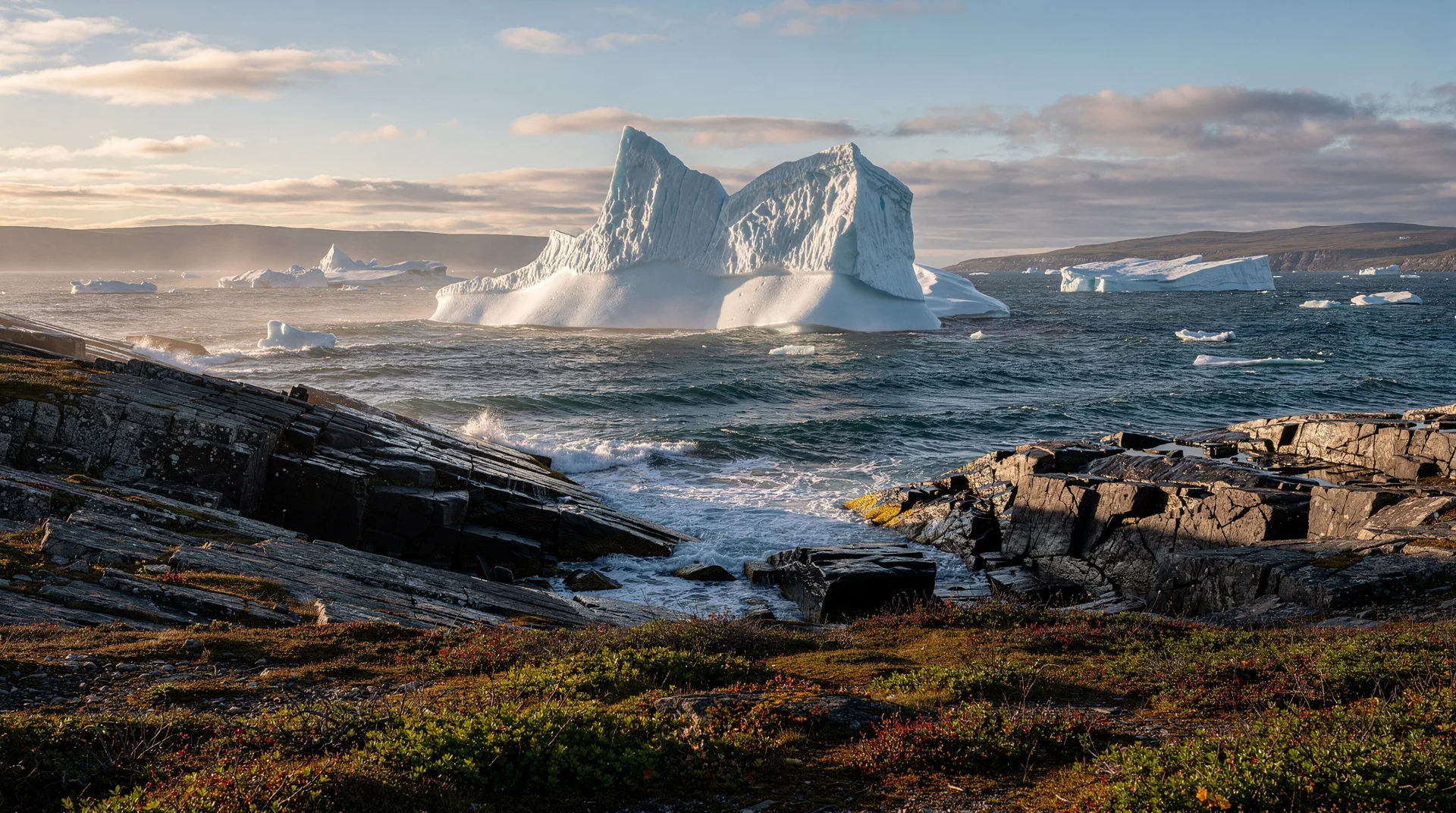
There are moments in travel that completely recalibrate your sense of scale, and standing on a Newfoundland headland watching a ten-storey iceberg drift past, glowing white and blue against the gunmetal Atlantic, is one of them. These are pieces of Greenland’s ice sheet, calved off glaciers that began forming up to 15,000 years ago, now completing a journey of 2,000 kilometres down the Labrador Current before melting away in the warmer waters south of the island.
Newfoundland is one of the few places on earth where you can reliably watch icebergs from shore — for free, with a coffee in hand — or get within extraordinary proximity by boat. This guide covers everything you need to know to plan your iceberg-viewing trip: the best spots, the exact timing, what tours are worth taking, and how to get the most out of an experience that is genuinely unlike anything else in North America.
At a glance
| Where | Iceberg Alley, along Newfoundland’s east coast — St. Anthony, Twillingate, the Avalon Peninsula and Fogo Island |
| Cost | Shore viewing is free; boat tours around CAD 60-80 for 2 hours, CAD 80-120 for combined whale-and-iceberg tours |
| Time needed | An afternoon for shore viewing at one spot; a full day if you’re combining a boat tour with driving |
| Getting there | Self-drive from St. John’s or Deer Lake; flying into Deer Lake or St. John’s and renting a car is most practical |
| Best time | Late April through June, with May typically the strongest month |
Understanding Iceberg Alley
The term “Iceberg Alley” refers to the stretch of ocean running along the eastern coast of Newfoundland and Labrador, from the northern tip of the island down past the Avalon Peninsula. It is the most reliable iceberg corridor in the world outside of polar expeditions.
The icebergs themselves originate primarily from the western coast of Greenland, where glaciers calve enormous chunks of freshwater ice into Baffin Bay. These pieces — which can range from the size of a grand piano to the size of a small city block — are caught by the Labrador Current and carried south over the course of two to three years. By the time they reach Newfoundland, they have been sculpted by wind, wave, and partial melting into fantastical shapes: arches, towers, castellated fortresses, tilted slabs, and flat-topped tabular bergs.
The quantity of icebergs varies significantly from year to year, depending on Greenland glacial activity, wind patterns, and ocean temperatures. The International Ice Patrol (a US Coast Guard operation, established after the Titanic disaster) tracks icebergs annually; their data shows year-to-year counts ranging from fewer than 100 to over 2,000 icebergs passing the 48th parallel. Most years, several hundred icebergs make it to visible range from Newfoundland.
Best time to see icebergs
April: The season begins, with icebergs arriving off the northern Newfoundland coast first. Numbers are building but unpredictable. Weather can be harsh.
May: Historically the single best month for iceberg viewing. Numbers are typically at their peak, the bergs are concentrated along the northern and eastern coasts, and the weather, while cool, is more manageable than April. This is when to go if you have flexibility.
June: Still excellent, particularly in the first half. Icebergs are now reaching the Avalon Peninsula in larger numbers. The season starts to wind down by late June as warmer Atlantic waters accelerate melting.
July: Icebergs become scarce by July, though rare stragglers appear occasionally. Don’t plan a trip primarily for icebergs this late in the season.
March: Very early season icebergs appear occasionally near St. Anthony and the Labrador coast. Not worth a dedicated trip unless you’re already there.
The Iceberg Finder website (operated by c-core.ca) provides near-real-time tracking of confirmed iceberg sightings and is the most reliable planning tool available.
Best spots for iceberg viewing
St. Anthony and the Northern Peninsula
The northern tip of Newfoundland, accessible via the Viking Trail from Deer Lake, is the earliest and most reliable place to see icebergs each season. Icebergs arrive here in April, weeks before they appear farther south.
Fishing Point Park in St. Anthony has a clifftop viewing platform that looks directly over the Labrador Current. On a good May day, you can see multiple bergs simultaneously from this single vantage point, often accompanied by humpback whales feeding in the same current. The park is free and accessible.
The boat tours operated from St. Anthony Harbour get visitors within extraordinary proximity — sometimes 50 metres — of icebergs. These northern boats are operated by experienced local captains who know the ice, the whales, and the currents intimately.
See our Viking Trail itinerary for how to incorporate iceberg viewing into a broader northern Newfoundland road trip.
Twillingate — the Iceberg Capital
Twillingate, on Notre Dame Bay on Newfoundland’s northeast coast, brands itself “the Iceberg Capital of the World,” and while that’s a marketing claim, it’s not entirely unearned. The town’s position jutting out into Notre Dame Bay means icebergs frequently ground in the shallow waters nearby, sometimes sitting within view of town for days or weeks before breaking up and drifting on.
Long Point Lighthouse, at the tip of Twillingate Island, is one of the most photographed iceberg-viewing spots in Newfoundland. The lighthouse sits atop dramatic red cliffs; icebergs drifting past below create images of extraordinary compositional perfection.
Twillingate is also the departure point for some of the best iceberg boat tours on the island. Several operators run 2-3 hour excursions that combine iceberg viewing with whale watching and seabird observation.
The Avalon Peninsula
For travellers based in St. John’s, icebergs arrive on the Avalon Peninsula somewhat later in the season — late May through June. The east coast of the peninsula, particularly around Cape St. Francis, Pouch Cove, and the Cape St. Mary’s area to the south, provides shore-based viewing.
Signal Hill in St. John’s, while primarily a historic site, occasionally provides iceberg views from its cliff tops when bergs drift into the approaches to St. John’s Harbour. This is not the most reliable spot but creates remarkable images when it happens.
The Bonavista Peninsula, northeast of St. John’s, is another excellent area with tours departing from Trinity and Bonavista itself.
Fogo Island
Fogo Island, accessible by ferry from Farewell (northeast of Gander), sits directly in Iceberg Alley and has some of the most spectacular iceberg viewing in Newfoundland. The island’s eastern shore faces the open Labrador Sea; icebergs drift past at close range throughout May and June.
Fogo Island is also one of the most architecturally distinctive destinations in Atlantic Canada, home to the celebrated Fogo Island Inn and several remarkable artist studios designed by the same architect. The combination of iceberg viewing and extraordinary contemporary design makes Fogo Island a genuine bucket-list destination for those who can access it.
Boat tours vs. shore viewing
Both have merit, and the two experiences are genuinely different.
Shore viewing is free, unhurried, and allows you to observe icebergs over time — watching them roll, crack, and calve in real time from a fixed vantage point. Long Point Lighthouse in Twillingate and Fishing Point in St. Anthony are the two finest shore viewing platforms. Bring binoculars (10x magnification is sufficient), a telephoto lens if you photograph, and dress for wind regardless of the forecast.
Boat tours provide proximity that shore viewing cannot match. Being within 100 metres of a 20-metre-tall iceberg — feeling the cold air radiating from it, seeing the blue-green luminescence below the waterline, watching meltwater cascade down its flanks — is a completely different experience from watching from a cliff. Most reputable operators maintain a safe distance (typically 150-200 metres as a minimum, closer for smaller fragments) but the proximity is still extraordinary.
Browse iceberg boat tours and Newfoundland experiencesBoat tours range from 2-hour zodiac excursions (most intimate; you feel every wave and ice-generated cold) to 3-4 hour rigid-hull tours with enclosed cabins. Twillingate, St. Anthony, Trinity, and Bonavista all have multiple operators.
Safety note: Icebergs are inherently unstable. They can roll without warning, and calving events (when large pieces break off) create hazardous waves. Reputable operators know the danger signals and maintain appropriate distances. Do not approach icebergs by personal watercraft or kayak without professional guidance.
Combining icebergs with whale watching
One of the remarkable facts about Iceberg Alley is that the same Labrador Current that carries icebergs south also concentrates the krill and small fish that feed humpback whales, fin whales, and minke whales. In May and June, it is entirely common to see both icebergs and whales on the same boat tour — sometimes simultaneously.
This combination is particularly reliable from St. Anthony and Twillingate. The whale-watching season in northern Newfoundland begins in late May and peaks through July, overlapping with the tail end of iceberg season in June.
See our whale watching guide for Atlantic Canada for detailed information on species and viewing spots.
Photography tips
Iceberg photography requires some planning to get the results the subject deserves.
Light: Early morning and late afternoon light is dramatically better than midday. The low-angle light picks up the texture and colour variation in the ice — the blues and greens are richest in indirect or overcast light, which softens shadows.
Lens: A telephoto zoom (100-400mm range) is ideal for shore photography; a wide-angle lens works best on boat tours when proximity allows. The combination of a 24-70mm and a 70-200mm covers most situations.
Weather: Overcast days produce better ice colours than bright sunshine, which can blow out the white portions. Fog is atmospheric and can produce otherworldly images but limits what you can see. Clear days with good light are best for the seascape context.
Scale: Icebergs are photographically deceptive — without a reference for scale, even enormous bergs can look merely interesting. Including a lighthouse, a boat, or a coastline feature in the frame establishes the true scale and transforms the image.
Getting to the best iceberg spots
Twillingate: Located on Notre Dame Bay, approximately 350 km northwest of St. John’s via Trans-Canada Highway (Route 1) and Highway 340. The drive takes about 3.5-4 hours. Accommodation in Twillingate is limited; book well ahead for May-June.
St. Anthony: At the northern tip of the Viking Trail (Route 430), approximately 580 km from Corner Brook or 450 km from Deer Lake. The full drive from St. John’s is about 9-10 hours; flying to Deer Lake or St. Anthony’s small airport and renting a car is more practical.
Trinity and Bonavista: On the Bonavista Peninsula, about 240-280 km northeast of St. John’s. A manageable day trip from St. John’s or an excellent 2-3 night base.
Our 7-day Newfoundland road trip itinerary includes iceberg viewing as a key element and provides a practical routing for the Avalon Peninsula.
Practical information
What to wear: Even in May, Newfoundland coastal temperatures are cold — typically 5-10°C at sea level, with wind chill making it feel considerably colder. On boat tours, the proximity to icebergs drops the ambient temperature further. Dress in warm layers with a waterproof outer layer regardless of the forecast.
Accommodation: Book accommodation for Twillingate and St. Anthony at least 2-3 months in advance for May. These are small communities with limited rooms, and they fill early during peak iceberg season.
Real-time tracking: IcebergFinder.com and the provincial tourism website (newfoundlandlabrador.com) both aggregate recent sighting reports. Check in the week before your trip for current conditions.
Vehicle: A standard car handles all routes described here except the Meat Cove Road on the northern tip (gravel, requires high clearance). All main highways are paved.
Cost: Shore viewing is free. Boat tours cost approximately CAD $60-80 per adult for a 2-hour tour, $80-120 for longer combination whale-and-iceberg tours.
Building a Newfoundland trip around iceberg season
Iceberg viewing works best as the anchor of a broader Newfoundland trip rather than a single-day detour, since the best viewing towns are several hours from St. John’s. A full 10-day Atlantic Canada itinerary or the dedicated 7-day Newfoundland road trip both give enough time to reach Twillingate or St. Anthony without rushing.
Along the way, puffins are also nesting in May and June — see our puffin watching in Newfoundland guide for the best colonies, several of which sit close to iceberg viewing towns. Check our driving guide for Atlantic Canada and the Atlantic Canada weather guide before you go — coastal fog and wind can affect both driving conditions and what you’re able to see on a given day.
Related experiences
Iceberg viewing pairs naturally with several other Newfoundland experiences. The Screech-In ceremony is a cultural rite of passage you can complete in any pub in the province. The Viking Trail and L’Anse aux Meadows makes the journey to the northern peninsula worthwhile even in years when iceberg counts are lower. And the best time to see icebergs guide provides month-by-month detail for planning.
Frequently asked questions about Iceberg viewing in Newfoundland: season, tours & best spots
Are icebergs visible every year in Newfoundland?
Yes, every year, though the number varies significantly. Even in low-count years, enough icebergs reach Newfoundland to make a dedicated trip worthwhile — particularly to St. Anthony and Twillingate. In high-count years, they can be visible from almost any eastern headland.
Can I drink iceberg water?
Yes — many Newfoundland distilleries and breweries use harvested iceberg water, and several offer products made with it. Some boat operators collect small pieces of ice for passengers to taste. The water itself is exceptionally pure freshwater.
Is it safe to be near icebergs?
From shore, yes. On boat tours with reputable operators, yes — they maintain safe distances. Do not approach icebergs yourself by kayak or small watercraft without professional guidance; rolling and calving are unpredictable and dangerous.
What if there are no icebergs when I visit?
This is a genuine risk, particularly for early April or late June visits. Shore-based viewing at Twillingate or St. Anthony during May is the highest-probability option. Travel insurance is advisable; many operators offer weather/ice-condition rescheduling policies.
Can I see icebergs and puffins on the same trip?
Yes, and many visitors do. Puffin colonies are active from roughly late May through August, overlapping with the tail end of iceberg season in May and June. Several puffin colonies are close to iceberg viewing towns — see our puffin watching guide for the best sites and timing.