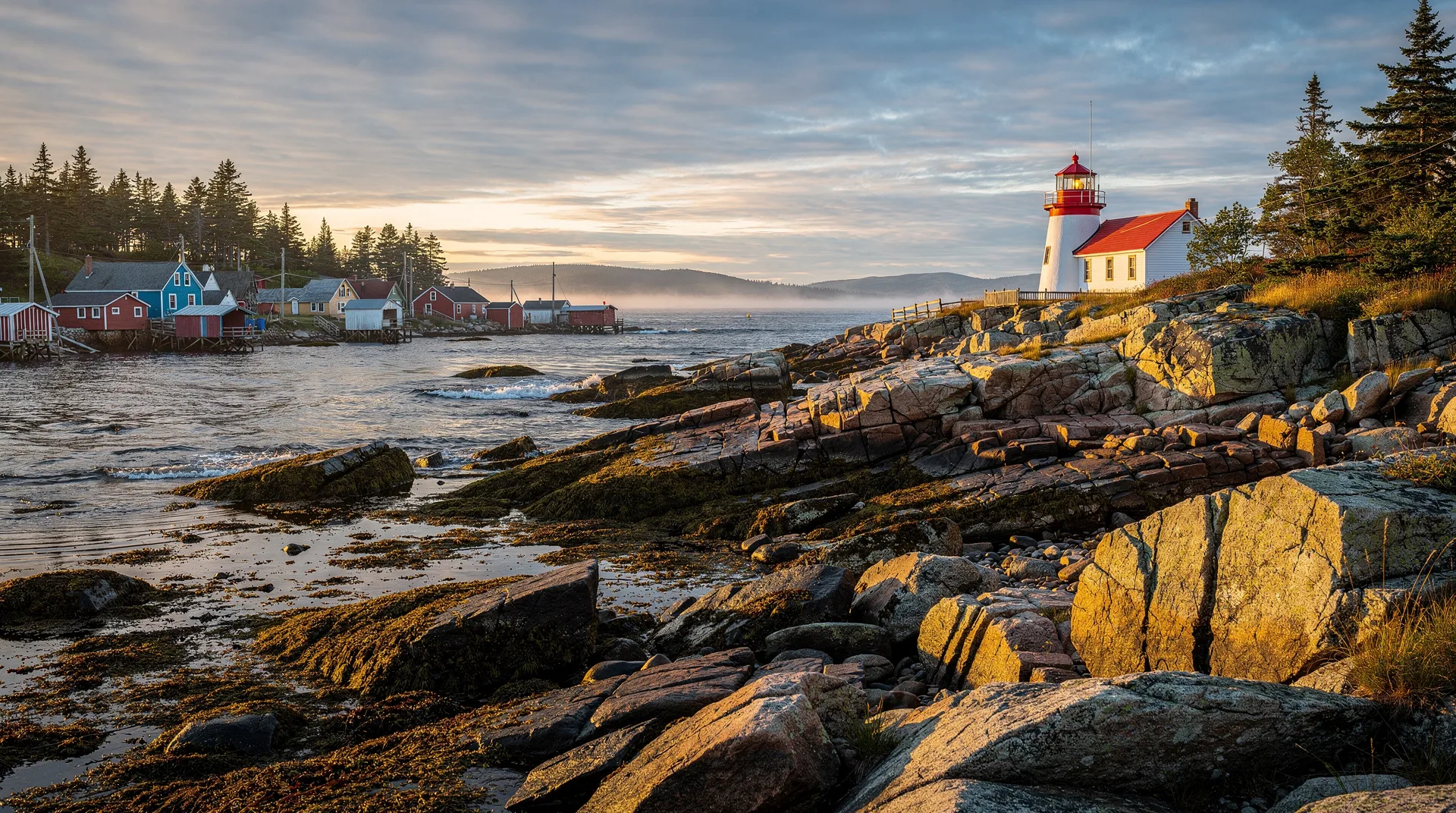
10 days in Atlantic Canada: Halifax to the Bay of Fundy
Overview
Atlantic Canada is the country’s most underappreciated region for international visitors. The four provinces of Nova Scotia, New Brunswick, Prince Edward Island, and Newfoundland (the latter for a different itinerary) offer a coastline of extraordinary beauty, seafood that ranks among the best in the world, Celtic and Acadian cultures still very much alive, and a pace of life that feels genuinely restorative after the intensity of larger cities.
This 10-day itinerary is a carefully paced circuit through the best of what Nova Scotia and Prince Edward Island offer: the vibrant waterfront of Halifax, the UNESCO-listed Lunenburg, the stunning Cabot Trail drive around Cape Breton, the pastoral red-soiled island of PEI, and a finale at the Bay of Fundy — home to the highest tides on earth. A rental car is essential; this is a road trip.
At a glance
| Start/end | Halifax Stanfield International Airport (YHZ) |
| Car required | Yes, from Day 1 |
| Total driving | Around 1,000-1,100 km over 10 days |
| Cost | Around CAD $2,500-3,500 per person, excluding flights |
| Best time | Mid-June to mid-October; September for the best balance of crowds and weather |
| Days | Destination |
| 1-2 | Halifax |
| 3 | Lunenburg |
| 4-5 | Cape Breton / Cabot Trail |
| 6-7 | Prince Edward Island |
| 8 | Moncton, NB |
| 9-10 | Bay of Fundy |
Best season: Mid-June to mid-October. July and August are peak season with warmest temperatures (20-25°C on sunny days), maximum services, and busy lobster season. September is excellent — smaller crowds, warm enough for beaches on PEI, autumn colour beginning on Cape Breton. The Cabot Trail in fall colours (late September to mid-October) is spectacular.
Days 1-2: Halifax — Nova Scotia’s vibrant capital
Halifax is the largest city in Atlantic Canada and one of Canada’s most walkable and enjoyable medium-sized cities. The waterfront boardwalk, the world-class maritime museum, the pub culture of Argyle Street, and the remarkable fortified hilltop of Citadel Hill together make it an excellent 2-day base.
Halifax Waterfront
The 4-kilometre waterfront boardwalk along Halifax Harbour is one of the best urban waterfronts in Canada. Historic properties buildings, working fishing wharves, and the converted Seaport Farmers’ Market are strung along the harbour edge. At the south end, Pier 21 is the former immigration terminal through which over a million immigrants entered Canada between 1928 and 1971; the museum here is moving and well-done.
The Canadian Museum of Immigration at Pier 21
This is one of Canada’s finest museums and an emotionally powerful one — the stories of the people who arrived at this wharf form a microcosm of Canadian immigration history. Interactive exhibits, recorded testimonials, and a searchable arrivals database (useful for those with family connections to Pier 21) make it worth 2-3 hours.
Citadel Hill and the Town Clock
Halifax Citadel National Historic Site sits at the top of the hill that dominates the city, a star-shaped fortification built in its current form between 1828 and 1856. The noon-hour cannon fire (a tradition since 1857) is a genuine event — the single boom carries across the harbour with startling authority. The views from the ramparts over the harbour and out to the Atlantic are the best in the city.
Alexander Keith’s Brewery
Canada’s oldest operating brewery, founded in 1820, operates excellent theatrical tours of its historic Spring Garden Road brewery. The costumed guides who play Victorian-era characters and lead visitors through the production process and history make it more entertaining than most brewery tours.
Browse all Halifax tours and experiencesWhere to stay in Halifax
The Prince George Hotel is a comfortable mid-range choice in the heart of downtown. The Westin Nova Scotian, in a 1930 railway hotel on the waterfront, has historic character and excellent views. For boutique style, the Muir Hotel in the Bishop’s Landing development is the newest and most design-forward option in the city.
Eating in Halifax
Halifax seafood is extraordinary. The Bicycle Thief on the waterfront serves excellent lobster and local fish in a reliably good room. Bicycle Thief’s neighbour, the Five Fishermen, occupies a historic building and is known for its seafood buffet on weekends. For lobster rolls (the Atlantic version, served warm with butter, which is the correct version), Edna, Lot Six, and multiple waterfront chowder shacks all produce excellent versions.
Day 3: Lunenburg — the most beautiful town in Canada
Drive 100 km southwest from Halifax on Highway 103, exiting at Lunenburg. The drive takes about 90 minutes.
Lunenburg is a UNESCO World Heritage Site — the entire Old Town is protected — and it earns the designation. Settled by German, Swiss, and Montbéliard Protestants in 1753 on a grid plan set out by the British government, Lunenburg’s waterfront block of colourful wooden buildings climbing the hill above the harbour is one of the most consistently beautiful townscapes in Canada. It looks, on a sunny morning with the harbour boats at their moorings, like a painting that would be criticised for being too perfect.
The Fisheries Museum of the Atlantic on the waterfront is the best museum of its kind in Canada — the story of the Atlantic fishing industry told through historic vessels (including the Theresa E. Connor, the last banking schooner), working exhibits, and remarkably well-curated artifacts. The replica of the Bluenose II (the schooner on the Canadian dime) occasionally sails from this harbour.
Drive the Lighthouse Route south of Lunenburg to Peggy’s Cove — a 75-km detour past fishing villages, lighthouses, and coves that is among the most reliably picturesque drives in Nova Scotia. Peggy’s Cove itself, with its lighthouse perched on smooth granite boulders above the Atlantic surf, is one of the most photographed places in Canada. It is also busy; go early or in off-season for the best experience.
Return to Halifax for the night or continue to a Cape Breton-direction accommodation.
Days 4-5: Cape Breton and the Cabot Trail
Drive from Halifax north to Cape Breton Island — roughly 300 km to the Cabot Trail entrance near Baddeck, about 3.5 hours. The Canso Causeway connects the mainland to Cape Breton Island; it is a brief but symbolic crossing.
The Cabot Trail
The Cabot Trail is a 298-km loop drive around the northern tip of Cape Breton Island and is one of the most spectacular coastal drives in the world. The road climbs over the Cape Breton Highlands (a plateau of ancient highland terrain at up to 532 metres elevation), drops to the sea in long sweeping curves, hugs cliff edges above the Gulf of St. Lawrence on the west side, and follows the Atlantic coast on the east. In autumn, when the maple and birch forests ignite in red, orange, and yellow, the combination of highland colour and coastal views is overwhelming.
Drive the trail clockwise (starting from the Cheticamp direction) to keep the cliff side on your driver’s side for better views and safer passing of campervans.
Key stops on the Cabot Trail:
Cheticamp: The largest Acadian community in Nova Scotia, with a working fishing harbour, excellent Acadian restaurants, and the Les Trois Pignons museum dedicated to Acadian culture and the remarkable hooked-rug tradition that originated here. Try the Acadian rappie pie (rapure) at any local restaurant.
Cape Breton Highlands National Park: The park covers 948 km2 of highland plateau, boreal forest, and coastal terrain. The Skyline Trail (9.4 km return) is the park’s signature hike — an out-and-back along a ridge to a headland with dizzying views down the cliff to the Gulf below. Moose are common on the trail at dawn and dusk. The French Mountain lookout, accessible by a short roadside pull-out, gives the best overview of the coastal highlands.
Pleasant Bay: A small fishing village at the base of the highlands where the road descends dramatically to sea level. Whale-watching boats depart from here for pilot whale, finback, and minke sightings that are common in the gulf waters.
Ingonish: The eastern gateway to the national park, with the Keltic Lodge (a classic resort hotel) and access to Middle Head peninsula. The drive from Ingonish back toward Baddeck follows the Atlantic coast through fishing villages and past Englishtown ferry.
Browse Cape Breton Island tours and Cabot Trail experiencesWhere to stay on Cape Breton
Baddeck, on the shores of Bras d’Or Lake, is the best base for the Cabot Trail. The Inverary Resort and the Telegraph House are both comfortable options in a good location. On the Cabot Trail itself, the Keltic Lodge at Ingonish is the most atmospheric choice — a red-roofed historic resort with extraordinary coastal views.
Days 6-7: Prince Edward Island
Cross the Confederation Bridge from Cape Breton direction (drive through New Glasgow and north to the Confederation Bridge on the New Brunswick side — about 280 km from Baddeck). The 12.9-km bridge, the longest in the world over ice-covered water, spans the Northumberland Strait between New Brunswick and PEI. The crossing takes about 12 minutes and costs CAD $50 per vehicle (paid on exit, not entry).
Prince Edward Island is Canada’s smallest province and one of its most charming. Red sandstone cliffs, green farm fields, white churches, and sandy beaches form a pastoral landscape unlike anywhere else in the country. The island is also Anne of Green Gables country — Lucy Maud Montgomery’s 1908 novel set here is one of the most-read Canadian books of all time and generates significant tourism from Japan, in particular, where Anne is beloved.
Charlottetown
The provincial capital (population 36,000) is a pleasant small city with a well-preserved Victorian downtown, good seafood restaurants, and Province House — the site where the Confederation of Canada was negotiated in 1864, making Charlottetown “the Birthplace of Confederation.” The Confederation Centre of the Arts, an architecturally distinctive 1964 building opposite Province House, hosts the Anne of Green Gables musical (running every summer since 1965, one of the longest-running musicals in Canada).
Cavendish and Green Gables
Drive north from Charlottetown to Cavendish on the north shore — about 35 km. Green Gables Heritage Place is the farmhouse that inspired Anne of Green Gables, maintained by Parks Canada as a national historic site. The surrounding area includes Cavendish Beach, part of Prince Edward Island National Park, with 50 km of sand beach, red sandstone dunes, and warm(ish) Gulf of St. Lawrence water for swimming.
The north shore beaches are some of the best in eastern Canada — the combination of red sand, blue water, and dunes forms a distinctive landscape. July and August water temperatures hover around 20°C, genuinely warm enough for comfortable swimming.
Browse Prince Edward Island tours and experiences Book a small-group Charlottetown and Prince Edward Island tourEating on PEI
PEI lobster is the centrepiece of the food experience. The island’s lobster season runs May-June and August-October; a lobster supper at one of the island’s church hall or community lobster suppers (New Glasgow, St. Ann’s, and several others) is one of the most authentic and enjoyable food experiences in Canada — all-you-can-eat chowder, fresh bread, and a whole boiled lobster for a very reasonable price. PEI mussels, Malpeque oysters, and the island’s own potato preparations (PEI is Canada’s potato capital) round out the food picture.
Day 8: Return to the mainland — Moncton, New Brunswick
Cross back to New Brunswick (ferry from Wood Islands, PEI to Caribou, NS, is an alternative route) and drive to Moncton — approximately 170 km from Charlottetown via the Confederation Bridge.
Moncton is a bilingual city (English and French in roughly equal proportions) and the commercial hub of Acadian New Brunswick. The Magnetic Hill attraction north of the city — an optical illusion where cars appear to roll uphill — is the kind of roadside wonder that merits a brief stop. The Greater Moncton area is the most convenient base for the Bay of Fundy.
Days 9-10: Bay of Fundy — the world’s highest tides
The Bay of Fundy, which separates New Brunswick from Nova Scotia, contains the highest tidal range on earth — up to 16.3 metres between high and low water in the upper bay. The phenomenon results from the bay’s geometry and the resonance of its tidal cycle: water sloshes in and out on a 13-hour cycle that perfectly amplifies the tidal force. The scale of the change is genuinely astonishing to observe.
Hopewell Rocks
The most dramatic expression of the Fundy tides is at Hopewell Rocks Provincial Park, 40 km south of Moncton. The “Flowerpot” rock formations — sea stacks topped with wind-stunted trees — are accessible on foot at low tide and by kayak at high tide. Walking among the flowerpots at low tide, looking up 15 metres to where the waterline will be in 6 hours, makes the tidal force viscerally comprehensible. Kayaking around the same formations at high tide is an extraordinary perspective.
Time your visit to arrive 2-3 hours before low tide to maximise your time on the ocean floor. The Parks Canada tide schedule is posted at the park and online.
Fundy National Park
Fundy National Park covers 206 km2 of Acadian highland and Fundy coastline, with 120 km of hiking trails and some of the best shoreline walking in eastern Canada. The Fundy Trail is a recently opened multi-use trail system along the coast that provides access to dramatic cliff scenery and secluded coves. The Alma, NB area at the park entrance has good seafood restaurants and the famous sticky buns from Alma Bakery, which have somehow achieved national fame.
Return to Halifax or fly from Moncton
For this itinerary, the return to Halifax for the outbound flight is about 2.5 hours from the Bay of Fundy area (or from Moncton). The Moncton airport (YQM) has flights to Toronto, Montreal, and Halifax if you prefer to end the trip in New Brunswick.
Practical information
Car rental: Pick up in Halifax, return in Halifax (or Moncton, for a one-way option). All major rental companies are at Halifax Stanfield International Airport.
Distances and driving: All driving on this itinerary is on good provincial highways. The longest single day’s drive is Day 6 (from Cape Breton to the Confederation Bridge, about 280 km). No driving day exceeds 4 hours.
Lobster season: Check the current lobster season dates (they vary slightly year to year) before planning. A PEI lobster supper is one of the highlights of the trip and timing matters.
Tides: The Bay of Fundy tidal schedule is essential information for planning the Hopewell Rocks and Fundy National Park portions of the trip. Tide tables are freely available online. Walking on the ocean floor at low tide is only possible within roughly 2 hours on each side of low tide.
For more on eastern Canada travel, see our Atlantic Canada destinations guide and our best time to visit Canada planning resource.
Packing and weather notes
Atlantic Canada’s weather is genuinely variable across a single day — a sunny morning on the Cabot Trail can turn to fog and drizzle by afternoon, particularly on the highland sections. Pack layers, a waterproof shell, and comfortable walking shoes rather than dressing for a single expected forecast. Evenings can be cool even in July and August, especially near the water in Lunenburg and on the Fundy coast. See the Atlantic Canada weather guide for a month-by-month breakdown before finalising what to pack.
Comparing this route to the shorter and longer versions
Ten days is the sweet spot for a first Atlantic Canada trip: enough time to cover Halifax, the Cabot Trail, PEI, and the Bay of Fundy without rushing any of them, but shorter than the commitment a Newfoundland extension requires. Travellers with only a week should look at the 7-day Nova Scotia itinerary, which drops PEI to protect time on the Cabot Trail and at the Bay of Fundy. Those with two weeks available can extend into Newfoundland or go deeper into each region with the 14-day Atlantic Canada road trip.
Frequently asked questions about 10 days in Atlantic Canada: Halifax to the Bay of Fundy
What is the best time of year for the Cabot Trail?
Late September to mid-October for autumn foliage — the combination of highland forest colour and coastal scenery is extraordinary. July and August for maximum services, warm weather, and whale-watching opportunities. Spring (late May-June) is less crowded and beautiful with wildflowers and returning wildlife.
How long does the Cabot Trail drive take?
The 298-km loop can theoretically be driven in a day, but doing it justice requires two days with overnight in Cheticamp or Ingonish. Allow more time if hiking the Skyline Trail or doing a whale-watching tour from Pleasant Bay.
Do I need a car for this itinerary?
Yes. Atlantic Canada’s attractions are spread along coastal routes and through small communities that have no public transit. A rental car is essential for this itinerary. The driving itself — particularly the Cabot Trail and the Bay of Fundy coastal roads — is a central pleasure of the trip.
What is the ferry crossing between PEI and Nova Scotia?
Northumberland Ferries operates a seasonal ferry between Wood Islands, PEI and Caribou, Nova Scotia (near Pictou). The crossing takes about 75 minutes and provides a scenic alternative to the Confederation Bridge. Runs May through December; book in advance in summer.
Can I see whales in Atlantic Canada?
Yes — whale watching is excellent from several points on this itinerary. Pleasant Bay on the Cabot Trail is one of the best locations for pilot whale sightings. Bay of Fundy waters support humpback, minke, and fin whales; tours operate from Digby, NS and St. Andrews, NB. June through September is the peak season.
How much does this 10-day trip cost?
A moderate-budget traveller (comfortable mid-range hotels, restaurant meals twice daily, activities and park passes) should budget approximately CAD $2,500-3,500 per person for accommodation, food, activities, and fuel, excluding flights. Lobster suppers and whale-watching tours are excellent value; Keltic Lodge and Halifax’s better hotels push costs up. See our Canada budget guide for more detail.
Should I add Newfoundland to this trip?
Not on a 10-day timeline. Newfoundland deserves its own dedicated visit — Gros Morne and the Viking Trail alone justify a week — and squeezing it in here would mean cutting Cape Breton or PEI short. If Newfoundland is a priority, the 14-day Atlantic Canada road trip builds in an optional Newfoundland leg.
Is this itinerary suitable for families with young children?
Largely yes. The pace is easy to moderate, driving days are manageable, and highlights like Hopewell Rocks, PEI’s beaches, and Peggy’s Cove appeal to children. The Skyline Trail hike on Cape Breton can be shortened or skipped for younger kids without losing the Cabot Trail’s coastal driving experience.