Whale watching Bay of Fundy: tours, species & best time
What whales can I see in the Bay of Fundy?
The Bay of Fundy is one of North America's premier whale watching destinations with humpbacks, finbacks, minkes, and the critically endangered North Atlantic right whale. Peak season is July through September. Tours depart from Digby, NS and St. Andrews and Grand Manan, NB.
The Bay of Fundy is famous for its tides — those extraordinary 16-metre surges that make the ocean floor a walkable landscape at low water. But the same geography that creates the world’s highest tides also creates something else: one of the richest whale feeding grounds in the western North Atlantic. The funnel shape of the bay concentrates cold, nutrient-rich deep water upward in the tidal mixing zone, producing massive blooms of copepods and small fish that draw whales in numbers that continue to astonish marine biologists.
This guide covers everything needed to plan a whale watching trip in the Bay of Fundy: the species you’ll encounter, the best times and locations, how to choose between the various tour operations, and what to combine it with for a complete Bay of Fundy experience.
| At a glance | |
|---|---|
| Where | Outer Bay of Fundy, tours from Digby/Brier Island (NS) and St. Andrews/Grand Manan (NB) |
| Cost | Around CAD 70-100 per adult for a 3-4 hour tour |
| Time needed | Half a day per tour; a full Bay of Fundy loop with tidal stops runs about a week |
| Getting there | A car is essential to reach the ferry terminals for Brier Island or Grand Manan |
| Best time | August is the single best month; July and September are close behind |
Why the Bay of Fundy is a world-class whale destination
The physics of the Bay of Fundy creates whale habitat. The bay’s resonant tidal cycle — water entering and draining over a 13-hour period — generates extreme vertical mixing of the water column. Cold, deep water rich in nutrients is pulled to the surface along the western shore of Nova Scotia and around the islands of the outer bay, creating conditions that sustain extraordinary quantities of copepods (tiny crustaceans) and sand lance (small fish). These are the primary food sources for the bay’s whale populations.
Several distinct whale feeding areas exist within the bay. The most productive are the waters around Grand Manan Island (in the outer bay between New Brunswick and Nova Scotia), the area around Brier Island at the southern tip of Nova Scotia’s Digby Neck, and the deeper waters of the mid-bay. Different species favour different areas based on their prey preferences.
The bay’s whale population is genuinely significant at an international scale. It supports one of the last remaining feeding aggregations of North Atlantic right whales — a species reduced to approximately 350 individuals globally by whaling and ship strikes. Watching this species, here, is a sobering and remarkable experience.
Whale species in the Bay of Fundy
Humpback whales
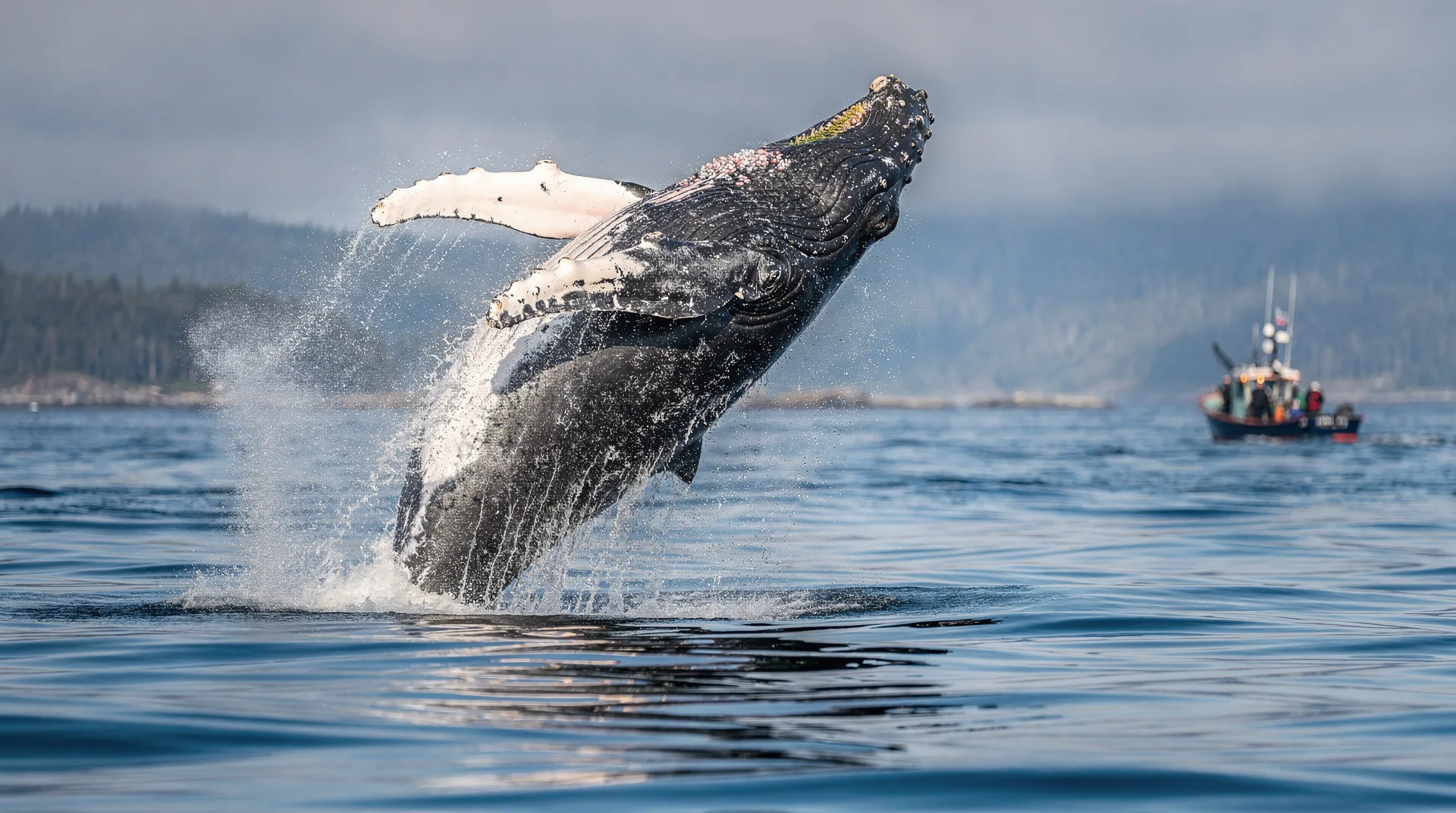
The showpiece species of any Bay of Fundy whale watching tour. Humpbacks are large (12-16 metres, 25-30 tonnes), acrobatic, and frequently engage in behaviours that make for memorable watching: breaching (launching much of their body clear of the water), lobtailing (slapping the tail repeatedly on the surface), and the bubble-net feeding behaviour in which groups of humpbacks cooperate to trap fish in a rising spiral of bubbles before lunging through the concentrated school at the surface.
Humpbacks are present in the Bay of Fundy from June through October, with peak numbers in July through September. They are reliably seen on most tours during these months.
Finback whales
The second-largest animal on earth, finbacks reach 25 metres in length and can be identified by their distinctive asymmetrical colouring (right jaw white, left jaw grey) and their exceptionally tall, straight dorsal fin. They are fast swimmers and less acrobatic than humpbacks but magnificent in their sheer scale.
Finbacks are year-round residents of the outer bay and are commonly seen on tours from Brier Island and Grand Manan throughout the summer.
Minke whales
The smallest of the baleen whales regularly seen in the bay, minkes are compact, fast, and often unpredictable — they have a tendency to approach boats out of apparent curiosity before disappearing without warning. They are the most commonly seen whale species in the bay and present from May through October.
North Atlantic right whales
The most critically endangered large whale in the world. Right whales were hunted to near-extinction by the 18th century (they were the “right” whale to hunt — slow, buoyant after death, and rich in oil). The current population of approximately 350 individuals is threatened by ship strikes and entanglement in fishing gear.
The Bay of Fundy, particularly the area around Grand Manan, is a critical summer feeding ground for right whales — one of only a handful of such areas known globally. Seeing one is an extraordinary and sobering experience. Tour operators who encounter right whales maintain strict distance requirements (450 metres in some regulatory frameworks) and may adjust routes to avoid approaching too closely.
Harbour porpoise and white-sided dolphins
Smaller cetaceans round out the bay’s wildlife. Harbour porpoise (the smallest cetacean in Atlantic Canadian waters) are common near shore, visible as brief surfacing movements in sheltered coves and tidal channels. Atlantic white-sided dolphins and white-beaked dolphins are seen occasionally, often in larger groups that move quickly through the frame.
Best time to go whale watching in the Bay of Fundy
June: The season is opening; humpbacks and finbacks are arriving. Excellent for those who prefer smaller crowds. Some operators not yet at full schedule.
July: Peak season begins. Humpback numbers are building; right whales are typically present in the Grand Manan area. Long daylight hours. Book ahead.
August: The best single month statistically. Maximum whale density, warmest sea conditions, all operators running full schedules. Very busy; accommodation in Digby and Grand Manan must be booked weeks ahead.
September: Excellent whales, thinning crowds, comfortable temperatures. One of the best months overall. Some operators begin reducing schedule in late September.
October: Late season; numbers declining but still productive. Some spectacular autumn weather creates dramatic seascape photography conditions.
Where to go: Nova Scotia side
Brier Island and Digby Neck
Brier Island, at the southern tip of the long peninsula south of Digby, is the closest Nova Scotia point to the productive outer bay feeding grounds. The journey to Brier Island is itself an experience: driving the length of Digby Neck (a narrow strip of land between St. Mary’s Bay and the Bay of Fundy) with two short ferry crossings (Tiverton to Long Island, and Freeport to Brier Island).
Brier Island Whale & Seabird Cruises has been operating from Westport for decades and has an excellent reputation for knowledgeable naturalist guides. The combination of whale watching with seabird observation (the outer bay hosts significant numbers of shearwaters, storm petrels, and gannets in summer) makes these tours particularly rewarding for wildlife enthusiasts.
Digby
The town of Digby is the largest community on Digby Neck and the arrival point for the Digby-Saint John ferry from New Brunswick. Several whale watching operators depart from Digby Harbour for the outer bay, though the journey to productive waters takes longer than from Brier Island. Digby has better accommodation options and dining than Brier Island.
Browse Nova Scotia tours and Bay of Fundy experiencesWhere to go: New Brunswick side
Grand Manan Island
Grand Manan, 28 km into the outer bay from Blacks Harbour (near St. Andrews), is one of the premier whale watching destinations in eastern North America. The island sits at the convergence of the cold, nutrient-rich Fundy waters with the warmer waters of the Gulf of Maine, creating a feeding zone that right whales, humpbacks, and finbacks return to every summer.
The ferry from Blacks Harbour takes about 90 minutes. Grand Manan Whale & Seabird Research Station operates tours that combine whale watching with genuine research observation — guests participate in photo-identification of individual whales, contributing to long-term population studies.
Grand Manan is also worth visiting for its own sake: a remote fishing island with excellent birding (it sits on a major migration corridor), dramatic coastal scenery, and smoked herring production that dates back centuries.
St. Andrews
The beautiful Victorian resort town of St. Andrews-by-the-Sea, on the New Brunswick shore near the Maine border, is the most accessible and tourist-friendly whale watching base on the New Brunswick side. Several operators run tours from the town wharf into the outer bay.
The waters around St. Andrews are productive but not quite as rich as the outer bay around Grand Manan and Brier Island. For those combining whale watching with the town’s historic architecture and excellent restaurants, St. Andrews is a very good choice.
Browse Bay of Fundy tours and Atlantic Canada wildlife experiencesBrier Island vs Grand Manan: which side to choose
| Brier Island (NS) | Grand Manan (NB) | |
|---|---|---|
| Access | Drive Digby Neck plus two short ferries | 90-minute ferry from Blacks Harbour |
| Character | Long-established operator, strong reputation | Research-based tours, scientific photo-ID |
| Best for | Straightforward, reliable tours from Nova Scotia | Right whale odds, educational depth |
| Combine with | Digby, Bay of Fundy loop itinerary | St. Andrews’ historic town, birding |
Neither side is objectively better — Brier Island suits travellers routing through Nova Scotia who want a dependable, well-run tour, while Grand Manan suits those prioritising right whale odds and a research angle, typically as part of a New Brunswick-focused loop.
Choosing a whale watching tour
Duration: Most tours run 3-4 hours. This is genuinely necessary — the transit to productive feeding grounds takes 30-60 minutes each way, and you want time with any whales encountered. Shorter tours (under 2 hours) tend to be less productive.
Vessel type: Rigid inflatable boats (zodiacs) get lower to the water and closer to the whales; they are exhilarating but cold and wet. Larger motor vessels offer protection from spray and wind; better for families and those prone to seasickness. Some operators offer both vessel types.
Naturalist presence: Tours with trained marine biologists or naturalists who interpret behaviour, identify individuals, and explain the ecosystem are worth the premium. The educational dimension significantly enriches the experience.
Guarantee policies: Many Bay of Fundy operators offer a “whale guarantee” — a free return trip if no whales are sighted. While the sighting rate is very high (typically 95%+ in peak season), this policy is worth checking.
Seasickness: The Bay of Fundy’s tidal mixing can make for choppy conditions even on calm days. Take appropriate precautions (ginger, acupressure bands, or prescription medication) if you are susceptible. Sit toward the stern and look at the horizon.
Combining whale watching with other Bay of Fundy experiences
Whale watching and the tidal experience are the twin draws of the Bay of Fundy. A well-planned visit combines both.
Hopewell Rocks, 40 km south of Moncton, provides the most dramatic tidal experience — walking among the Flowerpot rock formations on the ocean floor at low tide is extraordinary. See our Hopewell Rocks guide for timing and planning detail.
The 7-day Bay of Fundy loop itinerary builds a complete circuit incorporating whale watching from Brier Island or Grand Manan, the tidal experience at Hopewell Rocks, Fundy National Park, and the historic charm of St. Andrews.
Tidal bore rafting near Moncton is another distinctive Bay of Fundy activity — see our tidal bore rafting guide for the full experience.
Building a wider trip around the whales
A whale tour is easiest to enjoy when it is one part of a larger plan rather than the only reason for the journey. Our Bay of Fundy destination page gives the regional overview, and the individual bases are covered in more depth on the pages for Digby, Grand Manan Island and St. Andrews-by-the-Sea. Reading them before you book helps you decide which side of the bay suits your route and how much time each stop deserves.
If you want to spend a day on land between boat trips, Fundy National Park offers a quieter, forested counterpoint to the open water, and the Hopewell Rocks overview explains how the tides shape that stretch of coast. Weather on the Atlantic side can change plans at short notice, so the Atlantic Canada weather guide is worth a look when you choose your dates, and leaving a flexible day in the schedule makes a postponed departure far less stressful.
Whales are wild animals, and good behaviour around them matters on land as well as on the water. The wildlife safety guide sets out sensible habits for any encounter, and the packing list helps you assemble the warm, waterproof layers a boat trip calls for. If this trip makes you curious about other places to see whales, the Quebec whale watching guide and the overview of whale watching across Canada show how the experience differs elsewhere.
Practical information
What to wear: Temperatures on the water are typically 5-10°C cooler than on shore, even in August. Bring a warm waterproof layer regardless of conditions when you depart. Gloves are useful in June and September.
Binoculars: 8x or 10x binoculars dramatically improve the experience of watching distant surfacing and spouting. Most operators have some available for loan.
Photography: A telephoto lens of at least 200mm (effectively 300mm or more on an APS-C sensor) is needed for satisfying whale photographs. Continuous shooting mode and patience are the other requirements. The unpredictability of whale behaviour makes sustained photographic success genuinely challenging and rewarding.
Children: Most operators welcome children; check minimum age policies (some zodiac tours require a minimum age of 8-10). Children old enough to handle a 3-4 hour boat trip typically find whale watching among the most memorable experiences of any trip.
Car: A car is essential to reach Brier Island or Grand Manan ferry terminals. From Halifax, Digby is about 200 km (2.5 hours); from Moncton, the Grand Manan ferry is about 120 km (90 minutes).
Frequently asked questions about Whale watching Bay of Fundy: tours, species & best time
What is the success rate for whale sightings?
In peak season (July-September), virtually all tours at Brier Island and Grand Manan encounter whales. The operators have decades of knowledge and often communicate whale locations with each other. Early and late season rates are lower.
How close do the boats get to whales?
Canadian regulations require a minimum distance of 100 metres from whales; right whales require 450 metres. In practice, whales frequently approach boats voluntarily, reducing this distance on their own terms.
Can I see right whales?
Yes, but there is no guarantee on any given day. Grand Manan is the most reliable location. Operators will prioritise right whale encounters when they occur (at a respectful distance) given the species’ extreme rarity.
Is the Bay of Fundy better than other Atlantic Canada whale watching areas?
Different. The species diversity and the possibility of right whale encounters make the Bay of Fundy unique. For sheer numbers of humpbacks in a dramatic setting, the St. Lawrence (particularly Tadoussac) and the waters off Newfoundland are comparable or superior. See our complete Atlantic Canada whale watching guide for a full comparison.
Should I stay in Digby, Brier Island, St. Andrews, or Grand Manan?
It depends on your route. Digby has better accommodation and dining but a longer boat transit; Brier Island itself is quieter with fewer amenities but the shortest transit to productive waters. On the New Brunswick side, St. Andrews is the more comfortable, tourist-friendly base, while Grand Manan is more remote but offers the research-tour angle. Fold whichever fits into the 7-day Bay of Fundy loop itinerary for a complete circuit.