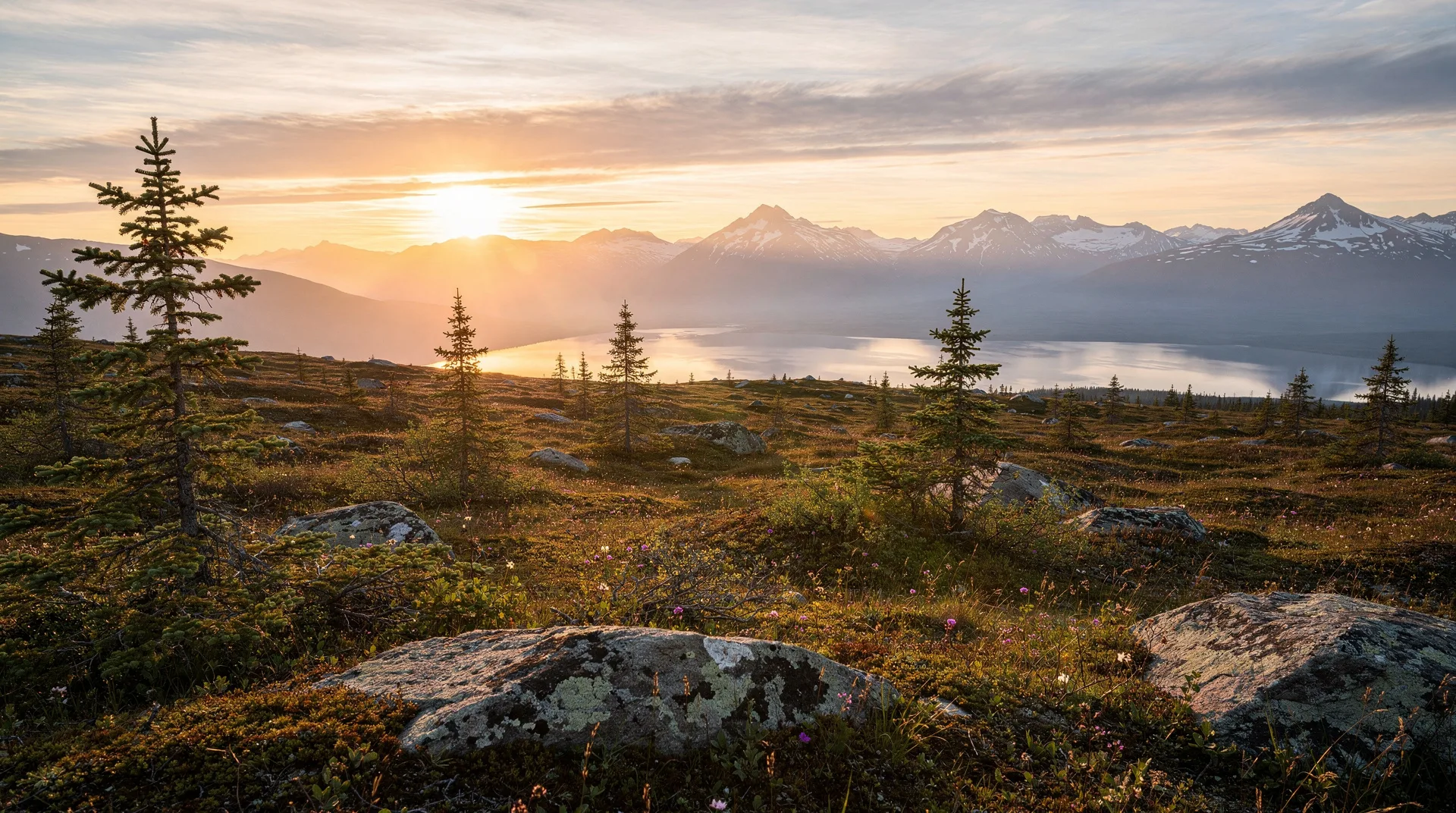
Midnight Sun in Canada: Where and When to See 24-Hour Daylight
Where can I see the midnight sun in Canada?
Inuvik (NWT) has full 24-hour daylight from May 24 to July 19. Dawson City (Yukon) experiences near-midnight sun around June 21. Iqaluit (Nunavut) has no true sunset from mid-May to late July. Whitehorse and Yellowknife see extended twilight but brief technical sunsets.
The midnight sun — the period of continuous daylight when the sun does not set at all — is one of the defining experiences of summer in northern Canada. Above the Arctic Circle, the phenomenon is complete: for weeks around the summer solstice, the sun remains above the horizon 24 hours a day. At slightly lower latitudes, the sun dips below the horizon only briefly; twilight extends through the “night,” and true darkness never arrives. Either way, the experience is deeply disorienting to southern visitors and one of the most memorable aspects of a northern summer trip.
This guide covers where in Canada the midnight sun is visible, when to travel for the full experience, how to manage sleep in continuous daylight, and what to do with the extra hours.
| Where | Above the Arctic Circle for the full effect (Inuvik, Tuktoyaktuk, Old Crow); Dawson City, Whitehorse, Yellowknife and Churchill for near-midnight-sun twilight |
| Cost | No entry fee for the phenomenon itself; northern flights and accommodation run well above southern Canada prices in summer |
| Time needed | 4-7 days minimum to feel the effect and adjust sleep; a week or more if combining with the Dempster Highway |
| Getting there | Scheduled flights to Inuvik/Whitehorse/Yellowknife via Edmonton or Ottawa; the Dempster Highway from Dawson City for a road-trip approach |
| Best time | Around June 21 (solstice) for the peak; late May to late July for the broader window |
The science in brief
The Arctic Circle (66°33’ North) marks the southern limit of continuous 24-hour daylight at the summer solstice (June 21) and 24-hour darkness at the winter solstice (December 21). North of the circle, the sun does not set on the solstice. The further north you go, the longer the period of continuous daylight — from 24 hours at the circle to a full six months at the North Pole.
Canada extends well beyond the Arctic Circle. The territory above 66°33’ North includes:
- Northern Yukon (Old Crow, Ivvavik National Park area)
- Northern Northwest Territories (Inuvik, Tuktoyaktuk, Sachs Harbour)
- Most of Nunavut
South of the circle, technical sunset still occurs, but the effect of low sun angle means twilight can persist through the “night” — the sun dips briefly below the horizon but the sky remains bright enough that the distinction between day and night becomes subjective. This “civil twilight” condition characterises the subarctic — Yellowknife, Whitehorse, Dawson City, and Churchill all experience this at the solstice.
Where to see it
Full 24-hour sun (above Arctic Circle)
Inuvik, Northwest Territories (68°21’ N). The most accessible town above the Arctic Circle. Continuous daylight from May 24 to July 19 (56 days). Road access via the Dempster Highway; scheduled flights from Yellowknife and Edmonton. Inuvik has tourist infrastructure and midnight-sun programming including the Midnight Sun Music Festival in late July.
Tuktoyaktuk, Northwest Territories (69°26’ N). On the Arctic Ocean coast. Continuous daylight from May 18 to July 25 (68 days). Accessible via the year-round Inuvik-Tuktoyaktuk Highway. More remote than Inuvik with basic services.
Iqaluit, Nunavut (63°45’ N). Just below the Arctic Circle, but the sun remains above the horizon (with brief civil twilight) from mid-May to late July. Nunavut’s capital with scheduled flights from Ottawa and Montreal. Different from Yukon midnight sun because the Baffin Island light and landscape is distinct.
Sachs Harbour and Grise Fiord, Nunavut (71°+N). Remote High Arctic communities with genuinely extended full-sun periods. Reached only by scheduled flight. For travellers seeking the most extreme midnight-sun experience.
Old Crow, Yukon (67°34’ N). The northernmost community in Yukon. Fly-in only. Small population, rarely visited by tourists.
Near-midnight sun (subarctic)
Dawson City, Yukon (64°04’ N). Sun technically sets around midnight on June 21, rising again around 3am. True darkness never occurs from late May to late July. Dawson’s Midnight Dome gives an elevated view that extends the visible sun.
Whitehorse, Yukon (60°43’ N). Twilight throughout summer nights. On June 21, around 4 hours of genuine twilight; no true darkness. Easy to reach and culturally rich.
Yellowknife, Northwest Territories (62°27’ N). Similar pattern — no true darkness from late May to late July. Great Slave Lake at sunset and sunrise (merging into each other) is exceptional.
Churchill, Manitoba (58°46’ N). Not true midnight sun, but very extended twilight. On June 21, darkness is limited to 2–3 hours; the rest of the night is bright civil twilight.
When to go
May 21 to June 21. Approach to peak. Daylight extends rapidly. Bugs are just beginning to emerge.
Around June 21 (solstice). Peak midnight sun. For communities above the Arctic Circle, the sun is continuously above the horizon. Cultural events — solstice gatherings, festivals — draw visitors.
Late June to mid-July. Post-solstice. Full midnight sun persists above the Arctic Circle. Bugs reach peak. Vegetation is green and active. Wildlife activity at its summer peak.
Late July. Sun begins setting again at the Arctic Circle. Duration of continuous daylight shortens.
August. Normal night returns everywhere. By late August, darkness and aurora viewing return even to Arctic communities.
Activities for the midnight sun
Continuous daylight transforms the possibilities of a day. Trip patterns shift toward late-evening and overnight activities.
Hiking at midnight
The most compelling midnight-sun experience. Hikes that would be impossible in darkness become routine. In Dawson City, the Midnight Dome; in Whitehorse, Miles Canyon; in Inuvik, the Gwich’in Territorial Park trails — all accessible in what feels like late afternoon light throughout the night.
Golf under the midnight sun
Multiple northern communities offer midnight-sun golf events. Dawson City’s Top of the World Golf Course runs tournaments that start at 10pm; Yellowknife’s golf club runs similar events.
Fishing
Northern fishing is often best in the “evening” — which in midnight-sun conditions means all night. Extended fishing sessions are common on the solstice.
River and lake activities
Paddling, boating, canoeing all continue through the night at midnight-sun latitudes. Many commercial operators offer evening or overnight trips timed to avoid the midday heat (which is often more significant than the midnight cool). You can compare guided tours across Canada to find evening departures.
Festivals
Midnight-sun-timed festivals include:
- Midnight Sun Music Festival (Inuvik) — late July
- Dawson City Music Festival — mid-July
- Yukon’s Dawson City Arts Festival — timed around solstice
- Tuktoyaktuk Country Music Festival — July
Northern community time
Communities above the Arctic Circle adjust summer schedules around the midnight sun. Stores may remain open later; meals shift later; social life extends into “night” hours. Visitors can observe or participate.
Managing sleep
The most common complication for southern visitors experiencing the midnight sun: sleep disruption. The physical absence of darkness disrupts the normal circadian cues for sleep.
Practical sleep strategies
Blackout conditions. Most northern hotels have genuine blackout curtains. Confirm before booking if sleep reliability matters to you. Bring an eye mask as backup.
Melatonin supplementation. Some travellers find that 0.5–3mg of melatonin taken at normal bedtime helps. Consult your physician before trying.
Consistent schedule. Maintain normal bed/wake times despite the temptation to stay up late. Your body adjusts faster if the schedule remains consistent.
Limit caffeine. In 24-hour daylight, caffeine disrupts sleep more than usual. Avoid it in the last 6 hours before your intended bedtime.
Physical activity during the day. Active outdoor time during traditional daylight hours supports sleep quality later.
Accept disrupted sleep. For a 1–2 week trip, some disruption is tolerable. Southern travellers rarely fully adjust to 24-hour light in less than a week; don’t set unrealistic expectations.
What locals do
Residents of midnight-sun communities have lived with the phenomenon for lifetimes. Most use blackout curtains year-round, maintain disciplined sleep schedules despite external cues, and accept that disrupted sleep is part of summer. The cultural response is pragmatic rather than fighting the condition.
Combining with other activities
The midnight sun in Canada usually combines with other summer Arctic experiences.
Inuvik base: Drive the Dempster Highway to Tuktoyaktuk; fly to Ivvavik National Park; experience Gwich’in and Inuvialuit cultural programming.
Dawson City base: Add gold rush history, Tombstone Territorial Park, and the Klondike landscape.
Yellowknife base: Combine midnight sun with the NWT’s lake-and-boreal landscape, float plane trips, and Indigenous cultural centres.
Iqaluit base: Nunavut summer experience — Inuit art, Auyuittuq National Park, Baffin Island adventures.
Practical trip considerations
Weather. Northern summers are short but often warm. Temperatures in June and July routinely reach 20°C in the central north (Yellowknife, Dawson, Whitehorse); Arctic communities stay cooler (10–18°C typical).
Bugs. Significant. Mosquitoes and blackflies are serious throughout the midnight-sun zone. Head nets, DEET repellent, and insect-resistant clothing are essential.
Cost. Summer is peak tourist season in northern Canada. Accommodation, flights, and activities cost more than shoulder periods. Book early, and reserve Canada tours and activities ahead of the solstice rush.
Flights. Direct flights to northern communities are limited. Plan for connections through Yellowknife, Whitehorse, or Edmonton. Weather delays occur.
Daylight disorientation. Allow yourself time to adjust. The first 48 hours in a midnight-sun location are the hardest.
Packing and gear for midnight-sun travel
A midnight-sun trip has a few packing quirks that first-timers underestimate. A proper sleep mask or the confirmation of blackout curtains at your accommodation matters more than almost anything else on the list — see the sleep section above. A wide-brimmed hat and sunglasses remain useful at any hour, since the sun stays high enough in the “afternoon” hours to be genuinely bright even at 10pm or 11pm.
Layers matter: northern summer days can swing from 20°C at midday to single digits overnight, especially at higher latitudes like Iqaluit or Tuktoyaktuk. A good bug net and DEET-based repellent are non-negotiable — described in more detail below, but worth packing before you leave rather than sourcing locally, since small-community stores have limited stock.
Costs and logistics
Northern Canada in summer is not a budget destination. Flights to Inuvik, Whitehorse, or Yellowknife typically route through Edmonton or Ottawa and cost considerably more per kilometre than flights in southern Canada. Accommodation in Yukon and NWT hub towns during peak solstice weeks (mid-June to mid-July) should be booked well in advance — rooms sell out around festival dates. Car rental in Whitehorse or Inuvik is the most flexible way to explore the Dempster Highway, but rates run higher than in the south and one-way drop-off fees can be steep. Budgeting more than a standard Canadian road trip is realistic; treat the north as its own trip category rather than an add-on to a Rockies itinerary.
Related reading
- Midnight sun Yukon
- Inuvik
- Tuktoyaktuk
- Dawson City midnight dome
- Dempster Highway
- Canada in June
- Canada in July
- Aurora best time in the north
- Yellowknife
Frequently asked questions about Midnight Sun in Canada
Do I need special gear to visit during the midnight sun? No special gear beyond standard northern summer packing: layers, insect protection, and a sleep mask or confirmed blackout curtains. A sun hat and sunglasses are useful even late in the “evening,” since light stays bright well past normal sunset hours.
Can I see both the midnight sun and the northern lights on the same trip? Not really — aurora requires genuine darkness, which is exactly what the midnight sun eliminates. Visit in June-July for midnight sun, or shift to late August through April for aurora viewing at the same northern latitudes.
The midnight sun in Canada is a genuinely distinct travel experience — simultaneously exciting and disorienting, culturally different, and visually unique. For travellers who pair it with compelling day activities and manage sleep thoughtfully, a week in the Canadian north around the solstice is one of the most memorable experiences the country offers.