Midnight Sun Yukon: Where, When & What to Do
When does the midnight sun occur in Yukon?
In Whitehorse (60.7°N), civil twilight never fully ends from approximately June 5 to July 7. In Dawson City (64°N), the sun does not set from June 17 to June 25. Further north on the Dempster Highway, above the Arctic Circle, the sun stays above the horizon from late May to mid-July.
The midnight sun is one of the most disorienting and beautiful phenomena available in the Canadian North. Above 60° latitude, summer days extend to the point where the sun barely dips toward the horizon before climbing again — and north of the Arctic Circle, it doesn’t dip at all. The result is a weeks-long period of uninterrupted daylight that reorganises your relationship with time, sleep, and what activities belong to which part of the day.
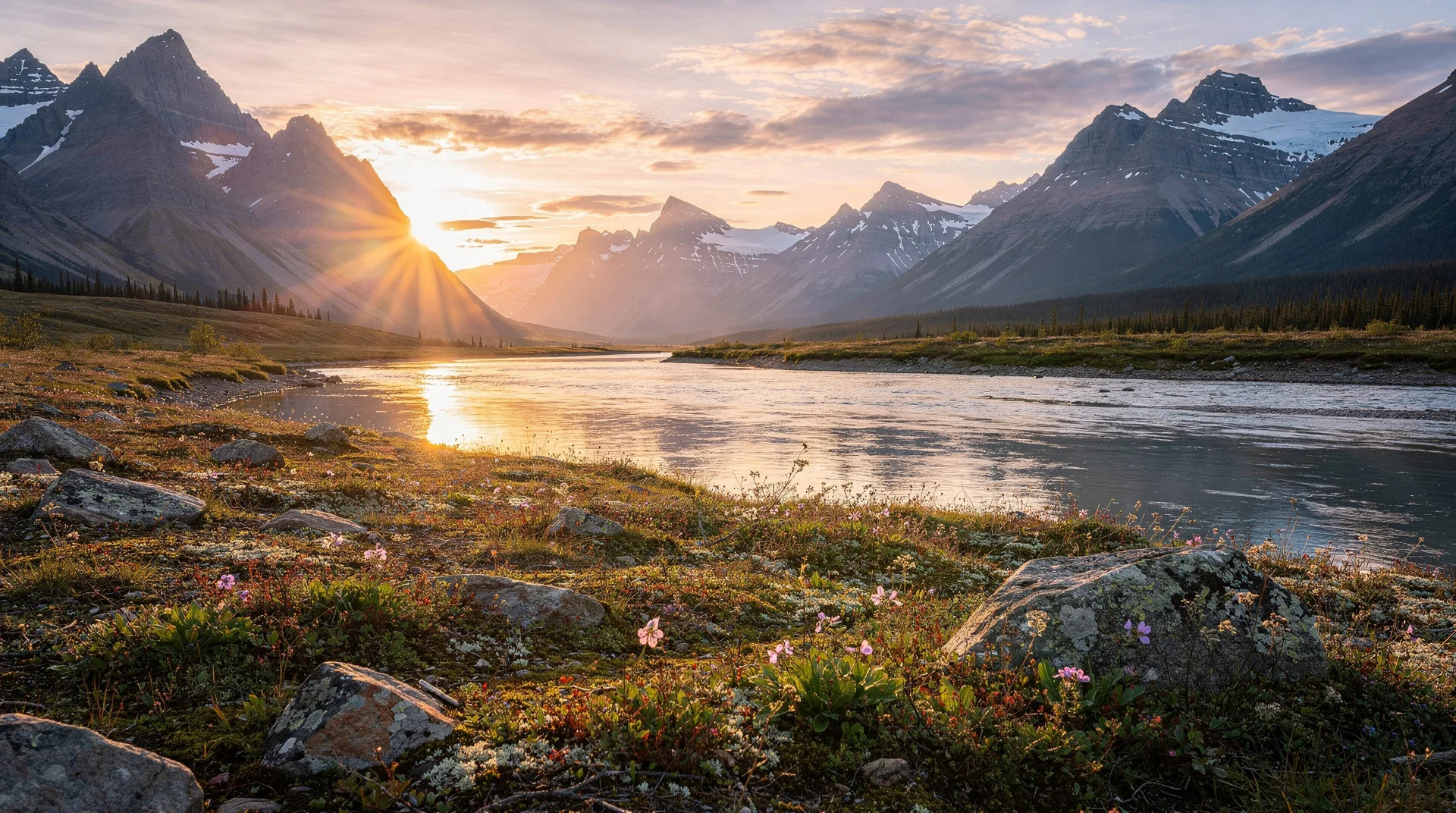
The Yukon experiences the midnight sun from late May through mid-July depending on latitude, and the effect is qualitatively different from anything achievable at southern latitudes. Not just long days, but genuinely circular sun — tracing a low ellipse above the horizon at midnight, casting a warm, golden, low-angled light that photographers find irresistible and newcomers find profoundly strange.
| Where | Whitehorse, Dawson City, and the Dempster Highway up to and beyond the Arctic Circle |
| Cost | Free to experience; northern accommodation and car rental cost more than southern Canada in summer |
| Time needed | 4-6 days to feel the effect properly; add 2-3 days for a Dempster Highway extension |
| Getting there | Fly into Whitehorse (main gateway), drive north to Dawson City (roughly 6 hours) and beyond on the Dempster |
| Best time | Mid-May through mid-July, peaking around the June 21 solstice |
When the midnight sun happens in the Yukon
The midnight sun is a function of latitude — the further north you are, the longer the midnight sun period.
Whitehorse (60.7° North): Civil twilight (bright enough to read without artificial light) persists through the entire night from approximately May 25 to July 17. The sun itself sets briefly — dipping below the horizon for a short period around midnight — but the sky remains bright. True darkness does not occur. Locals and experienced travellers use blackout curtains; first-timers attempt to sleep in daylight rooms and generally fail.
Dawson City (64.1° North): The sun does not set from approximately June 17 to June 25 — a week of genuine midnight sun where the solar disc remains visible above the horizon at midnight. In the weeks on either side of this, the sun dips below the horizon for only minutes before climbing again.
Arctic Circle on the Dempster Highway (66.5° North): The theoretical boundary at which the sun stays above the horizon for the full summer solstice. In practice, the midnight sun period extends from approximately May 25 to July 18 at this latitude. Standing at the Arctic Circle sign on the Dempster at midnight on June 21 and watching the sun sitting on the northern horizon is one of the quintessential Canadian North experiences.
Inuvik (68.3° North): The sun does not set from approximately May 24 to July 18 — nearly two months of continuous daylight. The midnight-sun golf games, the walking at 2 AM, and the general temporal disorientation are most intense here.
What the midnight sun feels like
The first day in Yukon summer is confusing rather than dramatic. The light at 11 PM looks like late afternoon. The light at midnight looks like early evening. The light at 2 AM looks like what you expect 6 AM to look like. Your internal clock — built around the rhythm of dark nights — loses its primary reference points.
By the third or fourth day, most visitors have accepted the strangeness and begun to work with it. Activities that would normally require daylight planning become possible at any hour. Dinner at 9 PM followed by a 4-hour evening hike is entirely feasible. Kayaking on the Yukon River at midnight is lit well enough to photograph without a headlamp. A round of golf at 11:30 PM is not only possible but routine at Whitehorse’s municipal course.
The specific quality of midnight sun light is different from daytime sun. The sun is very low on the northern horizon at midnight — perhaps 3–8° above the horizon depending on your latitude and the date. At this angle, the light travels through the maximum thickness of atmosphere, warming its colour temperature to rich golden tones. Shadows are extremely long and horizontal. Surfaces that face north — normally shaded — are lit directly.
For photographers, this is extraordinarily good light that simply lasts much longer than the golden hour at any other time of year. The challenge is choosing when to shoot.
Midnight sun activities in Whitehorse
Midnight sun hiking
Whitehorse’s trail network becomes a 24-hour recreation zone in summer. Popular hikes include:
Grey Mountain: A 13-kilometre return hike climbing 550 metres above the city. At midnight in June, the view from the ridge encompasses the Yukon River valley lit by low golden sun, the city below, and mountains to the horizon in all directions. The trail is completely hikeable at midnight — carry water and a windproof layer, as the ridge can be cool regardless of time of day.
Millennium Trail: The riverside trail along the Yukon River in Whitehorse is entirely accessible at any hour. A midnight walk along the river, with the sun low on the northern horizon reflecting off the water, is one of Whitehorse’s best free experiences.
Miles Canyon: The 3.5-kilometre canyon trail south of downtown is a popular evening walk that extends easily into the midnight hours. The basalt gorge walls and the Yukon River below take on a specific quality in midnight sun light that daytime visits don’t replicate.
Kayaking and paddling
The Yukon River is paddleable at midnight in summer — and many people do. Canoe and kayak rental in Whitehorse can be arranged for evening and overnight paddles on the river. The experience of floating downstream on a calm Yukon night with continuous light, no engine noise, and the possibility of seeing moose or beavers is specific to this latitude and this season.
Midnight golf
The Meadow Lakes Golf Course outside Whitehorse offers tee times through the midnight hours in June and early July. This is not a novelty act — people are genuinely playing golf at midnight, by natural light, in one of the more surreal uses of the northern summer. Visitor green fees apply; rental clubs are available.
Browse Yukon summer adventures and midnight sun experiences from WhitehorseMidnight sun at the Dempster Highway
The drive up the Dempster Highway during the midnight sun period is one of the great Canadian road experiences. The highway is open for summer driving; the combination of the open tundra landscape, the mountain terrain of the Ogilvie and Richardson ranges, and the midnight sun hanging on the northern horizon produces a visual environment of sustained beauty.
Tombstone Territorial Park at midnight: At km 71 of the Dempster, Tombstone Mountain is lit from the north at midnight — the low angle of light on the black quartzite peaks is particularly dramatic in this direction. Wildlife is often more active in the cooler late-night hours; grizzly bear sightings at the interpretive centre at 10 PM–1 AM are not uncommon in summer.
Arctic Circle at midnight: The Arctic Circle marker on the Dempster, approximately km 405 from the highway junction, is the standard stopping point for travellers who want to be north of the Arctic Circle at the moment of midnight. In mid-June, the sun is a few degrees above the horizon at this latitude even at the technical midnight — staying up here to watch the sun continue across the horizon is a worthwhile commitment.
Dawson City and the summer solstice
Dawson City celebrates the summer solstice with an event that has been running for over 120 years: the Midnight Dome ceremony, where locals and visitors climb the hill north of the city in the middle of the night to watch the sun — barely setting, barely rising — roll along the northern horizon. The Dome is 884 metres; the climb takes about 45 minutes from town; and the view of the Yukon River confluence, the Klondike River valley, and the mountains to the north with low midnight sun on all of it is one of the most atmospheric experiences in the northern territories.
Dawson City’s Discovery Days festival in mid-August celebrates the Klondike gold rush discovery, and while the midnight sun has waned by August, the festival brings together music, First Nations cultural events, and gold rush heritage activities that make it a distinct summer reason to visit.
Practical challenges of the midnight sun
Sleep: The most common complaint from first-time midnight sun visitors. Blackout curtains or a good sleep mask are the minimum requirement. Melatonin supplements help regulate the sleep cycle; earplugs may also be useful as outdoor activity continues through the night. Most Yukon hotels in the summer tourist areas provide blackout curtains; ask specifically if it matters.
Timing activities: Without dark as a reference, meal times drift. Restaurants in Whitehorse and Dawson stay open late in summer. Tours and activities are scheduled in the evening hours that take advantage of the midnight sun photography opportunities.
Photography scheduling: The golden hours — sunrise and sunset — overlap with midnight in June. Scheduling photography for 10 PM to 2 AM gets the best light conditions. The rest of the “day” has bright overhead sun that washes out shadows and reduces landscape drama.
Where to base yourself
Most visitors split time between Whitehorse and Dawson City, since the two give genuinely different versions of the phenomenon. Whitehorse works well as a first stop — it has the territory’s main airport, the widest range of accommodation and restaurants, and an easy set of midnight-accessible trails right in town.
Dawson City rewards travellers who make the drive north (roughly 6 hours on the Klondike Highway) with the most concentrated midnight-sun experience in the territory during the week either side of the solstice, plus gold rush heritage sites. Travellers with more time can push on to the Dempster Highway and the Arctic Circle marker for the most extreme version of the light. See the Yukon destination guide for a fuller regional overview before building an itinerary.
The transition out of midnight sun
By late July, the nights begin to return to the Yukon. First a deep twilight at midnight, then genuine darkness, then — by late August — the possibility of aurora viewing as the skies grow dark enough. September is when the territory’s two great light phenomena coexist in possibility: the midnight sun is gone but not long gone, and the aurora has returned in the lengthening nights.
Book Whitehorse midnight sun and summer wilderness experiencesRelated content
For summer activities in specific Yukon destinations, see things to do in Whitehorse, Dawson City gold rush history, and the Dempster Highway guide. The Yukon 7-day itinerary covers a summer circuit timed to experience the midnight sun across multiple destinations. For the winter counterpart, the Whitehorse aurora viewing guide covers the dark season’s main attraction. For broader northern context, see our guide to the midnight sun across Canada and aurora best time in the north.
Frequently asked questions about Midnight Sun Yukon: Where, When & What to Do
Can I sleep during the midnight sun? Yes — but it requires preparation. Blackout curtains or a good sleep mask are essential. Earplugs help if outdoor activity near your accommodation continues through the night. Melatonin can assist sleep-cycle regulation. Most people adapt within 3–5 days; the first few nights are the most difficult.
What is the best place to experience the midnight sun in the Yukon? Dawson City during the summer solstice week (June 17–25) offers the most dramatic midnight sun experience — the sun does not set at all for this period, and the Midnight Dome celebration provides a communal experience of the phenomenon. Whitehorse is more accessible with more services but slightly less extreme.
Does the midnight sun affect wildlife? Wildlife in the Yukon is adapted to the midnight sun cycle — they don’t sleep at conventional night hours in summer. Grizzly bears feed around the clock in good berry seasons; moose are seen at all hours; and bird activity is continuous rather than concentrated in dawn and dusk. This makes summer wildlife watching in the Yukon fundamentally different from temperate wildlife watching — you can see animals at any hour.
Is the midnight sun visible across all of Yukon? The midnight sun effect is strongest north of 65° latitude (Dawson City and above), where the sun genuinely stays above the horizon for days. South of 62° latitude (most of southern Yukon below Whitehorse), nights remain briefly dark even at the solstice peak. The Dempster Highway provides a driving route from the midnight-twilight zone of Whitehorse to the genuine midnight sun of the Arctic Circle.
Is the Yukon midnight sun the same as in Nunavut or the Northwest Territories? No — the underlying phenomenon is identical, but the Yukon’s main hubs sit further south than Inuvik or Iqaluit, so the effect is generally near-midnight-sun twilight rather than full 24-hour sun, except on the Dempster Highway approaching and crossing the Arctic Circle. See our midnight sun across Canada guide for a full latitude-by-latitude comparison.