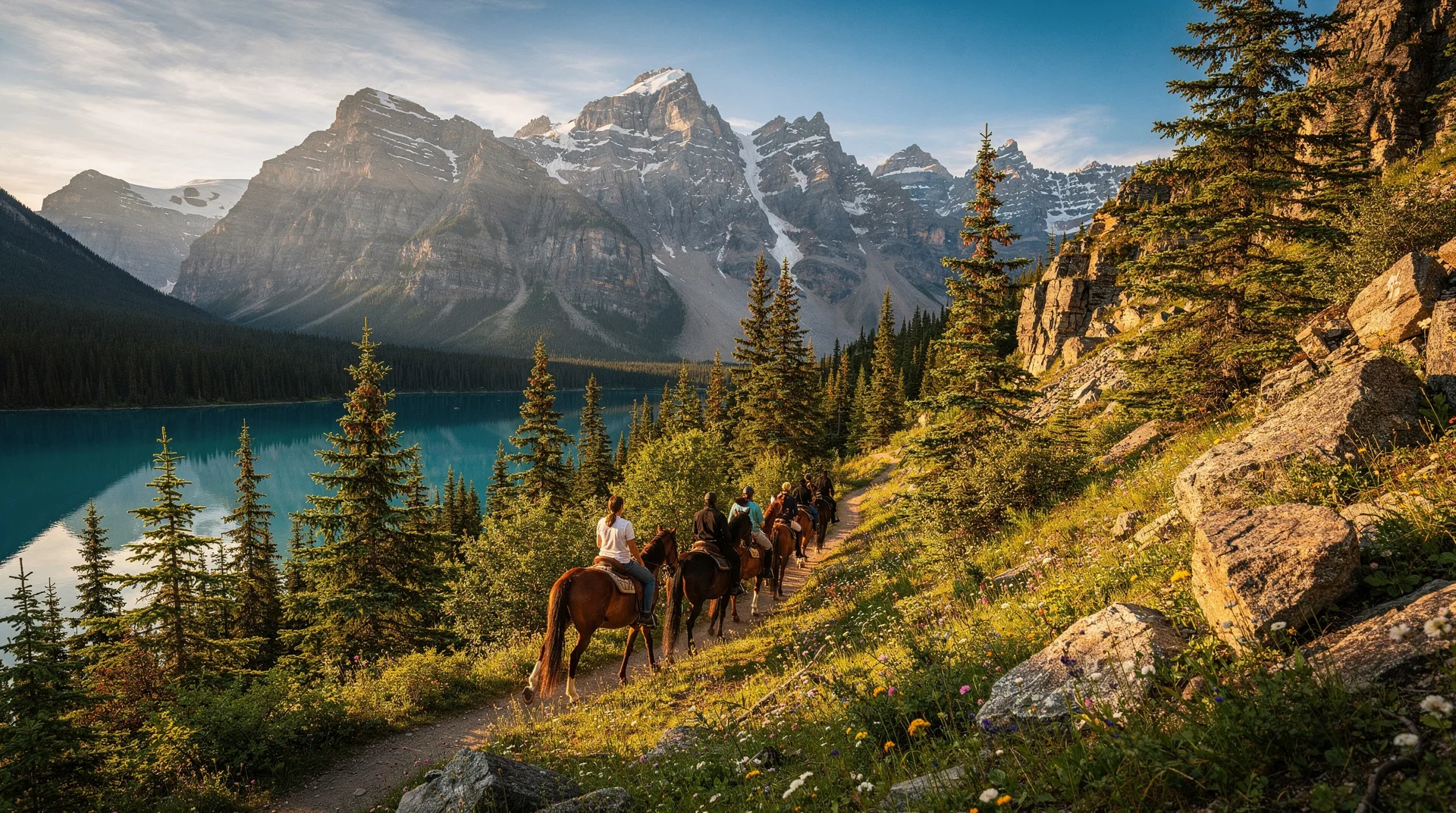
Horseback Riding in Banff National Park
Can you horseback ride in Banff National Park?
Yes. Banff has a long outfitting tradition. Operators offer trail rides from 1 hour to multi-day backcountry pack trips. Popular options include 3-hour rides to Sundance Canyon, full-day rides to Healy Meadows, and overnight pack trips to Halfway Lodge. Suitable for beginners through experienced riders.
Horseback riding in Banff National Park predates the park itself. Long before Banff became Canada’s first national park in 1885, Stoney Nakoda people traversed the Bow Valley on horseback, and early European outfitters pioneered the trails that are still used by guided riding parties today. The tradition is preserved and accessible: modern visitors can saddle up for anything from a one-hour introduction to a multi-day backcountry pack trip into the high country.
For visitors who want a genuine connection to the Rockies landscape at a slower pace than hiking or driving — and who enjoy the particular pleasure of travelling by horse through mountain terrain — Banff offers some of the finest trail riding in North America. Several established outfitters operate under Parks Canada licensing, ensuring trail and horse standards remain high.
| At a glance | |
|---|---|
| Where | Trailheads near Banff townsite, the Spray River, and the Fairmont Banff Springs |
| Cost | Around CAD $70-90 for 1 hour up to CAD $1500-3000+ for multi-day pack trips |
| Time needed | From 1 hour up to 3-6 days for backcountry lodge trips |
| Getting there | Stables reachable by car or on foot from Banff town; some require a short drive |
| Best time | June through September, when high-country trails are clear of snow |
The main trail riding operators
Banff Trail Riders
The most established operator in Banff, with stables directly accessible from Banff town. They run rides of varying lengths from the Warner Stables near the Spray River and the Martin Stables near the Fairmont Banff Springs. Routes include Spray River trails, Sundance Canyon, Sulphur Mountain lower slopes, and Bow Valley routes.
Offerings include:
- 1-hour introductory rides
- 2-hour rides to Stanley Falls and other nearby destinations
- Half-day rides (3-4 hours) to Sundance Canyon or along the Spray River
- Full-day rides to Healy Meadows or Spray River Lodge
- Multi-day pack trips to Halfway Lodge or Sundance Lodge
Brewster Adventures
Part of Pursuit (the same company that operates the Banff Gondola, Columbia Icefield, and Lake Minnewanka Cruise). Offers rides near Cascade Ponds, the Bow Valley, and backcountry operations.
Yamnuska Wilderness Adventures (Kananaskis)
For visitors considering Kananaskis instead of Banff proper, Yamnuska operates backcountry pack trips in the K-Country wilderness.
What to expect on a trail ride
The horses
Outfitters use a mix of quarter horses, appaloosas, and some draft-type horses suited to trail work. Horses are matched to riders based on experience — beginners get calm, trail-seasoned animals; more experienced riders can request horses with more spirit.
Most trail horses have years of experience on the specific routes they work. They know the trail, handle stream crossings and other obstacles calmly, and follow in single file.
The pace
Trail rides are primarily at a walk. Trotting and cantering may be included for experienced riders on suitable terrain, but most rides (particularly introductory tours) remain at a walk throughout. The pace allows conversation, photography, and relaxed observation of the surroundings.
The guide
A trained wrangler/guide rides at the front (and typically a second wrangler at the back on larger groups). Guides are experienced horsepeople with knowledge of the area’s history, flora, fauna, and often personal stories of the trails and horses they know.
Group dynamics
Most trail rides run 4-12 riders. Everyone rides in a line behind the lead wrangler. Spacing is maintained consistently (horses can be protective of personal space), and riders are briefed on basic handling before departure.
Ride options by duration
1-hour rides (around CAD $70-90)
The shortest options suit riders who want to try horseback riding without committing to half a day. Typically cover 3-5 km of easy trail close to the stable. Good for families with young children and absolute beginners.
2-hour rides (around CAD $120-150)
Most popular format. Cover 6-10 km on more interesting trails with better views. Include a mid-ride rest stop. Good balance of commitment and experience.
Half-day rides (3-4 hours, around CAD $180-230)
Genuinely substantial rides. Typically cover 12-20 km with lunch included. Reach more remote or scenic trail segments. Require some baseline riding comfort (though absolute beginners can manage with adequate briefing).
Full-day rides (6-8 hours, around CAD $300-400)
Serious trail rides, often to backcountry destinations like Healy Meadows, Sundance Lodge, or other historic camps. Include hot lunch, extensive backcountry exposure, and covering 25-30+ km.
Multi-day pack trips (CAD $1500-3000+)
The classic Banff outfitting experience. 3-6 day trips into the backcountry with overnight stays at historic backcountry lodges. Covered wagon-style pack horses carry gear; riders focus on riding. Includes all meals, accommodation, and guide service. Book months ahead for summer dates. If you would rather compare shorter options first, browse guided tours in Banff before committing to a long trip.
Popular trail destinations
Sundance Canyon (half-day)
A popular half-day ride following the Bow River corridor to a small canyon southwest of Banff town. Rides typically combine with a brief walk into the canyon. Good wildlife habitat, reasonably gentle terrain, suitable for most skill levels.
Spray River (various lengths)
Rides along the Spray River Valley follow old fire roads and trails through conifer forest. Easier riding with continuous mountain backdrops. Options from 1 hour to full day.
Healy Meadows (full-day)
A serious full-day objective to the subalpine meadows near Healy Pass. The meadows are spectacular in wildflower season (mid-July to August) and support grizzly bears and other wildlife. Requires reasonable riding fitness.
Sundance Lodge (overnight pack trip)
A historic backcountry lodge accessed by a half-day ride from Banff. Popular 2-day, 1-night pack trip format. Rustic accommodation, cooked meals, and the genuine feeling of a historic mountain outfitting camp.
Halfway Lodge (overnight pack trip)
More remote than Sundance Lodge, accessed via a longer ride. Ideal for visitors wanting a more immersive backcountry experience without hiking-and-camping self-sufficiency.
Season and weather
Peak season: May through October. Trail conditions depend on snow melt in high-country rides; low-country rides typically operate earlier and later.
Spring (May-June): Some trails still muddy from snowmelt. Lower routes and shorter rides are best. Cool weather; dress in layers.
Summer (July-August): All trails operating. Afternoon thunderstorms possible; morning rides often better. Mid-day can be warm; sun protection essential.
Fall (September-October): Excellent conditions. Cool, dry weather. Fall colour visible on slopes. Wildlife active before winter.
Winter: Most summer trail operations close in winter. A few operators run limited winter trail rides; dress extremely warmly.
What to wear and bring
Footwear. Boots with a small heel (to prevent the foot slipping through the stirrup). Hiking boots work for most visitors; dedicated riding boots aren’t necessary for guided rides. Sneakers are not appropriate.
Pants. Long pants are required. Jeans, cargo pants, or riding breeches all work. Avoid shorts.
Upper body. Layered clothing. A t-shirt, long-sleeved shirt, and light jacket handle most conditions. Waterproof outer shell for possibly rainy weather.
Helmet. Most operators provide helmets; wearing is strongly recommended regardless of operator policy. Some operators require it for all riders.
Water. Water bottles for longer rides. Operators typically provide water at rest stops on full-day rides.
Sun protection. Sun hat compatible with helmet, sunglasses, sunscreen. UV at elevation is intense.
Camera. Most riders use phone cameras from horseback. A wrist strap or neck strap helps prevent drops.
Is riding suitable for beginners?
Yes — the vast majority of trail riding operators cater heavily to beginners. Briefings cover mounting, basic control (stop, go, turn), and safety. The horses are trained to follow in line without much input from the rider.
Realistic expectations for first-time riders:
- Mounting a horse the first time is awkward but not dangerous
- The first 20-30 minutes on a horse feels unfamiliar
- Saddle soreness after 2-3+ hours is normal and resolves quickly
- You do not need riding skills to enjoy a guided trail ride
Riders who should skip:
- Those with significant back or hip problems
- Visitors with severe anxiety around large animals
- Children under 6 (most operators have minimum age requirements; check when booking)
For experienced riders
Visitors with riding experience can request horses with more spirit or responsiveness. Some operators offer advanced rides with more trotting and cantering, scrambling on technical terrain, or destinations that require a more engaged rider. Communicate your experience when booking.
Ranch stays and lesson weeks (multi-day properties offering intensive riding experiences) exist outside the national park boundary, particularly in the Kananaskis and Cochrane areas.
Safety and responsibility
Trail riding in Banff has an excellent safety record but genuine risks exist. Horses can spook at wildlife (particularly bears), falls are possible on steep or uneven trails, and cold or wet weather can be uncomfortable. Follow your guide’s instructions, wear a helmet, and be honest about your experience level.
Insurance policies often exclude trail riding accidents; confirm coverage if this matters to you.
How horseback riding compares to other Banff pace-of-travel options
Riding is slower than driving and generally slower than hiking on the same terrain, but it covers more ground than walking while demanding less physical effort — a good fit for mixed-ability groups or travellers wanting a change of pace mid-trip. Compared with a Banff Gondola day, which delivers a quick summit view, a half-day trail ride is a slower, more immersive way to experience the valley floor and lower forest terrain rather than the alpine zone.
For travellers deciding between Banff and neighbouring areas for their outdoor time, see the Banff vs Canmore and Banff vs Kananaskis comparisons — both areas have their own outfitters, and Kananaskis in particular is a strong alternative for visitors who find Banff’s peak-season trails crowded.
Combining riding with other activities
Trail riding pairs well with other Banff experiences in a multi-day plan:
- Ride + hike days: Alternating days between riding and hiking spreads physical load
- Ride + Lake Louise canoe: Morning ride plus afternoon canoeing is a classic gentle-day combination
- Ride + Icefields Parkway: Morning ride plus afternoon Icefields drive
- Ride + Hot Springs: Soak at Banff Upper Hot Springs the evening after a long ride
Frequently asked questions about Horseback Riding in Banff National Park
How old do kids need to be to ride? Most operators accept children 6 and up for trail rides. Some have lower minimums for pony rides or hand-led rides.
Do I need to know how to ride? No for trail rides; yes for more advanced options. Most beginners ride successfully.
How much does it cost? Expect CAD $70-100 per hour. Full-day rides run CAD $300-400. Multi-day pack trips CAD $1500+.
Is it humane for the horses? Reputable operators rotate horses, provide rest, quality feed, and proper veterinary care. Ask operators about their horse welfare practices if this matters to you.
Can I bring my own horse? Not typically. Banff National Park has specific regulations; guided operations use their own stock. Bringing your own horse requires advance Parks Canada approval.
What’s the weight limit for trail rides? Most outfitters set a maximum rider weight, commonly around 250-280 lbs (113-127 kg), to protect horse welfare on longer or steeper routes. Check with the specific operator when booking, as limits vary by horse and trail.
Can I see wildlife on a trail ride? Yes — elk, deer, and occasionally black bears are seen on Banff trail rides, particularly on the quieter Spray River and Healy Meadows routes. Guides carry bear spray and know how to manage encounters; horses are generally trained to stay calm around wildlife at a distance.
Book Banff guided horseback riding toursRelated pages
- Things to do in Banff — full activity list
- Banff in summer — peak riding season
- Healy Pass hike — alternative by foot
- Dog sledding Banff and Canmore — winter analog
- Sleigh rides in Banff — winter horse experience
- Kananaskis — alternative riding area