Canadian maple syrup complete guide: grades, regions and tours
Where is maple syrup made in Canada?
Canada produces about 75% of the world's maple syrup. Quebec alone accounts for 90% of Canadian production, followed by Ontario, New Brunswick and Nova Scotia. Production peaks in March and April when sap flows.
Maple syrup is Canada’s liquid gold
Canada produces about three-quarters of the world’s maple syrup, and the industry is not a folk tradition — it is a CAD $500+ million annual business with exports to 60+ countries and a strategic reserve (the Global Strategic Maple Syrup Reserve in Quebec) that operates rather like the strategic petroleum reserve. For visitors, maple syrup is one of the most distinctly Canadian experiences, bridging food, culture, landscape, and seasonal ritual.
This guide covers how maple syrup is actually made, what the grades mean, the best regions to visit, how sugar shacks work, and what to buy to take home.
| Where | Quebec (90% of Canadian production), plus Ontario, New Brunswick, Nova Scotia |
| Cost | Sugar shack meal typically CAD $30-55 per adult; a 540 ml tin of syrup around CAD $15-25 |
| Time needed | Half a day for a sugar shack visit including travel from a nearby city |
| Getting there | A rental car — most sugar shacks are 30-90 minutes from major cities and not served by public transit |
| Best time | Sap season runs late February to mid-April; mid-March is typically the reliable peak |
Sugar season month by month
| Month | Sap flow | Sugar shack atmosphere | Booking pressure |
|---|---|---|---|
| Late February | Just starting, unreliable | Quiet, some shacks not yet open | Low |
| March | Peak flow | Full operation, best atmosphere | High, especially weekends |
| Early April | Tapering off | Still active, warmer days | Moderate |
| Mid-April onward | Season typically ending | Most shacks closed for the year | N/A |
How maple syrup is made
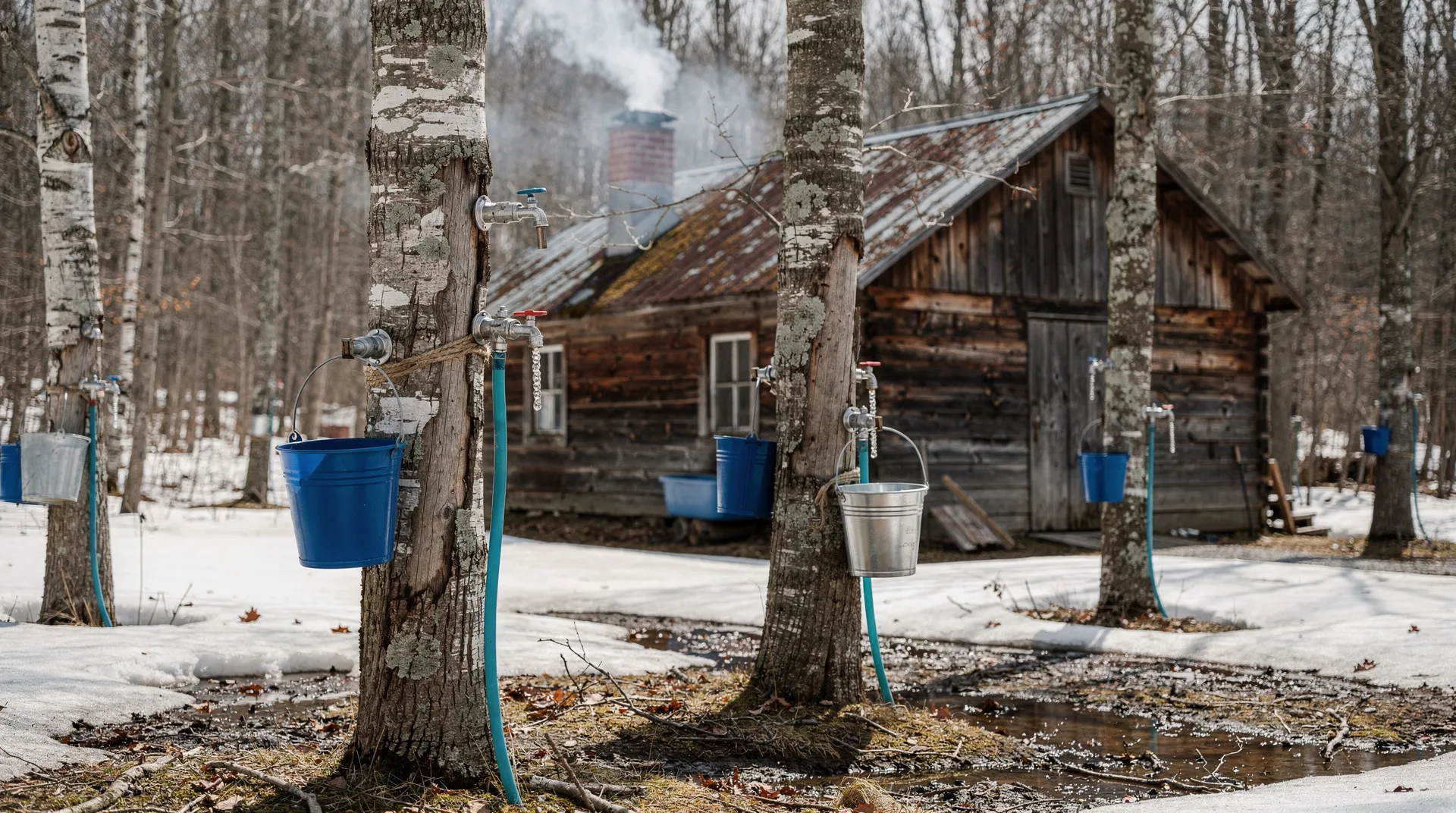
The sap. Sugar maple trees (Acer saccharum) produce a clear sap that is approximately 2-3% sugar. Each tree can be tapped with one to three taps depending on size, producing roughly 40 litres of sap per tap per season.
The season. Sap flows when nights are below freezing and days are above freezing — a specific spring window that typically runs from late February to early April, varying with latitude. Climate change is shifting the season earlier in most regions.
The boiling. To produce one litre of maple syrup, 40 litres of sap must be boiled down. Traditional sugar shacks use open evaporators fuelled by wood; modern commercial operations use reverse osmosis to concentrate sap before boiling, saving enormous amounts of energy.
The classification. Once boiled to approximately 66% sugar content and strained, the syrup is tested for colour and filtered, then graded.
Understanding maple syrup grades
Canada uses a unified grading system that replaced older provincial grades in 2015. Quality is identical across grades — the difference is colour and flavour intensity, which correspond to when in the season the syrup was produced.
Golden, Delicate Taste — Produced early in the season. Light colour, subtle maple flavour. Ideal over light desserts and in subtle applications.
Amber, Rich Taste — Mid-season. The most balanced grade and the one most Canadian households buy for pancakes and general use.
Dark, Robust Taste — Late-season. Deeper colour and stronger maple flavour. Preferred for baking and cooking.
Very Dark, Strong Taste — End of season. Very deep flavour, sometimes used commercially for confectionery and industrial applications.
There is no “best” grade — it is a matter of preference and application. Many Quebec households keep two grades: a delicate golden for pancakes and a robust dark for cooking.
The main maple regions
Quebec — the heartland
Quebec produces over 90% of Canadian maple syrup. The best regions for visitors:
Beauce (south of Quebec City) — The heart of Quebec maple country. Many of the largest sugar shacks and the strategic reserve itself are located here.
Bois-Francs and Centre-du-Québec — Another dense maple production area, home to many traditional family sugar shacks.
Eastern Townships — Scenic sugar shacks in a landscape of rolling hills and lakes.
Laurentians — Sugar shacks closer to Montreal, convenient for day trips.
Île d’Orléans and Île-aux-Coudres — Small-scale producers on picturesque islands.
See Quebec maple regions for a detailed breakdown, Quebec sugar season for timing, and Quebec maple season for a week-by-week guide.
Ontario — a smaller but strong tradition
Ontario produces about 5% of Canadian maple syrup but has a passionate culture around it. Lanark County, west of Ottawa, calls itself the Maple Syrup Capital of Ontario. The Elmira Maple Syrup Festival in Waterloo region claims to be the world’s largest single-day maple festival.
Algonquin Provincial Park area and the Haliburton Highlands have small producers and sugar bushes open to visitors.
Atlantic Canada
New Brunswick has a small but proud maple industry, particularly around Moncton and the St. John River Valley. Nova Scotia produces maple in Cumberland County and Inverness. Visits are possible but the scene is smaller than Quebec or Ontario.
The sugar shack experience
A visit to a cabane à sucre (sugar shack) is the quintessential Quebec spring experience, running from late February to mid-April. A traditional sugar shack meal is a specific cultural ritual:
The traditional menu:
- Pea soup
- Baked beans with maple
- Maple-glazed ham
- Sausages
- Pickled eggs
- Tourtière (meat pie)
- Pancakes
- Maple pie (tarte au sucre)
- Maple taffy on snow (tire sur la neige)
The experience. You sit at long communal tables, fiddlers often play, and food keeps arriving in waves. The meal typically takes 2-3 hours. Alcohol is usually available (caribou — a sweet red wine-and-spirits mixture — is traditional).
The taffy demonstration. Hot maple syrup is poured onto packed snow, quickly cooling into a chewy taffy rolled onto a stick. This is the iconic sugar shack moment.
See cabane à sucre guide, sugar shacks Quebec, and Quebec sugar shack experience for specific recommendations.
The best sugar shacks to visit
Traditional family sugar shacks
Érablière Charbonneau (Mont-Saint-Grégoire, near Montreal) — Large, welcoming, accessible from Montreal.
Sucrerie de la Montagne (Rigaud, west of Montreal) — Historic, atmospheric, with traditional entertainment.
Érablière Lefebvre (Chaudière-Appalaches) — Working family operation with authentic Quebec character.
Modern and chef-driven
Cabane à sucre Au Pied de Cochon (Martin Picard) — Quebec’s most acclaimed chef converted a sugar shack into a destination restaurant. Books out months ahead.
Le Chic Shack (various Quebec City-area sugar shacks with modern menus).
Accessible from major cities
Érablière Meunier (Laurentians, near Mont Tremblant) — Good for a Laurentians visit.
Fulton’s Pancake House (Lanark County, Ontario) — A century-old operation that is the most famous maple destination in Ontario.
Browse Quebec City maple and cultural toursMaple beyond syrup
Canadian cuisine uses maple in forms beyond syrup:
Maple butter — Creamed maple syrup, used as a spread.
Maple sugar — Granulated hardened maple syrup, used as a seasoning.
Maple taffy — The sugar shack snack, often available commercially in tins.
Maple vinegar — A Quebec specialty, used in dressings.
Maple-infused whisky and spirits — Several Canadian distillers produce maple-accented spirits.
Maple in savoury cooking — Maple-glazed salmon, maple bacon, maple beans, maple-dressed squash. See maple dishes beyond syrup for more.
Buying maple syrup
What to look for
Pure maple syrup. Verify the label says “pure Canadian maple syrup.” “Maple-flavoured” is not the same thing — it is corn syrup with maple flavouring.
Quebec or Canadian origin. Quebec syrup benefits from a standardised grading system and strong quality controls.
Glass or tin. Glass bottles and traditional tins preserve flavour better than plastic jugs over the long term.
Grade for your use. Amber Rich Taste is the all-purpose choice; Dark Robust Taste for cooking; Golden Delicate for lighter applications.
Where to buy
Farmers markets (Marché Jean-Talon Montreal, St. Lawrence Market Toronto) — Excellent selection direct from producers.
Maple shops at the airport — Montreal and Toronto airports both have maple shops with solid selection at fair prices.
Directly at sugar shacks — Purchase at the source during the spring season.
Grocery stores — Decent quality at reasonable prices, though specialty selections are limited.
Prices
A 540 ml tin of pure maple syrup typically runs CAD $15-25 in Canada, somewhat less direct from producers.
Find Montreal food tours and maple experiencesPractical tips for a maple trip
Timing. The sugar season runs late February to mid-April in Quebec, slightly later in Ontario. Visit during March for the full operating season with the best atmosphere.
Book ahead. Popular sugar shacks like Au Pied de Cochon book out 2-3 months in advance for weekends.
Rent a car. Most sugar shacks are in rural areas 30-90 minutes from major cities. Public transit is not practical.
Bring warm layers. Sugar shacks are often partially outdoors; the taffy demonstration is always outside.
Come hungry. Sugar shack meals are enormous by design.
Combine with other spring experiences. Late March-April overlaps with early cherry blossoms in BC (for cross-country travellers), bear emergence in the Rockies, and the start of iceberg season in Newfoundland.
Building a maple-focused day or weekend
For visitors basing themselves in Montreal or Quebec City, a maple day trip is one of the easiest half-day excursions to add to a spring itinerary. Combine a sugar shack visit with a stop in Old Quebec or the Eastern Townships wine route for a fuller day. If you’re planning a longer Quebec trip around the season, see the Quebec 7-day itinerary or Quebec in April for timing guidance alongside other spring activities.
Outside Quebec, Ontario’s Lanark County and the Elmira Maple Syrup Festival are worth building a specific detour around if you’re already exploring the Ottawa area, and pair well with the Rideau Canal region more broadly (in its non-winter form).
Frequently asked questions about Canadian maple syrup complete guide: grades, regions and tours
Is Quebec maple syrup the best?
Quebec produces about 90% of the world’s maple syrup and maintains rigorous quality standards. It is not categorically better than Ontario or Vermont syrup — which can also be excellent — but the range, tradition, and scale in Quebec are unmatched.
What is the difference between Canadian and American maple syrup?
Production methods are similar and both countries use harmonised grading. Differences are regional and producer-specific rather than national. Vermont and Quebec syrup are broadly comparable in quality.
Can I bring maple syrup home on a plane?
Yes — maple syrup in sealed bottles can be checked in luggage without restriction. In carry-on it must follow the 100 ml liquid rule. Most travellers check their maple syrup.
How long does maple syrup keep?
Unopened, indefinitely. Once opened, refrigerate and use within 6-12 months for best flavour. It rarely goes bad — at worst it crystallises, which can be fixed by gentle warming.
Is maple syrup healthy?
It is sugar — about 64% sucrose with traces of minerals and antioxidants. Treat it as a sugar with some nutritional upside, not as a health food.
Can I tap a maple tree myself?
Yes, in your own backyard if you have a sugar maple or red maple. Taps, buckets, and basic how-to guides are widely available. Home production is common in rural Ontario and Quebec.
When is the best time to visit a sugar shack?
Mid-March is the reliable peak — full sap flow, reliable operations, best weather. Late February can be too cold; mid-April can be too late.
Are there vegetarian options at sugar shacks?
Increasingly yes, though the traditional meal is meat-heavy. Modern sugar shacks often have a vegetarian menu on request — ask when booking.
Do I need a car to visit a sugar shack?
Effectively yes. Most sugar shacks sit 30-90 minutes outside Montreal or Quebec City in rural areas without meaningful public transit, so plan on a rental car or an organised day tour from the city.
Can I visit a sugar shack outside Quebec?
Yes — Ontario’s Lanark County and the Elmira Maple Syrup Festival near Waterloo are the strongest alternatives, along with smaller producers in New Brunswick and Nova Scotia, though the scale and tradition are smaller than in Quebec.