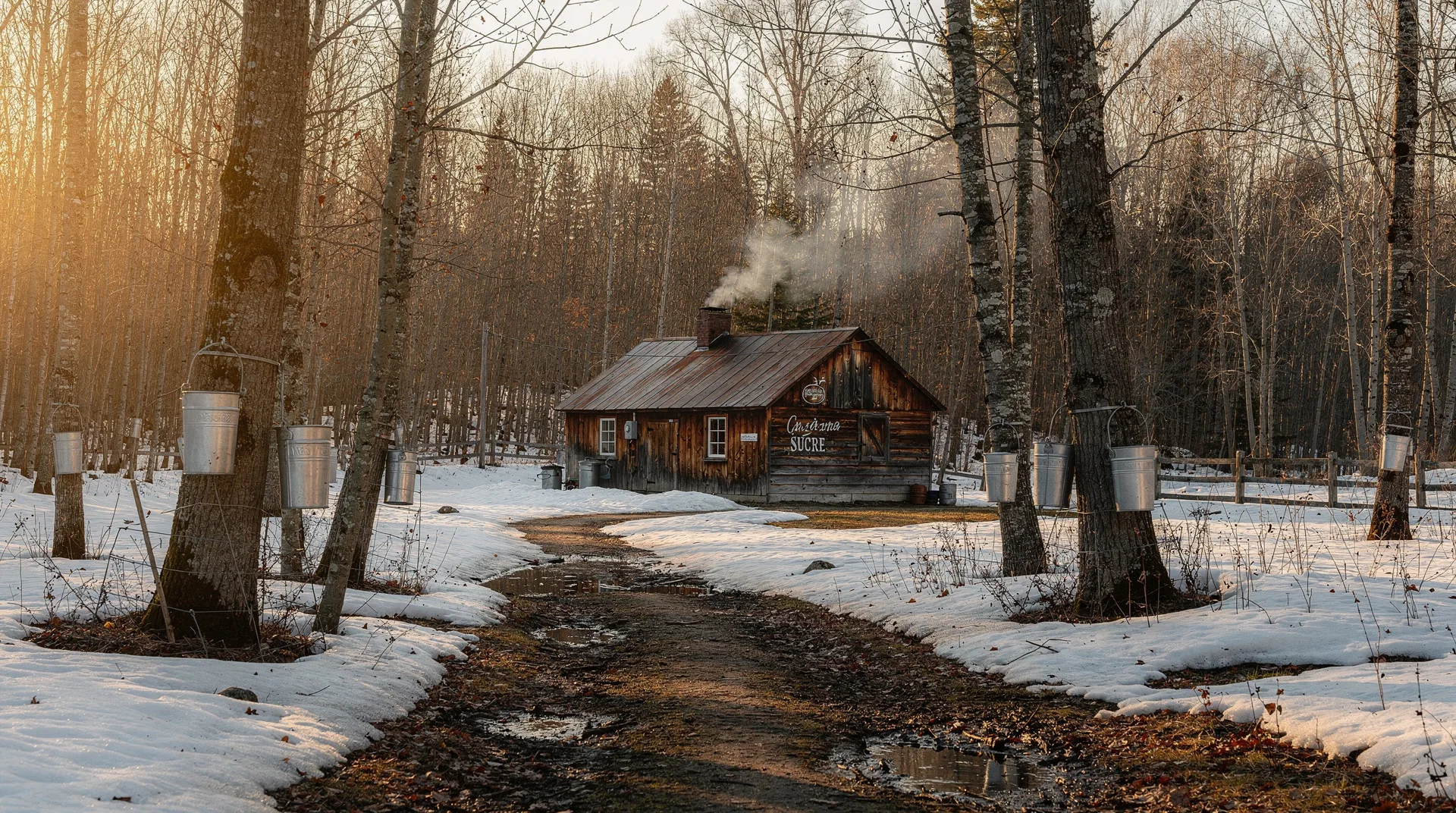
What to expect at a sugar shack (cabane à sucre) in Quebec
What happens at a Quebec sugar shack?
A cabane à sucre visit combines a farm tour (showing sap collection and boiling) with a traditional family-style meal of pea soup, pork and beans, tourtière, ham, and maple desserts. It ends with tire sur la neige — maple taffy on snow.
A visit to a cabane à sucre — a Quebec sugar shack — is one of the most distinctive experiences the province offers, and one of the most difficult to prepare for from abroad. Nothing in North American food tourism really compares. You don’t sit down to an elegant tasting menu. You don’t take polite sips. You arrive at a wooden building in the woods in late winter, you sit at a long communal table with strangers, and you eat an enormous maple-soaked meal while fiddlers play in the corner. Then you go outside and eat hot maple syrup off snow.
This guide covers exactly what happens at a sugar shack visit, what to expect on the menu, how much it costs, how to book, and how to dress — so that when you arrive, you recognise what’s happening and enjoy it fully.
| At a glance | |
|---|---|
| Where | Rural sugar shacks within roughly 30 minutes to 2 hours of Montreal or Quebec City (Laurentians, Montérégie, Eastern Townships) |
| Cost | Around CAD $30-45 traditional, $80-150 gourmet, per adult for the full meal |
| Time needed | Around 2-3 hours on-site including the farm tour and meal |
| Getting there | Rental car or organised day-trip tour from Montreal; few are reachable by public transit |
| Best time | Peak sugaring season, mid-March to mid-April; some shacks run limited off-season hours |
The arrival
Sugar shacks are rural. Most are 30 minutes to 2 hours from Montreal or Quebec City, down small country roads. You’ll arrive at a cluster of wooden buildings in the woods — sometimes one building, sometimes several (a dining hall, a boiling room, shops, a farm store). The parking lot will be packed on weekends.
You’ll typically check in at the main entrance. You may be asked to wait a few minutes before being seated; meals run on a fixed schedule (often 11:30 am, 1:30 pm, 5:00 pm, 7:00 pm seatings).
The farm tour
Most cabanes à sucre offer a short farm tour before or after your meal. This covers:
- Maple tree identification and the biology of sap flow.
- The sugar bush — walking among the tapped trees, seeing either the old-style metal pails hanging on the trees or the modern plastic tubing system that collects sap into a central tank.
- The boiling room (the actual “shack”) — where sap is boiled down into syrup. 40 litres of sap produces 1 litre of syrup. The steam and smell of the boiling room is the most atmospheric part of the experience.
In peak season (mid-March to early April) the boiling is actually happening. Earlier or later in the season, the equipment is there but idle.
The meal
You’ll be seated at long tables with other visitors (8–20 people per table depending on the shack). The meal is family-style: dishes brought to the table in large quantities for communal serving.
The classic menu, served in courses over 90 minutes to 2 hours:
Starter course:
- Pea soup (soupe aux pois jaunes): yellow split peas with salt pork
- Bread with fresh butter
Main course (all arrive together, help yourself):
- Tourtière: Quebec meat pie, pork-based, spiced
- Ham glazed with maple syrup
- Bacon (thick-cut, often with maple glaze)
- Sausages (local pork sausages)
- Baked beans (fèves au lard) — white beans slow-cooked with salt pork and molasses
- Oreilles de Christ — fried pork rinds, eaten as a side
- Omelette soufflée — fluffy eggs cooked over the wood-fired stove
- Pickled beets and onions
- Boiled potatoes
- Bread
The main course is overwhelming in quantity. You’re not expected to finish. Pace yourself.
Dessert course:
- Grands-pères au sirop d’érable — dumplings poached in maple syrup
- Pouding chômeur — “unemployment pudding,” cake with maple sauce
- Tarte au sucre — sugar pie
- Crêpes with maple syrup
Throughout the meal: pitchers of maple syrup at every table. Pour it on ham, bacon, eggs, pancakes — on everything, the locals say.
Tire sur la neige
After dessert, the group moves outside (wearing coats) to a covered area where hot maple syrup is poured onto a trough of clean snow. The syrup cools on contact with the snow into a soft taffy. You roll it up on a flat wooden stick, wait a few seconds, and eat it.
This is the photo moment of the visit. Kids love it. Adults love it.
The music
Most traditional cabanes à sucre have live music during the meal. This is usually accordion, fiddle, and stomping feet — the Quebec folk tradition with strong Celtic and rural French influences. Songs are usually sung in Quebec French; don’t worry if you don’t understand. Clapping along is welcomed.
Some gourmet shacks (see below) skip the music for a more restaurant-like atmosphere.
Types of sugar shack — and what changes
Three categories of sugar shack exist, and the experience varies significantly.
Traditional sugar shacks
The format described above. $30-45 per person for adults, children’s pricing reduced. Plenty of these within an hour of Montreal and Quebec City.
Good examples: Sucrerie de la Montagne (Rigaud, 45 min from Montreal), Érablière Meunier (Laurentians), Cabane à Sucre du Pic Bois (Brigham, Townships).
Gourmet sugar shacks
Same communal format but with chef-driven menus — tasting-menu-style plates, premium ingredients, creative reinventions of traditional dishes. $80-150 per person. Reservations open months in advance and fill within hours.
The pioneer is Cabane à Sucre Au Pied de Cochon in Mirabel (Laurentians) — Chef Martin Picard’s version is famous enough to be a genuine gastronomic event. Reservations released in November for March dates.
Quick-visit sugar shacks
Farm tours, maple product sales, and a sit-down snack or lunch without the full traditional-meal experience. Cheaper ($10-25 for a snack, $20-30 for lunch), more flexible, shorter time commitment. Good if you want the maple experience but not a full 2-hour meal.
What to wear
Sugar shacks are in the woods in late winter. Expect:
- Outside: -5 to 5°C, snow or slush on the ground, muddy paths between buildings
- Inside: warm — the wood stove, the crowd, and the meal all generate heat
- Boots: waterproof, with grip. Essential.
- Layers: a warm jacket you can remove indoors; a sweater or shirt underneath
- Gloves and hat: for the farm tour and tire sur la neige
- No dress code: sugar shacks are casual. Jeans, sweaters, outdoor clothing
Booking
- Traditional weekend shacks: book 4-6 weeks ahead for Saturday/Sunday seatings during peak season (mid-March to mid-April).
- Gourmet shacks (Au Pied de Cochon etc.): book in November/December for March-April dates. Reservations often sell out within hours of release.
- Weekday seatings: typically easier. Consider a Friday lunch or Thursday dinner to avoid the crush.
- From Montreal without a car: multiple Montreal-based tour companies run sugar shack day trips — pickup in Old Montreal, transport to a cabane, full meal experience, return by evening. Typically $120-180 per person all-inclusive. You can compare Quebec day tours and activities before choosing a date.
See our cabane à sucre guide for the Laurentians for regional specifics.
Sugar season timing: when to go
The commercial sugaring season runs roughly from early March to late April, driven by weather (sap flows on the freeze-thaw cycle of cold nights and warm days), not the calendar. Peak activity, when the boiling room is genuinely in operation and the sugar bush looks its most alive, is usually mid-March to early April. Early March can still be cold and quiet; late April sometimes runs past the season’s end if the weather cooperates. For the full month-by-month picture, see our Quebec maple season guide. If you’re planning a broader Quebec winter or shoulder-season trip around the sugar shack visit, our Quebec in April guide covers what else is open that time of year.
Getting there without a car
Most sugar shacks are rural and not served by public transit. Options: rent a car for the day (easiest, most flexible); join an organised day-trip tour departing Montreal, which bundles transport and the meal for around $120-180 per person; or, for visitors basing themselves in Quebec City instead, check whether your target shack is closer to that side — several operate in the Charlevoix and Quebec City hinterland as well as around Montreal. See our driving in Quebec winter guide if you’re considering self-driving during shoulder-season snow or ice.
Pairing a sugar shack with the rest of your trip
A sugar shack visit works well as a half-day add-on to a Montreal or Quebec City stay rather than a full day trip on its own — most visits run 2-3 hours including the farm tour. If you’re building a longer Quebec itinerary around maple season, see our Quebec 7-day itinerary for a route that can absorb a sugar shack afternoon without disrupting the rest of the plan. If you would rather not plan every stop yourself, browse guided tours across Canada for other bookable activities.
Where the shacks are, and how to choose a base
Sugar shacks cluster around the two big cities, so your base shapes which ones are realistic. From Montreal, the countryside to the west and north opens up easily, and our Montreal to Eastern Townships guide and Laurentians destination page show what else sits along those roads. From the capital, the Quebec City destination page and our guide to the Quebec City hinterland point to rural options that avoid the Montreal crowds. If you want to see how maple fits into a wider regional picture, the Quebec maple regions guide compares the main producing areas.
Making a day of it
Because the meal is long and heavy, plan the rest of the day lightly. A late seating pairs well with a slow morning in Old Quebec or Old Montreal, while an early seating leaves the afternoon free for a drive. Food-minded travellers will enjoy continuing the theme with our maple dishes beyond syrup article and the maple syrup tours guide, which explain what you are tasting and how producers differ.
What it costs (typical)
- Traditional sugar shack meal: $30-45 adult, $15-20 child
- Gourmet sugar shack meal: $80-150 adult, wine pairings extra
- Beverages (usually not included): coffee $3, beer $7-9, wine glass $8-12
- Tip: 15-18% expected on top
- Maple products from the farm shop: varies ($8-40 per bottle/tin)
What to bring home
Every sugar shack has a shop. Typical good buys:
- 1 litre tin of syrup ($25-35): the best-value souvenir
- Maple butter ($10-15): spreadable, caramel-like
- Maple sugar ($10-15): granulated, for cooking
- Maple taffy in small tins ($6-10): shelf-stable, good gifts
Quebec maple products pass airline security easily if properly sealed (liquid allowance apply for syrup bottles in carry-on, but tins and jars in checked baggage are fine).
Is it worth it?
For travellers who like food-focused cultural experiences, unreservedly yes. The meal is specific to Quebec and to the late-winter season; the tradition is strong; the atmosphere is family-friendly and welcoming to outsiders who make the effort to show up.
If you don’t like pork, maple syrup, or crowded communal eating, the traditional format will be miserable. Consider a gourmet shack (more varied menus) or a quick-visit shack (tour + snack only) instead.
For context on the season itself, see our Quebec maple season guide. For the broader Quebec food picture, see our French Canadian cuisine guide.
A sugar shack visit, done well, is a genuine cultural experience — not a tourist spectacle, but a living rural tradition that Québécois families still mark every spring. Arrive hungry, sit with strangers, and accept the second helping.
Frequently asked questions about What to expect at a sugar shack (cabane à sucre) in Quebec
Can I visit a sugar shack outside of maple season?
Some sugar shacks operate a limited off-season schedule with the meal and shop but no active boiling, since sap only flows during the freeze-thaw cycle of late winter. If a working boiling room matters to you, plan for mid-March through early April.
Is a sugar shack visit suitable for young children?
Yes — the format is casual, family-style, and most shacks are used to children at the table. The farm tour and tire sur la neige are usually the highlights for kids; just plan for a long seated meal, which can test younger children’s patience.