Maple beyond the bottle: products, recipes and festivals
What maple products can I bring home from Canada?
Beyond syrup, Canada produces maple butter (cream), maple sugar, maple taffy, maple vinegar, maple tea, and an ever-expanding range of maple-flavoured confections. Quebec produces 72% of the world's maple syrup. Sugar shacks during March–April season are the best places to buy directly from producers.
Canada’s liquid gold and what you can make with it
Maple syrup is to Canada what olive oil is to Italy or soy sauce is to Japan — a foundational ingredient that expresses something essential about the landscape, climate, and culture of the country. But where olive oil and soy sauce have been incorporated into sophisticated cuisines over millennia, maple syrup is still in an early phase of culinary exploration. The range of products, preparations, and applications is expanding rapidly, and Canada is in the middle of a genuine maple renaissance.
Quebec alone produces approximately 72% of the world’s maple syrup output — more than 150 million litres in a good harvest year. The province’s maple industry is one of the most organised agricultural sectors in Canada, governed by the Fédération des producteurs acéricoles du Québec (the maple syrup producers’ federation), which maintains strategic reserves in what is affectionately known as the “maple syrup bank.” Ontario, New Brunswick, and Nova Scotia also have significant maple industries.
Understanding maple’s full range means going well beyond the familiar amber bottle. This guide covers the full spectrum of maple products, where to buy them, how they are used in Canadian cooking, and the festivals and experiences that celebrate the sugaring-off season.
| At a glance | |
|---|---|
| Where | Mostly Quebec (72% of world production), plus Ontario, New Brunswick, Nova Scotia |
| Best time to buy fresh | March-April, during sugaring-off season at working sugar shacks |
| Typical cost | around CAD $18-25 for a 540ml tin of pure syrup at an artisanal producer |
| Where to shop | Sugar shacks directly, or public markets like Marché Jean-Talon and St. Lawrence Market |
| Year-round option | Grocery stores and specialty shops stock maple products outside the March-April window |
Understanding maple syrup grades
Canada standardised its maple syrup grading system in 2015, aligning it across provinces and internationally. All maple syrup is now marketed as Grade A with four colour and flavour classifications:
Golden, Delicate Taste — the lightest, clearest, and most delicately flavoured syrup. Produced at the very beginning of the season when sap is coldest and most refined. Best for drizzling over ice cream, yogurt, or fresh fruit where you want the maple flavour to be subtle and the sweetness gentle.
Amber, Rich Taste — the classic all-purpose maple syrup. The colour and flavour most people associate with maple. Excellent on pancakes and waffles, in baking, and as a table sweetener.
Dark, Robust Taste — produced later in the season as temperatures warm. Stronger, deeper, more caramel-like maple flavour. Excellent for cooking, glazing, baking, and use in savoury dishes where you want maple flavour to be a dominant note.
Very Dark, Strong Taste — the final production of the season, with the most intensely maple flavour. Used in food manufacturing, baking, and by cooks who want maximum maple intensity. Increasingly popular with restaurant chefs.
Each grade is identical in caloric content and food safety — the differences are purely flavour and colour. Buying a range of grades at a sugar shack and experimenting at home is one of the best souvenirs from a Canadian trip.
Maple products beyond the bottle
Maple butter (maple cream): Made by heating maple syrup to a precise temperature and then cooling it while stirring constantly, maple butter is a smooth, spreadable, creamy beige confection that contains nothing but maple syrup — no dairy, no fat. It is one of the most underrated Canadian food products. Spread on toast, bannock, crackers, or eaten directly from a spoon, it is rich, complex, and deeply satisfying. Jars of maple butter are available at sugar shacks, specialty food stores, and Quebec tourist shops. Refrigerate after opening.
Maple sugar: Maple syrup heated until all the water evaporates leaves behind maple sugar — granulated or compressed into moulds. Maple sugar is sweeter by volume than cane sugar and can substitute for it in baking and cooking at a roughly 3/4 cup maple sugar to 1 cup white sugar ratio. Maple sugar cookies are outstanding. Artisanal chocolatiers use it as a primary sweetener.
Maple taffy (tire sur la neige): Hot maple syrup poured onto snow or ice, then rolled onto a stick as it cools to a soft-candy consistency. The texture falls between caramel and toffee, with an intensely clean maple flavour. This is the iconic treat of Quebec’s sugaring-off season. Packaged taffy is available year-round at tourist shops, but the experience of rolling fresh tire at a sugar shack during March is in a different category entirely.
Maple vinegar: One of the newer artisanal maple products — maple syrup fermented and then acetified (converted to acetic acid) to produce a golden, maple-flavoured vinegar. It is extraordinary in salad dressings, marinades for salmon and pork, and reduction sauces. A distinctly Canadian product with no international equivalent.
Maple whisky and spirits: Several Canadian distillers use maple as a flavouring agent in whisky, vodka, and other spirits. Crown Royal’s maple whisky is the most widely distributed; smaller artisanal distillers in Quebec and Ontario produce more complex maple-influenced spirits. Maple liqueur is a popular souvenir.
Maple beer: Canadian craft brewers have embraced maple as an ingredient. Quebec’s Brasserie Dieu du Ciel! and several Ontario and BC breweries produce seasonal maple beers, often dark ales or porters where the maple character complements roasted malt.
Maple tea: Herbal infusions enhanced with maple syrup. A growing category among specialty tea producers in Quebec.
Maple-infused foods: The range here is extensive — maple granola, maple-glazed almonds, maple candied bacon, maple butter tarts (the Ontario classic enhanced with maple sugar), maple fudge, maple-smoked salmon, and maple-glazed ham. Many Canadian food producers have developed maple product lines.
Maple in Canadian cooking
Beyond the breakfast table, maple has worked its way into sophisticated Canadian cooking at every level.
Savoury applications:
-
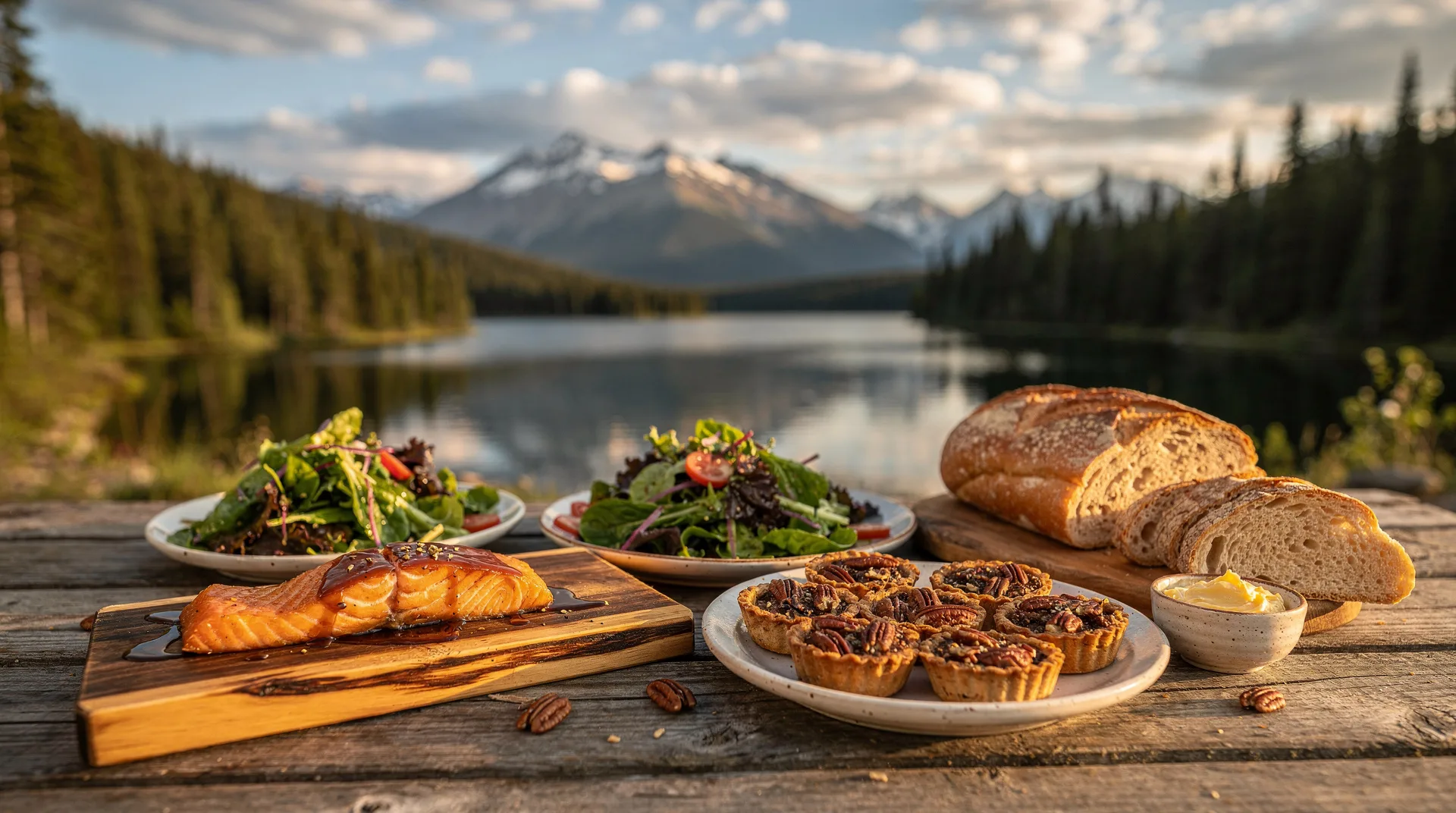
Maple-glazed salmon: BC sockeye or Atlantic salmon brushed with a glaze of maple syrup, soy sauce, and ginger, then roasted or cedar-planked. One of Canada’s signature dishes. The sweetness of the maple plays against the salmon’s richness beautifully.
-
Maple-glazed ham or pork: Quebec’s traditional ham dinner at sugar shack is built around this combination. Slow-roasting a ham with a maple syrup and mustard glaze produces a lacquered, caramelised exterior with complex flavour.
-
Maple-balsamic vinaigrette: A classic Canadian salad dressing using maple syrup as the sweetener in place of honey or sugar. Works beautifully with bitter greens, goat cheese, and toasted pecans.
-
Maple-glazed root vegetables: Carrots, parsnips, or sweet potatoes tossed with maple syrup and butter before roasting become intensely sweet and caramelised. A Canadian Thanksgiving staple.
-
Maple-cured bacon: Some Canadian bacon producers cure with maple syrup, producing a sweeter, more complex flavour than standard salt-cured bacon.
Sweet applications:
-
Maple pie (tarte au sirop d’érable): Quebec’s version of a custard pie, made entirely from maple syrup thickened with cream and eggs. Rich, intensely sweet, and entirely unique to Quebec.
-
Pouding chômeur: “Poor man’s pudding” — a yellow cake batter poured over a maple syrup sauce that sinks to the bottom during baking and creates a sticky, caramelised base. One of the great desserts of Quebec cuisine.
-
Maple baked beans: Beans slow-cooked with salt pork, onion, and maple syrup — a traditional Quebec and Acadian staple. Entirely different from canned baked beans; richer, more complex, more deeply flavoured.
-
Maple butter tarts: Ontario’s classic butter tart (see the Canadian cuisine guide) is further elevated when maple sugar or syrup replaces part of the brown sugar in the filling.
Maple festivals and events
Festival des sucres (Sugar Festival) events take place throughout Quebec during March and April at sugar shacks, town parks, and community halls. These are informal, family-oriented celebrations with maple products, traditional food, folk music, and outdoor games.
Elmira Maple Syrup Festival, Ontario — held annually in Elmira, near Waterloo, on the first Saturday in April, this is billed as the world’s largest single-day maple syrup festival. Hundreds of thousands of visitors descend on a small town for pancakes, maple products, craft vendors, and activities. Entry is free; maple products are for sale everywhere.
Festival des sucres in Lanaudière — the Lanaudière region north of Montreal hosts several maple festivals during March.
West Nipissing Maple Syrup Festival, Ontario — the French-Canadian community of Sturgeon Falls celebrates maple season with sugar shack events and traditional Québécois food north of Lake Nipissing.
Maple Fest in Nova Scotia — several sugar shack operations in Nova Scotia’s Annapolis Valley run March–April events. Nova Scotia maple syrup has a distinctive flavour profile due to the mix of sugar maple and red maple sap.
Where to buy the best maple products
At sugar shacks: The freshest and most diverse range of maple products is available directly from producers during sugaring-off season. The direct-from-producer purchase also ensures you are getting authentic Quebec maple without the retailer markup.
Marché Jean-Talon, Montreal: The premier public market in Montreal has multiple maple product vendors, including some selling artisanal small-batch maple products from specific regions of Quebec.
Marché du Vieux-Port, Quebec City: Similar concentration of Quebec food artisans, with excellent maple product selection.
Public markets across Canada: Granville Island in Vancouver, St. Lawrence Market in Toronto, Byward Market in Ottawa, and Farmers’ Markets across the Maritimes all carry Canadian maple products of various quality levels.
LCBO and grocery stores: Standard maple syrup is widely available in supermarkets. For premium grades and specialty products, seek out specialty food shops or artisanal food markets.
Online from producers: Many Quebec maple producers now ship directly to customers across Canada. The Fédération des producteurs acéricoles du Québec website lists certified producers.
The maple syrup industry and sustainability
Canada’s maple industry is one of the world’s most sustainably managed agricultural sectors. Maple trees are tapped for sap without harming the tree — a properly tapped maple can produce sap for 100 years or more. The industry relies on healthy maple forest ecosystems and has strong incentives to maintain forest health.
Climate change is a significant concern for maple producers. Warming winters reduce the freeze-thaw cycles that drive sap flow, and the geographic range of optimal maple syrup production is gradually shifting northward. Quebec producers are experimenting with adapted varieties and new production techniques.
The Indigenous dimension of maple is important to acknowledge: Indigenous peoples of eastern Canada, particularly the Haudenosaunee (Iroquois), Anishinaabe, and Mi’kmaq nations, were the original maple syrup producers. They developed the technology of collecting sap and concentrating it before European contact. The knowledge was shared with French settlers and became central to Quebec’s agricultural identity. Several Indigenous producers now operate maple operations as a reclamation of this heritage.
Practical tips for buying maple souvenirs
Container types: Maple syrup is sold in tins (the classic gift format), glass bottles, and plastic containers. Tins are the traditional gift choice and travel well. Glass looks beautiful but is heavy. Plastic is lightest for travel but least aesthetically pleasing.
Sizes: Common sizes are 100ml (too small, gone in two breakfasts), 250ml (good for personal use), 540ml (standard gift size), 1L (excellent value), and 4L (for serious enthusiasts). For air travel, 540ml is the most practical checked-luggage size.
Cost: Genuine Quebec maple syrup costs approximately CAD $10–$15 for 250ml, CAD $18–$25 for 540ml, and CAD $30–$45 for 1L at artisanal producers. Supermarket prices are lower but quality varies. Anything priced dramatically below these figures is likely not pure maple syrup.
Customs regulations: Maple syrup is a natural food product without restrictions in most countries. Always declare food products at customs and check specific country regulations before travelling.
Explore Montreal and Quebec City food experiencesFor the full sugar shack experience, see the cabane à sucre guide or the more detailed maple syrup tours guide. For more Canadian food context, visit the Canadian cuisine guide, the Quebec food deep dive, or the Quebec food markets guide. Travellers timing a visit around production itself should read the complete Canadian maple syrup guide and the Quebec maple season guide for exact windows by region, or compare the Quebec maple regions if choosing where to base a trip.
Pairing maple with Quebec cuisine
Maple rarely stands alone on a Quebec table — it is a seasoning as much as a sweetener, and understanding how it interacts with other regional staples deepens the souvenir shopping and the cooking both. Maple butter tarts pair naturally with a strong black coffee; maple-cured bacon and maple baked beans are traditionally served alongside tourtière (meat pie) at holiday meals; and maple vinegar is increasingly used by Montreal chefs the way a Spanish sherry vinegar would be used — a bright, acidic counterpoint rather than a dessert ingredient.
If touring Montreal’s food scene, ask vendors at Marché Jean-Talon which producer’s syrup they personally buy — small-batch differences in terroir are real, even if blind taste tests rarely isolate them reliably.
Storing and travelling with maple products
Unopened tins and bottles travel well in checked luggage; airlines generally treat maple syrup like any other liquid food product in checked bags (carry-on quantities are subject to normal liquid restrictions). Maple butter and maple taffy are more fragile — maple butter can separate or soften in heat, so avoid leaving a suitcase in a hot car or cargo hold on a connecting flight in warm weather. Maple sugar in solid moulded form travels best of all, since it is essentially shelf-stable and immune to temperature swings. If bringing products home as gifts, buy a range of grades rather than several bottles of the same one — the contrast between a Golden and a Very Dark syrup is a better souvenir story than volume alone.
Frequently asked questions about Maple beyond the bottle: products, recipes and festivals
What is the difference between maple syrup and maple-flavoured syrup?
Pure maple syrup contains only maple sap concentrate. Maple-flavoured syrup (often labelled “pancake syrup” or “maple-flavoured pancake syrup”) contains corn syrup or other syrups with artificial maple flavouring. They are categorically different products. Canadian maple syrup labelling is strictly regulated — “maple syrup” on a Canadian label means 100% pure maple.
How long does maple syrup last?
Unopened maple syrup keeps indefinitely stored in a cool, dark place. Once opened, refrigerate it and use within a year. If mould appears on the surface, it can be skimmed off (the syrup itself is safe) or you can boil the syrup briefly to kill any mould spores.
Is maple syrup healthier than sugar?
Maple syrup contains more minerals than refined white sugar (particularly manganese and zinc) and has a slightly lower glycemic index. It also contains trace antioxidants. However, it is still primarily sucrose and should be treated as a sweetener rather than a health food.
Can I visit maple production facilities outside sugar shack season?
Yes — many larger maple operations run tours year-round. The production facilities (with their evaporators and storage tanks) can be visited any time; only the live sap-to-syrup production is seasonal. Quebec’s Centre Acer in Saint-Albert is a year-round maple education and visitor centre.
What makes Quebec maple different from Vermont or New York maple?
Geographically adjacent regions with similar maple populations produce broadly similar syrup. Quebec maple’s dominance is about scale and classification standards rather than unique flavour. Small regional differences in terroir — soil type, maple species mix, microclimate — produce subtle flavour variations. Blind taste tests rarely distinguish regional origin reliably.
What are the dark specks sometimes visible in maple syrup?
Tiny particles of bark, mineral deposits from the sap, or crystallised sugar (niter) that can form in syrup. All are harmless. Filter maple syrup through a fine cloth or coffee filter if appearance matters for a particular use.
Is maple butter vegan?
Yes. Despite the name, maple butter contains only maple syrup — no dairy butter, no cream. It is entirely plant-based. This surprises many visitors who assume it must contain dairy.
Can I bring maple syrup back through customs?
Generally yes — maple syrup is a shelf-stable, sealed food product with no special restrictions in most destination countries, though rules vary and you should check your home country’s food import regulations before travelling. Always declare food items on customs forms; undeclared items, even harmless ones, can cause delays.
Which maple product makes the best gift for someone who isn’t a big sweets fan?
Maple vinegar is the best option — it reads as a serious culinary product rather than a candy, works in savoury cooking, and is distinctive enough that most recipients won’t already own a bottle.