Cabane à sucre guide: Quebec's maple sugar shack experience (dates, regions, types)
When is Quebec sugar shack season and what is the experience like?
Sugar shack season runs mid-March through mid-April. Visitors enjoy a traditional feast of tourtière, oreilles de crisse, pea soup and pouding chômeur, plus the iconic tire sur la neige — maple taffy rolled onto fresh snow.
Quebec’s defining seasonal ritual
No experience captures the spirit of Quebec in spring like a visit to a cabane à sucre. The sugar shack — a working maple production facility that opens its doors to visitors during sugaring-off season — is simultaneously a farm, a restaurant, a cultural event, and an expression of deep identity. For Quebec families, the annual pilgrimage to the shack is as fixed in the calendar as Christmas; for visitors, it is one of the most immersive and distinctive experiences available anywhere in Canada.
The mechanics are ancient and unchanged: thousands of maple trees are tapped in late winter, the watery sap is collected (by bucket or plastic tubing pipeline in modern operations), and boiled in a large evaporator until it reduces to syrup at a ratio of roughly 40 litres of sap to one litre of finished syrup. What transforms this agricultural activity into an event is everything that happens around it — the communal feast, the folk music, the sleigh rides through the snow-covered maple forest, and above all the tire sur la neige: hot maple syrup poured onto packed snow, rolled onto a wooden stick as it cools, and pulled into a taffy that no packaged candy can replicate.
This guide covers dates, regions, types of sugar shack, what to expect from the feast, practical logistics, and how to combine a sugar shack visit with the rest of a Quebec itinerary. For context on maple products more broadly and how they fit into Quebec’s cuisine, see the Quebec food deep-dive guide.
At a glance
| Where | Rural sugar shacks around Montreal, Quebec City and the Laurentians, plus a few urban events |
| Cost | Around CAD $28-55 per adult, CAD $12-22 per child, for the full feast |
| Time needed | Around 2-3 hours for the feast and tire sur la neige; a half-day with sleigh ride and forest walk |
| Getting there | A car is nearly essential; most shacks are 45-90 minutes from Montreal or Quebec City |
| Best time | Mid-to-late March for peak syrup and full snow cover for tire sur la neige |
When to go: understanding the season
Sugar shack season is governed by temperature, not by the calendar. The critical condition is the freeze-thaw cycle: maple sap runs when daytime temperatures rise above 0°C while nights remain below freezing. This pressure differential draws the sap upward through the tree. In a typical year, this pattern begins in late February in the warmest parts of Quebec (Montérégie, Eastern Townships) and in mid-March in the Laurentians and northward.
Peak season: The last two weeks of March and the first week of April represent peak production and peak visitor season simultaneously. The syrup produced at this stage tends to be Amber or Dark grade — balanced, versatile, and deeply flavourful.
Early season (first two weeks of March): Less crowded, earliest Golden-grade syrup (the lightest and most delicate), and some risk that sap runs are not yet fully established. Worth monitoring weather forecasts.
Late season (mid-April): The sap becomes “buddy” as leaf buds swell, and the resulting syrup takes on an earthier, slightly fermented character — highly prized by Quebec connoisseurs but a departure from the clean sweetness of peak-season syrup. Operations begin winding down. Some shacks close before the end of April; check before planning a late-season visit.
The snow question: Tire sur la neige requires snow. By late April, many lowland Quebec sugar shacks have lost sufficient snow cover. Shacks at higher elevations in the Laurentians tend to hold snow longer. When booking a late-April visit, confirm that snow is still available.
Season at a glance
| Period | Syrup grade | Crowds | Snow for tire sur la neige |
|---|---|---|---|
| Early March | Golden (lightest, most delicate) | Light | Usually reliable |
| Mid-to-late March | Amber to Dark (peak flavour) | Heaviest of the season | Reliable, especially at higher elevation |
| Early April | Dark to Very Dark | Moderate, tapering | Still reliable most years |
| Mid-to-late April | Earthier “buddy” syrup | Light, many shacks closing | Not guaranteed in lowland areas; confirm before booking |
Types of cabane à sucre
Not all sugar shacks are the same, and the experience varies considerably by type. Understanding the differences helps you choose the right option.
Traditional experience sugar shacks
These operations prioritise authenticity — a wood-fired evaporator, a traditional feast served at long communal tables, a fiddle player and accordion, sleigh rides, and the complete tire sur la neige experience. They typically operate only during sugaring season and may have limited English-language capacity. Sucrerie de la Montagne in Rigaud is the gold standard: no electricity, wood-fired everything, and an intensely French-Canadian experience. These shacks are ideal for visitors who want maximum immersion and are comfortable navigating in French.
Family-oriented modern operations
Larger operations with extensive facilities — modern heated buildings, multiple activities, organized children’s programming, bilingual staff, and a buffet-style feast. These are excellent for families with children and visitors who want comfort alongside tradition. Constantin and similar large operations in the Montérégie and Lanaudière regions fall into this category.
Gastronomic sugar shacks
A newer category: operations where the traditional meal has been elevated by trained chefs while maintaining the seasonal and maple-focused framework. Some Montreal chefs have opened or partnered with sugar shack operations. The traditional dishes appear alongside more refined preparations. These cost more and require advance reservation.
Urban sugar shack events
During maple season, Montreal restaurants and event venues host sugar shack-themed dinners and events for visitors who cannot easily reach a rural operation. Jean-Talon Market hosts maple-season events; some restaurants offer cabane-style meals. These are a reasonable alternative but lack the outdoor experience, the production context, and the tire sur la neige on real snow.
The feast: what you will eat
The traditional sugar shack meal is one of Quebec’s great eating experiences — unapologetic in its use of pork, lard, and maple syrup, served in quantities that assume you have been working a maple forest since dawn.
Soupe aux pois: Yellow split pea soup with salt pork, cooked for hours until thick and deeply savoury. This begins the meal and sets the register: comforting, substantial, flavoured with smoke.
Oreilles de crisse: Deep-fried salt pork rinds — crispy, salty, and served with maple syrup for dipping. The name translates to “Christ’s ears” (from the shape). They are addictive.
Saucisses grillées: Grilled pork sausages, served with maple syrup.
Jambon: Ham, typically glazed or served alongside maple syrup.
Oeufs dans le sirop d’érable: Eggs fried in lard, cooked directly in maple syrup, or fried conventionally and served with maple syrup. Simple and extraordinary.
Fèves au lard: Baked beans slow-cooked with salt pork and maple syrup for eight to ten hours in a clay pot. These are nothing like commercial baked beans; they are deeply sweet, smoky, and gelatinous.
Tourtière: The traditional Quebec meat pie with pork and spices. See the Quebec food deep-dive for full context.
Grands-pères dans le sirop: Dumpling balls poached in maple syrup. Simple, sweet, warm.
Pouding chômeur: “Poor man’s pudding” — cake batter poured over hot maple syrup sauce, which migrates to the bottom during baking. The result is a tender cake atop a sticky caramel maple pool. One of Quebec’s great desserts.
Tire sur la neige: The culmination. Maple syrup boiled to soft-ball candy stage is ladled over troughs of packed snow. As it cools, visitors roll the thickening taffy onto wooden sticks and pull it off in strips. The combination of warm sweet maple and cold snow is one of those sensory experiences that seems to imprint permanently. Eat as many as you want — this is the one occasion in Quebec where no one is counting.
Book a Montreal and Quebec seasonal experience on GetYourGuideBest regions and specific sugar shacks
Montérégie (south shore, Montreal)
The highest density of sugar shacks in Quebec, most within 45–90 minutes of central Montreal.
Sucrerie de la Montagne (Rigaud): The most famous traditional sugar shack in Quebec. No electricity, wood-fired production, horse-drawn sleighs, and a traditional feast that has not changed materially in decades. Owner Pierre Faucher has maintained this as one of the province’s most authentic experiences. Reserve well in advance for March weekends.
Cabane à sucre Constantin (Saint-Eustache area): Large, well-organised, family-oriented operation with bilingual staff. Excellent for first-timers and families with children.
Érablière Au Sous-Bois (Sainte-Brigide-d’Iberville): Smaller, more intimate, beloved for its setting in a mature maple forest.
Lanaudière (north of Montreal)
Several family-run operations in rolling countryside north of Montreal. Slightly less crowded than Montérégie, slightly longer drive.
Chaudière-Appalaches (south shore, Quebec City)
One of Quebec’s most productive maple regions. Several large operations near Beauce County welcome visitors, with Quebec City easily accessible for day trips.
Laurentides (north of Montreal, ski country)
Combining a sugar shack visit with a weekend at a Laurentian ski resort is a natural pairing during March. The higher elevation means snow holds longer. See the Laurentians vs Eastern Townships guide for the broader region.
Near Quebec City
Several operations within 30–45 minutes of Quebec City are accessible by car. Combine with a stay in Old Quebec — see Quebec City destinations for lodging and city context. The cabane à sucre experience guide covers many of the same operations from a Quebec City base perspective.
Activities beyond the feast
Sleigh rides: Horse-drawn or tractor-pulled sleigh rides through the maple forest are standard at larger operations. Duration is typically 20–40 minutes. Bundling under heavy wool blankets while being pulled through a snow-covered forest of sugar maples with their tap lines running is one of those quietly perfect winter experiences.
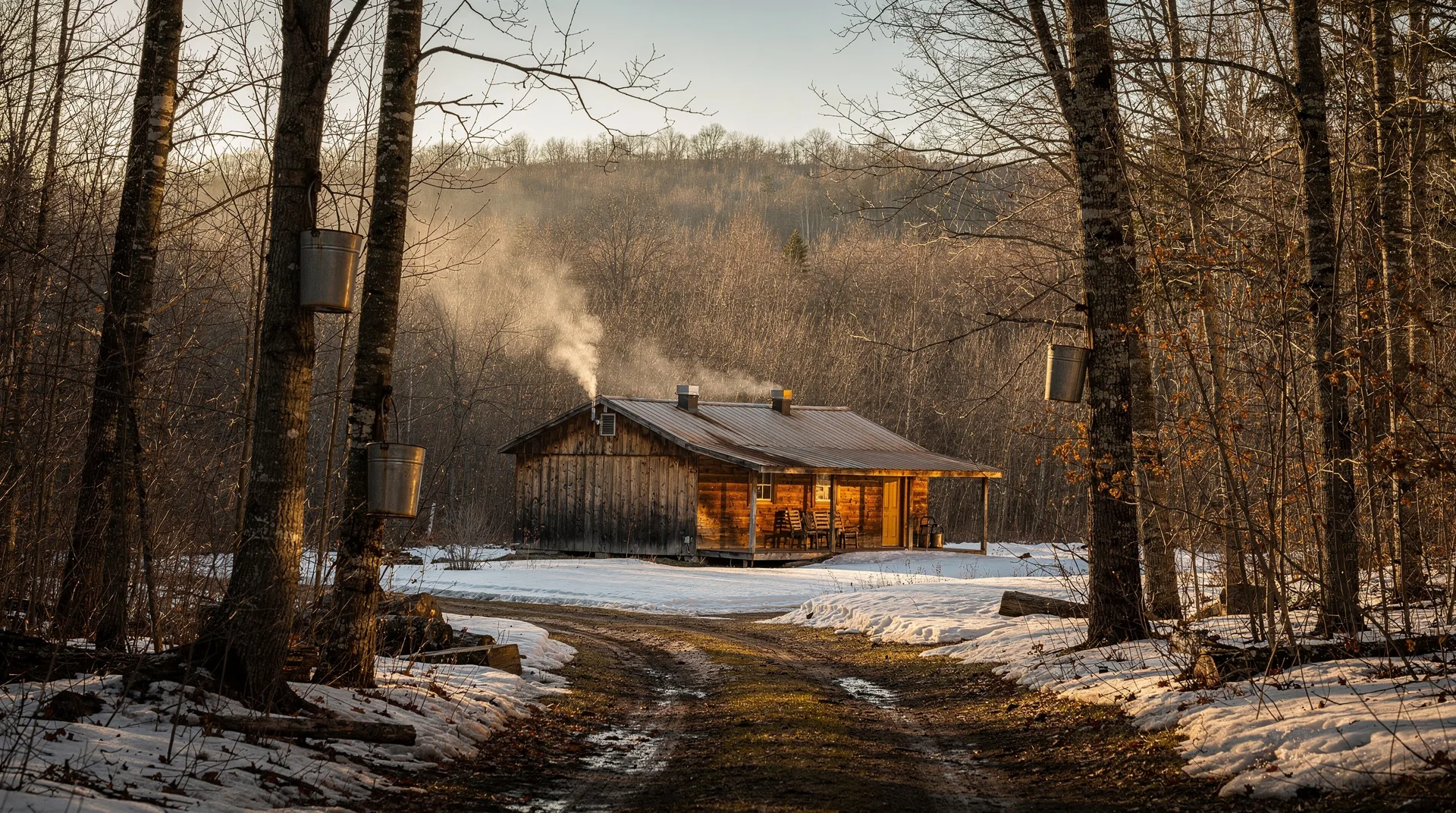
Sugar bush walks: Many operations allow visitors to walk through the maple forest and observe the tapping operation up close — the tap holes, the plastic tubing systems on modern operations, or the traditional metal pails on heritage-style shacks. The scale of a large sugar bush is impressive: hundreds of acres of mature maple trees, each producing 20–40 litres of sap per season.
Evaporator viewing: The evaporator building is often open to visitors. Watching maple sap transform into syrup in real time — the colour deepening, the consistency thickening, the temperature rising as water evaporates — is genuinely fascinating. The steam rising from a wood-fired evaporator in late March is a signature Quebec image.
Folk music and dancing: A fiddle player and accordion are standard at traditional sugar shacks. Square dancing, jigging, and general enthusiasm follow the feast. The music is traditional Québécois folk — energetic, cheerful, and somewhat irresistible after a glass or two of local cider.
Buying maple products at the shack
Sugar shack visits provide the best opportunity to buy maple products directly from the producer at source prices. The range typically includes:
- Maple syrup in all four Canadian grades (Golden, Amber, Dark, Very Dark) in tins from 250ml to 4L
- Maple butter (beurre d’érable): Whipped maple syrup with a spreadable consistency. Excellent on toast, crumpets, or pancakes
- Maple sugar: Granulated for baking or formed into decorated moulds as gifts
- Tire d’érable (packaged taffy): The same product as tire sur la neige, packaged in rounds or strips
- Maple vinegar: Less well-known but excellent in salad dressings and glazes
- Confiseries: Maple fudge, maple lollipops, chocolate-maple combinations
Prices at the shack are typically lower than in Montreal or Quebec City specialty food stores. Maple syrup is non-perishable and travels well; it is one of the best edible souvenirs from Quebec.
Explore Canada seasonal tours and experiences on GetYourGuidePractical logistics
Reservations: Non-negotiable for popular shacks on March weekends. The busiest Saturdays — particularly the last two weekends of March — book up two to four weeks in advance. Most operations accept online reservations through their websites; some require phone calls. Very few accept walk-ins on peak days.
Cost: A full traditional feast including tire sur la neige typically costs CAD $28–$55 per adult, CAD $12–$22 for children under 12. Some operations charge separately for activities (sleigh rides, etc.); others include everything. Confirm when booking.
Getting there: Nearly all sugar shacks require a car. From Montreal, most Montérégie operations are 45–90 minutes. From Quebec City, 30–60 minutes to Chaudière-Appalaches shacks. GPS can be unreliable in rural Quebec; download directions offline or print them. Some sugar shacks have poor cellular coverage.
What to wear: Late March in Quebec can be anywhere from -10°C to +10°C. Plan for cold. Waterproof boots are important — the sugar bush walk and tire sur la neige involve standing in snow. Layers are essential. The interior of the cabane is typically very warm.
Language: Most traditional shacks operate primarily in French. Tourist-oriented operations near Montreal and Quebec City typically have bilingual staff. Language should not deter non-French speakers — the experience is sufficiently experiential that communication manages itself.
Dietary restrictions: Traditional menus are heavily pork-based. Most modern operations accommodate vegetarians with advance notice when booking. Completely vegan menus are rare. Gluten-free options are inconsistent; ask when booking.
Combining the sugar shack with a Quebec itinerary
Montreal base: A sugar shack day trip from Montreal is one of the city’s most popular seasonal activities. Depart by 10am, reach the shack for an 11am or noon session, spend the afternoon, and return to Montreal by early evening. Combine with a visit to Jean-Talon Market in the morning to buy maple products before heading out to the shack.
Quebec City base: The Old Town is compact and walkable, and several excellent shacks are under an hour away. A two-night stay in Quebec City with a morning sugar shack visit and an afternoon in the Old City is a near-perfect spring Quebec itinerary. See Quebec City destinations for accommodation and city guidance.
Ski weekend combination: March is the best month for combining skiing with a sugar shack visit. The Laurentians vs Eastern Townships guide covers both ski regions that have sugar shacks within easy reach.
If you can’t get a reservation
Popular traditional shacks on peak March Saturdays sell out weeks ahead. If your preferred date is unavailable, a few fallbacks work well: try a weekday visit (quieter and easier to book, and the feast is unchanged), look at family-oriented modern operations rather than the smallest traditional shacks (they generally have more capacity), or shift your visit to early April rather than late March — the crowds thin noticeably while snow and syrup quality are usually still good. Visitors basing a trip around Quebec City rather than Montreal often find slightly more last-minute availability at the Chaudière-Appalaches shacks.
For deeper context on the maple category itself — grades, production regions, and how maple fits into Quebec’s food identity beyond the sugar shack — see the complete Quebec maple syrup guide and the maple syrup tours guide for operators offering year-round production visits. The Quebec maple season guide and Quebec sugar season guide cover the same freeze-thaw timing from a slightly different angle if you’re trying to pin down exact dates for a specific year.
Frequently asked questions about Cabane à sucre guide
Can I visit a cabane à sucre without a car?
It’s difficult. Nearly all sugar shacks are in rural areas 45-90 minutes from Montreal or Quebec City with no direct transit. Some tour operators run organised day trips with transport included from both cities, which is the most practical car-free option.
Is a cabane à sucre visit suitable for young children?
Yes — family-oriented modern operations in particular are built for this, with sleigh rides, open space to run around, and a feast that most kids enjoy (especially the tire sur la neige). Traditional shacks like Sucrerie de la Montagne also welcome children but have less structured programming.
Related pages
- Quebec food deep-dive: tourtière, poutine and the full culinary canon
- Quebec food markets: Jean-Talon, Atwater and Old Port Quebec City
- Laurentians vs Eastern Townships: which Quebec region for you?
- Speaking French in Quebec: what anglophones need to know
- Montreal destinations
- Quebec City destinations