Quebec Sugar Season: When Sugar Shacks Open and Where to Go
When is Quebec sugar season?
Quebec's maple sugar season typically runs from late February to mid-April, peaking in mid-March. The exact timing varies by year and region — southern Quebec (Montérégie, Eastern Townships) opens slightly earlier than the Laurentians and Beauce. Sugar shacks (cabanes à sucre) are open for the full season and offer traditional meals alongside sap-to-syrup production.
Every spring, Quebec experiences a collective ritual that has no real equivalent anywhere else in the world. As temperatures begin to fluctuate between freezing nights and warming days — the precise meteorological condition that drives sap up through maple trees — sugar shacks across the province throw open their doors. Families drive out from Montreal and Quebec City in their thousands. Accordion music plays. Enormous meals built entirely around maple syrup are consumed. Children pour hot syrup onto snow and roll it onto sticks into tire sur la neige (maple toffee). Quebec, briefly, becomes entirely focused on the maple.
For visitors, the sugar season is one of the most culturally immersive experiences in the province. It requires no French, no special equipment, and no prior knowledge — just an appetite and a willingness to understand that Quebec’s relationship with maple runs considerably deeper than the bottle on the breakfast table.
| At a glance | |
|---|---|
| Where | Montérégie, Beauce, Laurentians, Eastern Townships — rural regions within about 30-90 minutes of Montreal or Quebec City |
| Cost | a traditional sugar shack meal runs around $30-50 CAD per adult, often less for children |
| Time needed | half a day for a meal and tour; a full day if combining with skiing or a sleigh ride |
| Getting there | a rental car is the practical option — see Canada car rental — some Montreal-area shacks run shuttle buses |
| Best time | roughly late February to mid-April, peaking mid-March |
Why Quebec dominates maple syrup production
Quebec produces approximately 70–75% of the world’s maple syrup — a market share that would be remarkable in any industry, but is particularly striking for a product that requires specific climate conditions to produce. The province’s geography — cold winters, late springs, vast tracts of sugar maple (Acer saccharum) forest — creates ideal sap flow conditions that more southern regions cannot fully replicate.
The Federation of Quebec Maple Syrup Producers manages what is effectively a strategic reserve of maple syrup — the Global Strategic Maple Syrup Reserve in Saint-Georges-de-Windsor — to buffer price swings from season to season. Quebec’s maple economy is a serious industry, not a rustic novelty.
This scale means that the quality, variety, and experience available to visitors during sugar season is unmatched anywhere else in the world. Hundreds of sugar shacks, from tiny family operations to large commercial enterprises, offer direct-to-consumer experiences during the spring season.
When exactly does sugar season run?
Sap flows when temperatures cycle above and below freezing within the same day. This thermal oscillation — warm enough by day to drive sap up, cold enough at night to reset the pressure — occurs in late winter and early spring. In practice, this means:
| Region | Typical start | Peak production | Typical end |
|---|---|---|---|
| Montérégie (south of Montreal) | Late February | Early to mid-March | Late March |
| Eastern Townships | Early March | Mid-March | Early April |
| Montérégie and Centre-du-Québec | Late February | Early March | Late March |
| Laurentians | Mid-March | Late March | Mid-April |
| Beauce and Chaudière-Appalaches | Early March | Mid-March | Early April |
| Mauricie and Lanaudière | Early to mid-March | Late March | Mid-April |
The season typically lasts six to eight weeks per producer, though individual taps on any given day may run strongly or barely at all depending on that day’s temperature pattern. A warm snap in February can trigger an early but brief flow; a cold March can push peak season into April.
Sugar shacks typically open on weekends first, then add weekday openings as the season peaks. Most operate seven days a week during the height of season (mid-March) and close when the sap begins to “run off” — turning darker and stronger in flavour as the trees begin to bud, which signals the season’s end.
What happens at a sugar shack
The cabane à sucre experience has a formula that has evolved over generations and is now as codified as it is welcoming.
The meal
A traditional sugar shack meal is one of the most distinctive culinary experiences in Quebec. The menu varies by shack but follows a recognisable template:
Soupe aux pois: Split pea soup, thick and savoury, the traditional opening.
Fèves au lard: Oven-baked beans slow-cooked with maple syrup and salt pork — sweet, smoky, and warming.
Jambon à l’érable: Ham glazed with maple syrup and cooked until caramelised on the outside. The ham is usually carved tableside from a large piece.
Omelettes: Large eggy omelettes, sometimes with potatoes and chives.
Oreilles de crisse: Crisped, fried salt pork rinds — the Quebec answer to pork crackling, sticky with maple and intensely savoury. One of those foods that rewards an open mind.
Crêpes: Thin pancakes served with warm maple syrup poured directly from a heated pitcher.
Tire sur la neige: The moment everyone waits for. Hot maple syrup — boiled beyond the syrup stage to a taffy consistency — is poured in lines on a wooden box of clean snow. It sets quickly and is rolled onto a stick, creating a chewy, intensely sweet maple toffee that is eaten immediately. This is not an affectation; it is a genuine technique for cooling the syrup rapidly, and the result is unlike commercially produced maple candy.
Meals are typically served buffet-style or family-style at long communal tables, with unlimited coffee and often a glass of cold apple cider. The atmosphere is deliberately festive — noise, music, and the smell of maple permeating everything.
The sugarhouse tour
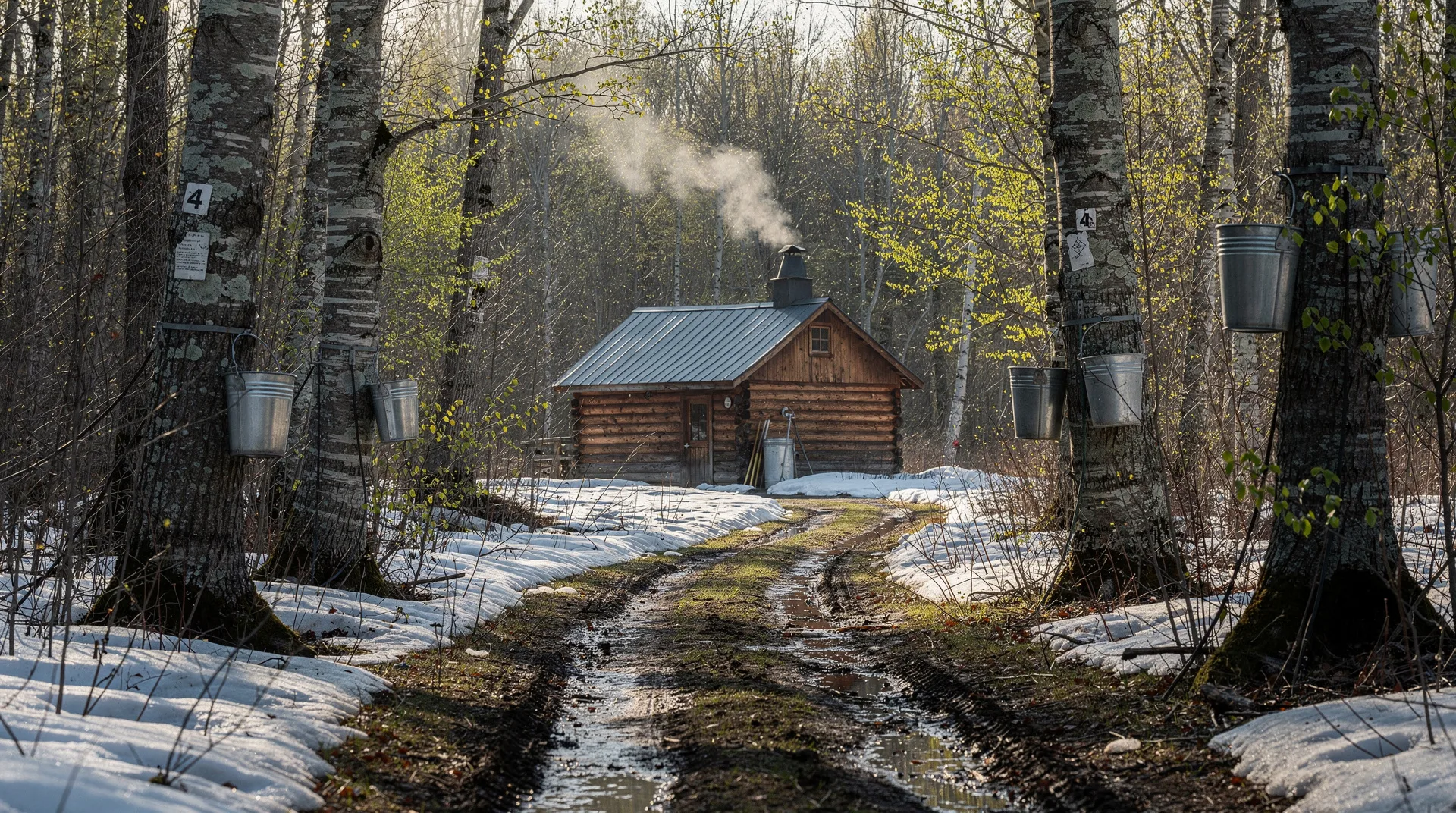
Most shacks offer a tour of the production process. The core equipment has remained essentially unchanged for over a century: taps hammered into maple trees, tubing or buckets collecting the sap, and an evaporator — a wood-fired or gas-fired stainless steel pan — boiling the sap continuously. It takes approximately 40 litres of sap to produce one litre of syrup. Watching the evaporator operate — the rolling boil, the syrup gradually thickening as water evaporates, the hydrometer testing the sugar content — provides a clear and satisfying understanding of why maple syrup commands a premium.
Book a Montreal sugar shack guided excursion with traditional meal includedWhere to go: the best sugar shack regions
The Montérégie: closest to Montreal, earliest season
The flatlands south of Montreal — the Montérégie region between the St. Lawrence and the US border — have the highest density of commercial sugar shacks within easy reach of the city. The main concentration runs through Saint-Hyacinthe, Granby, and the Monteregie agricultural corridor.
Sucrerie de la Montagne near Rigaud (west of Montreal) is one of the most famous and atmospheric, set in a genuine maple forest with horse-drawn sleigh rides and a traditional log sugarhouse. It books up quickly for weekend lunches in peak season.
The Beauce: Quebec’s maple heartland
The Beauce region south of Quebec City — along the Chaudière River valley — is where Quebec’s maple industry is densest. The regional culture is deeply intertwined with maple production; in some Beauce communities, nearly every family has a connection to the industry.
The Érablière du Lac-Beauport near Quebec City and numerous operations along Route 173 south of Lévis offer the full experience within an hour of the provincial capital. For a more immersive visit, the Centre d’interprétation de l’érable in Plessisville (the self-described “maple capital of the world”) provides the deepest context on the industry.
The Laurentians: season + skiing
The advantage of visiting a Laurentians sugar shack is the opportunity to combine the maple experience with late-season skiing. March skiing in the Laurentians — with soft spring snow, warming temperatures, and the knowledge that the season is ending — has its own pleasurable quality. After morning runs at Mont-Tremblant or Mont-Saint-Sauveur, an afternoon at a nearby cabane à sucre fits naturally into the day.
The Eastern Townships: maple with vineyard context
The Cantons-de-l’Est (Eastern Townships) offer a slightly more polished version of the sugar shack experience, reflecting the region’s general orientation toward agrotourism. Several operations in the Brome-Missisquoi and Coaticook areas combine maple production with broader farm visits, and the region’s growing wine scene adds an additional dimension to a spring visit.
Grades and types of maple products
Not all maple syrup is the same, and Quebec’s classification system is worth understanding before you buy.
Golden, Delicate Taste: Light amber colour, delicate flavour. Produced early in the season when sap sugar content is highest and flow temperatures are most stable. Best for salad dressings and delicate applications.
Amber, Rich Taste: The most versatile grade. Standard colour for most commercial maple syrup. Good for everything from pancakes to glazes.
Dark, Robust Taste: Produced mid-to-late season. Stronger maple flavour, better for cooking, marinades, and applications where maple needs to hold its own against other flavours.
Very Dark, Strong Taste: End-of-season syrup with intense, almost bitter maple flavour. Used primarily in commercial food production and for specific culinary applications; rarely the best choice for table syrup.
Beyond syrup, sugar shack shops sell:
- Maple butter (beurre d’érable): Creamed maple syrup, spreadable and intensely flavoured
- Maple sugar: Granulated or powdered, for baking and cooking
- Maple vinegar and beer: Produced by a small number of artisan operations
- Maple jelly and confections: Various forms suited to different uses
Practical logistics
Getting there: Most sugar shacks are located in rural areas 30–90 minutes from Montreal or Quebec City. A car is essential for the majority of operations. Some Montreal-area shacks offer shuttle buses or organised day tours from the city — these are popular with visitors who do not have a rental car.
Reservations: Traditional sugar shack meals are served in sittings (typically noon and sometimes 6pm) with fixed capacity. Weekend reservations during peak season (mid-March) are essential and should be made at least two to three weeks ahead. Weekday visits are easier to arrange at shorter notice.
What to wear: Sugar shacks are typically in maple forests. Snow is usually present in March, and ground conditions vary from packed snow to mud as the season progresses. Waterproof boots are strongly recommended. The shacks themselves are warm; dress in layers you can remove.
Children: Sugar shack visits are among the most family-friendly experiences in Quebec. Children are welcomed, the tire sur la neige activity is universally loved by children, and the casual, communal atmosphere is ideal for families. Many shacks offer sleigh rides, hayrides, and outdoor games as part of the experience.
Book a Quebec City sugar shack experience with traditional meal and maple tourMaple in Quebec beyond the shacks
Sugar season opens the maple experience at source, but Quebec’s maple culture extends through the year:
Le Mondial des Cultures de Drummondville (summer): Incorporates maple-themed food stands alongside international cultural performances.
Île d’Orléans: The agricultural island downstream from Quebec City maintains several maple operations that sell products year-round and welcome visitors outside sugar season for maple museum exhibits.
Montreal and Quebec City restaurants: Both cities’ restaurant scenes incorporate maple throughout the year in ways that go far beyond syrup on pancakes: maple-glazed duck breast, maple vinaigrette, maple-smoked salmon, and maple-based cocktails appear on menus city-wide.
Quebec’s maple liqueurs: Several Quebec distilleries produce maple-flavoured spirits and liqueurs. Coureur des Bois Maple Whisky is the best-known nationally; numerous craft distilleries in the Laurentians and Beauce have their own versions.
Pairing sugar season with the rest of a spring trip
Sugar season sits right at the edge of Quebec’s shoulder season, which makes it easy to combine with other spring activities if the dates line up. Late-season skiers can pair a Laurentians sugar shack with a final run at Mont-Tremblant, while visitors based in Quebec City can combine a Beauce cabane à sucre with a walk through Old Quebec the same day.
If the trip is built entirely around the season, Quebec in April covers the wider shoulder-season picture beyond maple, including what is and isn’t open yet. For travellers weighing whether to time a trip around sugar season versus Quebec’s other signature seasons, summer vs winter Canada and Quebec festivals calendar help frame the trade-offs against peak summer or the winter carnival season.
Related guides
- Quebec in summer: festivals, whale watching and peak season guide
- Quebec in October: peak fall foliage, cranberry harvest and snow geese
- 7 days in Quebec: Montreal, Quebec City and a day in Charlevoix
- Charlevoix 4-day foodie escape
Frequently asked questions about Quebec Sugar Season: When Sugar Shacks Open and Where to Go
Can I visit a sugar shack without a reservation?
For traditional meals, reservations are strongly recommended and often required for weekend sittings during peak season (mid-March). Some larger operations accept walk-ins for their self-guided tours and store visits outside meal sittings. If you want the full meal experience on a specific date in mid-March, book at least two to three weeks ahead — popular shacks fill on weekends from the first week of season.
Is the maple syrup at sugar shacks better than what I can buy in stores?
Yes, typically. Sugar shacks sell their own production — fresh from that season’s sap — and often offer grades and styles that do not reach mainstream distribution. The early-season Golden syrup in particular is rarely available outside the production region during season. Buying directly from the producer also means the provenance is clear and the price is fair without retail mark-up.
What is the difference between a sugar shack visit and buying maple syrup at a supermarket?
The sugar shack experience is primarily cultural and experiential rather than a purchasing exercise. The traditional meal, the production tour, the tire sur la neige, and the communal atmosphere are the attraction. The syrup is excellent and worth buying, but the visit is worth doing even if you only want to take home a small bottle. Think of it as visiting a wine estate rather than just buying wine from a shop.
Does sugar season timing affect which region I should pick?
Yes. Because the Montérégie and Centre-du-Québec run earlier (late February into March) while the Laurentians typically peak later (late March into mid-April), a visit planned for late February is better matched to the south, while a mid-April trip has a better chance of a full season further north. Checking a specific shack’s opening dates for the year is more reliable than relying on the regional averages alone.