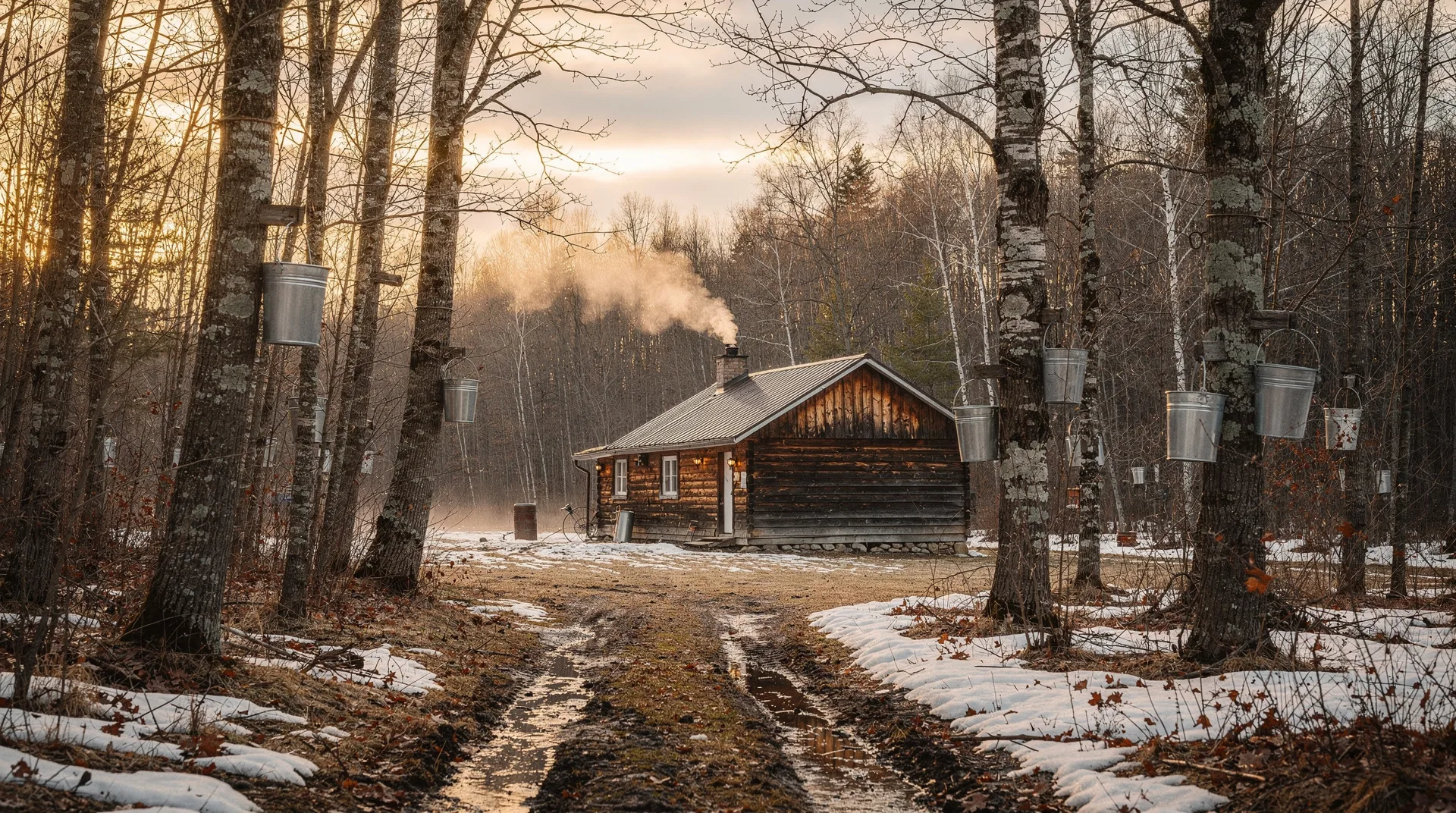
Quebec sugar shacks: the cabane à sucre experience
What is a cabane à sucre (sugar shack)?
A sugar shack is a building where maple sap is boiled down into syrup during early spring. In Quebec, visiting a cabane à sucre is a beloved cultural tradition — families and groups gather for a feast of maple-infused dishes, traditional music, outdoor activities, and the iconic tire sur la neige (maple taffy pulled onto fresh snow).
Quebec’s most beloved seasonal ritual
Every March, as winter loosens its grip on Quebec and the sap begins to run in the maple trees, the province undergoes a collective awakening. The snow is still on the ground, temperatures swing between freezing nights and mild afternoons, and the air smells faintly of wood smoke and sweetness. This is sugaring-off season — the season of the cabane à sucre.
A Quebec sugar shack experience is one of the most distinctively Canadian things you can do. It is simultaneously a practical agricultural enterprise (maple syrup production), a cultural ritual, a family reunion occasion, and a gastronomic adventure. The cabane à sucre (literally “sugar hut”) is where maple sap collected from thousands of tapped trees is boiled in large evaporator pans until it reduces to syrup — a process requiring about 40 litres of sap to produce a single litre of maple syrup.
For visitors, the sugar shack experience means gathering in a large, rustic building fragrant with steam and woodsmoke, eating enormous quantities of traditional food, listening to folk music (often a fiddle player and accordion), and participating in the great ceremonial highlight of the season: tasting tire sur la neige — fresh maple syrup ladled onto packed snow, rolled into a taffy on a wooden stick, and eaten immediately.
At a glance
| Where | Montérégie, Lanaudière, Chaudière-Appalaches and Laurentides, roughly 30-90 minutes from Montreal or Quebec City |
| Cost | Around CAD $25-50/adult, CAD $12-20/child for the full feast; some charge admission plus menu items |
| Time needed | Half a day (2-4 hours including the meal, sleigh ride and tire sur la neige) |
| Getting there | Car required — most sugar shacks are rural and not served by public transit |
| Best time | Mid-March through the first week of April; reserve weekends well ahead |
When to visit: the sugaring-off season
Mid-March through April is sugar shack season. The precise timing depends on temperature: maple sap runs when days are above 0°C and nights fall below 0°C — the freeze-thaw cycle drives the sap upward. In most years, production is heaviest in the last two weeks of March and the first week of April.
March weekends are the busiest time. Quebec families treat the cabane à sucre outing as an annual pilgrimage, and popular sugar shacks book up quickly. If visiting on weekends in late March, reserve weeks in advance.
Early April tends to be slightly quieter as sap quality begins to decline. The syrup at this stage of the season is darker and more robustly flavoured (Grade A Dark or Grade B production) — many Quebec connoisseurs prefer this late-season syrup.
The season typically ends by mid-April in southern Quebec as temperatures warm consistently above 0°C. Some sugar shacks have extended their visitor season into summer and fall with permanent restaurant operations, but the authentic sugaring experience requires being there in spring.
The traditional sugar shack feast
The meal at a cabane à sucre is legendary in its quantity and unapologetic in its use of maple syrup and pork fat. It is not diet food. It is January-to-April-and-your-body-needs-fuel food, and it is wonderful.
A typical cabane à sucre feast includes:
Soupe aux pois — thick pea soup, slow-cooked and deeply savoury. Often the first course, setting the stage for what follows.
Oreilles de crisse — literally “Christ’s ears” — crispy deep-fried salt pork rinds. Usually served with maple syrup for dipping. Crunchy, salty, sweet, and absolutely addictive.
Saucisses — pork sausages, typically served with maple syrup.
Jambon — ham, glazed or served with maple syrup.
Oeufs dans le sirop — eggs fried in lard or cooked directly in maple syrup.
Fèves au lard — baked beans cooked with salt pork and maple syrup. A Quebec comfort food standard.
Tourtière — the meat pie of Quebec, spiced with cloves and allspice.
Grands-pères dans le sirop — dumplings cooked in maple syrup. Simple, sweet, and satisfying.
Pouding chômeur — “poor man’s pudding,” a depression-era dessert of yellow cake with a maple syrup sauce that pools beneath the batter during baking and creates a sticky, caramel base. One of the great desserts of Quebec.
Tire sur la neige — the climax of the feast. Maple syrup boiled to soft-candy stage is poured over a long trough of packed snow or a table of fresh snow; visitors roll it onto wooden sticks as it cools and pull it into taffy. The contrast of the sweet warm taffy against the cold snow is perfect. Children (and adults) run back for multiple rounds.
The meal is typically served buffet-style or family-style at long communal tables, and seconds (and thirds) are expected. Arrive hungry.
If the feast whets your appetite for Quebec’s wider table, the French-Canadian cuisine guide explains where dishes like tourtière and pouding chômeur come from, and the Quebec food deep dive shows how to keep eating well once the sugaring season is over.
Find Quebec City food and culture experiences on GetYourGuideWhere to find the best sugar shacks
Quebec’s sugar shacks are concentrated in several main regions within an hour or two of Montreal and Quebec City.
Montérégie region (south shore of Montreal) has the highest density of cabanes à sucre. The Richelieu Valley, Monteregie, and Estrie regions are all within 45–90 minutes of central Montreal.
-
Sucrerie de la Montagne in Rigaud is one of the most famous and traditional sugar shacks in Quebec. Owner Pierre Faucher has maintained an intensely authentic experience for decades — no electricity, wood-fired evaporator, fiddle music, traditional feast, and a genuine heritage property. It is one of the most photographed sugar shack operations in the province.
-
Érablière Au Sous-Bois in Sainte-Brigide-d’Iberville is beloved for its setting and authentic approach.
-
Cabane à sucre Constantin near Saint-Eustache is a popular family-oriented operation with traditional meals and extensive activities.
Lanaudière region (north of Montreal) has numerous family-run operations in a more rural setting.
Chaudière-Appalaches (south shore of Quebec City) is one of the province’s most active maple production regions. Several large-scale operations near Beauce County welcome visitors.
Laurentides (north of Montreal, ski country) combines a sugar shack visit with a weekend at a ski resort — visit a cabane à sucre on Saturday afternoon after a morning on the slopes.
Near Quebec City: Several excellent operations are within 30–45 minutes of the city, making them accessible for visitors based in the capital. Check with the local tourism office for current recommendations.
If you want to understand which areas of the province are most tied to maple production before choosing a shack, the Quebec maple regions guide maps them out, and the Eastern Townships destination page is a good base if you would like to pair a sugar shack meal with a wider countryside stay.
Activities beyond the feast
The meal is the heart of the experience, but sugar shack visits typically include outdoor activities and cultural programming.
Sleigh rides: Horse-drawn sleigh rides through the maple forest are a classic element of the sugar shack visit. Often running for 20–30 minutes through the woods, they allow you to see the tapped trees and sap collection lines while wrapped in blankets.
Maple forest walks: Many operations invite visitors to walk through the sugar bush — the maple forest — and see the tap holes and collection pipes or buckets up close. Some operations still use traditional metal pails hanging from the trees; others use extensive networks of plastic tubing.
Watching the evaporation: The evaporator building is often open to visitors, allowing you to watch (and smell) the transformation from watery sap to thick, amber syrup. The steam rising from the evaporator pans is spectacular.
Folk music: A good fiddler and accordion player are standard at many traditional sugar shacks. Dancing (often square dancing or traditional Quebec folk styles) is encouraged after the meal.
Activities for children: Sugar shacks are extremely family-oriented. Many offer sleigh rides, games, and additional hands-on maple activities designed for children.
Maple products to buy at the shack
The sugar shack visit is also the best opportunity to buy maple products directly from the producer — fresher, better, and often cheaper than retail.
Maple syrup in four grades: Golden (most delicate), Amber (balanced, all-purpose), Dark (robust flavour, excellent for cooking), Very Dark (intense, strongly maple-flavoured). Most visitors buy a 540ml or 1L tin.
Maple butter / maple cream: Maple syrup whipped to a creamy, spreadable consistency. Extraordinary on toast, bannock, or directly from a spoon.
Maple taffy (tire): Sold in small rounds or strips, the same product as the tire sur la neige but in packaged form for taking home.
Maple sugar: Granulated or formed into moulds. Use it as a substitute for regular sugar in baking or coffee.
Maple vinegar: A less well-known product that is excellent in salad dressings and marinades.
Confiseries: Maple candies, lollipops, and chocolate-covered maple treats. Perfect gifts.
Practical tips: planning your sugar shack visit
Reservations: Essential for weekends in March. Many popular sugar shacks book up two to three weeks ahead for prime March Saturdays. Book online or by phone; some accept email reservations.
Cost: A full traditional meal including tire sur la neige typically costs CAD $25–$50 per adult, CAD $12–$20 for children. Some operations charge admission plus menu items separately.
Dress: Dress warmly and wear waterproof boots. The traditional sugar shack experience involves standing outside in late winter conditions. Temperatures in late March can still be -5°C to +5°C. Layering is essential.
Driving: Most sugar shacks are in rural areas and require a car. From Montreal, expect 45–90 minute drives. From Quebec City, 30–60 minutes. GPS addresses can be unreliable in rural Quebec — print or screenshot directions as backup.
Language: Many traditional sugar shacks operate primarily in French. This should not deter non-French speakers — the universal language of good food crosses all barriers, and staff at tourist-oriented operations speak English. Simply smile and follow everyone else’s lead. A few words of courtesy go a long way, and the speaking French in Quebec guide has simple phrases that make the staff and other diners smile.
Combining a sugar shack visit with Quebec City or Montreal
From Montreal: A sugar shack visit makes an ideal day trip. Leave the city by 10am, visit the cabane for a late-morning or noon feast, spend the afternoon in the maple forest, and return to Montreal by dinner. The Montérégie region southeast of Montreal has the most accessible options.
From Quebec City: Combine a sugar shack visit with time in Old Quebec. Several operations in Chaudière-Appalaches are an easy 30-minute drive from the Old City. A two-night Quebec City stay with a morning or afternoon at a sugar shack is a perfect spring itinerary.
Explore Montreal and Quebec cultural experiencesSee also the maple dishes and products guide for how maple fits into broader Canadian food culture, and the Vieux-Montreal guide for the best of Montreal beyond the shacks.
Traditional vs modern sugar shacks
Not all cabanes à sucre are the same, and picking the right style matters more than picking the right region.
| Traditional (heritage) | Modern (commercial) | |
|---|---|---|
| Atmosphere | Wood-fired evaporator, no electricity, fiddle music, farmhouse tables | Large dining hall, buffet service, bigger groups |
| Group size | Small, intimate (20-80 guests) | Large (100-400+ guests), especially on weekends |
| Food | Family-recipe, cooked on site | Buffet-style, still traditional dishes but higher volume |
| Booking window | 2-3 weeks ahead for March weekends | Book further ahead — popular ones fill a month out |
| Best for | Couples, small groups, first-timers wanting the “real” version | Families, large groups, tour groups |
If you only have one shot at the experience, a smaller heritage operation (like Sucrerie de la Montagne) gives a noticeably more authentic afternoon than a high-volume commercial one, but it costs more to book last-minute and fills up faster.
For the wider context of how maple fits into the province’s food calendar, see the Quebec sugar season guide and the Canadian maple syrup complete guide.
Frequently asked questions about Quebec sugar shacks: the cabane à sucre experience
Can I visit a sugar shack if I don’t speak French?
Yes, absolutely. Sugar shacks near Montreal and Quebec City that cater to visitors generally have bilingual staff and English menus. Some traditional operations in more rural areas are primarily French, but the experience is sufficiently visual and experiential that language matters less than it might in a formal dining setting.
Are sugar shacks suitable for vegetarians?
Traditional cabane à sucre menus are heavily pork-based. Most operations now offer some vegetarian alternatives, but advance notice (when booking) is helpful. Some modern sugar shack operations have specifically developed vegetarian or vegan menus. Ask when booking.
Is it worth visiting in April after the main rush?
Yes, especially mid-April on weekdays. Crowds are smaller, the maple forest is beginning to show signs of spring, and the late-season syrup is darker and more flavourful. The tire sur la neige experience requires snow, so check that snow conditions are still suitable at your chosen sugar shack.
Can I do a sugar shack visit as a day trip from Montreal?
Absolutely — it’s one of the most popular day trips from the city during maple season. Sucrerie de la Montagne in Rigaud is about 60 km west of Montreal. Numerous operations in the Monteregie south shore are 45–70 km from central Montreal.
What is the difference between maple syrup grades?
The four Canadian maple syrup grades are determined by colour and flavour intensity. Golden/Delicate is the lightest and most subtle — ideal for pancakes or eating on its own. Amber/Rich is the most versatile all-purpose syrup. Dark/Robust has an intense maple flavour good for baking and glazing. Very Dark/Strong is the most powerfully flavoured, excellent in savoury cooking.
How much maple syrup can I bring home?
Maple syrup is allowed in both carry-on (if under 100ml per container and in a liquid bag) and checked baggage in larger quantities. Tins of 540ml and 1L are the practical choices for travel. Customs in most countries allow personal quantities of food products.
Are sugar shacks open year-round?
Some operations have expanded beyond the sugaring season to serve as year-round restaurants or event venues, but the authentic maple production and tire sur la neige experience is exclusively available during sugaring-off season (mid-March to mid-April in most years). A summer visit to a sugar shack property is pleasant but misses the essential magic.
Do I need a car to visit a sugar shack?
In almost all cases, yes. The vast majority of cabanes à sucre are in rural areas without public transit access. A few operators near Montreal offer shuttle packages during peak season — check directly with the sugar shack or a tour operator before booking if you don’t have a car.
How does a sugar shack visit compare to buying maple syrup at a grocery store?
Buying at the source means fresher product, a wider range of grades (including small-batch dark syrup rarely sold retail), and direct support for the producer — often at a similar or lower price than supermarket tins. It’s also the only way to get genuine tire sur la neige, which isn’t sold outside sugar shack season.