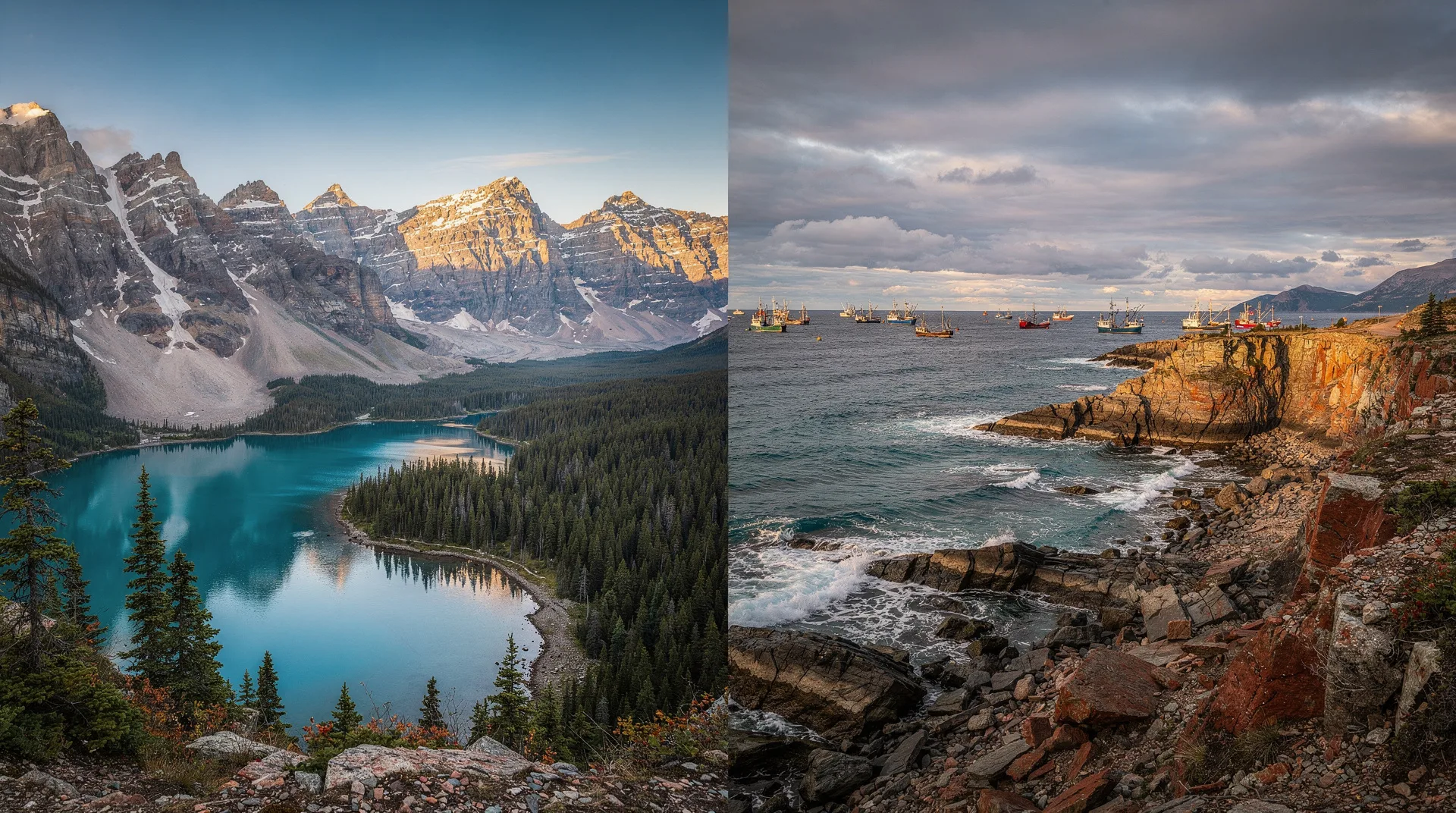
BC Rockies vs Alberta Rockies: Which Side Should You Visit?
Should I visit the BC Rockies or the Alberta Rockies?
Alberta (Banff, Jasper) has the most famous scenery and best infrastructure. BC (Revelstoke, Golden, Yoho, Kootenay) has fewer crowds, superior skiing, and is often just as beautiful. Most visitors to the Rockies should explore both sides.
At a glance
| Alberta side | Banff, Lake Louise, Jasper, Icefields Parkway |
| BC side | Yoho, Kootenay National Park, Revelstoke, Golden |
| Park pass | required on both sides (Parks Canada Discovery Pass or day pass) — neither is free entry |
| Getting there | Alberta side via Calgary Airport (around 90 min to Banff); BC side via Kelowna or Calgary plus a longer drive |
| Best time | July-August for full access; late Sept-early Oct for fall colour and thinner crowds on both sides |
The mountain range that straddles two provinces
The Canadian Rockies do not respect provincial boundaries. The mountain range runs northwest–southeast along the BC–Alberta border, with the Continental Divide determining which side each peak belongs to. The result is that some of Canada’s most spectacular mountain scenery lies directly on the border or within a short drive of crossing it.
Most first-time visitors to the Canadian Rockies visit Alberta — specifically Banff National Park and the Icefields Parkway to Jasper. This is understandable: Banff is famous worldwide, the infrastructure is excellent, and the scenic drive between the two parks is genuinely one of the world’s great road trips.
What many visitors do not know is that the BC side of the Rockies contains national parks and mountain communities that are equally spectacular, significantly less crowded, and — in some cases — better for specific activities like skiing or backcountry hiking.
This guide compares the two sides honestly.
The Alberta Rockies at a glance
Banff and Jasper National Parks
Banff National Park is Canada’s most visited national park and the country’s most recognisable mountain landscape. Lake Louise, Moraine Lake, the town of Banff, and the Icefields Parkway are all global icons. The infrastructure is exceptional: well-maintained roads, hundreds of hiking trails, excellent accommodation at all price points in Banff town and Lake Louise, and gondola access at Banff (Sulphur Mountain) and Lake Louise.
Jasper National Park to the north is larger and less developed than Banff — a 10,878 km² park with fewer visitors and more wilderness. The town of Jasper is smaller and more relaxed than Banff. The Icefields Parkway between the two parks is 230 kilometres of continuous mountain scenery that deserves its reputation.
The iconic highlights:
- Lake Louise (and the controversial but spectacular Moraine Lake)
- The Icefields Parkway — 230 km of mountain highway through one of the world’s great landscapes
- Athabasca Glacier and the Columbia Icefield (the largest icefield south of the Arctic circle in Canada)
- Banff Gondola at Sulphur Mountain
- Maligne Lake in Jasper
- The town of Banff — well-serviced, attractive, with a good restaurant and arts scene
The crowds problem: Banff and Jasper receive millions of visitors per year. Moraine Lake requires timed entry or shuttle reservations from mid-May to mid-October. Lake Louise is crowded throughout summer. The Icefields Parkway can be congested in July and August. This is not an argument against visiting — the scenery justifies tolerating the crowds — but it is a reality to plan around.
Browse Banff and Jasper tours and activitiesThe BC Rockies at a glance
The “BC Rockies” is an informal term covering the national parks and mountain communities on the British Columbia side of the divide — roughly the Columbia Basin, the Kootenays, and the mountain communities of Golden, Revelstoke, Fernie, and Nelson.
Yoho National Park
Yoho (translating to “awe and wonder” in Cree) sits directly west of Banff on the BC side of the Continental Divide. It is smaller than Banff but contains some of the most dramatic scenery in the Rockies:
- Lake O’Hara — widely considered BC’s most beautiful mountain lake. Access is by reservation-only bus from the parking lot (very limited, books out months in advance). The lake itself and the surrounding trail network are extraordinary even by Rocky Mountain standards
- Takakkaw Falls — 373 metres, one of the tallest waterfalls in Canada. Accessible by a short walk from a parking area
- The Spiral Tunnels — a remarkable piece of railway engineering (the Trans-Canada Railway drilled spiral tunnels through the mountains to reduce the grade; trains loop inside the mountain and emerge above or below where they entered)
- Emerald Lake — a glacially-fed turquoise lake with a lodge and excellent walking trails
Yoho is often treated as an add-on to a Banff visit (it is directly adjacent, 90 minutes west of Banff on the Trans-Canada), but it deserves its own time. Crowds are significantly lighter than Banff.
Kootenay National Park
Kootenay adjoins Banff on the south, accessible via Highway 93 South from Lake Louise. The park contains the Radium Hot Springs (natural mineral springs with two outdoor pools at the southern entrance to the park), the Paint Pots (iron-oxide mineral springs that pool on the forest floor in distinctive red formations), and extensive hiking through mountain and river valley terrain.
Kootenay sees a fraction of Banff’s visitors despite sharing its border. The highway through the park is dramatic, with the mountains of the Main Range visible to the east.
Revelstoke and Rogers Pass
Revelstoke is the mountain town most often cited by BC Rockies enthusiasts as a model for what mountain communities should be. A small city (population ~8,000) at the junction of the Columbia River and the Selkirk Mountains, it has:
- Revelstoke Mountain Resort — a cult destination among serious skiers for its extreme vertical drop (1,713m, greater than Whistler), deep interior snowpack, and uncrowded runs. Consistently ranked among the world’s top resorts by powder-focused ski media despite its limited lift infrastructure
- Mount Revelstoke National Park — a compact park with exceptional wildflower meadows accessible by Summit Road (one of BC’s finest drives)
- Glacier National Park (adjacent) — centred on Rogers Pass, a historic mountain crossing used by the Trans-Canada Railway and now the Trans-Canada Highway. The Rogers Pass Discovery Centre covers the engineering history and the park’s remarkable alpine ecology
Golden and the Kicking Horse River
Golden sits at the junction of the Trans-Canada and Highway 95, 80 kilometres west of Banff. It is the gateway to:
- Kicking Horse Mountain Resort — another cult powder destination. 2,750 metres of elevation, the highest top elevation of any Canadian ski resort. Limited crowds, exceptional terrain for advanced skiers, and reliable interior powder
- Kicking Horse River — one of BC’s premier whitewater rafting rivers, with Class IV rapids accessible to guided beginners
- Blaeberry Valley and the Columbia River Wetlands — one of the most significant bird and wildlife habitat wetlands in North America, on the eastern edge of Golden
The Kootenays (Nelson, Kaslo, Fernie)
The West Kootenays — centred on Nelson — are one of the most distinctive regions in BC: a mountain arts community with a strong heritage of alternative culture, a beautifully preserved heritage downtown above Kootenay Lake, hot springs, exceptional skiing at Whitewater Ski Resort, and a food and art scene disproportionate to the population.
Fernie, in the East Kootenays near the Alberta border, has similarly excellent skiing (Fernie Alpine Resort), a heritage downtown, and a local culture focused on outdoor recreation.
Head-to-head comparison
Scenery
Tie, with different characters.
Alberta’s famous landmarks — Moraine Lake, the Icefields Parkway, the Columbia Icefield — are genuinely among the world’s most spectacular mountain landscapes. If you have seen the photographs and want to experience them in person, go to Alberta.
BC’s mountain scenery is equally spectacular but less branded. Emerald Lake in Yoho is not less beautiful than Lake Louise; it is simply less famous. The Rogers Pass highway is as impressive as the Icefields Parkway; it receives one-tenth the visitors.
If your priority is experiencing world-famous landscapes you already know by photograph, Alberta wins. If you want equivalent scenery with fewer crowds, BC wins.
Skiing
BC wins substantially.
Revelstoke Mountain Resort and Kicking Horse are both in a different category from Lake Louise (the main Alberta Rockies ski destination). Revelstoke’s vertical drop of 1,713 metres is the greatest of any ski resort in North America. Its snowpack — driven by Pacific moisture meeting the Interior cold — is exceptional. Both resorts attract a skilled, powder-focused clientele who specifically seek out BC’s Interior mountain skiing.
Whistler, while not in the Rockies, adds further weight to BC’s skiing dominance — it is a Vail Resorts property with lift infrastructure and village quality that neither Revelstoke nor Kicking Horse can match.
For serious skiers, BC is the answer.
Wildlife
Tie.
Both sides of the Rockies have abundant wildlife. Grizzly bears, black bears, elk, moose, bighorn sheep, mountain goats, wolves, and wolverines inhabit both the BC and Alberta national parks. The roadside wildlife viewing on the Icefields Parkway is famous — elk are regularly seen near Jasper town, wolves occasionally cross the highway, bears are spotted each spring.
On the BC side, the Columbia River Wetlands near Golden have outstanding bird populations. The Kootenay region supports healthy populations of grizzly bears with some guided viewing opportunities.
Crowds and price
BC wins substantially on both counts.
Banff town in July is extraordinary for crowds — the town of 9,000 receives more than 4 million visitors per year. Accommodation is expensive and books out months ahead in summer. Timed entry reservations for Moraine Lake require planning.
The BC Rockies communities (Golden, Revelstoke, Nelson, Kaslo) receive a small fraction of Banff’s visitors. Accommodation is significantly cheaper; restaurants are easier to book; hiking trails are uncrowded. The trade-off is a lower overall level of tourist infrastructure — fewer guided tour options, less polished visitor facilities.
Infrastructure and accessibility
Alberta wins.
Banff is 90 minutes west of Calgary Airport (YYC) on an excellent divided highway. Calgary has direct flights from almost every North American hub city and many European ones. The infrastructure within Banff (roads, trails, accommodation, guided tours, gondolas) is world-class.
Getting to Revelstoke requires either flying to Kelowna and driving 3 hours east, or flying to Calgary and driving 3.5 hours west, or driving 6 hours from Vancouver. The infrastructure in Revelstoke is growing but still limited compared to Banff.
For first-time Canada visitors who want a mountain experience without logistical complexity, Alberta is more accessible.
Recommended itinerary: doing both
The ideal Canadian Rockies trip crosses the Continental Divide and explores both sides. A 7–10 day Rockies itinerary might look like:
Day 1–2: Fly into Calgary. Drive to Banff. Lake Louise and Moraine Lake (early morning before crowds).
Day 3: Icefields Parkway to Jasper (full day drive with stops — Athabasca Falls, Sunwapta Falls, the Glacier).
Day 4: Jasper area. Maligne Canyon, Spirit Island (if time allows).
Day 5: Drive south from Jasper back toward Golden/Yoho via Highway 93 (the Icefields Parkway south section).
Day 6: Yoho National Park — Emerald Lake, Takakkaw Falls, Spiral Tunnels viewpoint.
Day 7–8: Revelstoke or the Kootenays. Drive west on the Trans-Canada to Revelstoke; or south on Highway 95 to Golden and the Kootenays.
Day 9–10: Return via the Trans-Canada to Vancouver, or fly from Kelowna.
This loop gives you the Alberta classics (Banff, Icefields Parkway, Jasper) with the BC counterbalance (Yoho, Revelstoke, the character of a smaller mountain community).
See the 14-day BC grand circuit for a coast-to-mountains version of this approach.
Browse Canadian Rockies tours and experiencesOur verdict
Go to Alberta first if this is your only or first Rocky Mountain trip. Banff and the Icefields Parkway are Canadian iconic experiences that justify the crowds.
Go to BC if you have already done Alberta; if skiing is the priority (Revelstoke, Kicking Horse, or Whistler); if you want to avoid crowds; or if you are already based in Vancouver and the drive to Kelowna or Revelstoke makes geographic sense.
Do both if you have 10+ days and want the most complete Rockies experience available.
Park passes and practical costs on both sides
Both sides of the border sit inside Parks Canada national parks, and neither is free to enter — a Discovery Pass (annual, covers multiple parks) or a day pass is required at Banff, Jasper, Yoho and Kootenay alike, and the pass is checked at highway entry gates. Budget accordingly: a family day pass runs roughly CAD 20-30, while a Discovery Pass covering a longer multi-park trip is usually better value if you are visiting more than about a week. On top of the park pass, popular add-ons are separately ticketed — the Banff Gondola, the Columbia Icefield Skywalk, and the Lake O’Hara bus in Yoho all carry their own fees and, in Lake O’Hara’s case, a reservation that books out months ahead.
Wildlife and safety on both sides
Bear activity is a genuine consideration on both sides of the divide, not just a brochure warning — grizzly and black bears are present in Banff, Jasper, Yoho and Kootenay alike, and backcountry hikers on either side should carry bear spray and know how to use it. The BC side’s lower visitor numbers mean animals on trails around Yoho and Kootenay can be less habituated to people than the well-trodden paths around Lake Louise, which argues for extra caution rather than less.
Frequently asked questions about BC Rockies vs Alberta Rockies
Is it worth visiting both the BC and Alberta Rockies in one trip?
Yes, if you have 7-10 days or more. The two sides are directly adjacent — Yoho is about 90 minutes from Banff — so a loop that covers both the Alberta icons and the quieter BC parks does not require major extra driving, just extra time.
Do I need a separate park pass for the BC side?
The Discovery Pass covers all Parks Canada national parks nationwide, including Banff, Jasper, Yoho and Kootenay, so one annual pass works on both sides of the border. A single-park day pass, by contrast, only covers the park it was bought for.