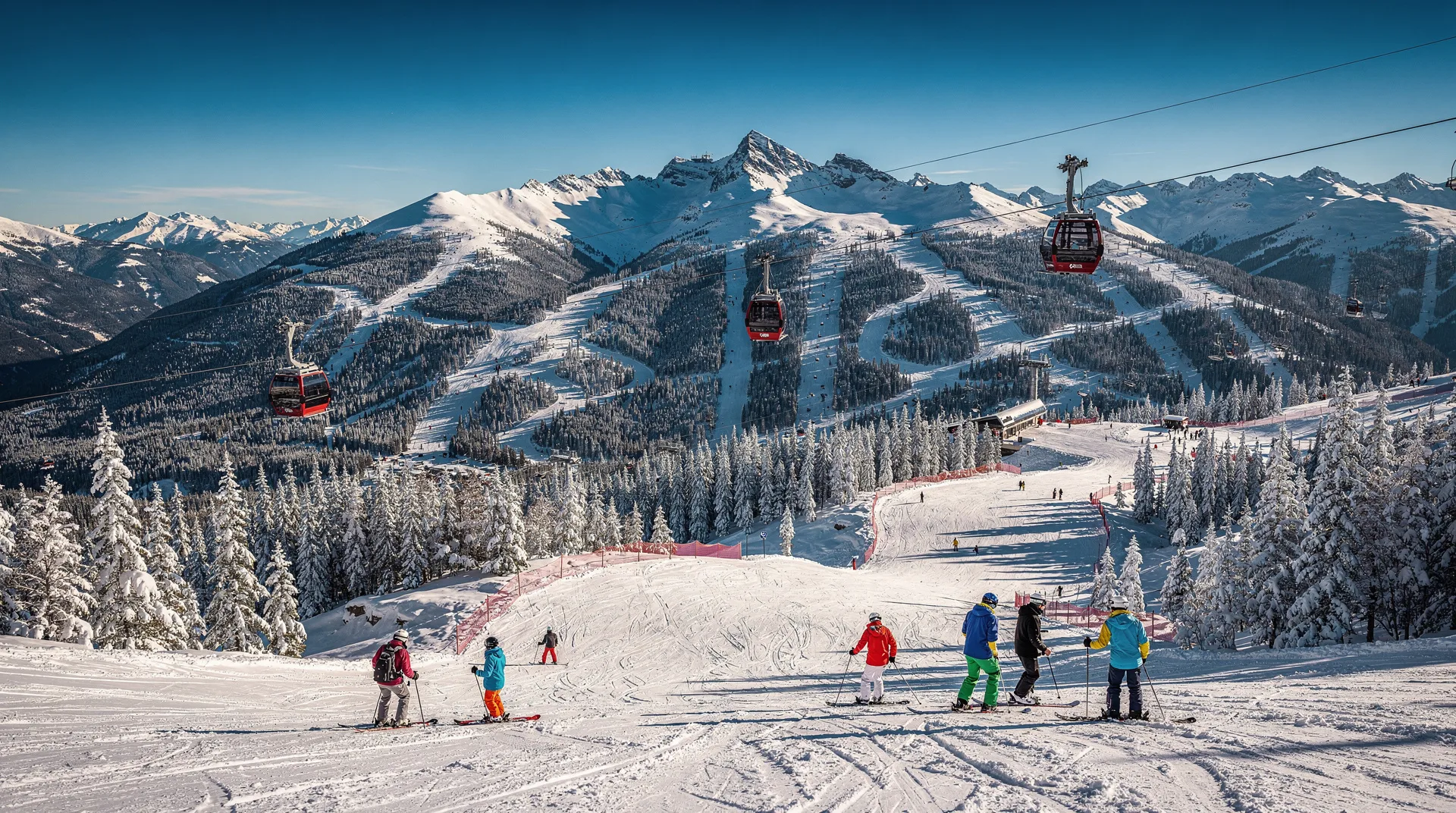
Whistler vs Sun Peaks: BC's Top Two Ski Resorts Compared
Which is better for skiing: Whistler or Sun Peaks?
Whistler is BC's world-class resort — unmatched terrain, better snow quality, and a superior village. Sun Peaks is BC's second largest resort: quieter, cheaper, and excellent for intermediate skiers who want to avoid Whistler's crowds and prices.
Two resorts, two very different experiences
Whistler and Sun Peaks are British Columbia’s two most significant ski resorts after each other. They are separated by roughly 400 kilometres, different in almost every characteristic — terrain, snow, village, price, clientele — and both excellent within their respective contexts.
Choosing between them is not a matter of one being objectively better. It is a matter of knowing what kind of skiing holiday you want.
At a glance
| Whistler | Sun Peaks | |
|---|---|---|
| Where | 120 km north of Vancouver | 55 km north of Kamloops |
| Cost | Daily lift ticket around CAD 170-230 | Daily lift ticket around CAD 100-145 |
| Time needed | 4-7 days to make the most of the terrain | 3-4 days covers the terrain comfortably |
| Getting there | Sea-to-Sky Highway from Vancouver, ~2 hrs | Via Kamloops (flight or 4-hr drive from Vancouver), then a 45-min transfer |
| Best time | January for the best snow-crowd balance | Any winter month; quieter than Whistler year-round |
The basics
| Whistler Blackcomb | Sun Peaks | |
|---|---|---|
| Location | 120 km north of Vancouver | 55 km north of Kamloops; 375 km from Vancouver |
| Skiable terrain | 8,171 hectares | 4,270 hectares |
| Vertical drop | 1,609 m | 881 m |
| Number of runs | 200+ | 137 |
| Longest run | 11 km | 8 km |
| Lifts | 37 | 12 |
| Annual snowfall | ~11 m (base) | ~6 m |
| Base elevation | 652 m | 1,255 m |
| Summit elevation | 2,182 m | 2,152 m |
| Mountain range | Coast Mountains | Interior Plateau/Shuswap Highlands |
Terrain comparison
Whistler Blackcomb
Whistler-Blackcomb is the largest ski resort in North America by skiable terrain and is consistently ranked among the top five resorts in the world. The two mountains — Whistler Mountain and Blackcomb Mountain — are connected by the Peak 2 Peak Gondola, a 4.4-kilometre cable span that constitutes a world record for gondola engineering.
The terrain is genuinely vast. A committed intermediate skier could ski different runs every day for a week without repeating. The upper mountain terrain (above the tree line, accessed via the Peak chairlifts) is some of the most spectacular lift-accessed skiing in North America: open bowls, glaciers, and ridgelines with views of the Coast Mountains in every direction.
Advanced terrain includes Blackcomb’s Couloir Extreme, the Glacier runs, the Double Black Diamond chutes off the West Bowl, and the terrain parks that have consistently produced Olympic halfpipe athletes.
The base area has extensive beginner terrain, and Whistler has invested heavily in beginner infrastructure — the learning zone at Whistler Creekside is well-designed. But Whistler is not especially known as a beginner mountain.
Best terrain for: Intermediate and advanced skiers with multiple days; first-timer groups where the variety of terrain suits mixed ability levels; anyone who wants to ski glaciers.
Sun Peaks
Sun Peaks is BC’s second-largest resort by skiable terrain — fourth in Canada. The resort covers three distinct mountains: Mount Morrisey, Tod Mountain, and Sundance. The terrain is predominantly intermediate, with a good selection of blue runs through the trees.
The snow conditions at Sun Peaks differ fundamentally from Whistler’s. The resort sits in BC’s Interior, where the climate is colder and drier than the coast — the snowpack is lighter and drier, less affected by the coastal “Cascade Cement” wet snow that can plague Whistler’s lower elevations. When Whistler is getting rain at the base, Sun Peaks often has fresh powder.
The lower vertical drop (881m vs Whistler’s 1,609m) is the most significant terrain limitation. Advanced skiers will exhaust the challenging runs within a day or two. The resort’s longest run (8 km) is excellent, but the Black Diamond options are limited compared to Whistler.
Best terrain for: Intermediate families; people skiing 3–4 consecutive days who want variety without extreme steepness; powder seekers who want interior snow quality; groups with a wide range of abilities.
Snow quality
Whistler
Whistler’s snow is legendary in reputation but complicated in reality. The resort receives approximately 11 metres of annual snowfall — one of the highest totals for any ski resort in North America. The problem is elevation and temperature.
The base village sits at 652 metres — low enough that warm coastal air can turn snow to rain at the base while the upper mountain is perfect. January rain events at Whistler Base (while the top is 30cm of fresh powder) are not uncommon. This frustrates visitors who expect continuous perfect conditions.
The glacier terrain above 2,000 metres holds excellent snow throughout the season. The Peak 2 Peak Gondola accesses this terrain easily. Skiing the upper mountain consistently produces the best conditions.
Powder day strategy at Whistler: The best powder days at Whistler are exceptional. Locals know to check conditions and call in sick when 30cm lands overnight. Getting on the mountain within the first hour is essential — the terrain is so popular that fresh snow is tracked out quickly on major runs.
Sun Peaks
Sun Peaks’ interior location means consistently cold, dry, light snow — “champagne powder” conditions that coastal resorts rarely achieve. The base sits at 1,255 metres, and cold temperatures mean snow stays light even in warmer periods.
The trade-off is volume. Sun Peaks receives roughly half the annual snowfall of Whistler. The snowpack is reliable (typically 150cm+ at the base by January) but storms are less frequent and powder days less dramatic in scale.
For reliable, consistent snow quality over several days of skiing, Sun Peaks often outperforms Whistler’s base area in mixed weather conditions.
Village comparison
Whistler Village
Whistler Village is one of the world’s great ski resort villages — entirely pedestrian, compact and walkable, with an architecture designed specifically to feel like a European mountain town. The accommodation, restaurants, bars, and shops are all within 15 minutes’ walk of each other and of the gondola bases for both mountains.
The village has excellent restaurants across all price points. Araxi (fine dining), Bearfoot Bistro (known for its 24,000-bottle wine cellar and champagne sabering at the table), Quattro, and dozens of mid-range and casual options. The après-ski culture is well-established with a strong nightlife scene.
Cultural programming includes the Squamish Lil’wat Cultural Centre (an outstanding First Nations cultural facility) and the Whistler Museum. The Olympic Legacy infrastructure from 2010 is still in active use (the sliding centre offers public bobsled experiences).
In summer, the village is equally active: gondola hiking, mountain biking, Vallea Lumina (a night walk multimedia experience), festival programming, and the pedestrian mall culture that makes European mountain villages so pleasant.
Sun Peaks Village
Sun Peaks Village is smaller, quieter, and more recent in origin — built from the 1990s onward with a similarly European-inspired aesthetic. The village is car-free at its core and genuinely charming, with accommodation, restaurants, and ski area access integrated effectively.
The scale difference from Whistler is significant. Sun Peaks has perhaps a dozen restaurant options versus Whistler’s 100+. The nightlife is more subdued — a good thing if you are travelling with children or prefer a quiet evening; a limitation if you want a buzzing après-ski scene.
The village’s quieter character is a genuine advantage for families and couples who want a relaxed mountain resort experience without the Whistler-scale crowds and noise.
Price comparison
| Category | Whistler | Sun Peaks |
|---|---|---|
| Daily lift ticket (walk-up) | CAD 170–230 | CAD 100–145 |
| Season pass (Epic Pass equivalent) | CAD 1,200+ (Ikon not included) | CAD 700–900 |
| Budget accommodation (per room) | CAD 200–350/night | CAD 120–200/night |
| Mid-range accommodation | CAD 400–700/night | CAD 200–350/night |
| Luxury accommodation | CAD 800–2,000/night | CAD 400–700/night |
| Dinner for two (mid-range) | CAD 100–160 | CAD 70–110 |
Whistler is approximately 40–60% more expensive than Sun Peaks across all categories. For a family of four skiing 5 days, the price difference easily exceeds CAD 2,000 including accommodation, lifts, and food.
Pass compatibility: Whistler-Blackcomb is a Vail Resorts property on the Epic Pass. Sun Peaks is an Ikon Pass property. If you already hold one of these passes, it may significantly influence your decision — both passes offer substantial discounts at their affiliated resorts.
Getting there
Whistler: 120 km north of Vancouver on the Sea-to-Sky Highway. Drive time 1h40m–2h (longer on Friday evenings). Coach service (Whistler Direct) runs from downtown Vancouver and YVR. Shuttle services operate from various Vancouver hotels.
Sun Peaks: 55 km north of Kamloops. Getting to Kamloops from Vancouver takes approximately 4 hours by road (Highway 1 through the Fraser Canyon) or 1 hour by air (daily flights from Vancouver Airport). From Kamloops, Sun Peaks is a 45-minute drive or shuttle. There is no direct Vancouver–Sun Peaks coach.
Winner for access: Whistler. Its proximity to Vancouver makes it dramatically more accessible for short trips and weekend visits. Sun Peaks requires more commitment to reach — but from Kamloops, it is simple.
Summer comparison
Both resorts operate in summer, but the summer experiences differ.
Whistler summer: The Peak 2 Peak Gondola runs for sightseeing and hiking access to alpine terrain. The Whistler Mountain Bike Park (one of the world’s best) is fully operational. The village is busy and lively with festival programming. The summer gondola ticket is slightly cheaper than winter. If you would rather not plan it all yourself, you can compare guided tours in Whistler before you go.
Sun Peaks summer: Chairlift access for hiking and mountain biking is available. The village has a golf course and mountain biking trails. The summer crowds are a fraction of winter levels and accommodation prices drop significantly. A quieter mountain summer experience.
Summer winner: Whistler. The Peak 2 Peak Gondola experience alone makes summer Whistler exceptional. The bike park adds another dimension. Sun Peaks in summer is pleasant but lacks equivalent drawcard activities.
Who should choose each resort
Choose Whistler if:
- This is your first (or a rare) ski trip and you want to experience North America’s best
- You have intermediate to advanced skiing ability
- You want the full resort experience — great village, nightlife, restaurants
- You are based in Vancouver and want accessibility
- You have 2–3 days to ski (Whistler’s scale rewards more time but delivers even on a weekend)
Choose Sun Peaks if:
- You prioritise powder snow quality over terrain variety
- You are travelling with children and want a quieter, family-focused environment
- Budget is a significant factor
- You dislike crowds and want uncrowded runs
- You are already travelling through the BC Interior and Kamloops is convenient
- You hold an Ikon Pass
The combined option
With 4+ days in BC for skiing, some skiers do both: ski Whistler for 2 days, drive across to Kamloops (4 hours), ski Sun Peaks for 2 days. This is logistically manageable and gives you a complete picture of BC skiing. The different mountain characters — coastal powder depth vs interior powder quality — are genuinely illuminating side by side.
Browse Whistler ski and mountain toursWhat about Banff as a third comparison?
Some skiers weighing Whistler against Sun Peaks are really weighing “big resort vs. quieter/cheaper alternative” — and Banff’s ski triangle in Alberta belongs in that conversation too, even though it’s a different province entirely. Banff trades BC’s coastal or interior snow character for classic dry Rocky Mountain powder and a national-park setting, at a price point closer to Sun Peaks than to Whistler. See the Whistler vs Banff comparison if you’re open to a Calgary-gateway trip rather than staying within BC.
Which one suits a first Canadian ski trip?
For a first-time visitor with no existing pass loyalty, the honest answer depends on group composition more than skiing ability. A solo skier or couple prioritising the biggest possible mountain and a lively evening scene should default to Whistler — see the Whistler skiing guide for the full terrain breakdown. A family with mixed abilities, a tighter budget, or a low tolerance for crowds and queues will likely enjoy Sun Peaks more even though it’s smaller, because the relaxed pace and lower prices reduce trip stress in ways that terrain statistics don’t capture.
Frequently asked questions about Whistler vs Sun Peaks
Is Sun Peaks good for beginners?
Yes — Sun Peaks is often considered one of BC’s best beginner and family resorts, with a high proportion of gentle, well-groomed intermediate and green terrain and considerably less on-mountain crowding than Whistler, making it easier for new skiers to build confidence.
Can I use an Epic Pass at Sun Peaks or an Ikon Pass at Whistler?
No — the two resorts sit on competing pass systems (Whistler on Epic, Sun Peaks on Ikon), so a pass for one does not grant discounted or included access to the other. Check your specific pass tier for any reciprocal day allowances before assuming coverage.